
June 29, 2010 – Children in New York City die from injuries at half the national rate, according to a new report from the Health Department. From 2001 to 2008, the city recorded 4.2 injury deaths each year for every 100,000 children between 1 and 12 years old. The national rate was 8.9 deaths per 100,000 children. The city’s advantage stems mainly from a lower risk of transportation-related fatalities. Children die in traffic accidents in New York City at less than one third the national rate, due to New Yorkers’ high reliance on public transportation. …
Continue reading “NYC Children Die from Injuries at Half the National Rate”
Gas taxes give us a break at the pump
By Dennis Cauchon, USA TODAY
When drivers hit the road in large numbers for the Fourth of July holiday, they will have something extra to celebrate — the lowest gasoline taxes since the early days of the automobile.
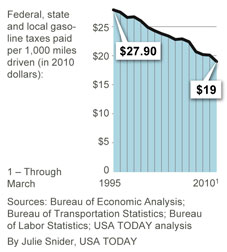
Holiday drivers will pay less than ever at the pump for upkeep of the nation’s roads — just $19 in gas taxes for every 1,000 miles driven, a USA TODAY analysis finds. That’s a new low in inflation-adjusted dollars, half what drivers paid in 1975.
Another measure of the trend: Americans spent just 46 cents on gas taxes for every $100 of income in the first quarter of 2010. That’s the lowest rate since the government began keeping track in 1929. By comparison, Americans spent $1.18 in 1970 on gas taxes out of every $100 earned.
Although the federal gas tax — 18.4 cents per gallon — hasn’t changed since 1993, tax collections are down because today’s vehicles go farther on a gallon of gas, cutting tax collections while increasing wear and tear on highways. Inflation since 1993 has eroded the value of the tax to maintain roads.
“The gas tax isn’t going to work as the user fee to finance the highway system in the 21st century,” says Robert Poole, transportation policy director at the free-market Reason Foundation.
…
Continue reading “Gas taxes give us a break at the pump”
Independence Day on the Gunpowder Trail
by
Bent Lorentzen
(c)1994, 2010, Bent Lorentzen & Baltimore Sun – All Rights Reserved
Thousands of Baltimoreans escaped the city heat to enjoy a different kind of Independence Day. Built up over an old railroad bed, the Northern Central Railroad Trail offers the cyclist and hiker easy access to one of Maryland’s most historic and pristine state parks. I asked many who walked, cycled or live along the trail what being here on the Fourth meant to them.
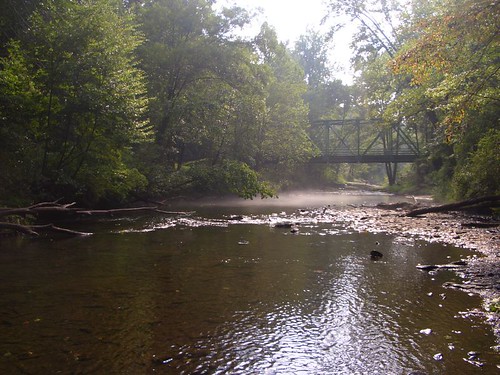
Gunpowder River, looking up to RR trail of park
It is curious to know that though construction impacts heavily locally, on the trail you are completely insulated from this. You can almost see the Native Americans who walked and traded along the misty river for thousands of years, or Maryland’s freedom fighters as they campaigned here to gain independence, or sadly, to hear the whistle of Lincoln’s final train ride, as his body was returned to Illinois. He’d taken this same train ride to deliver his address in Gettysburg.
The trail begins in Ashland, and on Sunday morning, the Fourth, mist from the Loch Raven Reservoir and the Gunpowder River hung heavy in the air. Bicycling into Sparks, shafts of sunlight have begun to pierce the green canopy and mist. Passing Glencoe, once a resort village for Baltimore’s affluent (circa 1880), the ivy shrouded rocks silently tell the story of those who carved out this railroad.
Emerging from a dark, misty overhang of trees, I came upon a startling view from a bridge. Below spread a farmfield of parked cars.
“It started as a wedding party,” said Richard Hyatt, who had walked up from below, “and has evolved into an annual gig. They call it ‘Kool-Aid.’ I came last night with a friend from D.C. and partied all night long, listening to a neat group, the Oxymorons, on an outdoor grandstand. We all brought along some food for the homeless. Part of the admission fee, I guess, goes to the homeless too. I guess that’s how the Fourth and this park relates to me.”
I cycled down to an ancient stone house, barn and several hundred people sleeping in a tent village or out in the open around a smoldering campfire. “Come back later this afternoon and talk with ‘Stan’,” someone suggested.

Sergeant Dave Davis, chief park ranger, ministering to Annie, the dog hit by careless driver
Cycling north, I entered the Monkton Train Station, now the park’s headquarters and museum. While there, Sergeant Dave Davis, chief park ranger, rushed to help a dog hit by a motorist. With thick but tender hands, he gently scooped up the paralyzed dog and set it in his truck to take it to the vet.
“Annie,” the dog, was doing okay at the vet’s, I was told later.
“That’s the Fourth to me,” said the ranger later while arranging several flags along his station. “I’ve had to dispatch deer who’ve been hit by cars, and it’s sad, so to be able to help an animal into recovery makes my day. Come on by later… we’ll be having watermelon. And there’s a nature walk at eleven.”
John Welling, a Towson State University student interning as the Station attendant, said, “I love this park especially on the Fourth. It’s like a part of me now. I love telling people how this area used to bustle with the railroad traffic from the Calvert Street Station in Baltimore to the Sunburg and Harrisburg area of Pennsylvania….”

Sands & Wantz family, by Monkton Train (ranger) Station
A two-family group descended on the station in bicycles with training wheels and high-tech ATBs. James Sands, father of three, said, “Coming here for the Fourth was a convenient thing to do for the whole family without argument–” His young daughter shuffled uncomfortably. “Well,” he admitted, “almost everyone.”
Judith Wantz, mother of three girls, said, “It’s a nice family trail. My husband is going all the way to Pennsylvania. We’ll be picnicking half way there sometime. Whenever they,” and she gave her brood a nod, “get tired.”
“Mom!” cried out little Melissa Wantz.
“Oh yes,” said Judith. “Tell the man what your job is.”
“I push,” she said matter-of-factly.
“Push?” I asked.
Smiling her mother said, “She means, she helps her daddy along by pushing him.”
“How old are you?” I asked.
She slowly unfurled four fingers.
Traveling north again and passing the crumbling relics to the old gunpowder-related industry, I come behind a beautiful Arabian mare.

Barbara Marcus with Mellodi
States Barbara Marcus of White Hall as we stopped: “For me to ride Mellodi–that’s two Ls and an i–on this trail on the Fourth is a part of my every day life as an artist. I come here not only to work out and exercise my horse, but also to find painting inspirations. There’s something about the early morning lighting here… haunting shafts of light…”
I was now following the smaller, Little Falls River, which empties into the Gunpowder. In White Hall, rose a landscaped rock where Old Glory hung limp in the late morning heat.

Gene Stiffler
Gene Stiffler, the property’s owner, squinted his eyes, then said, “Well, I usually work on the Fourth–“
“He means, around the house or on the grounds,” said his camera-shy sister.
“Err, yup. –Haven’t decided what I’ll do today. Kind’a early yet. Might look for some seasonal music and play it for the
folk on the trail… Can’t find too much of that patriotic stuff, though–“
“That’s because you like Bluegrass…” said his sister.
“How long have you lived here?” I asked.
“Been around here since , oh, 1964. The house here was built in 1898.”
“Do you like being so close to the trail?” I asked.
“It has its advantages and disadvantages,” he said. “It’s convenient for my bicycling and you meet the nicest people. But some people trespass, or their dogs run loose in my yard. I’d like for the DNR to definitely enforce some of the leash laws on the trail.” He smiled reflectively: “But there’s no rowdy people to speak of on the trail. It’s just that late at night… bikers talking to each other kind’a spook the night quiet.”
“Sunday mornings, too,” complained his sister.
“Yup. Sunday mornings is a nice time for quiet. But I’m glad the trail is here, especially on the Fourth, so I can show off my garden and flag.”
The trail was now busy with cyclists, joggers and picnickers. Just south of Parkton, Little Falls cascades into a large pool from an overlook with picnic tables.

Beetree Run beaver colony
Parkton once served as the northernmost point of the Baltimore commuter line. About a half mile north of Parkton, the trail leaves the Little Falls River and follows Beetree Run, a prime trout fishing stream. It also boasts an active beaver colony. The nearby Bently Springs once served as a health resort. Here also, blackberries and raspberries hang heavy.
The trail begins to ascend more steeply. To the seasoned cyclist, this slope feels absolutely flat. To a child who has been cycling for ten miles, it might be murder.
Freeland is the last outpost before the Mason-Dixie line. Crossing Freeland Road, I asked a pair of brightly attired cyclists how far I was from Pennsylvania.
“A little over a mile,” said the one in orange and black spandex.
“And it’s all uphill,” said the lady in red.
“But it feels great coming down,” said the other.
I found it a relaxing climb, with ever more dairy farms coming into view among gently rolling hills.
At the state line the trail instantly changed into a horrible bed of rocks for a hundred yards, then into complete disarray, and seemed to disappear into the local farming scene.
Back in Freedom I stopped at the FLOWER CAFE, on the west bank of the Beetree. Vera Simmons, proprietor, said, “For the sake of thirsty hikers and bicyclists, the Fourth for me means we’re open…
“We came to this area twelve years ago,” she continued, “to be a part of something more peaceful than what we had before. Now I feel I’m a permanent fixture of the trail.”
Sitting beneath the shade listening to the stream, a forty-something couple dismounted and sat beside me. “Well,” said Philip Gillum, “we’re here on the trail for the Fourth because…” he paused.
Bonnie Dunn, smiled as she said, “It’s because we weren’t invited anywhere…”
“We do it every Sunday,” he said.
“Too bad it doesn’t keep going in Pennsylvania,” she reflected.
“Yeah,” he said. “I hear it’s because the farmers up there have been farming the railroad property for so long now that they don’t want to part with it.”

Accident scene in Parkton, after arrival of ambulance
Southbound, I come upon a cycling accident in Parkton. A woman bleeding from the head was surrounded by cyclists.
A young girl approached and said, “That’s my mommy over there.”
“The one who got hit?” I asked.
“She didn’t get hit!” she said like I was supposed to know absolutely everything. “She ran into that pole… Anyways, that’s not my mommy. My mom’s helping the girl. My mommy is a doctor.”
“Do you like being here on the Fourth?” I asked her.
“Yeah… but now my mommy’s working.”
Back in Monkton, Sergeant Davis motioned me over to a flag-adorned table full of cold, sliced watermelon. “Dig in,” he said heartily. “It’s free.”
Suddenly, he sprang up and lectured a cyclist who failed to walk his bike across Monkton Road. After the warning had sunk in, he said, “Want some melon?”
I returned to the Kool-Aid fest along the Gunpowder to interview the landowner. Sporting a distinguished salt-and-pepper beard, Stan Dorman explained: “This all started as a wedding anniversary eight years ago in D.C. Somehow it grew–“
Tim McGuinnis of D.C., continued: “We’re all friends of friends of family. Last year there was two hundred–“
“And this year,” said Stan, “it grew to five hundred.”
“That’s too many,” reflected Tim.
Stan nodded in agreement but said, “But you know, when these people leave here, the farm is spotless. These are a remarkably responsible group of people. And we want to keep it that way. We had many kegs of beer, lots of good partying. There’s a river over there where we tube, and the live music… We didn’t have one brawl.”
“It’s not open to the public,” explained Tim.
“So don’t reveal our location, please,” stated Stan.
“What’s this I hear about helping the homeless?” I asked.
“Together with the groom, I’m in charge of the donations thing,” said Tim. “We decided to have lots of fun while also helping our fellow man. The food will go to the Capitol or Baltimore food bank.”
“That’s the Fourth for us,” said Stan. Proudly, he pointed to his home. “That was built in 1857… I’ve been here for seventeen years, and enjoy my proximity to the Trail.”
Southbound, near Phoenix, I come upon a young couple with a child sitting in the water who were gently talking. The scene was ever so peaceful… ever so Biblical.
Thus I left the trail and headed for the hustle and bustle of the hot city with a warm feeling about America stirring in my heart.

Danish writer, cultural anthropologist, Bent Lorentzen, exploring America’s backwoods society by bicycle many years ago
Q and A with Anna Ricklin
By Mark Brown
| Tags: Biking, MTA, Q and A | 1 Comment and 0 Reactions
I asked Anna Ricklin, Baltimore Department of Transportation’s Health and Environmental Specialist, about her experience living without a car in Baltimore. Here’s what she had to say:
How long have you lived without a car in Baltimore?
I have been in Baltimore for nearly three years and, actually, I have never owned a car. The only time I have had (mostly) unrestricted access to a car was when I was living with my parents.
What’s the most challenging aspect of being without a car in this city?
Definitely the lack of well-connect public transit. Before I moved to Baltimore, I figured getting around via public transport would be easy—like it had been in Washington, DC and Portland, OR, where I lived before. Alas, despite being an avid cyclist and trying my best to use the bus, I really only take transit when it’s either pouring down rain or I need to get to the airport. Because of the unreliable—and sometimes scary—public transit, not having a car sometimes makes it so I have to rely on friends for rides, which doesn’t always feel good. And when it’s a beautiful summer day and all I want to do is go on a hike or swim in the countryside? That can be frustrating, too.
What do you think have been the greatest benefits of not owning a car?
Well, it’s funny. Sometimes I borrow cars, and when I do I tend to drive around a lot to get lots of errands done. Usually, by the end of a day like that I am more than reminded of the pitfalls of having a car and more than happy to return the thing. Not owning a car means I am rarely at the whim of traffic (thank you bicycle), don’t have to pay a few thousand dollars per year in car insurance, maintenance and gas, and of course I don’t have to build in an extra 10 minutes parking time as yet another factor adding to me being late.
What’s the single most important thing the city can do to support alternate transportation modes?
Wow, this is a tall order—so much needs to be done. But I think the single mort important thing the city can do is work with MTA to significantly improve transit service. I don’t just mean pressure MTA to have cleaner buses or change a couple of routes. I mean the city needs to create a downtown car-free zone accessible only for buses, bicycles, and pedestrians. They need to subsidize transit passes for all city employees, create incentive programs for businesses to do the same, and massively hike parking fees. It’s ridiculously cheap to park downtown ($2 per hour?!) and the city could be making a lot more money from what is essentially rented street space. Nearly ¼ of the city’s land is used for streets or surface parking (24%). We need to change that if we are ever going to have a more livable—and peaceful—urban environment not dominated by car traffic.
A Little Biking May Help Premenopausal Women Stay Slim
By Alan Mozes
HealthDay Reporter
MONDAY, June 28 (HealthDay News) — Riding a bike is as effective as walking briskly at helping premenopausal women keep from gaining more weight, a new study reveals.
Click here to find out more!
Biking is particularly helpful at keeping pounds off such women who are overweight or obese, said study lead author Anne C. Lusk, a research fellow in the department of nutrition at the Harvard School of Public Health in Boston.
"Women of normal body weight can certainly benefit from biking," she noted. "But specifically for overweight and obese premenopausal women, bicycling just two to three hours per week makes them 46 percent less likely to gain more than 5 percent of their initial body weight over the long run."
Researchers also found that slow walking — walking less than three miles an hour — does not help control weight.
…
Continue reading “A Little Biking May Help Premenopausal Women Stay Slim”
Activities in Baltimore, Maryland
Overview
Baltimore, the State of Maryland’s largest city and a thriving tourist destination, is known for its magnificent Inner Harbor and historical significance. A major seafaring and trading community since the early 17th century, Baltimore played an active role in the American Revolution. Today, besides museums and historical sites such as Fort McHenry, Baltimore offers you numerous recreational activities including sailing, biking and golf and lots of options for healthy eating.
…
Biking
Explore the many bicycle trails Baltimore has to offer or alternatively go biking with the Baltimore Bicycling Club. The Baltimore Bicycling Club offers group rides Monday and Friday during the day, Tuesday and Thursday evenings and numerous rides throughout the weekend. The BWI Trail is a 12.5-mile biking loop that circles Baltimore Washington International Airport. Most of the trails are paved with the exception of a few wooden boardwalks located in environmentally sensitive areas. The trail begins at Linthicum rail station and continues on past the historic Benson-Hammond House to the Stewart Avenue Bridge. Parking is available at five separate locations along the trail.
RIP Avid Maryland Cyclist Stan Miller
Every time I see a soccer mom texting while driving down the road, watch a couple leave the restaurant with the second bottle of wine empty, or, like last week, have some jerk yell "wish I had me a coke bottle" as he buzzes by me 10 inches from his side view mirror, I get angry …. but this just makes me sad … breaks my heart. Services were this morning.
For the 34 year old killer … this will be his second DUI. He served three days in jail for the first conviction.
– jsselle
Continue reading “RIP Avid Maryland Cyclist Stan Miller”
Harford Co. man dies after scooter struck
By Jessica Anderson, The Baltimore Sun
Baltimore County police are investigating a fatal accident involving a Harford County driver on a scooter in Parkville early Saturday morning.
Shawn Appel, 30, of the 2500 block of Shuresville Road in Darlington was struck at the intersection of Perring Parkway and Taylor Avenue at about 3:12 a.m. Saturday, police said.
A Mercury Sable heading north on Perring Parkway collided with the scooter, throwing Appel from it, police said. Appel was pronounced dead at the scene.
No one has been charged, police said. The investigation is ongoing.
Continue reading “Harford Co. man dies after scooter struck”
Real Life on a Bike – Robert Anderson, Maryland’s Practical Cyclist

Jeff Ouellette
Ellicott City, Columbia, Maryland
By Dena Jackson
The life of Robert Anderson, a practical cyclist, blogger and commuter, changed three years ago after his doctor told him he was pre-diabetic. Some years earlier, Anderson had moved across the country for a career change as a software executive at Vectorworks in Columbia, Maryland.
“When I got the doctor’s bad news, I took up a cycle-commuting habit to improve my health. Now biking is a surprisingly large part of my life and I am surprised how much I enjoy and look forward to it,” he said.
A favorite part of Anderson’s commute is the hills.
“I have five hills going each way, and I can enjoy the vegetation, birds and sky while getting a real workout, and getting my heart rate up,” he said.
In his experience, Anderson said Columbia’s motorists are mostly reasonable and polite, and annoyances on his commute are few. Once in awhile, however, he is chagrined by the occasional car full of young adolescent boys who like to get right up behind him and honk. “It can be a definite nuisance,” said Anderson.
Anderson is so passionate about cycling, he initiated a great bike commuting blog, practicalcyclist.blogspot.com, and plans to get his League of American Bicyclists Instructor certification so he can open a cycle commuting class at his local community college. Anderson believes sharrows and improved pavement practicalcyclist.blogspot.com could contribute to a more enjoyable commute.
“Bikes need better paving than cars do. As for people doing great work, I admire the nearby folks in Washington, DC at Bikes for the World (bikesfortheworld.org) and think they are doing fantastic work,” he said.
When reading his highly compelling and professional blog, where in one post Anderson salivates over New York City cycling charts, one wonders at Anderson’s exact definition of being a “practical cyclist.”
“I think of practical cycling as cycling that displaces car miles: commuting, errands, anything that you do on a daily and needful basis,” he said.
Two years ago, Anderson struggled to get in 3,000 miles in a year, including recreational rides. Last year, he was able to get almost 3,700 purely “practical” miles under his belt.
Were you to ask Anderson what being a “self-propelled” person means, he might quote you a familiar advertising pitch:
“A decent commuting bike: $700; panniers, pump, lock and patch kit: $100; helmet, gloves and bike shoes: $150; the self-esteem you get from being self-propelled and always being able to wear your ‘skinny jeans’: priceless.”
by
Dena Jackson
7/1/10 8:48 PM
Continue reading “Real Life on a Bike – Robert Anderson, Maryland’s Practical Cyclist”
Moped Rider Dies In Howard County Crash
COLUMBIA, M.D. — A moped crash in Howard County resulted in the death of the rider.
Police said the crash happened at about 12:53 p.m. Sunday near the intersection of Tamar Driver and Foreland Garth in Columbia.
Officers said a SUV was turning left from Tamar Drive when it collided with the moped, driven by Mohammed Hammad Chaudhry, 24, of Columbia.
Chaudhry was flown to Shock Trauma in Baltimore and later pronounced dead.
Officials said the driver of the SUV, identified as Marganta Gonzalez Cruz, 45, also of Columbia, was uninjured.
The crash is still under investigation.
Continue reading “Moped Rider Dies In Howard County Crash”