Research Roundup — health impacts & Road Diets

There are a number of notable new reports out that are worth looking at this week. Here’s a quick summary.

Bicycling health benefits outweigh risks

Dutch researcher Dr. Jeroen de Hartog and his colleagues have published a new study, “Do The Health Benefits Of Cycling Outweigh The Risks?” that concludes that the health benefits of bicycling are “substantially larger than the risks of cycling relative to car driving.” The authors quantify the risks and benefits and determine that the increased physical activity gained from switching from driving to biking lead to “about 9 times more gains in life years than the losses in life years due to increased inhaled air pollution doses and traffic accidents.”

Road Diets decrease crashes

The Federal Highway Administration released a study (PDF) using data from the Highway Safety Information System (HSIS) that shows that reducing four lane roads to three lane roads with center turning lanes and bike lanes in both direction can improve safety without reducing annual average daily traffic (AADT) volumes for roads with under 20,000 AADT. (For more on road diets, here’s the classic Road Diet reference, PDF, by Dan Burden.)

Continue reading “Research Roundup — health impacts & Road Diets”

Bicycling Ban in Black Hawk Update

Adventure Cycling has an update to their route because of the recent cycling ban in Black Hawk Co. If I am reading it correctly the options are to avoid the area completely (including the Rocky Mt National Park) or walk your bike through town which some of the distance has no shoulder or sidewalks. Yep like that’s going to make things better having cyclists walk in the roadway rather the ride.
And in the words of Adventure Cycling: "We continue to encourage you to support Bicycle Colorado in their bid to overturn the ban via legal and legislative means. If this ban is allowed to stand, a precedent will be set with statewide ramifications that we’d rather not think about." https://bicyclecolo.org/articles/black-hawk-bike-ban-pg1118.htm
Continue reading “Bicycling Ban in Black Hawk Update”

This Road Ain’t Big Enough For the Both of Us

by The Verbal Ecdysiast

I was accelerating down York Road toward Lower Glencoe on my bike the other day, helmet on, heart filled with glee. To my left the sunlight was filtering through the trees, creating a richter-tape of tree shadows upon the road: glorious. Such delightful and immeasurable freedom of the senses can be found in physical velocity at forty plus miles per hour. Yet I purposely remained in the right margin, though Maryland State traffic law clearly maintains that a bicycle is just as much a vehicle as a car, and therefore, technically, I had and have the right to be riding on the road. Now, mind you, the right margin of York Road is analogous to a moonscape–pockmarked and cratered–not nearly as nice as the newly paved asphalt of the main road; however, for the sake of boundaries and safety I remained in the rough. Imagine my surprise, then, when I heard a rather corpulent four-by-four come upon my left rear, and subsequently, it’s invasive honk, or more precisely, the glaring ugliness of the driver manifested in the sound of his staccato horn. I jumped like a dog for a biscuit: no easy manifestation of the central nervous system, when one’s feet are clipped into her pedals which are still turning at over forty miles per hour. Further, I surprised myself: I ignored him. "I’m not in his way," I mused, remaining very cool and logical. "Why did he honk? Surely he will pass me, now," I thought.

I thought wrong.

Now, nearly alongside me (I could see the truck was a hefty white four-by-four Dodge Ram), he honked AGAIN, and leered down upon me. That did it. So much for cool logic. I did what any red-blooded cyclist does when she is infuriated: I gave him the finger.

He pealed out in front of me, his truck screeching as he briefly accelerated, then screeching again as he brought the truck to a halt about one-hundred yards in front of me and directly in my way.

I could try to go around him, but of course, he could still tangle with me. After all, the simple, unalterable, inexorable laws of physics dictate that when and if an accelerating bicyclist on a bicycle has some sort of, er, let’s say, "interaction" with a driver in a truck, the truck and therefore its driver will always win.

I could simply stop, but again, at forty miles per hour or more, the chances of flying over the handlebars were about fifty-fifty. And indeed, for she who is clipped in, Confucius say "she who stop bike short with hands take bike along on her feet…heheheh, vewwwwyyy twickyyyy…." …but not an option.

I was so angry (and all of the above had flown through my head in about five seconds) that I slowed deliberately and consistently over about seventy-five yards, brought my bike to a halt and unclipped in about ten seconds.

During that ten seconds, the driver exited his truck, slammed his door shut, and stood beside the door with his arms folded. I found myself rapidly approaching the O-K Corral at high noon. I saw that this man had on a wife-beater t-shirt with fully tatooed arms, and from his posture, he seemed bent on bullying and intimidating those who dared to cross either his path or him. Pity the fool.
… (more)
Continue reading “This Road Ain’t Big Enough For the Both of Us”

Yes, You Can Move the Needle on Public Support for a Gas Tax Hike

by

gas_tax_graphic.jpgPublic support for increasing the federal gas tax rises if revenues will be spent to combat global warming. Graphic: Mineta Transportation Institute

Last week, USA Today reported rather gleefully that the U.S. gas tax has never been lower. Having remained unchanged at 18.4 cents per gallon since 1993, American drivers are now paying half as much in inflation-adjusted gas taxes, per 1,000 miles driven, as they did in 1975. We can pretty much forget about investing in new and expanded transit systems — or even just holding up our bridges — as long as this is the case.

USA Today also cited a recent national survey by the Mineta Transportation Institute, which pegged public support for a 10-cent gas tax increase at a paltry 23 percent. Thanks to a post from Streetsblog Network member TrailBlog, penned by Steve Schweigerdt of the Rails to Trails Conservancy, we have a more complete — and interesting — picture of what this survey actually revealed. Schweigert reports from a recent panel discussion about the survey:

A couple key points from the survey were that:

  • Linking transportation tax to environmental benefits will increase support, specifically if the tax helps address global warming.
  • Support for gas taxes can be significantly increased with good program design.

The panelists portrayed the gas tax increase as a needed short-term fix, but a restructuring of transportation financing is necessary for long-term investment in the system. William Millar [of the American Public Transit Association] reminded the audience that we shouldn’t assume that the way things are can never change. We spent the last 60 years building the system we have, he said, and we can spend the next 60 building a better system.

You can download the survey results here. Of particular note: Support for the 10-cent gas tax hike rose to 42 percent if the revenue would be spent to reduce global warming. The survey also gauged public opinion on a mileage tax, finding that support increased from 21 percent to 33 percent if the rate would vary according to the fuel efficiency of the vehicle.

Tellingly, Americans seem more willing to tax everything they purchase than to pay for transportation infrastructure by taxing driving: A half-cent national sales tax enjoyed the highest support of all the options given, at 43 percent.

But the big takeaway from the Mineta survey is that a national gas tax hike gains support if you make a strong case for how the revenue will be spent. Should some national political figure come along and deliver a compelling public message that we need to raise the gas tax to invest in cleaner, more efficient transportation, move us away from oil addiction, and keep our existing infrastructure from falling apart, who knows, maybe you could break the 50 percent threshold.

Of course, seeing as how most Americans mistakenly already think the gas tax goes up regularly, and gas prices have fluctuated within a 24-cent range in just the last three months, you could also reach the conclusion espoused in this classic Infrastructurist post: Just raise the g-dd-mned gas tax already.

Continue reading “Yes, You Can Move the Needle on Public Support for a Gas Tax Hike”

The Return of the Bicycle

By Lester R. Brown
The bicycle has many attractions as a form of personal transportation. It alleviates congestion, lowers air pollution, reduces obesity, increases physical fitness, does not emit climate-disrupting carbon dioxide, and is priced within the reach of the billions of people who cannot afford a car. Bicycles increase mobility while reducing congestion and the area of land paved over. Six bicycles can typically fit into the road space used by one car. For parking, the advantage is even greater, with 20 bicycles occupying the space required to park a car.
Few methods of reducing carbon emissions are as effective as substituting a bicycle for a car on short trips. A bicycle is a marvel of engineering efficiency, one where an investment in 22 pounds of metal and rubber boosts the efficiency of individual mobility by a factor of three. On my bike I estimate that I get easily 7 miles per potato. An automobile, which requires at least a ton of material to transport one person, is extraordinarily inefficient by comparison.
The bicycle is not only a flexible means of transportation; it is ideal in restoring a balance between caloric intake and expenditure. Regular exercise of the sort provided by cycling to work reduces cardiovascular disease, osteoporosis, and arthritis, and it strengthens the immune system.
World bicycle production, averaging 94 million per year from 1990 to 2002, climbed to 130 million in 2007, far outstripping automobile production of 70 million. Bicycle sales in some markets are surging as governments devise a myriad of incentives to encourage bicycle use. For example, in 2009 the Italian government began a hefty incentive program to encourage the purchase of bicycles or electric bikes in order to improve urban air quality and reduce the number of cars on the road. The direct payments will cover up to 30 percent of the cost of the bicycle.
(more)
Continue reading “The Return of the Bicycle”

PSA: How To Bike Commute On A 100+ Degree Day

by

I was going to post about my 4th of July road trip with the LHT but that’ll wait until tomorrow. It was already 92 degrees when I biked in this morning and I think that warrants a public service announcement.

image

I think the most common question people have when they learn I commute by bike everyday is, “Do you have a shower at work?”. It doesn’t matter if we’re talking summer heat or winter freeze, most people think that having a shower at work is the only way bike commuting can work. It dawned on my this morning while pushing through the heat that not having a shower in the office is stopping a lot of people from even considering the bike as a way to get to work.

I don’t want a shower at work, it would make the process of biking to work longer and more tedious. Taking a shower is an important element of bike commuting in the summer heat but take it before the ride, not after. The best way I’ve found to manage the DC summer is to take a shower right before I leave the house.

If you are a burning hot when you get to work and take a quick shower odds are you’ll start sweating again the second you step out to dry yourself off. Your sweat isn’t what cools you down, it’s that sweat evaporating that does the trick so when you get to work all sweaty find a fan, a big ass fan.

image

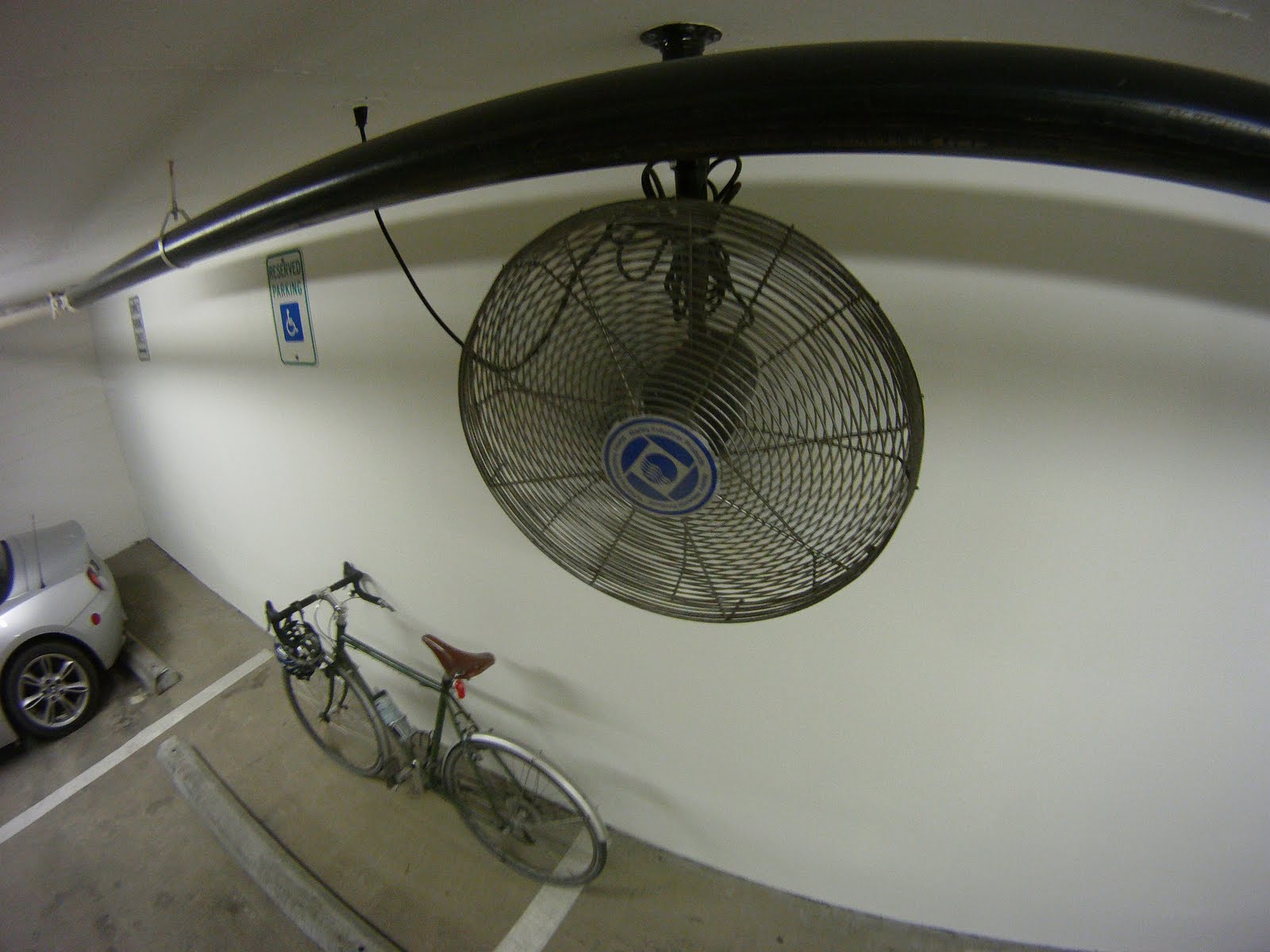
This BAF circulates the air in the parking garage under my building. It’s never on but I can plug it in when I need it. Three minutes in front of this with my shirt held open cools me down enough to enter the building. If  I’m still hot after changing in the bathroom I head to my desk where i have a stick of deodorant and a small fan waiting. After about 10 minutes I have to turn the fan off because I get too cold. If you can’t find a BAF try two small ones at your desk, you’ll be surprised at how effective they are.

All that an no shower! It’s a quick process and because I took a shower right before leaving the house I’m relatively clean.  

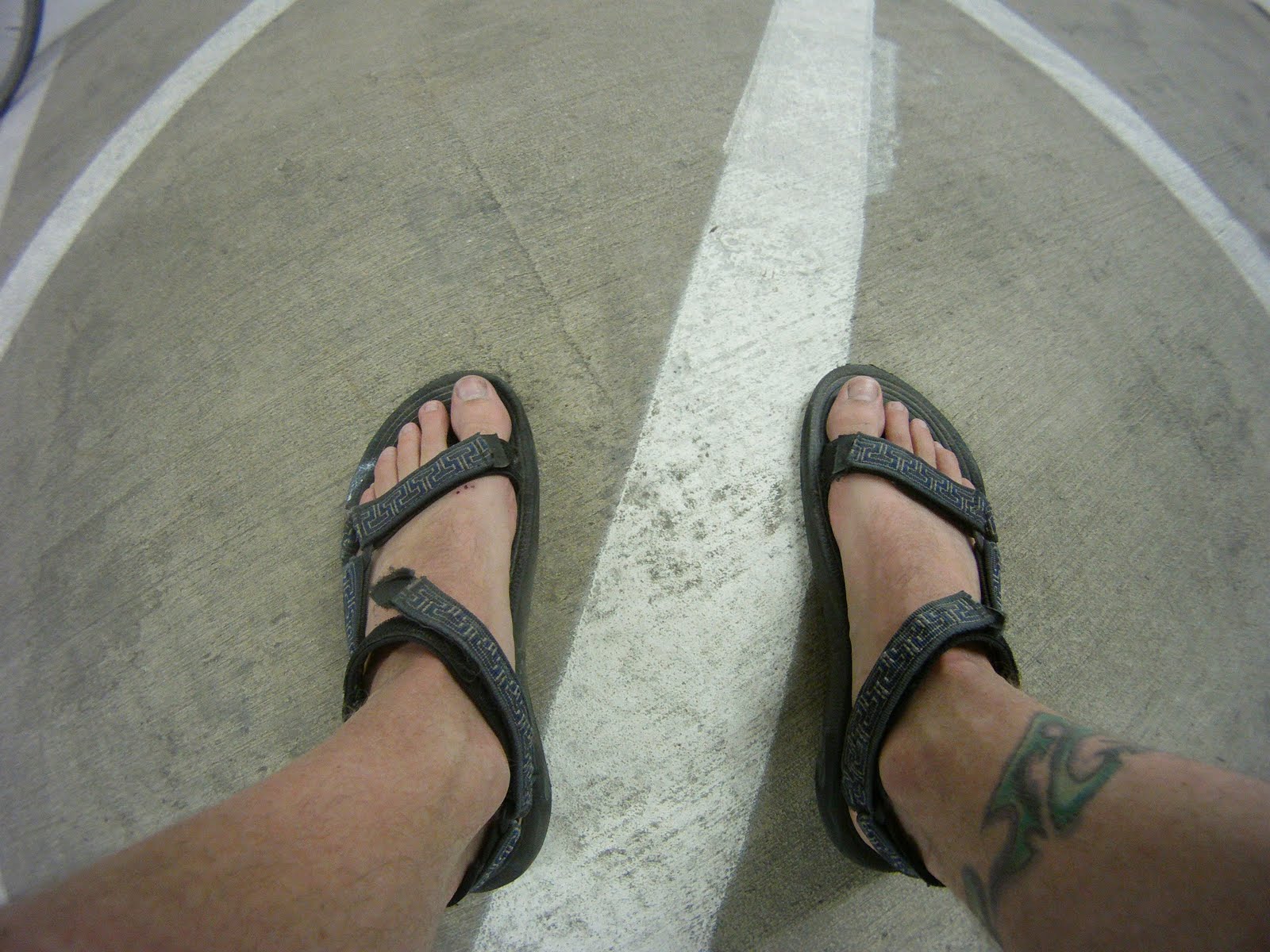
Another way to beat the heat is to wear sandals on your ride. Last fall I switched to platform pedals on the LHT (yeah you know me). In the winter I wear my boots, in the summer I’ve started wearing my Tevas. They’re not ideal for long rides but they are fine for a commute and they keep my feet nice and cool.

image

Now I know that everybody’s physiology is different, some of us are sweaty pigs that stink like a barnyard after a ride. Just give it a try, modify your routine until it works for you. Asking your coworkers to let you know if you smell of barnyard isn’t a bad idea either.

Got a good hot weather commuting technique? Please share it with the rest of the class.

Continue reading “PSA: How To Bike Commute On A 100+ Degree Day”

Calvert County Police Bar Patrol on Bikes?

DISORDERLY: Dep. J. Norton arrested Dorothy Irene Emerson, 41 of Chesapeake Beach and charged her with disorderly after she refused to leave the parking lot outside the Crooked I Bar in North Beach on July 5 at 12:51 a.m. She became disorderly and pushed over a bicycle belonging to the Calvert County Sheriff’s Office, causing $400 in damage. She was charged with disorderly conduct, failure to obey a lawful order and malicious destruction of property.
Continue reading “Calvert County Police Bar Patrol on Bikes?”

The Freedom to Not Drive

by Ben Fried

Automakers have been equating cars to “the national theme of freedom” for the better part of a century, so I think advocates for sustainable transportation and livable streets are well-served by flipping that argument on its head, as Carlson suggests. It’s not a tortured line of reasoning by any means. Generations of car-centric planning have, after all, yoked Americans to a transportation system that constrains the most basic elements of our lives — our time, our health, our finances, our ability to socialize with friends and neighbors.
In addition to liberating people from hellish commutes, as Carlson describes, reducing car-dependence means freedom from spending more and more of our household budgets on transportation; freedom from sedentary lifestyles that are contributing to skyrocketing rates of obesity and diabetes; freedom from worrying about the safety of walking or biking. Freedom, eventually, from having to extract and use oil in ways that pose catastrophic risks to the environment.

Continue reading “The Freedom to Not Drive”