"But how do children really get hurt or killed?
1. Car accidents"
[B’ Spokes: That’s car accidents as in being chauffeured around.]
Continue reading “5 Worries Parents Should Drop, And 5 They Shouldn’t”
Fewer and fewer young people are driving—but why?
There is more in the Grist article but I’ll highlight this:

Continue reading “Fewer and fewer young people are driving—but why?”
What is ‘smart growth,’ anyway?
by
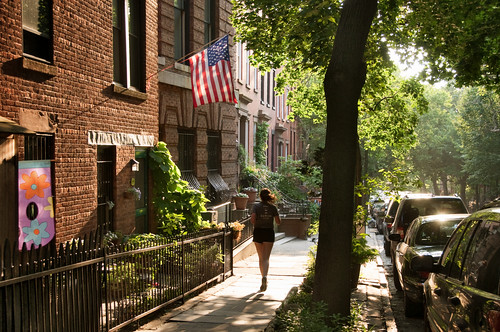
Lots of us have tried to answer that question in various ways, perhaps most frequently via the Smart Growth Network’s well-known ten principles. Empire State Future has recently posted some answers of their own that I really like:
“It’s the effort to build a healthy economy that offers real choices in transportation, housing, and education while respecting farmlands, open space, and our many natural and historic resources. By building more homes and businesses in already-existing communities, we can save valuable open space and conserve money spent on our roads and costly utility infrastructure. All of which makes Smart Growth important for our future, and for our children’s future . . .
“Why shouldn’t it be simpler for us to work toward a more attractive and economical civic future? A future where
- new development is constructed in places that maximize existing public investment in schools, roads, water and sewer service, transit facilities and information infrastructure.
- workers have good jobs that are within walking distance or an easy commute by bike, bus, rail or automobile
- farm land is protected from encroachment so it can continue to be used to raise livestock and crops, providing a continuing and strong agricultural sector, and rivers, lakes, streams and ponds are pollution-free and provide recreational opportunities for residents and tourists alike
- people can choose to live in older, thriving communities that are beautiful and unique, and that validate the reality that this is still the Empire State!”
Read the full post and find links to lots more about the work of Empire State Future here.
Move your cursor over the images for credit information.
Kaid Benfield writes (almost) daily about community, development, and the environment. For more posts, see his blog’s home page.
Abogo transportation costs made transparent
What is Abogo?
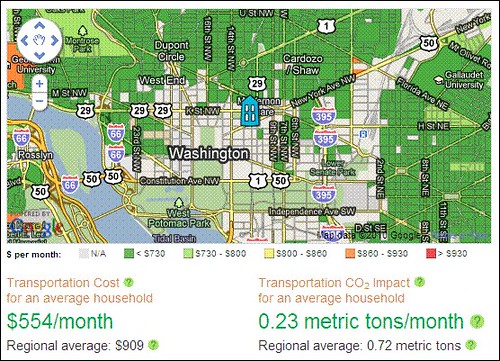
Abogo shows you how transportation impacts the affordability and sustainability of where you live. With Abogo, you can discover the costs of where you live now, or where you might want to live. Abogo measures the money an average household from your region living in your neighborhood would spend getting around, including car ownership, car use, and transit use. It also tells you what the CO2 generated by this car use would be. With this information, you can measure the true cost and impact of where you live.
Housing + Transportation Affordability Index

Abogo is powered by the Center for Neighborhood Technology’s Housing + Transportation Affordability Index. Instead of only counting just your housing costs, the idea behind H + T℠ is to include the cost of getting around when thinking about the cost of living in a certain place. This gives you a more complete idea of how the neighborhood fits for your budget.
But wait, there’s more to come!
We’ll be adding features to our site, including:
- personalized transportation costs
- housing costs
- saved searches
- …whatever else you might think of! Send ideas to abogo-info@cnt.org.
Continue reading “Abogo transportation costs made transparent”
MDOT – THE SAFETY OF OUR CHILDREN MUST BE A TOP PRIORITY FOR ALL
Back to School Means Back to Basics When it Comes to Safety
As school doors open across Maryland for another year, now is the time to remind ourselves that we all play a role in protecting the safety of our children. In the upcoming weeks, roadways will again be crowded with youngsters and teens heading back to school – some by car or bus, others on foot or bicycle and others driving themselves for the first time.
Unfortunately, each year more than 300 Maryland children are injured in crashes during school arrival and dismissal times. Those of us behind the wheel can help prevent these crashes by reviewing the rules of the road and practicing courtesy and common sense when driving. The opening of school brings more traffic to area roadways so build more time into your commute, especially during morning and afternoon travels. Stay alert, give driving your full attention and control your speed, especially in and around school zones, where the posted speed may be lowered.
Know the rules of the road when encountering a school bus. It is against Maryland law to pass a stopped school bus while its lights are flashing and its stop arm is extended. Motorists approaching from either direction must wait until the red lights stop flashing before proceeding. Remember to be patient when following a bus. The lives of dozens of young passengers are at stake.
Finally, be on the lookout for children walking along the road and for those waiting for school buses. Children can be unpredictable, so be prepared for the unexpected. Remind children to only cross the street at a crosswalk and that, before crossing any street, they must look left, then look right and then look left again to make sure their path is clear before taking that first step. Motorists should remember that state law requires all vehicles to stop for pedestrians in a crosswalk.
To help everyone make safe choices on the road, the Choose Safety for Life campaign emphasizes that everyone “B-SAFE.” “B-SAFE” includes five key reminders: Buckle up, Slow down – speeding kills, Always drive sober, Focus and Everyone share the road – everyone gets home. Parents, please take the time to review the rules of the road with your child. Make sure he or she understands how to cross the street and how to travel on the school bus safely. You and your child can learn more about safety at www.choosesafetyforlife.com as we all strive for a safe, happy and productive school year.

Beverley K. Swaim-Staley
Secretary, Maryland Department of Transportation
Continue reading “MDOT – THE SAFETY OF OUR CHILDREN MUST BE A TOP PRIORITY FOR ALL”
Washington Examiner gets it wrong
"If Mr. O’Malley wants to encourage people to walk or ride bikes or hop on a metro train–if they’ve got the guts–okay, but walking, biking and buses do not a transportation policy make. They are options. They are not solutions. They are sideshows."
Atlantic City police arrest man after he steals “bait” bicycle on Atlantic City Boardwalk
By ELAINE ROSE, Staff Writer
An Atlantic City man was arrested after he stole a bicycle police put out on the Boardwalk as bait in response to complaints of thefts, police said Tuesday.
Sgt. Richard Halverson put a bicycle out on the Boardwalk, locked it with a cable lock at about noon Monday, and waited a short distance away, police said. Within an hour, a man rode up on his own bicycle, cut the lock on the bait bike, and rode off on it, leaving his own bicycle behind, police said.
Halverson went after the suspect for several blocks while back-up officers arrived, police said. Halverson stopped the man on the 1700 block of Arctic Avenue, and the suspect got off the bicycle and ran away on foot. Officer Robert Dessicino arrested the suspect after a struggle.
Frank Forrest Jr. 53, of North Maryland Avenue, was arrested and charged with theft, resisting arrest, vandalism and possession of burglary tools, police said.
Police said they will continue to conduct stake-outs around the city in areas where residents complain of thefts. People are asked to call police when they see any suspicious people or activity.
Continue reading “Atlantic City police arrest man after he steals “bait” bicycle on Atlantic City Boardwalk”
How to promote cycling
See Kelly Brooks rides a bicycle (again) on Cyclelicio.us

Continue reading “How to promote cycling”
Seriously, get involved or suffer car centricity
Public Comment Periods
Currently, the Baltimore Regional Transportation Board has 3 open
Comment Periods (below). Comments are welcome through Tuesday, September 14.
o
Amendments to FY 2011-2014
Transportation Improvement Program
www.baltometro.org/transportation-planning/2011-2014-tip-amendments
o
2010 Update to the Human
Services Coordinated Transportation Plan
www.baltometro.org/transportation-planning/coordinated-transportation-plan
o
Draft Goals for Plan it 2035
www.baltometro.org/transportation-planning/goals-for-plan-it-2035
Citizens Advisory Committee
The BRTB is seeking new members to serve on their Citizens Advisory
Committee (CAC). We are looking for members from all parts of the
Baltimore Region, but are particularly interested in more members from Anne
Arundel, Howard, and Carroll Counties. A posting about the openings is
included below.
|
BRTB SEEKS MEMBERS |
|
Share Your Ideas.
The CAC is a diverse group of Why serve on the CAC? Transportation · Helping · · New members will be appointed for 3-year Applications will be accepted until September 10, 2010. Download an application or get more info about the CAC |
How to handle an encounter when you’re unjustly pulled over
By Bob Mionske
Most people don’t follow traffic laws. Motorists speed. Cyclists roll stops. Pedestrians jaywalk. And that is where the police come in–to enforce the laws. It’s good that they do, because when people on the road obey the law, we are able to predict with some measure of accuracy what will happen, allowing us to avoid most collisions. But what about when the officer is just plain wrong on the law? There are three things to keep in mind during any such encounter.
If you’re ordered to stop, then stop. The officer is not going to let you ignore an order, and the situation will become worse if you attempt to do so, even if you’re in the right.
Let the officer be in charge. Police officers are trained to maintain control of encounters. If you attempt to take control, you will find the tension escalating very quickly. So keep your interactions polite. Besides, nobody likes dealing with unpleasant people.
Be absolutely certain you are right. This means that you must not only know your state’s laws, but also any relevant local laws. Unless you’re sure, do not assume that the officer is wrong.
Beyond these rules, how you handle the encounter will depend on your goal. If you simply want to continue on your way with minimal hassle, then you should politely comply with the officer’s interpretation of the law. If you want to assert your rights under the law, then ultimately you must be willing to be ticketed, go to court and fight the citation.
However, when you were first stopped, the officer may not yet have decided to ticket you; he may have merely intended to have a talk with you. In this case you have an opportunity to discuss why you believe you were in the right. If you want to try to convince the officer that you were riding lawfully, keep in mind that your greatest chance for success is in not demeaning the officer. For example, it might be useful to have a copy of your local traffic laws on hand as a reference source, but suggesting that the officer should read the laws probably isn’t such a good idea.
Often an officer will relent, particularly when he knows that you’re right but stopped you for your own good, because he thinks that where you were riding is unsafe. But if the officer continues to insist that you are violating the law, your only recourse will be to ask the officer to cite you, which means your fate ultimately will be decided by a potentially disinterested traffic court judge burdened by a heavy docket. Still, that’s the place to use all your evidence and powers of persuasion–far better than having an interaction with an officer go south and decide your fate for you.
[B’ Spokes: I disagree with the above paragraph. We have had a lot of success writing to the Chief of Police after the fact, no citation needed.]
…
Continue reading “How to handle an encounter when you’re unjustly pulled over”