Fred Barnes: Americans Mainly Want to Stay in Their Cars

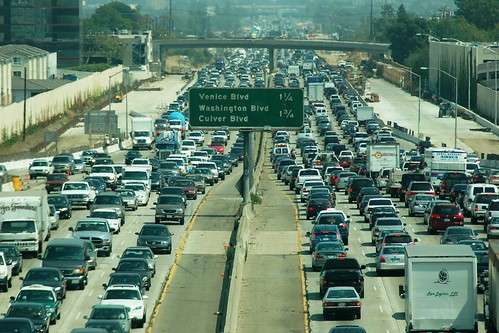
And they are basically asking why we can’t change this:
image (by Atwater Village Newbie)

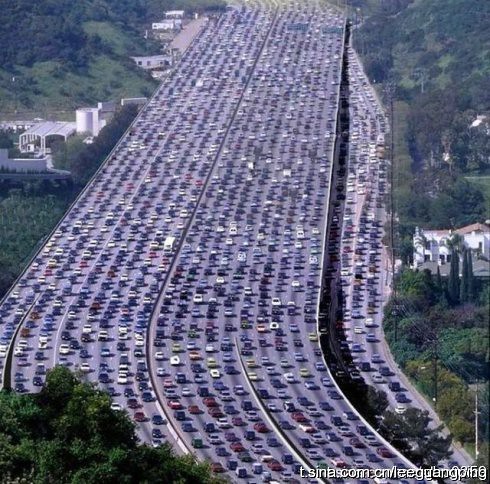
Into this:
image (copyright: Lee from t.sina.com.cn)

based on a tax that has not kept up with inflation nor has it kept up with improved fuel economy that puts in less money for the same wear and tear and the same demand for more space on the roads. (Not that it ever paid for all roads in full ever.)

This comment from from Streetsblog Capitol Hill by Ben Fried basically summaries the issues:

This is, basically, his entire argument: People just want to “stay in their cars.” We have zero interest in getting around any other way. According to Fred Barnes, we are perfectly content to drive and drive and drive, as long as we don’t have to put up with all the other people driving. If you believe that, then his cheerleading for highway construction makes a lot of sense.

If being inside our cars is what we’re really all about, by all means lets throw more money down the sinkhole of highway expansion. That will guarantee more quality time inside our cars. Then, a few years later, when we’re in our cars but not enjoying it so much because the new lanes are jammed with traffic again, we’ll repeat the whole expensive process.

But if we’d rather spend more time with our families and loved ones — or, you know, doing actual work instead of commuting — maybe we should try a different way of building our transportation system. According to public opinion research by Transportation for America, 57 percent of Americans would like to spend less time in their cars. Even with our highway-centric system, we’re already voting with our feet: These days, Americans are driving less and opting to walk, bike, and ride transit more than we were at the beginning of the decade.

Continue reading “Fred Barnes: Americans Mainly Want to Stay in Their Cars”

Montgomery making Conn. Ave. more like a freeway

This line from Greater Greater Washington by David Alpert caught my attention.
"In Montgomery County’s DOT and the office of the County Executive, however, no transportation idea less than 50 years old seems welcome."
Freeway like designs only make sense when bike/peds are prohibited I will also assert that freeway like designs on local streets is a major contributing factor to why people think bikes do not belong on the road. What ever happened to our #1 policy ratting and Complete Streets?
Isn’t Montgomery County the least concern about their percentage of fatalities that are bike/ped?
Continue reading “Montgomery making Conn. Ave. more like a freeway”

SHA to close part of Falls Road this weekend

[B’ Spokes: Cyclists might expect extra traffic on the side roads during this.]
*********************************************************************************************
from Getting There by Michael Dresser

The State Highway Administration will close a section of Fallls Road in Butler this weekend to repair pipes under the pavement.

The road wil be closed to all traffic between Butler Road and Black Rock Road between 8 p.m. Friday and 5 a.m. Monday. It will be closed to all but local traffic between a point south of Stringtown Road and to north of the Butler Volunteer Fire Department. At some points, motorists will not be able to cross Falls Road and will have to use the detours. Detours will be in place. If rain is expected, the work could be postponed until the following weekend.
Continue reading “SHA to close part of Falls Road this weekend”

Article explores bike-car-pedestrian relations

[B’ Spokes: More bike/ped/car relations from Michael Dresser. One thing I think that needs highlighting is the race to red lights. It amazes me how often road rage or aggressive driving ensues when cyclists dare to stop for red lights. It is human nature to avoid conflict so I am empathetic to cyclists that run red lights though I do encourage them to look for other ways to deal with this issue. It all boils down to education and what to expect from other road users and I am thankful to Michael for bringing more awareness on this issue.]


from Getting There by Michael Dresser

Reuters has an interesting article on the sometimes toxic relations among motorists, pedestrians and bicyclists. Felix Salmon writes from a New York bicyclist’s point of view, but he’s not at all sparing of his fellow bikers who trample all over the traffic laws. And most of his points are equally applicable in the streets of Baltimore.

The article is especially recommended  to bicyclists who think they should be exempt from the traffic laws that govern sidewalk use and one-way  streets. Salmon explains, clearly  and from a bicyclists’ point of view, why this is dangerous folly.


Continue reading “Article explores bike-car-pedestrian relations”

Bicycle travel on the rise, statistics say

Bicycle travel continues to grow in North America, according to research and anecdotal evidence from tour operators and tourism promoters in the United States.
Bicycle travel is becoming an increasingly visible part of the adventure travel market, which, according to a recent study issued by the Adventure Travel Trade Association, generates $89 billion annually.
Here are some points:

Continue reading “Bicycle travel on the rise, statistics say”

Cyclists Face Lack of Legal Protection in Crashes

— By Jen Phillips
Today is election day, but one candidate that won’t be on the ballot is Maryland candidate for Senate Natasha Pettigrew. Thirty-year-old Pettigrew, who represented the Green Party, was struck and killed by an SUV while biking on September 20. The driver of the Cadillac Escalade who hit Pettigrew said she thought she had hit a deer or a dog so she didn’t stop and continued driving for four miles until reaching her home. Upon parking the SUV, she saw Pettigrew’s bicycle lodged beneath it and called police. Pettigrew’s mother, Kenniss Henry, is running in her place but looks like Maryland is re-electing Democrat Barbara Mikulski.
The death of a promising young person is tragic, but at least charges for the driver are pending. (An eyewitness says she saw the SUV stop after striking Pettigrew, then take off with sparks and smoke trailing behind due to the bicycle stuck beneath the vehicle.) Often, charges aren’t filed in cases where bicyclists are killed by cars because it’s an accident. One could argue that’s what manslaughter charges are for, but of course traffic laws (and their execution) vary from state to state and city to city. Pettigrew’s mother has advocated stricter laws in Maryland, where if a driver hits a pedestrian or cyclist, they must be impaired, grossly negligent, or show intent to cause harm in order to be charged with a crime. Cases in other states show similar outcomes: in Florida this July, a Navy vet and executive was struck and killed by an SUV driven by a nurse, but no charges were filed because police considered it an accident. The same was true in a 2009 case involving the death of a Virginia bicyclist by an SUV. In 2008, there were 716 cyclists killed in crashes with motorized vehicles, making up 2% of all traffic fatalities.
A few weeks after Pettigrew’s death, a Maryland law was enacted that requires a 3 foot buffer zone between cars and bikes on roads, and require vehicles yield right-of-way to bicycles. But the fine for motorists who cause a crash that involves a bike is just $1000. "A loss of life is a loss of life," Henry told the Maryland Gazette. "We seriously need to look at how we balance these scales."
Continue reading “Cyclists Face Lack of Legal Protection in Crashes”

Could Restructuring the Gas Tax Fund the Transportation Bill?

This bit from Streetsblog Capitol Hill by Angie Schmitt caught my eye:

Sean Roche at Network blog Newton Streets and Sidewalks agrees with the impulse to restructure the gas tax, but says the proposal may not go far enough to bring fuel taxes in line with infrastructure spending:

Adoption of an ad valorem gas tax would be a step in the right direction. “Spending on road construction and maintenance grew almost exactly in line with the economy from 1994 to 2008 – a 102 percent increase.” As a consequence, “federal, state and local governments grew road spending faster than road revenues by borrowing more and by diverting general tax revenues to spend on roads.”

Ultimately, though, simply stemming the backward march of gas-tax revenue is not enough. We need to make up lost ground. We need to account for the impact of increased fuel economy. And, we need to capture more of the costs of driving from those who drive (or consume goods that have been shipped). One of the virtues of switching to an ad valorem gas tax, though, is that it has no immediate impact, but preps for the future.

It’s just math. Federal and state gas taxes are too low.

Continue reading “Could Restructuring the Gas Tax Fund the Transportation Bill?”

Thought for the day

From Florida’s gubernatorial campaign; AAA asks both candidates what they would do to boost highway safety.
Sink’s answer (in part) that she’d have FDOT study whether new road projects actually improved safety “over the ones they replaced.”
It’s time to get out of speed and capacity only issues and into improved safety for all road users. Sink also mentioned that she’d “seek to expand the percentage of federal safety funds that FDOT spends on bicycle and pedestrian safety programs.” It’s nice to see some candidates have some clue on what’s going on.
Continue reading “Thought for the day”

Earth to north county: Bikes aren’t going away

from Getting There by Michael Dresser

It never fails. If the Getting There Monday column deals with bicycles, it inevitably inspires emails lamenting the fact that bicyclists have the gall to actually use the roads. For some reason, it seems that about 99 percent of these messages emanate from northern Baltimore County, where the peculiar notion has taken hold that the roads are for the use of motor vehicles only.

There’s one little flaw with this premise: It’s not true. From the time Maryland roads were first paved, they have been open to bicycles, farm equipment, buggies and all manner of slow-moving vehicles (except for interstates and a limited number of other limited-access highways).

The variation I hear most on this theme is that bicyclists should not be permitted to use narrow roads without shoulders. Why? Because motorists have to slow down and are dreadfully inconvenienced.

Here’s one that came in today:

"Bicyclists should not be allowed to bike on a road that does not have a bike path or shoulder to the road. In Sparks, we have to be on the alert at all times for deer on the road, and there have been innumerable accidents when the deer and a car can’t both fit on the road. The deer don’t know any better – the bicyclists do. Bicyclists should be limited to bike paths."

I’m sure there isn’t a bicyclist in Maryland who wouldn’t love to have a wide, debris-free shoulder or parallel bike path along every country road in the state. But it’s not going to happen. The cost would be enormous. In many cases these are low-traffic roads where there is no need to add pavement just so a few impatient drivers never experience a delay. Sure, when a road is rebuilt, it makes sense to add a bicycle lane, but retrofitting the entire highway system is a non-starter.

The same correspondent wrote that bikes should be banned from the roads because they surprise her when she comes around a curve or over a hill. Sorry, but drivers are expected to cope with life’s little surprises — not that the presence of a bicycle in Baltimore County is exactly headline news. If a driver is startled by the sight of a bicyclist riding along the road in a legal manner, chances are the driver is going to fast for road conditions. It’s not the bicyclist’s fault that the driver is surprised.

Sharing the road with bicyclists is a basic driving skill and a legal duty for motorists. People who can’t cope with that reality shouldn’t be driving. Because bicycles aren’t going away. It’s a fantasy. You might as well propose banning rain on weekends.

One of the better things about this country is that it’s very difficult to take rights away from people. They have a way of fighting back.

So for all those people who harbor the fantasy that bicycles can be banned from their local roads, here’s a suggestion: Contact your local legislator and ask that person to introduce a bill curtailing the rights of bicyclists to use whichever class of roads you are tired of sharing.

If you find a politician foolish enough to put in such a bill, head down to Annapolis and sign up to testify at the hearing. It would be great theater, but you’d better get an early start because the capital city would be choked with bikes. Annapolis would be a sea of Spandex. The committee room would be overflowing with irate bicyclists reminding lawmakers thet they pay taxes too. You might even get a chance to meet Lance Armstrong.

Or those folks in the north county could just get a grip, slow down a little and pass bicyclists with care. It’s a beautiful part of Maryland, and folks on two wheels have a right to enjoy it too.
Continue reading “Earth to north county: Bikes aren’t going away”