
This Hot Wheel track really got me thinking about how to model real life commuting. Imagine enough track so the average car takes a half hour from beginning to end and you get and insanely large amount of track. Now think about just 24 buses on this track and the extra wasted space. Seriously think about how much space is needed to accommodate everyone driving single occupancy vehicles verses denser forms of travel.
I’m not sure you know what "right of way" means
from TheWashCycle by washcycle
During a Dr. Gridlock chat last week a cyclist wrote in about an aggressive driver who honked at them and threatened to run them off the road on the K Street service lane. The cyclist asked why the driver would be in that lane among other questions. To which Dr. G responded that, basically, you can’t understand crazy.
Well, Hugh O’Neill of DC wrote in with some serious windshield perspective based advice.
Surely the cyclist must share some of the blame for not yielding the right of way to the motorist who was legally using the service road. The cyclists actions were not only selfish, but even dangerous.
He or she could have taken the moral high ground and engaged in safer behavior by pulling aside, instead of being apparently annoyed and pigheaded by refusing to yield to the bigger and heavier automobile.
Jim Sebastian of DDOT and Glen Harrison of WABA both point out that the cyclist was legally using the service road. And I would argue that O’Neill was wrong about the driver. If you’re honking at a cyclist (or anyone really) in front of you to get out of your way and driving in an aggressive and threatening manner, that probably is not “legally using the service road.”
Both O’Neill and Harrison make the point that a cyclist should probably avoid a driver like this, and if that means pulling over where it is safe to do so, then maybe that is a good idea.
But O’Neill’s point that the cyclist was at fault is really blaming the victim. Would you call a kid who refuses to give up his lunch money to the school bully “selfish and dangerous?” Perhaps Mr. O’Neill does not know that this is a joke.
Continue reading “I’m not sure you know what "right of way" means”
study reveals cars at fault in accidents
By Greg Roberts
AAP
Nearly nine out of 10 accidents involving cyclists and cars in Australia are the fault of the motorist, new research has found.
The research also recommends introducing new road rules enforcing safe passing distances for cars.
Drivers were at fault in 87 per cent of incidents with cyclists and most did not realise they had behaved in a reckless or unsafe manner, according to the Monash University Accident Research Centre (MUARC) and The Amy Gillett Foundation.
Advertisement: Story continues below
The three-year study into cyclist safety on the roads used mounted video camera footage, as well as helmet-mounted cameras worn by cyclists, to determine the main causes of road accidents between cyclists and motorists.
Fifty-four events were recorded; including two collisions, six near-collisions and 46 other incidents.
The helmet camera study found that of the 54 incidents recorded, more than 88 per cent of cyclists travelled in a safe and legal way.
Conversely, drivers changing lanes and turning left [that would be right here] without indicating or looking were the cause of more than 70 per cent of the incidents, Amy Gillett Foundation chief executive officer Tracey Gaudry said.
…
Continue reading “study reveals cars at fault in accidents”
Explore Baltimore’s Most Walkable Neighborhoods

42% of Baltimore residents have a Walk Score of 70 or above.
Baltimore’s most walkable neighborhoods are Federal Hill, Downtown, Inner Harbor. Baltimore’s least walkable neighborhoods are Wakefield, Franklintown, Hunting Ridge.
76% have a Walk Score of at least 50—and 24% live in Car-Dependent neighborhoods.
Continue reading “Explore Baltimore’s Most Walkable Neighborhoods”
Confessions of a Recovering Engineer
By Charles Marohn
…
In retrospect I understand that this was utter insanity. Wider, faster, treeless roads not only ruin our public places, they kill people. Taking highway standards and applying them to urban and suburban streets, and even county roads, costs us thousands of lives every year. There is no earthly reason why an engineer would ever design a fourteen foot lane for a city block, yet we do it continuously. Why?
The answer is utterly shameful: Because that is the standard.
In the engineering profession’s version of defensive medicine, we can’t recommend standards that are not in the manual. We can’t use logic to vary from a standard that gives us 60 mph design speeds on roads with intersections every 200 feet. We can’t question why two cars would need to travel at high speed in opposite directions on a city block, let alone why we would want them to. We can yield to public pressure and post a speed limit — itself a hazard — but we can’t recommend a road section that is not in the highway manual.
When the public and politicians tell engineers that their top priorities are safety and then cost, the engineer’s brain hears something completely different. The engineer hears, "Once you set a design speed and handle the projected volume of traffic, safety is the top priority. Do what it takes to make the road safe, but do it as cheaply as you can." This is why engineers return projects with asinine "safety" features, like pedestrian bridges and tunnels that nobody will ever use, and costs that are astronomical.
An engineer designing a street or road prioritizes the world in this way, no matter how they are instructed:
1. Traffic speed
2. Traffic volume
3. Safety
4. Cost
The rest of the world generally would prioritize things differently, as follows:
1. Safety
2. Cost
3. Traffic volume
4. Traffic speed
In other words, the engineer first assumes that all traffic must travel at speed. Given that speed, all roads and streets are then designed to handle a projected volume. Once those parameters are set, only then does an engineer look at mitigating for safety and, finally, how to reduce the overall cost (which at that point is nearly always ridiculously expensive).
In America, it is this thinking that has designed most of our built environment, and it is nonsensical. In many ways, it is professional malpractice. If we delivered what society asked us for, we would build our local roads and streets to be safe above all else. Only then would we consider what could be done, given our budget, to handle a higher volume of cars at greater speeds.
We go to enormous expense to save ourselves small increments of driving time. This would be delusional in and of itself if it were not also making our roads and streets much less safe. I’ll again reference a 2005 article from the APA Journal showing how narrower, slower streets dramatically reduce accidents, especially fatalities.
And it is that simple observation that all of those supposedly "ignorant" property owners were trying to explain to me, the engineer with all the standards, so many years ago. When you can’t let your kids play in the yard, let alone ride their bike to the store, because you know the street is dangerous, then the engineering profession is not providing society any real value. It’s time to stand up and demand a change.
It’s time we demand that engineers build us Strong Towns.
Continue reading “Confessions of a Recovering Engineer”
Study finds U.S. lags in traffic safety
I’ve touched on this report before but Michael Dresser puts a nice local spin on it.
"In other words, other countries are taking this seriously — and we’re not. It’s not just a governmental issue. It’s cultural. Americans are simply much more likely to complain about getting a $40 speeding ticket from a camera — even when those cameras give them a 12-mph cushion — than they are about thousands of their fellow citizens dying on the road. Americans profess to oppose drunk driving but shy away from measures that would really crack down on offenders — finding it too "harsh" to permanently revoke the license of a repeat offender."
Continue reading “Study finds U.S. lags in traffic safety”
Hourglass Stoplight Concept
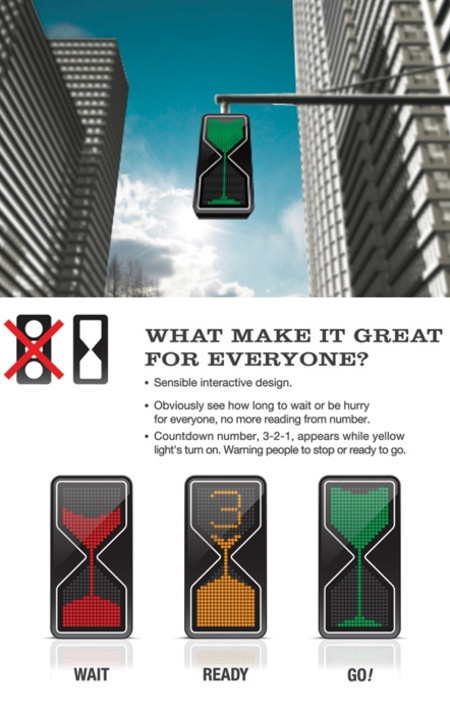
All earmarks are bad, but earmarks in my district are good
from Streetsblog Capitol Hill by Tanya Snyder
…
Tea Party darling Michele Bachmann (R-MN) has taken a hard line against earmarks in her second term, after getting nearly $4 million in earmarks her first term. “It’s all bad, as far as I’m concerned,” she told Fox News this spring. “All this pork is bad.”
This week, she told the Minnesota Star Tribune that she wants to redefine earmarks so that they don’t include transportation earmarks. Meaning, she wants an absolute ban on earmarks, except the ones she really, really likes. “Advocating for transportation projects for one’s district, in my mind, does not equate to an earmark,” she said.
Actually, that’s exactly what an earmark is, and that’s why they’ve been so controversial. They’re one of the primary ways that the legislative branch exercises control over spending. Many lawmakers see them as indispensable, since, they assert, they know better what the needs are in their districts than federal bureaucrats in Washington
…
Continue reading “All earmarks are bad, but earmarks in my district are good”
WMRT westward Expansion in EA process
from TheWashCycle by washcycle
The National Park Service has begun the Planning, Environment and Public Comment period on the proposed extension of the Western Maryland Rail Trail approximately 15 miles from its present western terminus at Pearre Station to a point near Paw Paw, WV. This extension will be under the management of the C&O Canal National Historical Park. Project information is available here. The Public Comment period is from Nov 16 – Dec 23. The project needs all the favorable comments it can get.
Note the Topic Questions Instructions here. Those submitting comments are encouraged to answer all, or part of, the six Topic Questions. Since the Indigo Tunnel detour will use the towpath, it is important that the towpath have a surface that will accommodate road bikes.
There were two public meetings earlier this week which kicked off the comment period. NPS will make its decision next year. If you’ve never been on the WMRT it’s really nice. And this next section will have several bridges – including six over the Potomac river, and two tunnels through the Paw Paw bends. It will also take the trail into West Virginia (and back).

Current Bicycle Laws (Phase one)
[B’ Spokes: as a result of your efforts the following corrections have been made to MVA’s web site. In particular note how our 3′ law is summarized, big improvement. Thanks again to all who helped in this, and to our good friends in Maryland Highway Safety Office who helped a great deal. Hopefully there will be a few additional changes but we are off to a great start.]
The laws referenced below are current as of October 2010, and can be found in the Annotated Code of Maryland, Transportation Article.
Take The High Road: Share The Road – It Belongs To Everyone
You are responsible for controlling your vehicle as necessary to avoid a crash!
By Maryland law, bicycles are vehicles. Bicyclists are authorized users of the roadway, and bicyclists have the same rights-of-way and the same duty to obey all traffic signals as motorists. But bicycles are less visible, quieter, and don’t have a protective barrier around them. Motorists should drive carefully near bicyclists; even a slight mistake can result in serious injury or even death.
Traffic Laws for Motorists
- The driver of a vehicle passing another vehicle, including a bicycle, must pass at a safe distance and leave plenty of space. The driver should be able to see the passed vehicle in the rear view mirror before returning to the original lane. After passing you must make sure you are clear of the bicyclist before making any turns.
- Drivers shall exercise due care to avoid colliding with any bicycle, Electric Personal Assistive Mobility Device (EPAMD), or motor scooter being ridden by a person.
- The driver of a vehicle must not pass any closer than three (3) feet to a bicycle or motor scooter if the bicycle is operated in a lawful manner. It is not lawful to ride against traffic.
- The bicycle has the right of way when the motor vehicle is making a turn, and you must yield to bicycle.
- Motorists must yield the right-of-way to bicyclists riding in bike lanes and shoulders when these vehicle operators are entering or crossing occupied bike lanes and shoulders.
- When riding on a sidewalk, where such riding is permitted, or a bike path, a bicyclist may ride in a crosswalk to continue on their route. Motorists are required to yield right of way to a bicyclist operating lawfully in a crosswalk. So, look for bicycles coming from both directions. (TR §21-101, §21-202, & §21-1103)
- A person may not throw any object at or in the direction of any person riding a bicycle, an EPAMD, or a motor scooter.
- A person may not open the door of any motor vehicle with intent to strike, injure, or interfere with any person riding a bicycle, and EPAMD, or a motor scooter.
- Failing to yield right of way to a bicyclist, resulting in a crash in which the bicyclist is seriously injured can result in a $1,000 fine and three points on your driving record.
Traffic Laws for Bicyclists
- Maryland’s traffic laws apply to bicycles and motor scooters. (TR § 21-1202)
- A bicycle may not carry a passenger unless it is specifically designed for and equipped with a seat for each passenger. (TR § 21-1203)
- Bicycles, motor scooters and EPAMDs are not permitted on any roads where the speed limit is more than 50 miles per hour or higher. (TR § 21-1205.1)
- A person riding a bicycle shall ride as close to the right side of the road as practicable and safe, except when:
- Making or attempting to make a left turn;
- Operating on a one-way street;
- Passing a stopped or slower moving vehicle;
- Avoiding pedestrians or road hazards;
- The right lane is a right turn only lane; or
- Operating in a lane that is too narrow for a bicycle to travel safely side-by-side within the lane (TR § 21-1205)·
- Where there is a bike lane, a person must use those and not ride a bicycle or motor scooter in the roadway except: (TR § 21-1205.1)
- If passing safely cannot be done within the bike lane or shoulder;
- When preparing for a left turn; o To avoid hazards;
- When the bike lane is also a right turn or merge lane.
- A person riding a bicycle or motor scooter may not cling to any vehicle on the roadway. (TR § 21-124)
- A motor scooter may not be operated at a speed in excess of 30 mph. (TR § 21-1205.1)
- An EPAMD may not be operated at a speed in excess of 15 mph. (TR § 21-1205.1)
- A person cannot carry anything that prevents them from keeping both hands on the handlebars or that interferes with the view or balance of their bicycle, motor scooter, or EPAMD. (TR § 21-1206)
- A bicycle, motor scooter, or EPAMD may not be secured to a fire hydrant; a pole, meter, or device in a bus or taxi-loading zone; a pole, meter, or device within 25 feet of an intersection; or where it would obstruct or impede traffic. (TR § 21-1206)
- A person may not ride a bicycle, motor scooter, or EPAMD while wearing a headset or earplugs that cover both ears. (TR § 21-12010)
Helmets
- Helmets are required for everyone under the age of 16, including passengers, who ride their bicycles on the road, bicycle paths, or any public property. (TR § 21-1207.1)
- Helmets are also required for everyone under the age of 16 who are riding on a scooter or on in-line skates. (TR § 21-1207.2)
- The helmets must meet or exceed the standards of the American National Standards Institute, the Snell Memorial Foundation, or the American Society for Testing and Materials. (TR § 21-1207.1)
Equipment Required
- A lamp is required on the front of a bicycle or motor scooter, if the bicycle or motor scooter is used on a highway when people and vehicles are not clearly visible at 1,000 feet. (TR § 21-1207)
- A red reflector on the rear is required if the bicycle or motor scooter is used on a highway when people and vehicles are not clearly visible at 1,000 feet. (TR § 21-1207)
- A bicycle or motor scooter may be equipped with a bell or other audible device, but not a siren or whistle. (TR § 21-1207
- A bicycle or motor scooter must be equipped with a brake. (TR § 21-1207)
.