There ought to be a law – about bicycle laws being available and accurate

Updated update: MVA’s site is coming along nicely: https://www.mva.maryland.gov/Driver-Safety/Bicycle/default.htm
There is more I would like to do but I have to involve the "committee" which is going to be hard in the middle of the legislative season, so stay tuned, more to come.

Unfortunately somehow the ball got dropped on changing the law summary on SHA’s site. After a bit of effort hopefully the right person has the info and motivation to update the laws. In the process we found another link to be fixed: https://www.marylandroads.com/oots/Appendix%20C%20-%20PedBikeCode.pdf
**********************************************************************
Update: Conversation has begun and I will let everyone know the outcome when it happens. Thanks to everyone who took time to write and getting the State to take more seriously the dissemination of bike laws and that they be correctly stated.

**********************************************************************
§ 21-1212. Copies or summaries of laws and regulations.
The Administration shall publish copies or summaries of the regulations and laws of this State that regulate the operation of bicycles …

This started off as a nice law but a lot has changed since 1986. I would hope that it’s implied those copy of summaries should be current and not to mention accurate.

I remember Bob Moore’s (may he rest in peace) testimony in Annapolis about "the quaint antiquated notion" of requiring bikes to have a bell and that was in 2006 yet the summary as provided by SHA has that we are still required by law to have a bell. Not to mention our resent removal of mandatory shoulder use, this really needs to be updated.
https://www.sha.maryland.gov/OPPEN/acom_bike_laws1.pdf

I have written to SHA’s bike/ped coordinator before on this subject but I guess they keep switching who is in charge of that position so this has yet to be done but 4 years out of date is really too much and should be corrected.

**********************************************************************
Continue reading “There ought to be a law – about bicycle laws being available and accurate”

How could bottled water be bad???

From Sustainable Stormwater Management

Every time I purchase a bottle of water I feel like I did something good for myself.  After all, water is so much better for you than some of the alternative beverage choices!  However, I was recently shocked to learn that maybe that bottle of water isn’t as wonderful as I thought.

I just finished watching a documentary called Tapped, produced and directed by Stephanie Soechtig and Jason Lindsey.  The film questions whether water is a basic human right or a commodity that should be bought and sold like any other article of commerce.  According to the film, much of the bottled water is drawn from municipal water sources (aka tap water), which gets filtered, bottled, and sold back at 1900X the cost of tap water.  They come into small towns in places such as Maine and Georgia and start pumping huge volumes of water, sometimes despite severe drought conditions.

The second issue the movie explores is that actual production of plastic bottles and the chemicals which they can contain.  Oil is made into plastic during the refining process.

Corpus Christi, TX oil refinery.

Some of the chemicals in the bottles have been shown to leach into the water, especially after the water is warmed, say while sitting in the trunk of your car.  The horrible chemicals in the plastic bottle themselves, including Bisphenol-A (BPA), have been linked to cancer, ADHD, reproductive issues and a whole lot of other nasty things by independent researchers.

Only about 20% of plastic bottles are recycled in the United States.  The bottles that are not recycled end up in landfills or in the ocean.
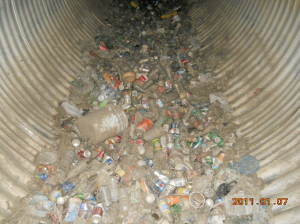
Plastic bottles inside a storm drain, taken during an annual site inspection.

Huge garbage patches filled with partially decomposed plastic have been found in both the Pacific and Atlantic Ocean.  Within these patches, one the size of Texas, the composition of the ocean is changing and plastic is becoming more prevalent than the plankton population.  We’ve written about these on this blog before.

As the Tapped movie website says “I had been naïve enough to think recycling alone was enough.  The only thing we can do is to stop putting plastic in the ocean.  Be more aware of the way things are packaged, say no to plastic bags, don’t buy Styrofoam cups, order less take out (or bring your own containers when you do), stop drinking bottled water, reduce, reuse and recycle.”
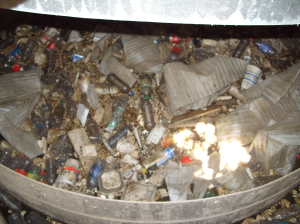
Bottles and other plastics found in vortex unit inside of a catch basin at a local shopping center.

Closer to home, we see the results of bottled water every day in our work at Stormwater Maintenance, LLC.

The volume of bottles we see, especially in underground structures, never ceases to amaze all of us.  And to think, everyone who drinks it thinks they are doing the right thing.
Continue reading “How could bottled water be bad???”

Maryland has a pedestrian problem

Michael Dresser did some excellent reporting on this issue.

When it comes to pedestrians, Maryland is the anti-Vegas. What we have here is a dysfunctional relationship between drivers and walkers that helps ensure a seemingly permanent spot among the most dangerous states for pedestrians.


But there are also cultural factors at work. Hedlund said that in California when a pedestrian moves to step off a curb, traffic cars are likely to stop. In Baltimore, they’re just as likely to speed up.


Jamie Kendrick, Baltimore’s deputy transportation director, said that over the next month or so the city will seek bids on a project to install about 40 flashing signals, repaint the stripes on nearly 600 crosswalks, install more than 150 new handicapped-accessible ramps and curb cuts and put up nearly 700 pedestrian countdown signals.

Kendrick said all of the projects will be undertaken in school zones. In addition, he said, the city will announce a significant investment this spring on traffic-calming measures.

These initiatives are quite welcome, but they don’t add up to a comprehensive policy. It does nothing about crosswalks that aren’t in school zones. It doesn’t crack down on scofflaws.

For that, the city and other Maryland jurisdictions need to step up enforcement.

According to Jonathan Adkins, spokesman for the governor’s safety group, other states have stepped up enforcement efforts using “decoy” pedestrians to nab drivers who ignore crosswalks.

Such operations have been used to good effect in the areas of drunken-driving and seat belt use, but they don’t make much of a dent without a media effort that gives each citation a multiplier effect.

Kendrick said Baltimore last mounted a sting operation in September but he acknowledges that it wasn’t well-publicized. These programs need to be done with a splash — including inviting video coverage of the enforcement actions. It would be fair if they targeted crosswalk-violating drivers and jay-walking pedestrians equally.

Meanwhile, the General Assembly ought to reconsider its current fines for pedestrian-related offenses. Right now, a ticket for a motorist failing to yield to a pedestrian in a crosswalk — one of the most dangerous of moving offenses — carries a measly $90 fine. Shouldn’t it be closer to the penalty for passing a school bus with flashing red lights? A $570 fine would certainly get motorists’ attention.

Last year, New York adapted the “Elle’s Law” statute, named for a 3-year-old girl who was struck in a crosswalk and left in a coma by an SUV traveling in reverse on a one-way street to grab a convenient parking space. The law automatically suspends the license of any driver who strikes a pedestrian while driving recklessly. Not a bad idea.

There is growing evidence that roads safer for pedestrains are safer for cyclists and roads safer for cyclists are safer for pedestrains. In the discussions that came up on this topic the following PBS video was highlighted how our road are dangerous by design:

Continue reading “Maryland has a pedestrian problem”

Congress Swings Back into Action – Boxer, Cardin Support Cyclists

from Bikeleague.org Blog by Andy
The nation’s capital was hit with both a major snowstorm and a return to Congressional action this week – with the transportation bill and future funding issues for once making more progress than the car commuters stuck in  Wednesday’s heavy snow!

On Wednesday, a Senate hearing on the transportation bill included a revealing exchange, reported by StreetsBlog DC, between Senators Inhofe, Boxer and Cardin, and witnesses from the construction industry who seem unaware that their members also build bike and pedestrian infrastructure. Inhofe (R-OK) appeared to ask for help in getting Republican support for a transportation bill that includes funding for transportation enhancements – which prompted witnesses from the National Construction Alliance and Associated General Contractors to express surprise that this even existed! Odd, given that the program has been popular and thriving for the last 20 years and their members have, presumably, been the primary beneficiaries of the investments that have gone to such community-building transportation projects such as trails, sidewalks, and bike lanes.

While no fellow Republicans leaped immediately to the defense of the program, long-time cycling supporter Senator Cardin (D-MD) certainly did, and he was joined by Senator Boxer (D-CA) who noted that many of her constituents consider cycling and walking to be transportation. Given her role as Chair of the Environment and Public Works Committee, this was good news.

Commuters on a Transportation Enhancement project in Denver. Source: NTEC

Commuters on a Transportation Enhancement project in Denver. Source: NTEC

Attention shifted to the House on Thursday. Representative John Mica (R-FL), chair of the Transportation and Infrastructure Committee, announced a series of dates and locations for field hearings on the next transportation bill. While there are a lot more details to come, we know for sure that its going to be important for our issues – i.e. continued investment in bicycling and walking transportation measures – to be raised at these hearings, and for those attending to know that there is a lot of public, business and public agency support for the programs that support these activities.

Concurrent with all this is an ongoing and slightly byzantine budget and appropriations process that will impact overall funding levels for transportation in the short term, and set the scene for longer-term transportation funding and policy. The America Bikes coalition – of which the League is obviously a part – is staying on top of all this, but it is a fast-moving and slightly bewildering process to try and follow from a distance. In the next month, there are probably going to be some action alerts and quick responses that are needed from cyclists around the country; we are continuing to encourage folks to meet with their members of Congress in their districts at this critical time – especially new members and new appointments to key committees. And we are looking forward to seeing many of you in Washington for the National Bike Summit in just a few weeks – where perhaps we can take stock of this current flurry of activity. It’s a lot to ask of state and local advocacy groups and individuals at a busy time for all of us – state legislatures are also back in session around the country and a lot of city and county agencies are struggling with difficult budget decisions at the same time – but all we can say is that we appreciate anything you can do to help amke the case for bicycling during this time…and this isn’t a drill, folks. The next month or so really is pretty crucial.

Which makes it really nice to have the support of key members of Congress like Senators Boxer and Cardin.

Andy Clarke
President, League of American Bicyclists

Continue reading “Congress Swings Back into Action – Boxer, Cardin Support Cyclists”

Maryland road safety head, Post’s Halsey blame pedestrians and even Michelle Obama for fatalities

by David Alpert
Pedestrian fatalities stopped declining in early 2010. Unfortunately, a safety nonprofit and its chairman, Maryland’s highway safety head, chose to blame pedestrians for getting killed while downplaying other, equally important causes.

The press release also ignores the report’s recommendations that government do more to design safer roads. Perhaps that’s not a surprise since the organization comprises state highway safety officials who have done little to even admit to, let alone address, their governments’ complicity in these pedestrian deaths.
In his writeup of the report, the Post’s Ashley Halsey III buys into Betkey’s narrative wholesale. He talks about how many fatalities in Prince George’s and Fairfax counties, in particular, involve crossings at night, away from crosswalks.
But missing in this discussion is the question of why people are trying to cross dark roads where there are no crosswalks. In many busy areas of those counties, there are shopping centers along multi-lane arterials with poor lighting and long distances without crosswalks. If someone on foot wants to get to one of those stores and isn’t in a car, they have few alternatives. The pedestrian could be more careful, but also the government could be putting in better streetlights, crosswalks, and traffic signals.
To frame his piece, Halsey cites a fatality in Landover which did involve a signalized crosswalk. According to the article, the pedestrian signal was flashing the red "don’t walk" hand icon, during which time three teenagers ran across the road. A driver hit and killed 15-year-old Wayne Cuffy. Halsey’s piece is dripping with accusations against Cuffy:
>>> "It is the kind of risk teenagers take: darting across six lanes of traffic, paying no mind to the flashing sign warning pedestrians to await the green light. Wayne Cuffy and his buddies bolted across Landover Road on their way to the mall Tuesday night, a mistake that cost the 15-year-old his life when he stepped in front of a Ford Expedition at Dodge Park Road. … It was dark, and rush hour was winding down when they dashed into traffic toward the mall. Cuffy was struck just after he left the curb."
But wait. The signal was flashing the red hand. That means the traffic light was red for cross traffic. For the driver to hit Cuffy, the driver had to have run the red light (added: or made a turn without yielding).
Yet there’s absolutely no mention of this fact in Halsey’s article. Who’s really at fault: a teenager who hurries to get across the road before the light changes, but while cross traffic has still got the red light, or the driver who hits him despite the red light?

Continue reading “Maryland road safety head, Post’s Halsey blame pedestrians and even Michelle Obama for fatalities”

Balto. Co. issues speed camera report

from Maryland Politics by Andy Rosen

Baltimore County officials released a report today evaluating its 6-month-old speed camera program.

Speed cameras are in place in 15 school zones throughout the county. The first two sites were activated last March; all 15 cameras were in place by June.

A few highlights:

• The county issued 16,342 violations in July — the first month that all cameras were in operation – a five-fold increase from the previous months.
• More than 3,000 potential violations were rejected throughout the year due to technical problems.
• Overall, the number of violations tends to decrease during the first several weeks after the camera is activated, although the overall level varies substantially among sites.
• There’s been an almost 52 percent decrease in the number of citations issued since August.
• Data involving car crashes is inconclusive. Six of the 15 locations had more traffic accidents within a one-fourth mile radius last year compared to previous years; eight had fewer. One had the same amount. Camera locations averaged 31 accidents per site before and after they were activated.
• Requests for additional cameras have come from Stoneleigh and Baltimore Highlands elementary schools, and Deer Park Middle School.
• 53,000 citations have been issued and 35,427 have been collected, generating $1.4 million. Contract costs have totaled about $1.1 million.
• Revenues go to a restricted account in the police department budget that can only be used for the actual program costs. Any additional funds may only be used for public safety projects such as technology/equipment enhancements, capital needs, staffing and matching funds.
• Additional staff will be needed for the program if it is expanded. The council is currently considering a bill that would lift the cap on the number of speed cameras.

The report, made public today, is dated Jan. 21.
Continue reading “Balto. Co. issues speed camera report”

Woman Says Metro Bus Driver Ordered Passengers Off

By JOHN HENREHAN/ myfoxdc


41-year old Maria Moss started her journey at 3:30 p.m., when she left work (in Rockville) early to try to get to her mother’s apartment in the White Oak section of Montgomery County. Like most traffic in the afternoon and evening, the bus crawled along for hours.

Around 11:30 p.m., Moss said the driver, "put us off the bus, and said he couldn’t go to Silver Spring. He couldn’t take us to the nearest subway station. We had to get out and walk."

Moss said she was terrified because she has poor night vision. "I thought I was going to die last night," she said.

Another Metro bus driver took pity on the passengers, and took them to the Wheaton Metro station, which, — by then — was closed. The small group eventually stumbled onto an all-night donut shop. After a 90-minute wait, Mrs. Moss managed to get a cab; she returned home at 3:00 a.m. — eleven-and-a-half hours after her journey began.

Reminded that Metro had ordered drivers to end service by 9:30 p.m., Maria Moss shook her head. "There were people on the bus," she replied. How can you put someone out in the snow with nowhere to go? How can you do that?"

Continue reading “Woman Says Metro Bus Driver Ordered Passengers Off”