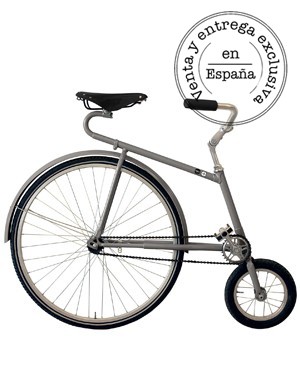
My first thought was to wounder how well this would go over on the MARC train.
Continue reading “Does it have to fold to be a portable bike?”
BIKE LANE SHORTAGE
A British national survey by cycle insurance provider, Cycleguard, finds that 83 percent of cyclists have bike lanes for less than half of their daily commute and 53 percent of cyclists only have bike lanes for one-quarter of their daily commute. Cycleguard has since called for the creation of more bike lanes in Britain.
Continue reading “BIKE LANE SHORTAGE”
Stay in your lane
By Kim Brown – ABC News

Cyclists and pedestrians are commuters too. While pedestrians do not always have the right of way when crossing the street, there are more rules protecting cyclists rights to the roadway than I knew.
According Maryland state law, the responsibility is on the driver of a vehicle to ensure cyclists are not struck, and not the responsibility of the cyclist to stay out of the way of the driver. The punishments for drivers who injure cyclists include a $1000 fine and up to three points on their license.
With some very sad stories in our state during the past year: the Hopkins student severely injured while struck on his bike and the Green Party candidate who was actually killed while cycling , the state legislature is working to enact stiffer penalties for drivers who cause major injury to bicyclists.
Click here to see the full list of rules for sharing the road with cyclists.
[B’ Spokes: I also found this video that kind of captures the “cyclists must stay out of the way” attitude. Was the driver’s “intent” to harm the cyclists, as some have insisted should be part of prosecution of unsafe drivers? Not really but look at the standard of due care exercised here vs what other drivers were doing, and that is what we are going after. Also note how much space she gives the car vs the cyclist, for me this is one of the fundamental changes in our culture, “it’s OK to pass a cyclist within inches even though a small mistake could kill but another car give plenty of space as you might get a dent or a scratch on your car.”]
Continue reading “Stay in your lane”
Vehicular Negligent Homicide: Illegal in Maryland Starting October 1
from TheWashCycle by Jim Titus
Yesterday both houses of the Maryland General Assembly approved the amended House Bill 363, which creates a new crime of negligent homicide by vehicle or vessel. Passage of this bill culminates a 7-year effort led by Delegate Luiz Simmons (D-Rockville) and the families of victims killed by negligent drivers.
Under the existing law, drivers who kill have only been convicted of vehicular manslaughter if they were drunk, drag-racing, or clearly knew that their driving might kill someone. Under the new law. drivers who should know that their driving could kill can be prosecuted for negligent homicide, with a maximum term of three years. The Governor has indicated that he will sign the bill.
We can attribute the success this year primarily to the perseverence of Delegate Simmons and several people who dedicated themselves to ensuring that something good came out of the trajedy that befell them. I won’t try to name them all, but Adiva Sotzsky deserves credit for engaging the bicycle community. She and Ed Kohls simply would not give up. Keniss Henry’s involvement added an extra degree of urgency to the matter within Prince Georges County after the death of her daughter Natasha Pettigrew, which is still under investigation. We also credit Senator Brian Frosh (D-Bethesda) for sharing his skepticism in a transparent fashion, which enabled proponents to address his concerns before the hearing in his committee. Realistically, there would not have been time to address them after the hearing. Bike Maryland and AAA supported the effort for several years before WABA became involved.
But with all of their great work, this bill still would not have passed this year had the Washington area cyclists not stepped forward. As always, you sent emails. But this time you also called your Senators—more than once in many cases. You asked your friends to call the key Senators—and they did. You handed flyers to people in public places and spoke with them about the importance of contacting their Senators. And they did. And the Senators got the message. They allocated enough in their hectic schedules to learn enough so they could be confident in supporting this bill that arrived so late in the session. That is no small accomplishment because a responsible legislator does not create a new type of homicide lightly.
We have no illusions that making negligent homicide a crime will make our roads safe. Many forms of bad driving remain legal, many forms of illegal driving go unenforced, and many drivers are undeterred by enforcement. The subtext that enforcement is worse than the crime will continue in some places. But Maryland has removed the most offensive blemish of all from its transportation legal system—the idea that killing a human being has no legal consequence. Now it will.
(Jim Titus is a member of WABA’s Board of Directors from Prince Georges County, Bike Maryland’s legislative task force, and the Maryland Bicycle and Pedestrian Advisory Committee (MBPAC) The opinions stated herein do not necessarily reflect the offials views of WABA, Bike Maryland, or MBPAC.)
Continue reading “Vehicular Negligent Homicide: Illegal in Maryland Starting October 1”
Cars are more efficient then trains, ya right.
from Streetsblog New York City by Noah Kazis
…
In the headlines this morning, we linked to a great historical photo of the approach to the Brooklyn Bridge on Brownstoner, and it’s taking a closer look at the full implications of the shot. Not for nostalgia’s sake, but to make a cool, calculated appraisal of the efficiency of this piece of transportation infrastructure, as currently configured.
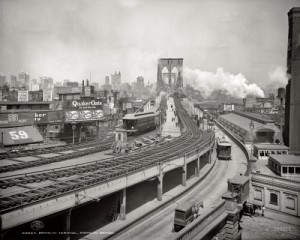

The Brooklyn Bridge in 1903 carried far more people than it does now. Top photo: Shorpy.com via Brownstoner. Bottom photo: Google Maps via Brownstoner.
The 1903 image shows the bridge with only one lane in each direction for private vehicles, which at the time were drawn by horses. The rest of the space is given over to tracks for streetcars, elevated railroads, and pedestrians. Now, of course, there’s still a shared bike-ped path through the middle of the bridge, but the rest of it is all for cars, with three lanes of automobile traffic running on either side. No buses or trucks run over the bridge.
If the job of the Brooklyn Bridge is to move people between the two boroughs, the reallocation of space from transit to cars has been disastrous. In 1902, one year before the photograph was taken, the Brooklyn Bridge moved roughly 341,000 people a day across all its modes, according to the Federal Highway Administration. It hit its peak capacity a few years later, with 426,000 people using it each day in 1907.
Today, 125,000 motor vehicles cross the Brooklyn Bridge each day [PDF], as do roughly 4,000 pedestrians and 2,600 cyclists. For the bridge to carry as many people as it did at its peak, each of those cars would need to carry more than three people, but they do not. In 1989, when the city counted around 132,000 motor vehicles crossing, the FHWA estimated that 178,000 people crossed the bridge daily.
More than a century has passed since this photo was taken, and the Brooklyn Bridge’s capacity has declined by an enormous amount, thanks to the elimination of transit across it. You just can’t fit enough bulky and mostly empty cars on the bridge for it to add up.
…
Continue reading “Cars are more efficient then trains, ya right.”
Bicycling Advocates of Howard County – Annual Fundraiser
Howard County Bicycling Community,
BAHC is initiating an annual April fundraiser to cover our annual expenses. Our costs include: membership in League of Amercan Bicyclists, insurance, Web site (domain/hosting), Bike HoCo ride, donations to supporters of HC cycling, and administrative costs. We have a relatively modest goal of raising approximately 1500 dollars per year.
Since our formation in 2008 BAHC has made an effort to support the Howard County bicycling community, some of our achievements have been:
* Established relationships with HC Government and Police: BAHC has provided a single-POC/interface for HC bicyclists who wanted/needed to communicate with County Government on road issues, accidents/near accidents, and other issues relating to cycling
* Established daily road work e-mail communications from HC Public Works/Highways
* Requested installation of ‘Share the Road’ signs on major bike routes
* Organized training for hundreds of new bike riders through our annual Biking 101 class and supporting Princeton triathlon training rides
* Helped organize Howard County rally for annual Bike to Work Day
* Held an Annual Bike HoCo (formerly All Club) Ride and picnic to connect cyclists from differenct Clubs/groups
* Established BAHC web site/listserves/Facebook page to establish an electonic cycling community
* Organized a quarterly Bicycling Advisory Group with HC Government
* Testified at County Council/Zoning Board and Columbia Association on bicycle accessibility issues
* Assisted the Mid Atlantic Off-Road Enthusiasts (MORE) in creating a new mountain biking skills course at Rockburn Branch Park
* Conducted bicycle road condition surveys; established a road damage/hazard web site (https://www.seeclickfix.com/md_howard-county)
* In October 2010 held the first HC Bicycling Advocacy Forum > 100 attendees
* Became a 501(c)4 Non-Profit Corporation in February 2010
* In December 2010, made donations to HC Police Department bike team for the annual Police Unity Tour and West Friendship Volunteer Fire Department for their support of the cycling community
Donations are not currently eligible for income tax deduction since BAHC is a 501(c)4 (Civic League type) versus (c)3 (Charitable Type) non-profit corporation. Donations can be made on Paypal – link is available on the BAHC web site: https://www.BikeHoCo.org or by check to: Bicycling Advocates of Howard County, c/o Jack Guarneri, 10224 Little Brick House Court, Ellicott City, MD 21042.
Jack Guarneri
President, Bicycling Advocates of Howard County
Smarter
From Google Maps Bike There
…
I stumbled across a website/company doing a couple of interesting things — fatamerican.tv. In particular, I liked their play on the Smart Car. Here is the Smart Car logo:

And here is the cool t-shirt design from fatamerican.tv:

What may be even cooler, though, is that the explanation of the design is on the inside of the t-shirt:
The “Smart Car” isn’t smart; it gets the same fuel efficiency as other economy cars but only seats 2 passengers. When compared to bicycles, all cars tend to look down right idiotic. Where’s the logic in working tons of hours to pay for a car to get to work to pay for a car? What’s the sense in driving to the gym to pay a membership to get some exercise?
Move within biking distance to work, sell your car, cancel your gym membership and start living smarter. Increase your quality of life while not contributing to the political, environmental, social calamity created by the world’s dependency on oil.
Frosh Amends, then pushes Bill Forward in Maryland
From WABA
Here is an explanation of the Senate Committee’s amendment to House Bill 363.
H.B. 363 is based on the Model Penal Code, a suggested criminal code developed by the American Law Institute. Senator Brian Frosh (D–Montgomery) has consistently maintained that he is concerned that the proposed version of House Bill 363 might unintentionlly subject relatively ordinary behavior to criminal penalties. WABA’s testimony before his committee showed that the states that have enacted some variation of the Model Penal Code have only upheld convictions for egregious conduct resulting in death, not ordinary negligence. (Our testimony before the House focussed on the inadequacies of the existing law in Maryland.)
Mr. Frosh noticed that H.B. 363 used different adjectives than the Model Penal Code. The original version of House Bill 363 included the following language
SECTION 1…. § 210 (c). For purposes of this section, a person acts in a criminally negligent manner… when… (2) [t]he failure to perceive constitutes a substantial deviation from the standard of care that would be excercised by a reasonable person.
SECTION 2. AND BE IT FURTHER ENACTED, That it is the intent of the General Assembly that the term “substantial deviation from the standard of care” in § 2–210(c)(2) of the Criminal Law Article, as enacted by
Section 1 of this Act, be interpreted synonymously with the term “gross deviation from the standard of care” under § 2.02(2)(d) of the Model Penal Code of the American Law Institute.
After some negotiation, the Senate Committee changed one word:
SECTION 1…. § 210 (c). For purposes of this section, a person acts in a criminally negligent manner…when… (2) [t]he failure to perceive constitutes a substantial gross deviation from the standard of care that would
be excercised by a reasonable person.
Because Section 2 of the bill already defined “substantial deviation” as “gross deviation” this amendment does not seem to change the bill’s meaning. If the Senate passes the amended H.B. 363, then sponsors in the House should be able to explain that the Senate’s amendment is purely technical.
Maryland Residents: Please CLICK HERE to email your state senator expressing your support for House Bill 363, as amended. [Don’t forget your full name and address. You have till midnight on Monday.]
Continue reading “Frosh Amends, then pushes Bill Forward in Maryland”
Some cyclists, drivers deserve each other
Time to send them both to bed without supper
By Michael Dresser – Baltimore Sun
Last week, on the blog that goes by the same name as this column, I posted a sad item about doctors giving up hope for the "meaningful recovery" of a 20-year-old Johns Hopkins student who was injured when struck by a car while riding his bicycle on University Parkway.
The response was tremendous in volume, but not so encouraging in tone. Instead of focusing on the tragedy of a family’s loss, it became a sounding board for bicyclists and motorists to air grievances against each other. The level of discourse made me want to send both groups to bed without their supper.
Now, we’re talking about a distinct subset of each group — the motorists who can’t bear the thought of sharing the road with smaller vehicles and the bicyclists who have begun to froth at the mouth about drivers — but it’s still distressing to realize how unhinged some people can become over something that ought to be no big deal, like sharing the road.
A reader named Jessica seemed to be very moved by the bad news, which she called "tragic." But she used it as an opportunity to draw an absurd conclusion: "I do believe that roads are for cars and it is extremely hard for bicycles and cars to coexist peacefully on roads as they are at the moment. Roads need to be widened, bike paths need to be added."
Someone who professed to be spouting common sense instead offered this: "When cyclists have to title and tag their bikes, then they have the right to share the roads. Autos and trucks pay taxes, and fees to use the roads, which give them the right to full lanes. Share the cost and you can share the road."
A more strident variation of the theme — reproduced here without editing — was posted by another reader, who seems to be a prisoner of the CAPS LOCK key:
"BICYCLIST DO NOT BELONG ON THE ROAD PERIOD..WHY ARENT GO CARTS NOT ALLOWED THEN?BECAUSE THEY HAVE THEIR OWN TRACK LIKE BICYCLIST SHOULD HAVE TO:)"
The three readers have this in common: They’re flat-out, 100 percent wrong — legally, historically, logically and morally.
Yes, the roads are for cars. They are also for bicycles, pedestrians and sometimes horses. Drivers of cars and trucks enjoy the advantages and responsibilities of being the biggest and most powerful users of the roads. Thus, motorists must know how to drive around bicyclists, pedestrians, horses, etc.
This is not an optional skill. Motorists who find it difficult to share the roads with other travelers who have a legal right to use them need to seek remedial education or stop driving. It’s a given that some bicyclists and pedestrians will perform badly. Drivers have to be alert and ready for those occasions, too.
The notion that cyclists have no right to the roads because the state does not require taxes and registration ignores the fact that the state has chosen through its elected representatives not to do so.
Why not? There are some obvious reasons. Bikes, unlike motor vehicles, add almost nothing to the wear and tear on the roadways. Those who use a bike do all motorists a favor by not being other motorists. Bike lanes, where they exist, do drivers as much good as they do bicyclists by moving them out of the way.
And talk about Big Government: Who but some leftist radical would want to expand the bureaucracy by imposing a licensing scheme on every child who gets on a kiddie bike with training wheels? Widen all the roads and build bike lanes? Show me the money! You can’t get Marylanders to agree to a gas tax increase to keep bridges from falling down. You think we’re ready to pay to widen all the roads for the sake of those who can’t deal with bikes?
Some might think from my comments I’m a fanatical biker. Hardly. You’ll find me on one maybe twice a year, while I’m in my car almost every day. But in 40 years of driving, never have I had the slightest difficulty sharing the road with bicyclists. It’s so easy even a reporter can do it. Just be patient, keep some distance and pass when it’s safe. And don’t honk.
Getting around on a bicycle isn’t rocket science, either, if you just give reasonable deference to traffic laws. (Treating stop signs as yield signs: Cool. Whizzing through stoplights? Not cool.) Don’t give the finger to motorists who annoy you. Don’t ride two abreast and delay drivers needlessly. And don’t whizz down a lane of traffic next to a line of parked cars oblivious to the dangers and then whine about being "doored."
Earth to bikers: Drivers aren’t thinking about bikes when they open car doors. They aren’t about to start in this lifetime, so either move into the travel lane or slow down and watch carefully for parked cars with people in them.
The debate over a bill to expand the definition of vehicular manslaughter to allow criminal prosecutions in more cases didn’t elevate the tone much. Some of the comments posted to my blog by bicyclists put me in a pox-on-both-your-houses mood.
For instance, where does a bicyclist get off saying: "Most, not all, motorists have no regard for those around them?" Gee, thanks for allowing that only 99 percent of us are goons.
Then there’s the bicyclist who responds to a driver’s taunt that "Your [sic] nothing but a bunch of BULLEYS [sic] on BIKES" by calling him a "moron."
Make them share a cell.
But occasionally in this tawdry debate there shines through a comment of such clarity and perceptiveness it makes one think it isn’t yet time to consign the human race to the protoplasm recycling vat. Wrote one reader:
"Bicycles? Yes. Most assuredly. Spandex? Please no. It seems a reasonable compromise to me."
Thank you for restoring my faith in homo sapiens.
*******************************************************************************************************************
[B’Spokes: A previous response still seems appropriate "lets look for opportunities to do a random act of kindness" https://www.baltimorespokes.org/article.php?story=20110323114538733 As a cyclist look for ways that are not that much of a bother to get behind the main platoon cars to maximize your time of low traffic between platoons of traffic (and drivers sorry but opportunities to do this are rare so don’t expect a bicyclist to instantaneously get out of your way ), move left to accommodate right turning cars. Yes we need to be assertive when riding in traffic but please don’t turn that into being aggressive. I know how bad driver can get even when there is a perfectly good empty lane they can use to get around us they still have to act out, just don’t let these guys get to you.]
Continue reading “Some cyclists, drivers deserve each other”
Nathan Krasnopoler case goes to the state’s attorney’s office.
…
On Tuesday, chief spokesman Anthony Guglielmi said investigators had completed their review and forwarded their findings to the state’s attorney’s office. He would not comment on what recommendations were made.
…
***************************************************************
[B’ Spokes: I really hope we are going to get some press on how cyclists have the right-of-way in bike lanes out of this and NOT the same old "motorists was not at fault" garbage. I hope our action alert https://www.baltimorespokes.org/article.php?story=2011030413431398 and the Mayor’s Bicycle Advisory Committee actions https://www.baltimorespokes.org/article.php?story=2011030523251899 will do some good toward this end. If not I do have a plan for the next level, so stay tuned.]
Continue reading “Nathan Krasnopoler case goes to the state’s attorney’s office.”