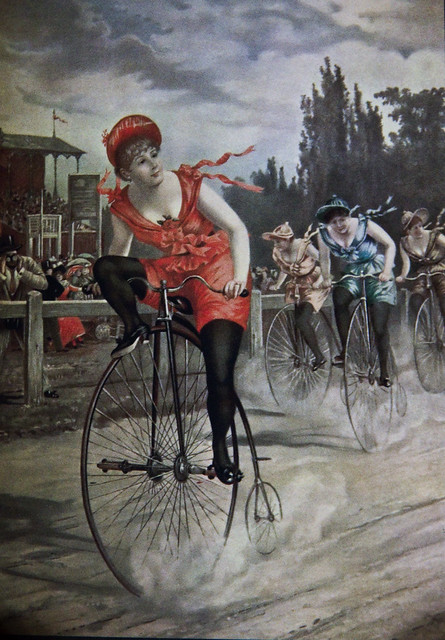
I wish there was more.
found via Copenhagenize.com

Biking in Baltimore
I wish there was more.
found via Copenhagenize.com
from Streetsblog.net by Angie Schmitt
Whet Moser mentioned recently in the Chicago Magazine blog that he’s more afraid of spiteful comments from readers than new data that may show there’s a huge number of dooring bike crashes going on in Illinois.
Whenever an article about some modest improvement in the lives of bicyclists is published, in this case news that the state of Illinois is going to start tracking when bicycle accidents involve doorings, the comments section will inevitably be filled with vitriol, and I can’t help but read it. There’s no other public forum in which people wish death on their fellow citizens like the comments to a story about biking. And I find it grimly fascinating, like a moral gapers block.
In line with a story that aired Thursday night about doorings and this new rule about collecting data, WTTW channel 11 (Chicago’s PBS affiliate) started a discussion thread title, “Should drivers be more courteous and mindful of bikers?” I think WTTW has a wildly different audience than those who read the Chicago Tribune online. And the comments, so far, reflect this.
A fairly respectful (and unidentified) commenter suggested a great idea that may have a positive impact on visibility of bicyclists:
Continue reading “No other public forum in which people wish death on their fellow citizens”
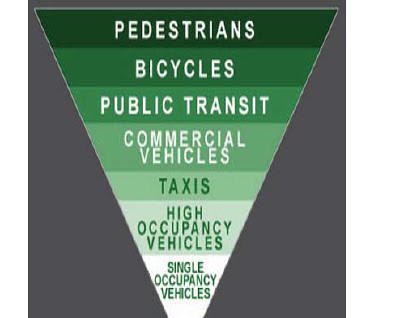
Most communities, including DC, don’t prioritize transportation in this manner.
Not having an equivalent policy in DC always worries me when City Council legislates various aspects of transportation policy in bits and pieces, from proposing free parking for funerals, angle parking to accommodate churches on Sundays, tax incentives for gas stations, streetcars, tolls on the 14th Street bridge, etc., there’s no overall plan, no overall vision, but worse, there’s no recognition of the need for an overall plan and vision.
Via Rebuilding Place in the Urban Space Sustainable transportation policy, City of Stonnington, Victoria State, Australia
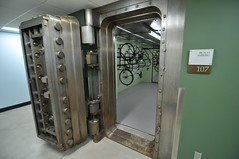
Bike vault. (Photos © J. Maus)
What else would you do in a renovated building with a unused bank vault?
Geared more for the ladies, Emilia Crotty goes over simple bike maintenance and basic adjustments to the bike.
https://www.wholeliving.com/article/diy-bike-maintenance
from WABA Quick Release by jtitus
Every year along about this time, a driver in Montgomery County has to wait behind cyclists traveling more slowly than the driver would prefer to drive, on a road with a nearby trail. And then the driver prepares a radio commentary or circulates a letter asking why those cyclists are on the road instead of the trail.
In this year’s widely circulated letter, a driver wrote:
I am both a bicyclist and motorist. Jones Mill Road is extremely dangerous, I think we all agree to that. I have seen 2 car/bike accidents in the past 3 years. Even one is too much. But I see bicyclists with limited lighting and motorists putting on makeup, eating, talking on cell phones.
This road has just barely room for 2 cars to pass and any bicycle on the road halts traffic and causes danger to all, particularly during rush hour. Adding to motorists frustration is the fact that we just resurfaced the immediately adjacent hiker/biker trail and the bicyclists refuse to use it…. They already have a trail, why not use it and avoid all this danger…
I… see huge gaggles of 40-50 bicycles completely blocking the road–not courteous and definitely not sharing–arrogance again. But during weekdays and particularly during rush hours, I just see arrogance by the bicyclists, with no concern for sharing the road with cars. I see bicyclists in danger and frustrated motorists almost every bike day.
IS it right for the bicyclists to force sharing a non sharable road when they have a trail right there? … Perhaps we organize a campaign to put up road signs stating (no bicycles, use trail). Yes, I ride that trail on bicycle almost every Mon, Wed, Fri and Saturday and drive that road every weekday.
Michael Jackson, the director of bicycle and pedestrian access for the Maryland Department of Transportation (MDOT) provided a reply that hit on just about every aspect of this issue
Your concerns are commonly shared by many members of the public. However bicycling has a lot of counterintuitive truths.
Under Maryland law bicycles are vehicles and bicycle vehicle operators have generally the same rights and responsibilities as motor vehicle operators. Bicyclists are legally entitled to use most roadways in Maryland including Jones Mill Road. Toll roads, interstate highways and travel lanes with posted speed limits of 55 mph or higher are places where bicycling is prohibited…
Why Do Bicyclists Insist on Exercising Their Legal Right to Use Roadways Adjacent To Trails?
Another counterintuitive truth is that generally roadways are safer than trails. Trails have higher crash rates than roadways. While certainly a car/bike collision can lead to serious injuries and fatalities, unfortunately serious injuries and fatalities occur on trails. Bicyclists run into each other, run into fixed objects or simply lose control and fall.
Trails often cannot safely accommodate the speeds that skilled bicyclists can achieve due to relatively narrow widths, tight curves, limited sight distances and sometimes worse overall pavement conditions than adjacent roadways. Another complicating factor [is] the presence of pedestrians, including children, dog walkers, and less skilled bicyclists. Often these folks are less predictable in their movements than motorists. Common speed limits on trails are 15 mph, a speed easily exceeded by skilled bicyclists. However a cyclist rarely exceeds the legal speed limit on a roadway.
Finally roadways often provide a more direct route than the adjacent trails which have a tendency to meander. So due to improved safety, less hassle with pedestrian conflicts, higher speed limits and directness often bicyclists prefer roadways over adjacent trails…
Jones Mill Road Safety
You mentioned that you’ve seen two car/bike crashes (presumably on Jones Mill Road) in three years and that even one is too much. I assume the argument is that bicyclists should be banned from Jones Mill Road because of these crashes. If true than we would have to ban motoring as well, considering the 32,000 motor vehicle fatalities occurring annually, let alone the hundreds of thousands of injuries and collisions that occur nationally. Instead of taking that extreme step as a society we determine if motoring and bicycling are reasonable risks while we continue to work on improving safety.
Bicyclist Arrogance, Motorist Inattention and Road Rage
Often the public believes that bicyclists are mere trespassers on public highways who deserve whatever abuse they receive from motorists. This is not the case. Motorists have to understand that bicyclists have as much right to use Jones Mill Road as motorists have. Bicyclists must travel in a lawful and courteous manner in the name of roadway safety and reinforcing the image of bicyclists as legitimate roadway users.It is true that bicyclists often aggravate motorists by violating traffic laws, including unnecessarily impeding traffic when riding in groups. As you noticed motorists often engage in distracted driving and occasionally can be prone to fits of road rage. The common factor is that both bicyclists and motorists are human beings with all the faults that come with being human…. there are jerks behind the handlebars, jerks being the steering wheels and jerks afoot. However this does not raise the danger level to such a degree that we should ban bicycling or motoring.
Why does this issue arise so often? First, Maryland actually did have a law requiring the use of sidepaths from 1970-77. That provision was part of the Uniform Vehicle Code, portions of which have been adopted by most states. Second, although Maryland repealed the requirement fairly quickly, about 15 states still had it as late as 2005. Until 2007 the Virginia code authorized localities to require cyclists to ride on sidepaths. Someone who moves from another state to Maryland does not have to take a test on all the differences between their former state and Maryland laws, so unless the law is publicized, people tend to assume that the law is the same in Maryland as the state whence they came. Finally, the mandatory side path law fits neatly into a conceptual model shared by most drivers, most public officials, and even many cyclists: that public safety and common sense requires bikes to stay out of through lanes built mainly for drivers.
That’s probably true for small children and others still learning to share the road. First-time drivers probably do not belong on the beltway during rush hour either. The fact that many long-time drivers and public officials also do not understand what it means to share the road suggests that there is a serious gap in driver education.
Throughout Maryland, the state and local highway departments have installed more than one thousand signs that say ”[bicycle symbol] Share the Road.” Clearly, many drivers believe that these signs are a directive to cyclists to share the road with automobiles by moving to the extreme right. In fact, the signs are a warning to drivers that bicyclists are sharing the road.
But the main problem is that most drivers do not know what it means to share a narrow road. A key principal of the Manual on Uniform Traffic Control Devices is that road signs should have a clear meaning, but it seems that to many, “Share the Road” signs do not have a clear meaning. Given this lack of clarity most “Share the Road” signs on roads without shoulders should be replaced with the new (R4-11) signs that say “Bicycles may use full lane.” No ambiguity there.
(Jim Titus is a member of WABA’s Board of Directors from Maryland)
Continue reading “That’s safe cycling, not arrogance, says MDOT”
BY MICHELLE LALONDE, THE GAZETTE
…
A recent study by researchers at McGill University and Montreal’s Department of Public Health suggests vehicles making right turns at busy intersections pose a more significant danger to cyclists than other traffic manoeuvres. The study also shows that bus stops in proximity to intersections increase cyclist injury occurrence.
"There are a panoply of solutions to this problem, and they all involve reducing the speed of vehicles turning right and improving the chances that motorists, cyclists and pedestrians will see each other in intersections," said Patrick Morency, a co-author of the study, which is to be published in an issue of the peerreviewed journal Transportation Research Records.
…
The study recommends cities analyze various measures that can reduce the danger posed by motor vehicles making right turns at high speeds, including:
–Reduction of turning radii (or sharpening the turn) to force the vehicle to slow down, so that drivers, pedestrians and cyclists have more time to see each other;
–Use of an exclusive bicycle and pedestrian signal phase;
–Advanced green lights for cyclists;
–Advanced stop line for cyclists, so the cyclists move ahead of vehicle traffic and are more visible.
…
Continue reading “Turning vehicles a major danger to cyclists: study”
Next Friday is the first Friday of Bike Month! We will be holding our monthly flat tire repair clinic at 7 PM May 6th.
So come on down to Hampden to enjoy extended hours on the avenue!!!
Continue reading “Twenty20 Cycling Co. – flat tire repair clinic”
By Aaron Naparstek
A new mode of transportation is muscling its way onto city streets. Politicians, editorial boards, cops and business groups consider it a nuisance and a threat. The public is angry and confused. Suddenly, this popular new urban transportation option is challenging New Yorkers’ longstanding traditions and ideas about what a street is for, who gets to use it and how. Used by a relatively small number of New Yorkers, this new mode of transport makes its presence felt in a big way. Local politicians insist that something needs to be done. Editorial boards vilify it. The cops are cracking down. War? Housing? Education? Poverty? Who cares! Some days, if the local press is any guide, it seems like the No. 1 issue on the civic agenda is this new form of transportation on New York City streets.
This is a story about the Great Bike Backlash of 2011, right? Nope. I’m talking about the Automobile Backlash of 1920.
The tabloid ravings, harsh police tactics and political posturing aimed against bikes and bike lanes may seem intense today. In a historic context, however, the Bike Backlash of 2011 is nothing compared to the battle that took place during the decade after World War I when organized “motordom” carved out its place on New York City streets. (Yes, that’s how the automobile interests actually referred to themselves: They were “motordom.”)
University of Virginia professor Peter Norton details the early history of the car and the city in his wonky but fascinating book, Fighting Traffic. He describes the “blood, grief and anger in the American city” and the “violent revolution in the streets” of New York and other U.S. cities as automobile owners bullied their way on to city streets, literally, leaving a trail of mangled children’s bodies in their wake.
In the 1920s, motor vehicle crashes killed more than 200,000 Americans, a staggering number considering how many fewer cars actually existed in those days. These days, 35,000-or-so Americans are killed in car wrecks annually. Most of the dead are drivers and passengers on highways and in rural places. In the 1920s, most of the dead were kids living in cities. In the first four years after the Armistice of World War I, more Americans were killed in car wrecks than had died in battle in France.
…
Continue reading “Take It To the Streets”

