City clarifies stance on Fells Point lights

Apparently per the linked article in the Sun, the City can make intersections pedestrian hostile without a study but need a study to restore even what was there prior to the improvement for motor vehicles. Jamie Kendrick seems to imply accommodating motoring traffic at 4 AM is the bigger priority then accommodating all users safely during peek travel times. This seems to go against State law:

§ 2-602. Public policy.

The General Assembly finds that it is in the public interest for the State to include enhanced transportation facilities for pedestrians and bicycle riders as an essential component of the State’s transportation system, and declares that it is the policy of the State that:

(1) Access to and use of transportation facilities by pedestrians and bicycle riders shall be considered and best engineering practices regarding the needs of bicycle riders and pedestrians shall be employed in all phases of transportation planning, including highway design, construction, reconstruction, and repair as well as expansion and improvement of other transportation facilities…

The following stats should make it clear that Maryland/City traffic engineers have been clueless for a long time and I’ll call BS in a lot of what they are saying.
image

image

Pedestrians involved in traffic crashes, Baltimore City represents 32% !!!

County 2005 2006 2007 2008 2009 AVG. %
Baltimore City 934 972 973 874 832 917 31.9

2009 Bike/ped fatalities by county

County Person Type

Total Killed
Driver Passenger Motorcyclists Pedestrian Pedalcyclist Other/Unknown
Number Percent Number Percent Number Percent Number Percent Number Percent Number Percent Number Percent

BALTIMORE CITY (510)

10

26.3

6

15.8

4

10.5

16

42.1

2

5.3

0

0

38

6.9

Total

269

49.2

83

15.2

69

12.6

113

20.7

11

2

2

0.4

547

100

That’s right more pedestrians then drivers were killed and 42% of Baltimore traffic fatalities are pedestrians, yet we need a “study” to see if safety improvements are warranted for pedestrians, after all we have 4 AM motoring traffic to consider.
Continue reading “City clarifies stance on Fells Point lights”
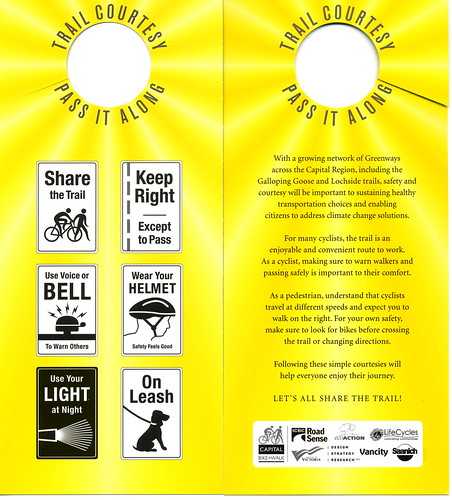
Trail (shared use path) courtesy tips

from Rebuilding Place in the Urban Space by Richard Layman

For Norm File2473

This is from Victoria BC from John Luton’s Flickr stream. It bugs me to no end that there aren’t “rules/etiquette” signs posted on DC’s Metropolitan Branch Trail. Uniformly I have found that bicyclists ride to the right. But pedestrians are all over the trail, either walking in the direction of traffic or against it.

But since etiquette signs aren’t posted, why should we be surprised?

(Otherwise, I love the trail–other than the lack of adequate signage generally.)


[B’ Spokes: And if there ever becomes a problem the first thing to go up is a 15mph speed limit for cyclists, when keeping all traffic to the right would make a lot more more sense.]
Continue reading “Trail (shared use path) courtesy tips”

Cardin proposes capturing highway runoff

from Maryland Politics by John Fritze
Rain water that rolls off new or newly renovated federally funded highways would be collected and treated for pollution before it reaches nearby waterways under a bill introduced this week by Sen. Benjamin L. Cardin.
Heavy rains wash tailpipe emissions, brake dust, oil and other pollutants off highways and ultimately into drinking water supplies, Cardin’s office said Thursday. The bill, similar to legislation the Maryland Democrat introduced last year, would require the U.S. Department of Transportation to develop design standards for how to address the problem.
There are more than 985,000 miles of highway in the United States. During a hearing last year, Cardin said that every inch of rain that falls on a mile of two-lane highway produces 52,000 gallons of polluted runoff.
“Stormwater is the largest source of water pollution in our nation,” Cardin said in a statement. “We must design and construct roads in ways that address contaminated highway runoff at its source, reducing the chance of flash floods and stopping pollution before it reaches the waters of the Chesapeake Bay.”
Cardin, a longtime proponent of addressing runoff issues, is a member of the Senate Environment and Public Works Committee and chairs a subcommittee on water and wildlife. It’s not clear how much his proposal would cost. [B’ Spokes: It is also not clear how much not doing this costs.]
Continue reading “Cardin proposes capturing highway runoff”

Keep Left

by Jeffrey Marks

The picture shows the bike lane on the right-hand side of St. Paul Street abruptly ending at Mount Royal Avenue, where traffic exiting the JFX merges onto Saint Paul (“Where the Bike Lanes End,” Feature, April 20). But perhaps the better choice would be to place the bike lane on the LEFT SIDE of St. Paul. That way the cyclist could avoid this hazardous traffic merge. Other advantages of a LEFT SIDE bike lane would be not having to deal with buses that are constantly pulling to the curb to drop off and pick up passengers. And drivers exit parked cars onto the sidewalk instead of the bike lane.

At the April 18 Bicycle Meeting at Johns Hopkins University, City Bicycle Planner Nate Evans indicated that he is leaning toward placing the bike lane on the left side of Maryland Avenue once the street is repaved. Why the left instead of the right? To avoid the hazard at Lafayette, where cyclist John Yates was killed by a right-turning tanker truck. Also to avoid conflicts at Franklin Street, where right turns are authorized from both the right-hand and right-center lanes. I look forward to the city carefully evaluating, when designing bike lanes, which side of a one-way street works best for bicyclists. Maryland law provides an exception, when operating on a one-way street, to our state’s general rule for cyclists to keep right. And other cities, like New York City, often have bike lanes on the left-hand side of a one-way street.

Lastly, a bike lane is no substitute for paying attention and evaluating whether to use the bike lane or roadway. Bike lanes work best when the road follows a stream, railroad track, freeway, etc., where right-hand turns aren’t authorized. Bike lanes are new to Baltimore, and motorists haven’t been instructed to slow down and merge into the bike lane behind the cyclist when preparing to make a right-hand turn. Consequently, bicyclists need to be alert. When a motor vehicle pulls beside you but doesn’t complete the pass or passes and slows down, WATCH OUT. The motorist may be preparing to make a right turn. The safest thing is for you to slow down, and when safe pull directly behind the motor vehicle, preparing to stop if the vehicle slows down further or turns right. And there are downhill bike lanes, where right-hand turns are authorized, that I leave the bike lane and use the regular traffic lanes. The University Parkway downhill bike lane north of 39th Street, where cyclist Nathan Krasnopoler was critically injured by a car turning right into Broadview Apartments driveway, is the tragic but classic example of why the bike lane isn’t always the safest place to ride.

Jeffrey Marks

Baltimore
Continue reading “Keep Left”

Bowie City Council Approves Overtime, New Bikes for City Officer

By Mimi Rauck
With one dissenting vote, the City Council Tuesday approved a request from Police Chief John Nesky to add $38,240 to the budget to put more bicycle officers on patrol.
Nesky proposed using two officers for seven hours a day on an overtime basis. In addition, the city would purchase four new police bikes at $2,000 each. The overtime funds would be used over the next two summers.
The officers would patrol areas throughout the city, including the city’s many trails, according to Nesky.

Continue reading “Bowie City Council Approves Overtime, New Bikes for City Officer”

Planet D.C.: Rising Gas Prices + Rising Transit Ridership = Cut Transit Funding

by Ya-Ting Liu

Congress returned to work this week just in time for a new round of political football over soaring gas prices, which have topped over $4/gallon in our region. Two weeks earlier, President Obama ordered a Department of Justice task force to “make sure that no one is taking advantage of the American people for their own short-term gain” by investigating the role of traders and speculators in oil markets. The House majority is laying the ground work to move two bills that will expand domestic oil and gas production while Senate majority leaders are planning to introduce a bill to repeal tax subsidies to oil companies.

As the President, the House and Senate majority leaders scramble to address rising gas prices, Americans are doing what they did when national gas prices rose to over $4/gallon in 2008: they’re driving less, buying smaller cars, and turning to transit. Type in “transit ridership” in Google News and one will see reports of upticks in transit ridership across the country, from large cities to small towns (Pierce County, WA; Lake Tahoe, CA; Palm Beach, FL; Luzerne County, PA; Nashville, TN; Montrose, CO; Valparaiso, IN to name just a few).

Unfortunately for those turning to public transportation for a reprieve, they’re most likely experiencing a system that has been cut to the bone in the past 18 months as lawmakers in D.C. stood by. Not only did the 111th Congress fail to pass the Public Transportation Preservation Act of 2010, which would have provided emergency federal funds to restore and maintain transit service across the country, the 112th Congress has recently slashed transit funding as a way to curb federal spending. More could be on the way. The House Budget Committee recently passed Congressman Paul Ryan’s proposal for fiscal year 2012 that would slash federal transportation spending by 30%, bringing it from $50B/year to about $35B/year. According to an analysis conducted by House Transportation & Infrastructure Committee minority staff, the tri-state region would lose over $1 billion in federal transportation dollars and 38,515 jobs.

Continue reading “Planet D.C.: Rising Gas Prices + Rising Transit Ridership = Cut Transit Funding”