
[B’ Spokes: It is my opinion that allowing right-on-red and/or the complete lack of enforcement requiring a complete stop on the part of motorists is a significant contributor to Maryland’s high pedestrian fatality rate. As the article implies if we have a duty to make sure a driver sees us (either legally or just not to be run over) then it makes sense to cross mid-block where there is fewer turning movements by motorist. Or more simply, by not enforcing bike/ped rights they get lost.]
********************************************************************************************************************************
By Rick Bernardi, J.D.
I went for a cup of coffee this morning. I walked down to the corner crosswalk, and waited for the light to change so I could cross. It would have been a shorter trip to just jaywalk across the street, but it seemed safer to use the crosswalk. So I waited for the light to change, and it did, but not before one last motorist rushed to get through before the light changed. And then another motorist blew through the red light—blew, not rolled, through the red light—and turned right. This motorist probably never even saw me waiting to step into the crosswalk, because although she was turning right, she was looking left, over her shoulder, for oncoming traffic. I waited for her to finish her illegal move, said “nice stop” to no one in particular, and stepped into the crosswalk.
I didn’t get hit by this driver, because I’ve come to expect that behavior from motorists. Virtually every driver I’ve ever seen waiting at a stop to make a right turn looks over their left shoulder for an opening in traffic, and when there is an opening, the driver turns right, still looking over their left shoulder. They never look right to see if a pedestrian is in the crosswalk, approaching from their right.
Well, almost never. Some drivers do look right as a kind of afterthought, but clearly their minds are focused on not getting hit by oncoming traffic. It almost never really occurs to drivers that there might be somebody legally in the crosswalk- somebody who has the legal right of way, and to whom they must yield before turning. And because this never even occurs to most drivers, it never occurs to them that they are required by law to look in the direction they are turning. Sure, they might give a quick glance to the right, before turning back to oncoming traffic with a laser-like focus. And then they turn, without ever having checked to see if they’re turning into a pedestrian who is on their right.
I know this, so I never assume that they will look. Instead, I delay crossing in front of these drivers until I they have indicated that they see me and are yielding the right of way. I don’t do this because I have a legal obligation to stay out of their way; I do it because I know with virtual certainty that they will not observe their legal duty to look in the direction they are turning.
Well, that’s me, but what about a child who is legally crossing in a crosswalk? Should we expect them to do this ridiculous “do you see me” dance with drivers? Or should we expect drivers to do their legal duty and look in the direction they are turning? I was reminded of this by a brief news item out of Middle Valley, Tennessee, where it was reported that a young cyclist was hit by a vehicle while crossing in the crosswalk. According to the report, the driver stopped at an intersection, and “after looking both ways, he turned right and struck a juvenile rider.”
Here’s the thing about this collision: I believe that the driver didn’t intentionally turn into the young cyclist. I believe that he didn’t see the child, and I believe that he looked both ways. What I question is whether he was looking in the direction of his turn when he made his right turn. If he had been looking right, he would have seen the child enter the crosswalk. He saw one other cyclist cross before he made his turn, but then, inexplicably, when he turned right, he hit a young cyclist he never saw. Based on my own experiences in crosswalks, I’m guessing the driver did what virtually every driver does—he turned right while looking for oncoming traffic over his left shoulder. And then he hit a child who doesn’t have the traffic experience to know that drivers always do this.
Of course, cyclists (and pedestrians) also have a duty not to enter the crosswalk when it would be impossible for a driver to yield the right of way. So, for example, if the driver has already proceeded to turn, it would not be legal to suddenly dart into the crosswalk, on foot or on bike. However, despite this duty for cyclists and pedestrians, the driver has still has the duty to look in the direction he is turning while making his turn.
Thus, even when the cyclist has a duty to be careful entering the crosswalk, the driver still has a duty to be careful when turning. Nevertheless, regardless of whether the cyclist was riding lawfully, some will attempt to blame the cyclist. It happened in 2009 in Los Angeles when a cyclist entered a crosswalk and was killed by a driver making a right turn. The conclusion of the LAPD accident investigator was that the cyclist was the “primary cause” of the collision because it is against the law for cyclists to ride on the sidewalk against traffic, and it is against the law for cyclists to ride in crosswalks. The only problem with that conclusion is that the LAPD officer was wrong on the law on both counts. In California, it is perfectly legal to ride against traffic while on the sidewalk (although local law may prohibit sidewalk riding), and it is perfectly legal to ride in the crosswalk, unless local law prohibits it. The result of this erroneous understanding of the law was that the driver who failed to look right while turning was let off scot-free, while the blame for the collision was shifted to the cyclist who had broken no laws.
And it’s not just law enforcement officers who blame cyclists for the carelessness of drivers. Many cycling safety advocates maintain that it is unsafe to ride on the sidewalk, particularly against traffic at intersections. Whether one agrees or disagrees with this advice, I think to the extent that some advocates seek to shift the blame to the injured cyclist, that’s missing the point. There’s nothing wrong with advocating for safe riding practices. There is something wrong with shifting the blame from a driver who has not observed his legal duty, to a law-abiding cyclist. It comes back to this: Do I have a duty to wait until a driver has seen me before I cross in the crosswalk? Of course not, and if the driver isn’t looking and turns into me, it’s the driver’s fault, not mine. Of course, it’s to my advantage to anticipate that drivers are generally not paying attention, but that still doesn’t absolve the driver of his legal duties to me. And it doesn’t mean that others (including cyclists) who are legally in the crosswalk should be blamed for the carelessness of the drivers who hit them—particularly when that person on a bike is a child who has little real world experience with the actual careless behavior of drivers. Is that what happened here? It’s not clear from the news, but what is clear to me is that there needs to be a careful investigation of the cause of this collision. We need to ask whether the cyclist suddenly darted into the crosswalk while the driver was turning, and we also need to ask whether driver was looking in the direction of his turn as he was turning. The answers to these questions will tell us what really happened.
Continue reading “CROSSWALK COLLISION”
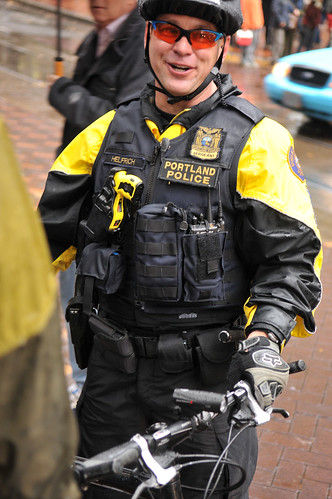
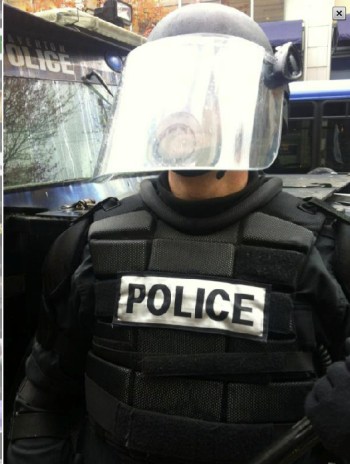
Would more bike cops and fewer riot cops lead to peaceful protests?
Five myths about your gasoline taxes
By Shin-pei Tsay and Deborah Gordon, Specials to CNN
…
1. Americans already pay too much in gas taxes. Not even close.
America actually taxes gasoline less than most other nations. Only two countries—Kuwait and Saudi Arabia—charge lower gas taxes than the U.S. and both are net global oil suppliers, not consumers. The U.S. is the world’s largest oil consumer. By under-taxing gasoline — and thus under-pricing gasoline — the United States encourages over-dependency. Furthermore, the federal gas tax does not even come close to covering the wide array of external social costs of driving cars and trucks.
2. Gas taxes rise every year. Quite the opposite.
The federal gas tax has remained unchanged at 18.4 cents for a gallon of gasoline (and 24.4 cents for diesel) for nearly two decades. It is not indexed to the price of crude oil or inflation, so Americans pay a fixed amount whether oil prices are high or low. Ironically, given today’s debate, the last time the gas tax was raised in 1993 was for deficit reduction purposes. Taking inflation into account, the gas tax has eroded to only 11 cents today. This has seriously diminished the ability to pay for infrastructure, with a purchasing power of 45 cents in gas taxes for every dollar in national highway construction costs. This means that only one-half of the transportation investments made since 1993 could be afforded today, even though GDP has grown 55% and demands (vehicle miles traveled) have grown 29%.
3. Gas taxes are unnecessary because the transportation system is paid for in other ways. Not so fast.
America’s transportation system is going broke. Revenue for the Highway Trust Fund is derived almost entirely from federal gas taxes and distributed to all 50 states. It covers nearly 80% of the capital costs of federally-funded transportation projects, with states carrying the remainder. From 2008 to 2010, Congress transferred $34.5 billion from general fund revenues to make up the funding shortfall. This stopgap measure was necessary to continue projects that are already in the works. Moreover, deferred maintenance—the failure to care for existing roads and bridges—combined with lost productivity are estimated to add more than $100 billion to the national deficit annually.
Over time, technology will help expand mobility options and improve system efficiency. This includes the ability to track real-time data and charge for system use and facilitate trip decision-making through virtual communications — social networking, skype, real-time ride-sharing, and on-line meetings. These 21st-century interactions will bolster economic productivity and competitiveness. But they will take time to mature and, in the near-term, will not obviate the need for travel. Moreover, a dedicated source of revenues, such as gas taxes or other user-based fees, will remain critical to fund and facilitate the transition to technology-oriented transportation solutions.
4. Transportation taxes are detrimental to American competitiveness. Wrong.
The reverse is true when it comes to gas taxes. Investing in transportation facilitates reinvestment in America that is vital to economic growth. The U.S., once No. 1 in the world for its infrastructure, has fallen to 15th. China and India are cruising ahead with transportation infrastructure investments each at 9% of GDP compared to 2% in the U.S. This lackluster level of investment prevails despite well-documented needs—aging infrastructure, growing population, and shifting demographics. An upgraded, well-maintained, operationally-efficient transportation system, on the other hand, offers a significant competitive edge. Plus, the gas tax spreads the burden over hundreds of millions of system beneficiaries.
Beyond system efficiency gains, vehicles themselves are becoming more fuel-efficient and less wasteful. A proposal to double car- and SUV-fuel economy standards by 2025, while highly beneficial in terms of energy will translate into lower gas tax expenditures by higher-mpg cars. The rational way to deal with this is to increase gas taxes slightly over time to account for the fiscal impacts that cleaner, more efficient cars have on transportation infrastructure investments.
5. Gas taxes make an already volatile gasoline market even worse. Partial thinking.
Domestic gas prices are largely influenced by world oil markets. With transportation accounting for about 70% of U.S. oil consumption and record oil-company profits reached when world oil prices go up, it’s only fair that oil companies share the cost of providing transportation infrastructure. Structuring an oil fee assessed on producers and a variable gas tax paid by consumers can further stabilize the price at the pump. When oil prices go up, the retail gas tax can be abated. The oil security fee will make up for the revenue gap. When oil prices go down, the gas tax can be slowly reinstated. There isn’t much that can be done about external events that affect global oil price volatility, but gas taxes can be designed to better manage abrupt price swings domestically.
In short, the transportation system is a critical component of America’s economy. The United States cannot be a superpower if it starves public investment in infrastructure. Taxes tend to be more politically acceptable when people understand how funds provide benefits. And nobody understands better than travelers that the nation’s infrastructure needs serious improvements. It’s time to face the fact: The gas tax is a good way to invest in America.
Are Complete Streets Incomplete?
[Just section headings.]
********************************
by: Gary Toth
“The desire to go ‘through’ a place must be balanced with the desire to go ‘to’ a place.” — Pennsylvania and New Jersey DOTs’ 2007 “Smart Transportation Guide.”
Rule One: Think of Streets as Public Spaces
Rule Two: Plan for Community Outcomes
Rule Three: Design for Appropriate Speeds
Moving Beyond Complete Streets to Build Communities
Continue reading “Are Complete Streets Incomplete?”
Wrong way sidewalk bicyclist hit
A bicyclist was rushed to the Maryland Shock Trauma Center in Baltimore on Monday night after he was hit by a sport utility vehicle on Chinquapin Round Road in Annapolis.
At 10:13 p.m., police and firefighters were called to Chinquapin Round Road near the Lincoln Park Laundry. There they found a man lying next to his bicycle and the Nissan Xterra that struck him.
Police said the victim was riding southbound on the northbound sidewalk of Chinquapin Round Road and was riding across the cross street when he was hit by the SUV as it pulled into the laundry.
He was flown to shock trauma and his condition became critical en route, police said.
On Tuesday, police said the man was recovering and was likely to be released from the hospital by yesterday.
Continue reading “Wrong way sidewalk bicyclist hit”
Sharing time: Tracking the ‘sharrow’ on city streets
Some thoughts on sharrows by Elly Blue in Grist https://www.grist.org/biking/2011-11-17-sharing-time-tracking-the-sharrow-on-city-streets
 A sharrow in Baltimore. Photo: Elly Blue
Plan proposes 34 miles of bicycle routes around Annapolis
[B’ Spokes: Historically Maryland gets $1 million a year just for trails like this (Recreational Trail Program) but sadly MDOT’s made up policy says no we don’t want to fund trails like this and we don’t want to put out any public accounting on how we spend a million bucks. Ref https://www.baltimorespokes.org/article.php?story=20100430170721104 ]
********************************************************************************
By Andrea F. Siegel, The Baltimore Sun
An off-street bike trail links Truxton Park in Annapolis to the Bates Sports Complex. A bicycle lane runs along Edgewood Road between the Back Creek Nature Park and Bay Ridge Road. A snippet of shared bicycle-motor vehicle lane cuts the angle from Bladen Street to Northwest Street.
There are six miles of trails in the city, but few connections between them, and almost no markers to point out routes to popular destinations.
The city council is considering a plan to create a network of 34 miles of marked bicycle routes: a mix of bike lanes on city streets, shared-use lanes for drivers and cyclists, and off-road paths.
In addition to routes that avoid the busiest sections of major roadways, said Iain Banks, the city’s personal transportation and parking specialist, the plan also includes safety and educational programs, promotion of bicycling, links to other forms of transportation and bicycle parking.
Bicyclists praised the plan, an 86-page document that lays out a long-term strategy, and officials say the point is to create an environment that allows bicycles to be used safely for transportation and recreation.
But the larger issue may be whether the cash-strapped city will be able to implement it. The price for turning the plan into reality is $2 million in the first five years, with a total of $3.4 million over a decade.
…
Continue reading “Plan proposes 34 miles of bicycle routes around Annapolis”
Sucking It Up In Winter
Some winter bike commuting advice: https://www.commutebybike.com/2011/11/18/sucking-it-up-in-winter/
Leopold Seeks Input on County Pedestrian/Bicycle Plan Update
County Executive John R. Leopold has started a comprehensive study of pedestrian and bicycle facilities in the County’s suburban and urbanized areas and has called upon citizens to become part of the process by attending public meetings and/or applying for appointment to the Citizens Advisory Committee.
The study aims to identify deficiencies in the current network of sidewalks, trails, on-road travel lanes, crosswalks, etc. and develop a systematic way to prioritize improvements as funds become available or as development occurs. The study will focus primarily on accommodating day-to-day transportation activities, such as travel to work, school, libraries and shopping.
Approximately 80% of the study is funded through a Federal transportation planning grant and it is expected to take about eighteen months to complete.
"Walking and bicycling are alternate modes of travel that should be encouraged and supported within our infrastructure," said Mr. Leopold. "This study will identify areas where improvement is needed."
In the meantime, the study will help the County identify those important projects that can be undertaken with limited resources and will serve as a guide for projects constructed by developers and Federal and State funding opportunities.
In addition to conducting a series of public meetings, the County Executive will appoint a Citizens Advisory Committee (CAC) who will work with the Office of Planning and Zoning (OPZ) and project consultant to provide ongoing citizen and community perspective.
OPZ will announce dates and locations for three public listening sessions in order to solicit citizen input regarding the presence, adequacy or lack of pedestrian and bicycle facilities and amenities in their communities. Members of the public who wish to apply for an appointment to the Citizens Advisory Committee should contact the Office of Planning and Zoning, Transportation Division.
Continue reading “Leopold Seeks Input on County Pedestrian/Bicycle Plan Update”
ICC director appointed to lead state highway agency
[B’ Spokes: Since Neil Pedersen was bike friendly, we hope Melinda Peters well be as well.]
***********************************************************************************************************************************
"[Melinda] Peters replaces Neil Pedersen, who retired in the summer as state highway administrator."
https://www.washingtonpost.com/local/commuting/icc-director-appointed-to-lead-state-highway-agency/2011/11/17/gIQAtW6lVN_story.html?socialreader_check=0&denied=1