
By Heath Urie Camera Staff Writer
…
By far, the most common danger to cyclists in Boulder is drivers making turns within intersections. Turning vehicles were the cause of 40 percent of all bike-vehicle crashes during the study period. In about 10 percent of the cases, a driver was making a right turn on a red light.
"That is a big deal," Estes said. "There’s definitely times when people are looking to the left and start pulling out and I have the right-of-way."
…
The Safe Streets report shows that drivers were far more likely to be found at fault in accidents involving pedestrians or cyclists.
Among accidents involving bikes, the driver of the vehicle was cited 41 percent of the time, while the cyclist was only cited about 24 percent of the time. Neither party was ticketed in 31 percent of the cases, and both the driver and the rider were at fault only 4 percent of the time.
…
The study also found that pedestrians darted out into traffic far more often than cyclists. People who dashed out in front of vehicles accounted for about 14 percent of collisions involving a pedestrian, but cyclists who illegally rode through a traffic signal accounted for only 2.3 percent of bike-related accidents.
…
He said the most frequent cause of traffic accidents in Boulder "by a long shot" is drivers who follow too close and rear-end other vehicles.
…
City baffled by summer drop
The study also poses something of a mystery for city officials.
The report revealed — not surprisingly — that as the weather warms up, more people in Boulder take to riding their bike. But the study also found that the number of accidents involving bikes goes down in May, June and July.
Cowern, the traffic engineer, wasn’t certain why that is, but the smaller population of students over the summer could be part of the reason.
He also speculated that as the number of people on bikes reaches a certain point, drivers become so aware of them that behaviors change and accidents decrease. That’s a tantalizing theory for a city that prides itself on getting people out of their cars.
…
Continue reading “Boulder study sheds light on bicycle, pedestrian accidents”
Master plan to make [Ocean] city desirable for year-round residents
by Ann Richardson, Ocean City Gazette
…
He said the city must adopt a complete streets policy: a “comprehensive, integrated, connected multi-modal transportation system” throughout the city to facilitate safe, attractive and efficient movement and access for everyone. The planning board, Scheule said, is looking to encourage pedestrian and bicycle traffic.
…
Continue reading “Master plan to make [Ocean] city desirable for year-round residents”
What Is Car Culture Doing to Our Children?
By KJ DELL’ANTONIA, New York Times
…
“Children,” Dr. Jackson told Jane E. Brody for The Times’s Well blog, “who grow up in suburbia can’t meet their life needs without getting a ride somewhere.”
For me, and I’m sure for many of you, those are slightly chilling words. The amount of time my children spend in a car being driven somewhere isn’t about being overscheduled or my hovering tendencies (although we could certainly discuss those things). It’s about the fact that unless I drive them, they’re limited: to one friend, whose mother has often already driven him somewhere else, and to the entertainment that’s to be found in one another and in the woods and fields around us. There are no sports, no movies, no after-school activities without my help.
We didn’t precisely choose this …
On the Well blog, Ms. Brody writes in her article “Communities Learn the Good Life Can Be a Killer,” … individual families like mine need to look at how we’ve structured our own lives around the expectation that we’re going to be constantly hopping in the car.
…
Continue reading “What Is Car Culture Doing to Our Children?”
Adventure Cycling Association’s 3rd Annual Bicycle Travel Photo Contest Winners

Ask your doctor. . .

Local and his bike
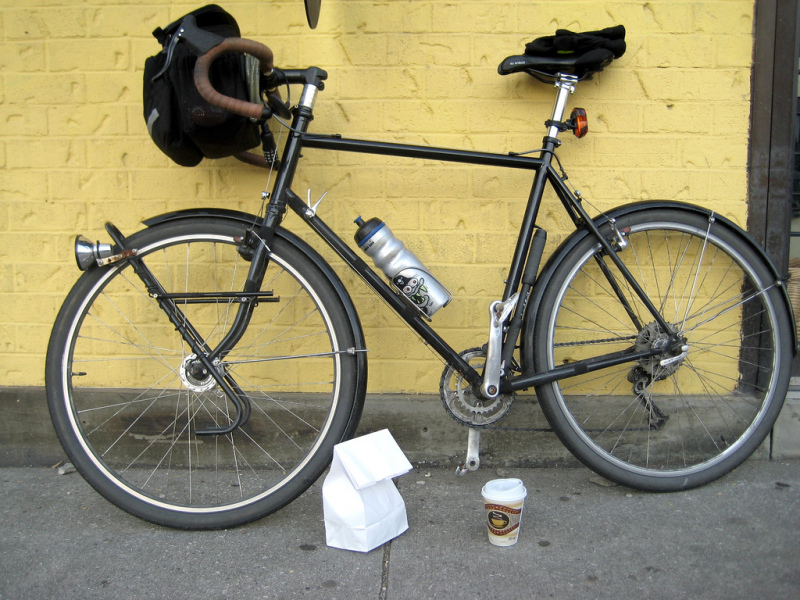
B’ Spokes: There is just something about this that says Baltimore cyclist to me.
To read more about Bob and his bike: https://chasingmailboxes.wordpress.com/2012/02/02/bikes-to-like-bob-w-s-kogswell-porteur-randonneur/
10. If your bike could talk, what is one thing it would say to you?
“Let’s see what’s up ahead.”
Bike Ride to Honor the Memory of Nathan Krasnopolar
Sunday, February 26, 2012, 5:00 PM
Broadview Apartments
116 West University Parkway, Baltimore, MD
This ride will start and finish at the site of Nathan’s accident one year ago. Route to be determined, but, most likely, the route will include Mt. Royal Ave. We will finish in time to join the Candlelight vigil being held by his family and friend.
RSVP https://www.meetup.com/Biking-in-Bmore/events/51251752/?a=ea1_lnm&rv=ea1
Creeps and Weirdos: The Auto Industry Agenda for Keeping You on Four Wheels
By Larry Cohen, Nation of Change (see the original for hyper links for more background)
Recently, Dr. Richard Jackson, a friend and colleague (a leading expert in health and the built environment) received a letter from his building’s management demanding he move his bike – from leaning against the wall of his rented parking spot. Though he lives in LA, he doesn’t own a car; his bike is his transportation. According to management, his bike posed an affront to the “safety, cleanliness and accessibility of the building” – meanwhile, the other tenants’ cars apparently raised no such concerns.
“The car is still king – from parking lots to roadways. And car companies intend to keep it that way.”
…
But, the auto industry’s profits depend on making sure that cars remain the standard mode of transportation – and that car companies grow their customer base, not lose them to bicycles. Auto companies are fueled by profits, and the auto industry spent over $45 million last year alone on lobbying Congress and other federal agencies in order to maintain a monopoly on our roadways. The auto industry makes money by ensuring that the public values driving and that roads are built for cars alone – even if this means greater demand for fossil fuel, increased environmental degradation, fewer opportunities for physical activity, and more road-related injuries.
They’ve gone beyond lobbying, releasing a spate of ads recently – many in college newspapers – that hone in on bikers and imply that alternatives to driving are humiliating or dangerous, and generally bad for communities – despite growing evidence to the contrary. Shame becomes the bargaining chip in GM’s recent ad depicting a biker, embarrassed to be seen by girls who are driving in a car. Another ad shows a bus with the destination sign reading "creeps and weirdos." But this campaign strategy makes no sense. Regular drivers benefit, too, when more people take alternate modes of travel. It means fewer cars will be on the road, which lowers the incidents of traffic crashes and helps to increase safety overall.
And, despite what these ads would have you believe, biking and active transportation are a solid investment in health, communities and prevention. Bikes could save our nation as much as $3.8 billion a year by promoting physical activity, decreasing chronic disease and reducing healthcare costs. An increase to 15% active transportation in the Bay Area would result in 2,236 fewer deaths, and a gain 22,807 total years of life. Bike commuting costs as little as five cents per mile, reduces water and noise pollution, road wear and traffic congestion. In Portland OR – known for its biking culture – researchers found that bike-related industry contribute significantly to the local economy – providing somewhere between 850 to 1150 jobs and generating about $90 million a year. A new report shows that bikes saved Iowa $70 million in healthcare costs, and generate $1 million each day.
And more people are biking. Nearly half of 18 to 34-year-old drivers are driving less and owning fewer cars. Equally important, nearly two-thirds surveyed said they would drive less if alternative transportation, such as public transportation, was available. In urban centers across the country, biking has enjoyed a re-birth of hipster cool – from fixies to cyclovias to bike rack art installations to Oakland’s scraper bikes that ‘go hard, I don’t need no car.’
This is great news for bike enthusiasts, environmentalists and public health advocates, but we need our street infrastructure to support physical activity. Roads designed for cars – and only cars – have real impacts on our health and safety. A recent report found that the number of combined biking and pedestrian traffic deaths has increased in the last two years to 14%. This is an appalling but preventable outcome, likely stemming from more people walking and biking without changes to the built environment and structural support.
…
Investing in cheap, proven solutions to improve health and the economy should be a top priority for our country. It’s time to think differently – to stand up to those who still say the car is king, and to create a new norm that is in harmony with the environment and our health. In order to do this, institutions need to support cyclists by providing bike racks, and not penalize them for locking bikes in parking lots. Cities can implement Complete Streets policies and include the needs of cyclists and pedestrians when plotting intersections and roads. But in order to do this, we also need support from the federal government – not for Congress to cut entirely federal funding for biking and walking. And we need car companies to value health over profits, and work with communities – not against them – in finding solutions.
Continue reading “Creeps and Weirdos: The Auto Industry Agenda for Keeping You on Four Wheels”
If this is wrong thinking…

Then why do so many Road “Engineers” think they can do the same with bike/ped traffic and just have them disappear by lack of facilities?
Continue reading “If this is wrong thinking…”
seriously, MoCo [and others] really needs young people to stick around
by Dan Reed, Silver Spring, Maryland
…
What I found most striking was the drop in the county’s young adult population. According to the Planning Department, Montgomery County has 15% fewer adults between the ages of 15 and 24 than we did in 2000.
…
"What" draws young people is pretty simple: Jobs, reasonably priced housing, short commutes, proximity to shopping and entertainment, and increasingly, neighborhoods where you can walk/bike/take transit instead of driving. The "how" is more challenging. But we should start going after those solutions now rather than waiting until it’s too late.
https://www.justupthepike.com/2012/02/seriously-moco-really-needs-young.html