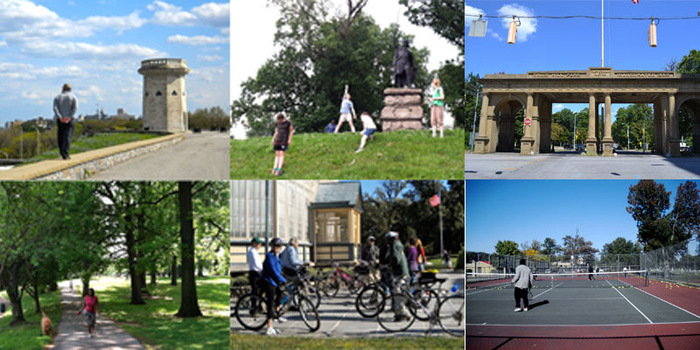
Kickstarter: Druid Hill Park Passport: Discover; Enjoy; Learn; Be active!

About this project

Druid Hill Park Passport 
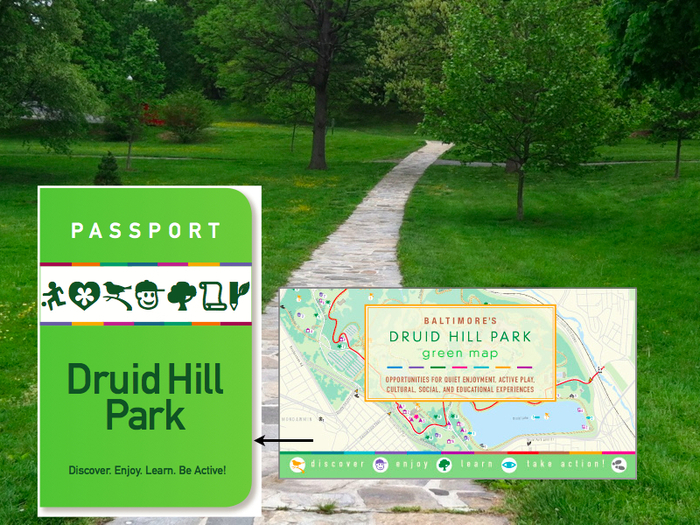
When Baltimore Green Map created the tantalizing, informative Druid Hill Park Green Map, we set aside 5000 maps for this Passport project. Why? Because it’s one thing to learn about a place by reading a map, but our goal is to have more people experience more aspects of the park, to visit it frequently, and ultimately become advocates for maintaining and improving it.  “Discover. Enjoy. Learn. Be active!” covers the sequence we hope to inspire. This Kickstarter will fund activity refinement, graphic design, and printing of 5000 passports

The Passport, accompanied by the DH map, will be a guide to this wonderful 745-acre park in the center of Baltimore, Maryland. It will contain 16 pages of activities to help you get to know the park through experiences around the themes: Nature, Exercise, History and Culture.  With each activity you will record the results, then bring the passport to the Conservatory to get it stamped. Actually observing, listening, walking, running, playing, relaxing at places throughout the park, then recording, composing, drawing, imitating, exerting, imagining….how can you resist becoming a Druid Hill Park fan? Passport + map will be available for free at places and events in the park and by request.
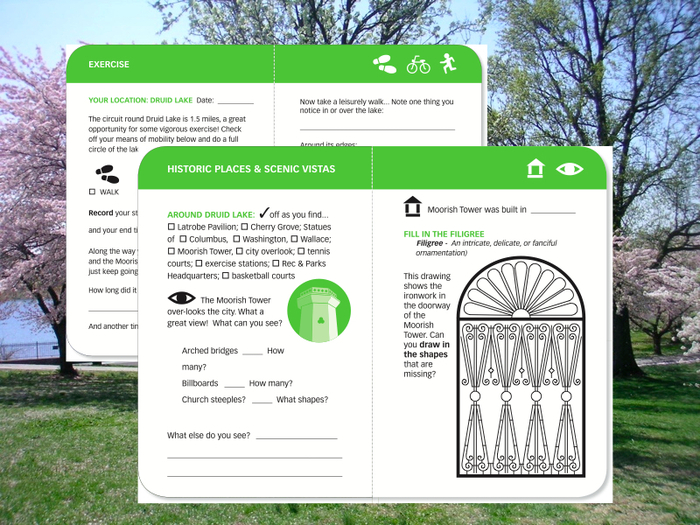
Key to this project is our use of the international Green Map® icons to signify the resources in the park and to be the actual stamps. I started Baltimore Green Map as the local mapmaking affiliate of this international network. I wanted to “map the positives” here in Baltimore, the places that contribute to making this such an interesting and livable city. We look forward to sharing this project as a model for other Green Mappers, now active in 63 countries worldwide, mapping what makes communities livable and sustainable.

We are testing ideas now with Friends of Druid Hill Park members, park-enthusiast families, and willing neighbors to be sure the instructions are clear and the activities engaging. Our graphic designer, Elizabeth Gething, has created some fine sample pages! 

Our Incentives

The Passport is very much a collaborative project. Advocates and stewards of the park are pitching in to offer a wide variety of incentives.  You can choose rewards that highlight any of our themes – nature, exercise, history & culture – or just feel good that you are helping.  We will invite you to a celebration at the very wonderful Rawlings Conservatory when the Passport is completed, but will send it out if you cannot attend. 

Even if you don’t live in Baltimore, you will love the map, created in collaboration with graphic designer Joanne Cooper Wingard. It was featured in the most recent Cooper Hewitt National Design Triennial exhibit.

I’m grateful to my Passport partners – the Friends of Druid Hill Park, the Rawlings Conservatory staff, Disc Golfers, and Baltimore City Recreation & Parks Department.  Huge thanks to Chris Hartlove who helped me create our video, to Harlan Brothers for use of his music, “Secret Song,” and to you Kickstarters who help us complete this project!


Click here to be a supporter!

Has the U.S. Reached "Peak Car"?

B’ Spokes: This article in Scientific American has a lot of interesting points but I would like to comment a bit about their subtitle "Traffic is easing as more Americans are deciding to drive less, sell their cars or not buy one at all"
My comment is to contrast "a 1.2 percent decline in vehicle miles traveled (VMT) last year" with "traffic congestion in the United States fell by 27 percent last year". While exactly what is cause and effect is still under consideration I still want to point out for consideration that just a small reduction in VMT results in larger relief of congestion. This is due in part because once a roadway is at the saturation point of maximum traffic the addition of just a small amount traffic cause a cascading delay effect (think of one person hitting the brakes on a crowded highway and then all those behind are now also hitting the brakes), a catastrophic failure (think grid lock but something similar happens once people have to wait more then one cycle for a light causing more and more people to wait in the queue at each cycle) or just a "simple" traffic accident (happens on average every 5 minutes in Maryland and "accidents" are the MAJOR cause of traffic delays.)
The short of it is our road designs cannot gracefully handle additional traffic above a certain threshold, they fail and they fail severely. I will assert that’s why just a small reduction in VMT will result in a larger reductions of congestion.
My point in bringing this all up is because we cannot afford to build enough roads to have congestion free driving. But we can afford to provide alternate transportation to keep travel times for all at tolerable levels. And that’s the question we should be asking, are travel times at a tolerable level and forget about congested roads (they are inevitable.) And on this point I will assert average commute travel time of around a half hour is tolerable and the "worst" of 5 more minutes* is not that big of a deal. Of course we should try and improve this but the main thrust should be on alternate transportation (not more road projects at the expense of alternate transportation) as that will yield the most bang for the buck.
The Scientific American article: https://www.scientificamerican.com/article.cfm?id=has-us-reached-peak-car-americans-driving-less
Continue reading “Has the U.S. Reached "Peak Car"?”

Halfway

On the transportation bill, Republicans agreed to drop two issues that have nothing to do with transporation (the Keystone pipeline – an issue of their own creation – and the EPA coal ash regulations) and in return Democrats “gave up on $1.4 billion for conservation and agreed to allow states more leeway in how they use money that was once mandated for landscaping, bike improvements and pedestrian walkways” much of which is directly related to transportation. This from a bill that was already a compromise with Senate Republicans. So Democrats gave into Republican demands not once, but twice, and somehow Barbara Boxer can say with a straight face ““I am so glad that House Republicans met Democrats halfway.” I’m sorry to tell you, but that is not halfway. If she thinks it is, then I would love to sell her a used car.  

Via The Wash Cycle

What is Baltimore Bike Party? [video]

Come ride with all your friends the last Friday of every month.
Join the Baltimore Bike Party group here…
https://www.facebook.com/groups/275878782500783/

And join us for the June 80's ride here…
https://www.facebook.com/events/318284521587946/

Thanks to Nate Evans for the additional shots!

All shot with a GoPro Hero HD

Music – Spitfire, Unison (Knife Party Remix)
– Airwolf Theme
-Matthew Wilder, Break My Stride

Continue reading “What is Baltimore Bike Party? “

Lack of connections, visibility hurt ICC Trail

Less than a year old, the Intercounty Connector Trail offers a new way to get across Montgomery County by bike. However, a circuitous route, a lack of connections to surrounding areas, and sections with poor visibility all hurt its potential.


Not surprisingly, area bicyclists were unhappy with the decision. “Why do designers think cyclists should have to go the long way, but cars need a direct route?” asked WashCycle.

https://greatergreaterwashington.org/post/15381/lack-of-connections-visibility-hurt-icc-trail/


[B’ Spokes: It may be of interest on how we got to this point.

The ICC Was A Fast Tracked Project

The problem the government looks at the length of the planning process as an unnecessary expense (this is evident in the new Transportation Bill and the “streamlining” of the timing of the environmental review process. When it should be looking at the quality of the results. It should be intuitive but there are studies that show that the more you involve the public the better the outcome of the project. Does this take longer? Sure but it gets better results which is a lot better then one under used road putting a strain on our road budget for years to come.

Defend, defend and defend

While no planning agency says this is their policy it has become very apparent (in Maryland at least) that this is the state’s policy. I say that because by the time a project comes up for public comment it is too late to go back and make changes as that will take more design time and there is no budget for that. So the public’s only option is to accept or reject the plan as given. It is my opinion one of the mistakes the cycling advocates made was to request minor tweaks to the original design of the ICC rather then just saying “This design is unacceptable so it has to be scraped in it’s entirety.” Which may sound a bit extreme but certainly less extreme then the state’s assertion “a highway is not an environmental problem, but a bike path is an environmental problem.” So my advice for future advocacy efforts, no more mister nice guy, if the project design is unacceptable, it is unacceptable, end of story even if it can be easily fixed. Our policy should be to demand that they fix the plan first or we come out against the plan. (Just to note some local planners are easier to work with then the state, so use your discretion when working with local projects. I will also point out the irony of it’s harder to work with the state with their bigger budgets and with more year end left over funds then with locals with tighter budgets because I will assert there is a greater need to be responsive to the public at the local level then at the state level. )

Stick your fingers in your ears and hum real loud syndrome and the impact on MBPAC

While this is directed at the previous administration [Ehrlich (Governor) and Flanagan (Secretary of Transportation)] I remain concerned vestiges of this attitude remain within MDOT. There is nothing about the current observations of the ICC and its trail that were not known before the project ever got approved. So why did they go ahead with it anyway? I can’t answer that but I can point to an issue that hindered getting a full and complete trail as envisioned by master plans.

While the concept of having members from different state agencies on Maryland Bicycle and Pedestrian Advisory Committee (MBPAC) sounds like a good one, the gotcha comes in can a state employee vote against the policy of the Governor? With that in mind MBPAC intended to send a message to MDOT that this convoluted mix of on and off trail route + indirect circuitous routing of a bike “trail” was not a full and complete trail as envisioned by master plans. But that got nixed very effectively by the state by threatening to fire any state employee who voted in support of trying to fix this so called “trail” that we got. So instead of MDOT getting just one vote it got 9 votes by this tactic. (I will also note that when the vote took place few general public members of MBPAC were present.)

With any planning just on paper one group can say one thing and another group can say the opposite but here we are with things mostly in place and guess what, Ehrlich and Flanagan got it wrong and used excessive force in trying to ignore public/advisory committee’s input. Perhaps if MBPAC amended its bylaws so members could vote the way they feel best and still be secure in their jobs to avoid this from happening again would be a good place to start.
]

Postcard from Crested Butte: Bicycles as form and function

By David T. Whitaker, AICP, Smart Growth Maryland

Another interesting observation about Crested Butte is that most bicycle traffic does not occur on trails or even on sidewalks in the town. Adults and children alike ride their bicycles down the middle of streets in Crested Butte. Although some trails exist in and around the town, bicyclists of all ages in Crested Butte ride primarily on town streets. This public acceptance of bicycle travel is a continuation of a town tradition where bicycles are considered functional transportation.
This was not entirely by happenstance. This was the result of policy decisions made by town elected leaders, planners and park and recreation staff. Enhanced bicycle activity in the town supports Crested Butte’s reputation as one of the original locations in the development of the mountain bike. It says to visitors: “If you come to Crested Butte, bring your bike.” Therein lays a story unique to this Colorado community. Town officials in Crested Butte value human travel higher than they do motor vehicular travel.

https://smartgrowthmd.wordpress.com/2012/06/28/postcard-from-crested-butte-bicycles-as-form-and-function/
******************************************************************************************
B’ Spokes: I’ll note I miss our rides with the Mayor, I believe it is the political connections that can make biking mainstream.