Surprising Aspects of Florida Maryland Pedestrian Laws
By Mighk Wilson, Smart Growth Planner for MetroPlan Orlando [edited to reference Maryland laws.]
 How well do you know
 Florida’s Maryland’s pedestrian-related traffic laws? If you’re like many folks you have some misconceptions. Here are some little-known truths about pedestrian law. See how well you understand them.
There Is No “Jaywalking” Law
Jaywalking is not a legal term. It is not found in Florida Maryland statutes and has no legal meaning. Jaywalking is a derogatory slang term coined in the early 1920s by automotive interests (only about 10 to 20 percent of street users at the time) during propaganda campaigns to get traffic laws changed in their favor. Their strategy was to put the blame on pedestrians who continued to walk the streets in the way they had for centuries – crossing wherever and whenever they wished – before the automobile became popular. A “jay” was someone from the country who didn’t understand “big city” ways. So a “jaywalker” was someone the city folks could poke fun at for being ignorant. This is well-documented in the book Fighting Traffic by Peter Norton.
Some actions that people call jaywalking – such as crossing against a red light – are illegal. But crossing mid-block, which is also called jaywalking, is not illegal in most locations.
Every Street Has Sidewalks on Both Sides
Well, sort-of. The legal definition of a sidewalk is “that portion of a street between the curbline, or the lateral line, of a roadway and the adjacent property lines, intended for use by pedestrians.” So if there is no paved sidewalk, that strip of grass in the public right-of-way is still a sidewalk. But it may not be a usable one for the pedestrian. Tall grass, landscaping and other challenges could make it unusable.
§ 21-101.(w) Sidewalk. — “Sidewalk” means that part of a highway:
- (1) That is intended for use by pedestrians; and
- (2) That is between:
- – (i) The lateral curb lines or, in the absence of curbs, the lateral boundary lines of a roadway; and
- – (ii) The adjacent property lines.
§ 21-101.(w) Sidewalk. — “Sidewalk” means that part of a highway:
- (1) That is intended for use by pedestrians; and
- (2) That is between:
- – (i) The lateral curb lines or, in the absence of curbs, the lateral boundary lines of a roadway; and
- – (ii) The adjacent property lines.
The roadway is the portion of the public right-of-way intended for vehicles. We all have the basic human right to walk in public spaces, so if we’re not intended to walk in the roadway, we must be intended to walk in the remaining space.
Drivers Must Yield to Pedestrians Who Are Legally In Crosswalks
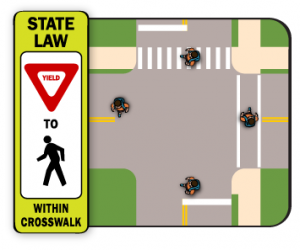
Some people misunderstand the purpose and meaning of a crosswalk, believing it is the only place pedestrians are permitted to cross the street. That is not the case. A crosswalk is where drivers are expected to yield (if possible) to pedestrians. Pedestrians may cross elsewhere, but outside a crosswalk, they are required to yield to vehicular traffic.
§ 21-502. Pedestrians’ right-of-way in crosswalks
- (a) In general. —
- – (2) The driver of a vehicle shall come to a stop when a pedestrian crossing the roadway in a crosswalk is:
- — (i) On the half of the roadway on which the vehicle is traveling; or
- — (ii) Approaching from an adjacent lane on the other half of the roadway.
- (b) Duty of pedestrian. — A pedestrian may not suddenly leave a curb or other place of safety and walk or run into the path of a vehicle which is so close that it is impossible for the driver to yield.
- (c) Passing of vehicle stopped for pedestrian prohibited. — If, at a marked crosswalk or at an unmarked crosswalk at an intersection, a vehicle is stopped to let a pedestrian cross the roadway, the driver of any other vehicle approaching from the rear may not overtake and pass the stopped vehicle.
There Are Crosswalks on All Sides of Every Intersection
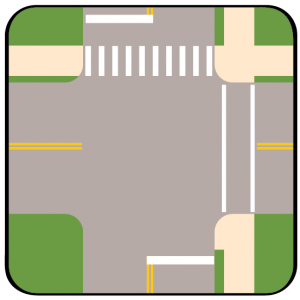
All sides of the intersection are crosswalks — marked or not, regardless of whether the sidewalk is paved or not.
The crosswalk is defined as the continuation of the parallel lines of the sidewalk across the roadway, so since every street has sidewalks, every intersection has crosswalks. The only exception is where a state or local government has explicitly closed a particular crosswalk, and a sign must be placed at such a crossing to indicate it is closed. So this means if you are driving along a road and there is a cross-street, you must yield to any pedestrian in an unmarked crosswalk at that intersection, just as you would yield if the crosswalk was marked. This is true even if you are not facing a stop sign or traffic signal.
§ 21-101.(i) Crosswalk. — “Crosswalk” means that part of a roadway that is:
- (1) Within the prolongation or connection of the lateral lines of sidewalks at any place where 2 or more roadways of any type meet or join, measured from the curbs or, in the absence of curbs, from the edges of the roadway;
- (2) Within the prolongation or connection of the lateral lines of a bicycle way where a bicycle way and a roadway of any type meet or join, measured from the curbs or, in the absence of curbs, from the edges of the roadway; or
- (3) Distinctly indicated for pedestrian crossing by lines or other markings.
The Pedestrian Does Not “Always Have the Right-of-Way”
No-one “has the right-of-way.” The law only defines who is required to yield the right-of-way, or “give way.”
Pedestrians attempting to cross mid-block are required to yield right-of-way to vehicle drivers on the roadway. Pedestrians at crosswalks at signalized intersections must yield if they face a red signal or steady Don’t Walk signal.
[B’ Spokes: While this is true, Maryland law gets complicated because drivers are required not to hit pedestrians.]
§ 21-504. Drivers to exercise due care
- (a) In general. — Notwithstanding any other provision of this title, the driver of a vehicle shall exercise due care to avoid colliding with any pedestrian.
- (b) Duty to warn pedestrians. — Notwithstanding any other provision of this title, the driver of a vehicle shall, if necessary, warn any pedestrian by sounding the horn of the vehicle.
- (c) Duty to exercise precaution on observing child or certain other individuals. — Notwithstanding any other provision of this title, the driver of a vehicle shall exercise proper precaution on observing any child or any obviously confused or incapacitated individual.
Drivers approaching crosswalks – either marked or unmarked – must yield to pedestrians who are legally in the crosswalk and approaching closely enough to be in conflict. Drivers entering a public street from a private driveway must yield right-of-way to a pedestrian approaching on the sidewalk or roadway, just as one yields to other traffic.
Pedestrians cannot enter the crosswalk at any time they wish. One cannot expect a driver to do the impossible, such as coming to a stop from 45 mph in 100 feet. Pedestrians must give drivers adequate time and distance to react and stop.
If Another Vehicle Is Stopped Ahead of You at a Crosswalk…
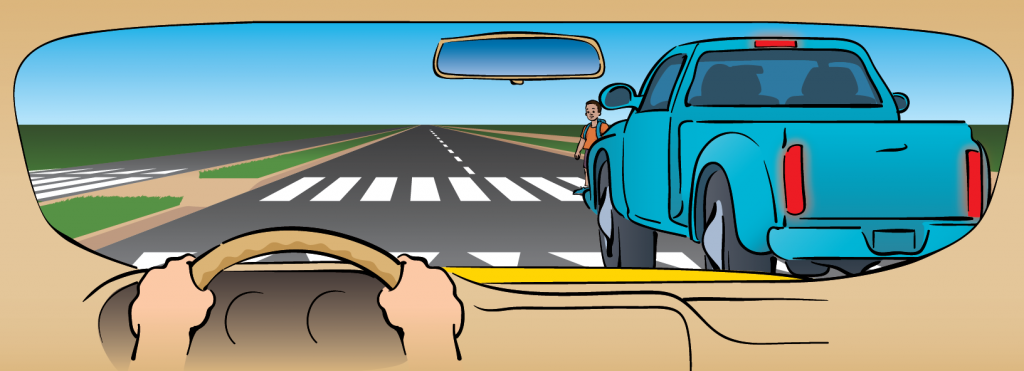
… you are not permitted to pass! Even if you are in another lane. There may be a crossing pedestrian hidden behind that first vehicle. You have to assume a pedestrian is there, and can only proceed once you are sure the crosswalk is clear.
§ 21-502.(c) Passing of vehicle stopped for pedestrian prohibited. — If, at a marked crosswalk or at an unmarked crosswalk at an intersection, a vehicle is stopped to let a pedestrian cross the roadway, the driver of any other vehicle approaching from the rear may not overtake and pass the stopped vehicle.
Crossing Mid-Block Is Legal in Most Situations
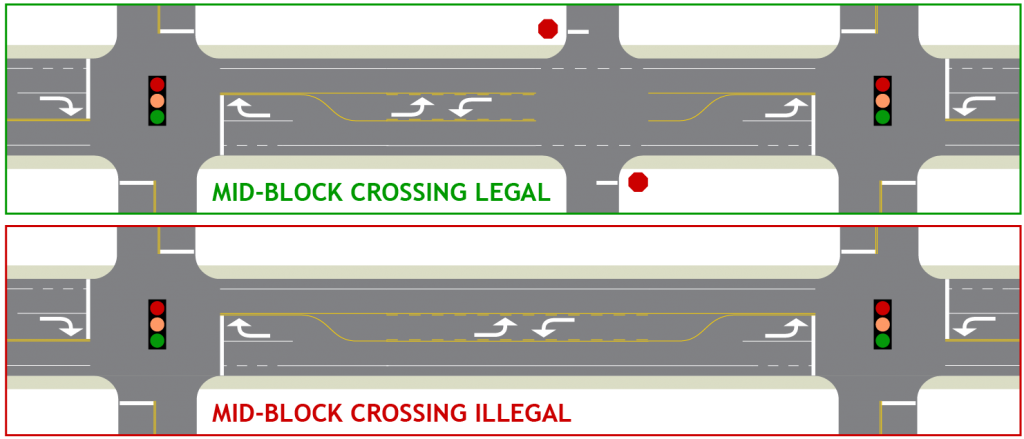
The law says pedestrians may not cross “between adjacent intersections at which traffic control signals are in operation.” So if you want to cross the street between intersections and both of the closest intersections have working traffic signals, then you may not cross, unless there is a marked crosswalk at that mid-block location. If one of the closest intersections does not have a traffic signal, then you may cross, provided you yield to approaching vehicles.
§ 21-503. Crossing at other than crosswalks
- (a) In general. — If a pedestrian crosses a roadway at any point other than in a marked crosswalk or in an unmarked crosswalk at an intersection, the pedestrian shall yield the right-of-way to any vehicle approaching on the roadway.
- (b) Where special pedestrian crossing provided. — If a pedestrian crosses a roadway at a point where a pedestrian tunnel or overhead pedestrian crossing is provided, the pedestrian shall yield the right-of-way to any vehicle approaching on the roadway.
- (c) Between adjacent intersections. — Between adjacent intersections at which a traffic control signal is in operation, a pedestrian may cross a roadway only in a marked crosswalk.
- (d) Crossing intersection diagonally. — A pedestrian may not cross a roadway intersection diagonally unless authorized by a traffic control device for crossing movements. If authorized to cross diagonally, a pedestrian may cross only in accordance with the traffic control device.
The Flashing DON’T WALK Signal Does Not Mean You Can’t Be In the Crosswalk
 It means you cannot enter the crosswalk. If you are already in the crosswalk you can finish crossing. The flashing DON’T WALK phase is timed so that you can make it all the way across at a normal adult walking pace – provided drivers are not cutting you off by turning across your path. This is important for you drivers to know, too. If the pedestrian is in the crosswalk and the DON’T WALK signal is flashing, you still have to yield!
§ 21-203. Pedestrian control signals
- (a) In general. — Where special pedestrian control signals showing the words “walk”, “dont walk”, or “wait” or the symbols of “walking person” or “upraised hand” are in place, the signals have the indications provided in this section.
- (b) Walk. — A pedestrian facing a “walk” or “walking person” signal may cross the roadway in the direction of the signal and shall be given the right-of-way by the driver of any vehicle. At an intersection where an exclusive all-pedestrian interval is provided, a pedestrian may cross the roadway in any direction within the intersection.
- (c) Dont walk. — A pedestrian may not start to cross the roadway in the direction of a “dont walk” or “upraised hand” signal.
- (d) Wait signal — Beginning crossing prohibited. — A pedestrian may not start to cross the roadway in the direction of a “wait signal”.
- (e) Wait signal — Partially completed crossing. — If a pedestrian has partly completed crossing on a “walk” or “walking person” signal, the pedestrian shall proceed without delay to a sidewalk or safety island while the “dont walk”, “wait”, or “upraised hand” signal is showing.
How did you do? How well do you think your friends, family members or co-workers would do? If we don’t have a common understanding of the rules, how can we know what we or others should be doing to keep our friends and neighbors safe?
What likely has some of you nervous now is the idea of having to stop for a pedestrian at a crosswalk with no stop sign or traffic signal along a high-speed arterial. You may be thinking, “If I do that I’ll get rear-ended.” Braking gradually gives the drivers behind you more time to react, so the earlier you brake to yield to a pedestrian, the less chance there is of a rear-end collision. As drivers on arterial and collector streets we have to be prepared to slow or stop at any time – for emergency vehicles, transit buses, school buses, animals, bicyclists, other motorists slowing to turn, and for many other situations.
Our first priority will be getting drivers to yield on lower speed streets and getting pedestrians to clearly communicate their intention to cross. Over time, we can work on getting the same type of good behaviors on our higher speed roads.
Continue reading “Surprising Aspects of Pedestrian Laws”