
-> "The goal for pavement widths on walkable streets is to reduce the pavement in order to encourage slower movements. Conventional street standards are typically designed for a higher ‘design speed’ than the intended ‘posted speed’. Watch for this. Excessive width encourages vehicles to drive in excess of the design speed (much less the posted speed) to the detriment of walkability, bikeability, and ultimately the safety of vehicles themselves. For urban thoroughfares, the design speed should be matched to the posted speed…"
— Geoff Dyer, Better! Cities & Towns
https://bit.ly/Ynz6xU
-> "Who ranks? Cars rank. The sidewalks never get plowed by our elected, tax-supported city government. Clearly it’s not our priority to make it easy to walk. Even though walking is better for our bodies and our planet, and in cities when coupled with public transit it’s the easiest, cheapest, healthiest and overall best way to get around…"
— John Kassel, Conservation Law Foundation
https://bit.ly/15I0Sey
from CenterLines, the e-newsletter of the National Center for Bicycling & Walking.
PARENTS DON’T FEAR KIDS WILL BE OVERWEIGHT ADULTS
-> According to a Mar. 4th NPR story, "About 69 percent of American adults are overweight or obese, and more than four in five people say they are worried about obesity as a public health problem. But a recent poll conducted by NPR, the Robert Wood Johnson Foundation and the Harvard School of Public Health revealed a curious schism in our national attitudes toward obesity: Only one in five kids had a parent who feared the boy or girl would grow up to be overweight as an adult."
"Put another way, assuming current trends persist, parents of 80 percent of American children think all these kids will somehow end up being among the lucky 31 percent of adults who are not overweight…"
Source: https://n.pr/Xs8KRB
from CenterLines, the e-newsletter of the National Center for Bicycling & Walking.
LEFT TURNING DRIVERS CAN’T CONCENTRATE WHILE ON THE PHONE
-> According to a Mar. 1st The Atlantic article, "Using a hands-free phone that leaves both hands free to steer may make the physical act of turning left at an intersection easier to pull off, but it doesn’t make it any safer. That’s because attempting to make a left turn at a busy intersection taxes the brain more than turning right or driving straight through. And having a conversation at the same time further impairs the brain’s ability to focus on the road."
"These findings, (Brain Activity During Driving with Distraction: An Immersive fMRI Study) published in Frontiers of Human Neuroscience, provide neural evidence for why hands-free phone technology isn’t a good alternative to cell phone use. Instead, it distracts the brain when it most needs to be paying attention to the road… ‘Hands free’ not does mean ‘brains free,’ is how Canadian researchers put it…"
Source: https://bit.ly/16r9YNX
from CenterLines, the e-newsletter of the National Center for Bicycling & Walking.
Fuel economy gains of more efficient cars undone by increased travel, decreased occupancy
By Michael Harley, Auto Blog
The good news is that the average fuel fuel economy of the entire US light-duty fleet improved by 40 percent over the past four decades (increasing from 13 miles per gallon to 21.6 mpg). The bad news is that Americans drive more, and with fewer passengers in each vehicle, undercutting the impact of the fuel economy gains.
…
https://www.autoblog.com/2013/03/09/fuel-economy-gains-of-more-efficient-cars-undone-by-increased-tr/
‘Helmet of Justice’ uses seven cameras to make a black box for bicyclists
B’ Spokes: Hit and runs make up ~20% of cyclists fatalities nation wide and in Maryland it seems too little is done to bring these people to justice. Even if you can identify the vehicle you can have an up hill battle if you can’t ID the driver. Maybe this device will help, a bit pricey but I do like the thought processes behind it.
https://mobile.theverge.com/2013/2/25/4029248/helmet-of-justice-uses-cameras-as-a-black-box-for-bicyclists
Life or Death: America’s Crosswalks
[There’s some pics around Baltimore in the article]
Via Comeback City
There are some good crosswalks out there, but there are heck of a lot more that are pretty mediocre. Many have the striped paint worn away and are in dismal shape. Others are in okay condition, but just not prominent enough to forcefully convey to oncoming drivers that road space is for pedestrians too! The sad state of crosswalks extends to the heart of cities, even areas that garner walkscore.com ‘s prestigious “walkers paradise” rating. Next time you are on a walk, notice the street crossings. Are they prominent? Are they in good condition? Do they slow car traffic?
In health circles, advocates preach that walking is good for your health. That is not true if you get mowed over by a car, truck, or SUV. Walking can be deadly. In 2009, 4092 pedestrians were killed and 59,000 injured in the US according to walkinginfo.org According to the New York Daily News, “about 19% of the 770 pedestrian fatalities from 2005 to 2009 (in New York)- roughly 150 deaths-were people crossing at an intersection with the walk signal in their favor.” Over the five year period, 335 deaths occurred at intersections controlled by traffic signals. To me, this means crosswalks are not doing a good enough job, and there is room for innovation and upgrades.
In the 2010 Pedestrian Traffic Fatalities by State, prepared for the Governors Highway Safety Association, the study makes no meaningful analysis regarding the quality or type of crosswalks in pedestrian safety, nor does it dive into vehicle speeds or road design in areas where pedestrians frequent. It does offer impotent conclusions like “pedestrian fatalities are affected by the amount of walking” and “no single countermeasure can make a substantial impact.” Pedestrian infrastructure deserves an out of the cubicle analysis.
Jeff Speck, author of Walkable City, argues walkability is the single factor to attracting and retaining business and entrepreneurial talent. Surely, playing frogger from one side of the street to the other is not part of the recipe for Speck’s walkable prosperity. Kaid Benfield has a persuasive post about poor walking conditions across America where he points out, that in 1973, sixty percent of American kids walked to school and by 2006, kids walking to school had dropped to 13 percent. Should walking to school in America be an unusual thing? I don’t think so.
I write this post, because crosswalk (and street) design does not consume enough of the discussion about safety, walking for health, or economic revitalization. It should. Pedestrian planners are often not the ones with the big influence at DOTs or MPOs and their influence is not heard enough. A notable exception may now be Los Angeles. LA Mayor Antonio Villaraigosa is championing the investment of 53 “Continental Crosswalks” starting implementation near transit lines and schools. These crosswalks will have a vehicle stop line, have wider stripes, and be more prominent than LA’s other 5250 crossings. LA has recognized the challenge and is beginning to overhaul its pedestrian infrastructure.
If your town, suburb, or city needs better crosswalks, let people know. It may save someone’s life. I’ll conclude with a slideshow of good and not so good crosswalks.
…
https://comebackcity.us/2013/02/08/americas-inadequate-crosswalks/
“Holy moly, there’s so many people who need this food."
As an urban farmer, Arthur Gray Morgan was shocked by how much food was tossed away at the end of a farmer’s market.
Morgan thought, “Holy moly, there’s so many people who need this food.”
So he founded Gather Baltimore.
Now Morgan and a group of volunteers are bringing healthy food access to neighborhoods throughout Baltimore. They harvest, pick up donations from local stores and collect unsold produce from the farmer’s market and deliver it to local communities – for free.
Gather also partners with local organizations who historically had to pay for the food that helped them meet their missions. Organizations like Moveable Feast, St Vincent De Paul’s Beans and Bread, the Franciscan Center, the Oliver community, and various churches who provide meals to the people who need it most.
The need for this service is immense, so Morgan recently purchased a refrigerated food truck to scale up the program and increase their delivery schedule.
He needs our help to pay off the loan and keep the truck on the road and making deliveries.
Recently, Gather delivered 4000 pounds of potatoes to Moveable Feast. Then, 4 tons of fresh vegetables days later. Imagine how many people benefited from this food. It wouldn’t have happened without the truck or Gather Baltimore.
How can you help?
Gather Baltimore delivers the food where it’s needed the most. They get this food for free but need a reliable way to deliver to local communities and organizations.
Your gift will enable them to continue making these critical deliveries, paying for the fuel, maintenance and insurance needed to keep the truck on the road.
Bicycling Means Business: How Cycling Enriches People and Cities
by Tanya Snyder, Streets Blog
…
Business Is Booming, Thanks to Bikes
As Janette Sadik-Khan told the Women’s Bike Forum, businesses on Eighth and Ninth Avenues in New York saw a 50 percent increase in sales receipts after protected bike lanes were installed on the corridor. On San Francisco’s Valencia Street, two-thirds of the merchants said bike lanes had been good for business. If a business has a bike-share station out front, bike-share users are more likely to patronize it.
Chuck Marohn of Strong Towns told the story of a Memphis neighborhood where people, without authorization, spent $500 on paint and made their own bike lanes. Six months later, commercial rents on the strip had doubled, and all the storefronts – half of which had been vacant – were full.
…
One Mile of Wider Asphalt = 600 Miles of Bike Lanes
…
https://dc.streetsblog.org/2013/03/08/bicycling-means-business-how-cycling-enriches-people-and-cities/
Upcoming used bicycle collection at Baltimore Polytechnic Institute

Tour dem Parks, Hon!
Sunday, June 9, 2013
8:00 AM
Carroll Park
1500 Washington Blvd., Baltimore, MD
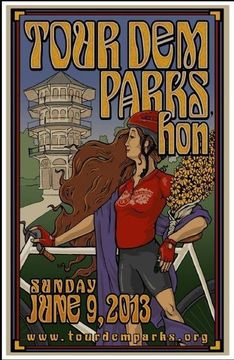 Register today for the 11th Annual Tour dem Parks, Hon!
Discount, early bird registration (until April 1st) is $35 for adults, and $20 for kids 15 and under. Save $15 by registering early!
https://www.tourdemparks.org/Joomla/index.php
The annual bike ride that winds through Baltimore’s parks and neighborhoods for a close-up view of Carroll, Patterson, Herring Run, and Druid Hill Park, as well as some quietly tucked away gems. Proceeds support Baltimore’s parks, environment and cycling groups.
Discount, early bird registration (until April 1st) is $35 for adults, and $20 for kids 15 and under.
Tour dem Parks, Hon! is Sunday, June 9th, 2013. We are capping registration at 2,000 riders, so sign up early! This annual bike ride through Baltimore’s parks and neighborhoods offers a close-up view of regional parks like Carroll, Patterson, Clifton and Druid Hill, as well as some quietly tucked away gems. Participants choose from 4 routes: 14 miles (the family ride on the Gwynn’s Falls Trail), 25 miles, 35 miles, or a metric century (64 miles). All rides start and end in Carroll Park
Discount, early bird registration (until April 1st) is $35 for adults, and $20 for kids 15 and under. Save $15 by registering early! Proceeds support Baltimore’s parks, as well as environmental, “friends of parks”, and cycling groups. Tour dem Parks, Hon! is fully supported with rest stops and ends with a jazz barbeque. Visit the website to register or for more information.