
B’ Spokes: Keep in mind in Maryland being partially at fault could prevent you from recovering any damages. So it might be interesting for you to see what kind of stuff they make up.
See: https://sf.streetsblog.org/2013/03/11/video-geico-partially-blames-this-cyclist-for-getting-doored/
On crosswalks, research and safety campaigns conflict
by Ben Ross, Greater Greater Washington
Marlyn Eres Ali was killed last week in Wheaton, crossing Connecticut Avenue on foot at an intersection with no traffic light. She was in a crosswalk that has wheelchair ramps and a paved median refuge but no markings on the pavement. Why aren’t crosswalks like this one marked?

Crosswalk where Marlyn Eres Ali died. By permission of nbc4 news.
Legally, a pair of crosswalks exists at every intersection, regardless of whether there are markings on the road. Most of the general public believes that marking those crosswalks makes them safer to use. But the Federal Highway Administration disagrees. Sometimes, at least.
Its Manual on Uniform Traffic Control Devices or MUTCD, the traffic engineer’s bible, states that on roads with 4 or more lanes, speed limits above 40 mph, and heavy traffic:
New marked crosswalks alone, without other measures designed to reduce traffic speeds, shorten crossing distances, enhance driver awareness of the crossing, and/or provide active warning of pedestrian presence, should not be installed across uncontrolled roadways.
Local agencies, reluctant to make cars go slower and short of funds to install the pedestrian warning lights called hawk beacons, usually take this as an injunction to simply leave the crossing unmarked.
The MUTCD bases this provision on studies of crash data. Pedestrians crossing big highways, these studies report, have a greater chance of being hit by drivers at marked crosswalks than at similar unmarked ones.
There are several possible reasons for this.
- Traffic engineers often locate marked crosswalks at the places where they interfere least with vehicle movement. Pedestrians may put a higher priority on safety when choosing where to cross.
- Politicians may demand crosswalk markings at the intersections with repeated crashes, meaning the crashes are not a consequence of the marked crosswalk but the cause.
- Researchers have other suggestions, too, as Tom Vanderbilt discusses on page 198 of his book Traffic.
Whatever the causes of this phenomenon, if it is real, there is an easy way to save lives: FHWA and state transportation agencies could instruct pedestrians to ignore crosswalk markings when they cross highways without traffic lights. Cross at whatever intersection feels safest, not the one with a marked crosswalk.
Of course, you will never hear that advice in a safety campaign. They urge pedestrians, as the current DC effort puts it, to “always use a crosswalk.” Pedestrians understand this to mean a marked one, and the campaigns reinforce that belief with images of marked crosswalks.

FHWA safety poster.
The FHWA’s own pedestrian safety campaign does not explicitly recommend using marked crosswalks. But—somewhat like advertising for an escort service—what isn’t said matters more than what’s said. The text assumes that the reader already has an idea of what’s going on and carefully avoids correcting that impression. The real message is in the pictures.
Why would highway agencies promote pedestrian behavior that their research shows to be unsafe? One potential reason is that the traffic engineers don’t really believe the research. The study results are often inconsistent; the researchers offer many cautions. Scientists know that when you get a result contrary to common sense, it’s most often wrong. If it still stands up after checking and double-checking, you may have a great discovery, but more often you’ll find a subtle mistake buried in your work.
The other possibility is that safety isn’t really what this recommendation is about. Rather, it may reflect drivers’ desire, reinforced by the historic biases of the traffic engineering profession, to get pedestrians out of unmarked crosswalks where they slow down cars. Peter Norton has shown that safety campaigns, when they started in the 1920s, aimed to push pedestrians off the streets and make room for cars.
Intentionally or not, the traffic engineering profession gravitates toward conclusions that support its existing practices and priorities. When the research supports a road design that speeds traffic—wonderful! A safety recommendation that would slow down vehicles—unthinkable!
Continue reading “On crosswalks, research and safety campaigns conflict”
Prosecutors Face Test Proving Serious Crime in a Fatal Crash
[B’ Spokes: We’ve had cases in Maryland where speeding is just speeding, even at twice the speed limit and even if it results in a death.]
***********************************************************************
By J. DAVID GOODMAN, New York Times
The crash left a young couple and their baby dead. The driver of the speeding BMW who struck them was charged with criminally negligent homicide. But making those charges stick will be a nettlesome challenge for prosecutors.
It has always been: persuading a jury that a driver’s negligence rises to the level of a crime is notoriously tough. But recent court rulings, which said that drivers’ actions failed to show moral blame, promise to muddy this already gray legal area further, and may work in the favor of the BMW’s driver, Julio Acevedo.
Mr. Acevedo was going twice the legal speed limit down a Brooklyn street when he crashed into a livery cab as it entered an intersection. Two passengers in the cab were killed; their son, delivered after the crash, died a day later. Mr. Acevedo was arrested several days later and charged by the Brooklyn district attorney’s office with criminally negligent homicide and leaving the scene of a fatal accident.
Vehicular-crime cases in New York are usually based on a driver’s committing at least two traffic infractions, which prosecutors informally call “the rule of two.” Speeding alone is frequently insufficient to establish criminality.
…
https://www.nytimes.com/2013/03/13/nyregion/serious-charges-in-fatal-crashes-pose-challenge-for-prosecutors.html
Red Line Now (NOT BIKEMORE) Fundraiser Duckpin Bowling Happy Hour!
Friday, March 22, 2013
6:00pm until 9:00pm in EDT
**IMPORTANT ANNOUNCEMENT** Bikemore is no longer a beneficiary of this event; the fundraiser is now solely for Red Line Now. HOWEVER, Bikemore still strongly encourages you to attend this event, because Baltimore needs quality public transit as much as we need bike lanes!
Red Line Now is fighting for better public transportation in Baltimore. They need your help! And, with duckpin bowling being a venerable Baltimore tradition, we figured it was an appropriate way to advocate for Baltimore’s transportation future.
$20 donation at the door = bowling shoes + free bowling!**
Learn more:
Red Line Now: https://www.red-line-now.com/
**FINE PRINT: We have reserved 3 duckpin lanes from 6-9pm; each lane can handle 6 people (2 teams of 3 each) at a time.
@ Mustang Alleys
1300 Bank St, Baltimore, Maryland 21231
Continue reading “Red Line Now (NOT BIKEMORE) Fundraiser Duckpin Bowling Happy Hour!”
Introducing the Baltimore Biking Hot Spots Map

Now this is pretty tight. It’s a crowd-sourced Google Map that calls out our favorite places to bike in and around Baltimore. Make sure you check it out to find some new spots, or to add your own favorites. …
Via BaltimoreVelo
Good news: Studies show bike commuting is one of the best ways to stay healthy
by Jay Walljasper, People for Bikes
It’s always a pleasure when scientific studies confirm your own long-held opinions, especially when what you think flies in the face of all conventional wisdom.
For instance, who knew that chocolate éclairs and triple fudge caramel brownies actually contain fewer calories than a 12-ounce glass of skim milk? Or that every $1000 you spend on lavish vacations before the age of 65 will, over the long run, provide you with more retirement income than if you’d stashed that same $1000 in a savings account?
Well, to be honest, I made up the fact about the éclairs. And the one about vacations too.
But here’s bona fide scholarly research that excites me in the same way: Biking for transportation appears more helpful in losing weight and promoting health than working out at the gym.
This means I can spend less time wearing a grimace as I endure mind-numbing exercise routines at the Y—and more time wearing a smile as I bike to work, shopping and social events. Just what I always thought.
But hey, don’t take my word for it. According to Australian epidemiologist Takemi Sugiyama, lead author of a recent study in the American Journal of Preventive Medicine, “Commuting is a relevant health behavior even for those who are sufficiently active in their leisure time.”
…
https://www.peopleforbikes.org/blog/entry/good_news_health_studies_show_bike_commuting_is_one_of_the_best_ways_to_sta
A Brief History of the 5-cent Bag Tax
[B’ Spokes: This funny video has relevance for Maryland in that we are considering a 5 cent plastic bag tax.]
Support Transportation Funding to Bring Better Bicycling to Maryland
WABA Action Alert
|
Dear Supporter, You may have heard that Maryland’s General Assembly is considering an increase in gas taxes and transit fares to better fund the state’s transportation needs (SB1054/HB1515). An increase in transportation revenue is critical to improving mobility in Maryland and improving bicycling infrastructure, public transit, and the quality of roads in the state. In some cases, the presence or absence of new funding will make or break the future of key projects, such as the Purple Line (which directly affects the state of the Capital Crescent Trail), the improvements to Route 1 through College Park, and many others. CLICK HERE to support funding for transportation projects & priorities. Fixing deteriorating roads, sidewalks, and bridges can alleviate unsafe, bumpy rides and give cyclists better areas to navigate. The benefits of investing in a multi-modally connected region that gives its residents transportation choices, including the choice to bike safely, cannot be overstated. This is especially critical this year, as the federal government has cut dedicated funding for bicycle and pedestrian infrastructure, meaning that the state must pick up the slack. Fortunately, the Governor and leaders in the General Assembly want to do that, but many legislators need to be persuaded that voters are willing pay their share. Thus, it is important that they hear from cyclists and others who understand the need for transportation funding and are willing to support the proposed increases in gas and transit costs for the greater good of keeping Maryland’s transportation network working. Please CLICK HERE to email your legislators to tell them to support SB1054/HB1515 to improve transportation for all who travel in Maryland, including those of us who bike. Many thanks, WABA |
WABA Website | Events | Maps | Rules of the Road | Take Action | Membership
Facebook | Twitter | Flickr | Quick Release: The WABA Blog
Washington Area Bicyclist Association
2599 Ontario Rd. NW, Washington, DC 20009
waba @ waba.org | Phone: 202.518.0524 | Fax: 202.518.0936
Continue reading “Support Transportation Funding to Bring Better Bicycling to Maryland”
WHAT IS YOUR MOTIVATION?
Pedestrian and Driver Safety
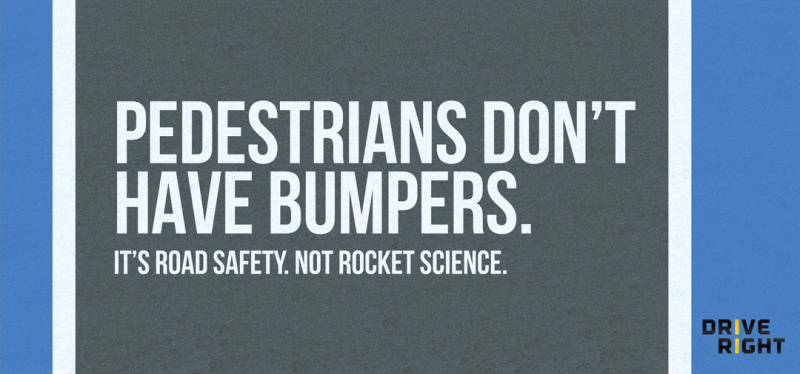
[B’ Spokes: This is what pedestrian safety looks like in Philadelphia, PA. Pennsylvania’s pedestrian fatality rate per 100,000 population is 1.14 and a ranking of 26 While Maryland’s pedestrian fatality rate per 100,000 population is 1.75 and a ranking of 8. Which do you think works better, Maryland’s tactic of blaming the victim (ticketing jaywalking which is not a violation) or Philadelphia’s tactic of reminding drivers and pedestrians to be mindful of each other? This should not be rocket science!] `
Continue reading “Pedestrian and Driver Safety”