
By HEATHER KEELS – Herald Mail
heather.keels@herald-mail.com
WILLIAMSPORT — Local officials gathered Tuesday afternoon at Williamsport’s Cushwa Basin to celebrate the opening of a pair of half-mile-long bike lanes they hope will bolster the town’s economy by drawing more C&O Canal towpath users off the trail and into town.
“Even though these are just bike lanes and just paint on the road, they really are the beginning of something much bigger for the town of Williamsport,” said Michael Sparks, the town’s new director of economic and community development.
The bike lanes run both directions along Potomac Street from the towpath access point at Cushwa Basin to Byron Memorial Park, passing through the town center. In addition, “share the road” markings have been added to the block of Conococheague Street from Potomac Street to Salisbury Street to encourage motorists to cooperate with bicyclists, and bike racks along that block are in the works, Sparks said.
The lanes connect two of the town’s most important attractions, Sparks said. There are an estimated 250,000 to 300,000 visits a year to Cushwa Basin, where the former Cushwa’s Coal and Brick warehouse has been converted to a C&O Canal visitors center, he said. In addition, there are an estimated 100,000 visits a year to Byron Memorial Park, home of the historic Springfield Barn and the site of popular town events like its Fourth of July celebration and Williamsport Days festival, Sparks said.
Before the bike lanes were added, getting from the towpath to the park could be intimidating to cyclists, Sparks said.
“They’d look like they were scared to death,” he said. “They’re hugging the side of the road and everything.”
Since the bike lanes were finished June 2, Sparks said the route has become a lot safer and the number of bicyclists on the road has increased.
The bike lanes cost about $1,200, which the town might be able to recover through a potential grant, Sparks said. He said by piggybacking on a state contract, the town got them for less than 6 cents a foot.
…
[Video notes, the C&O gets 250,000-300,000 visits a year with a potential spending income of $18 million a year.]
Continue reading “Bike lanes lauded as economic boosters in Williamsport”
Federal Safe Routes Program Under Attack
Urge Your Representative to Support Safe Routes To Schools
House Republican Whip Eric Cantor (R-VA) has targeted the federal Safe Routes to School program established under the 2005 Federal Surface Transportation Bill (SAFETEA-LU) as wasteful government spending in his weekly “YouCut program”.
Each week representative Cantor asks people to vote for which of five options they would cut from the federal budget. Republicans then hold a floor vote in the House of Representatives to try to eliminate the program that gets the most votes.
This week, the federal Safe Routes to School program is one of Rep. Cantor’s targets. He argues that SRTS duplicates other bicycling and walking programs, and that bicycling and walking infrastructure is a local government responsibility. We need your help making sure that Members of Congress understand the value of Safe Routes to School and support it.
Please take a few minutes to send a message to your Member of Congress to ask them to vote against any effort to cut Safe Routes to School.
Thank you in advance for your assistance in this matter.
Start posting R4-11 ("Bicycles may use full lane")
Yoy may recall that on Dec. 11, FWHA adopted a revision to the MUTCD. States have until Dec. 11, 2011 to adopt or modify the revision. One significant addition is R4-11, (“Bicycles may use full lane”).
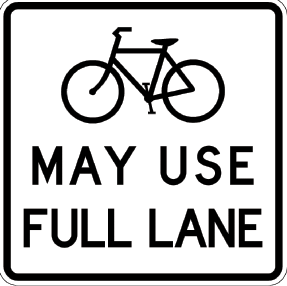
We need to nag SHA to approve these signs now rather than wait until 2011. One way of nagging SHA might be to start preparing a list of places where the sign is needed.
Please make your suggestions in the comments
Traffic enforcement still a joke in Maryland
The SUV crossed the intersection [but not] before an oncoming car’s driver had to put its brakes on to avoid a crash….Although the speed limit on Hayward Road is 25 mph, the cruiser’s radar showed the vehicle was going 45 mph…."She admitted to speeding because her kids were late for school,"
**************************************
[B’ Spokes: At lest her kids were "safely" tucked away in an SUV. How outrageous of behavior do we need before cracking down on these people? Traffic fatalities is the leading cause of death for kids, maybe health officials should be called in to determine if she is routinely putting her kids at risk of death and deemed an unfit mother? Maybe speeders in school zones should have their and their kids BMI noted and double fines if overweight and triple fines if obese. Something needs to be done to stress that exercise as part of adults and kids daily routine is far more important then speeding and overweight people have no right forcing their lifestyle on other people. Too many parents do not let their kids bike or walk to school because of the way they themselves drive and this is not right.]
**************************************
from Stop the Maryland Unsafe Driver by Driver
Maryland should be called the “Warning” state. The likelihood of a twenty-one year old female resident in a large SUV with children on board gliding (not stopping) at a colloquially-known dangerous intersection and then driving forty-five miles per hour in a twenty five miles per hour school zone receiving an actual citation seems remote.
There are some behaviors that SHOULD mandate a citation. When passengers, especially children, are placed at risk of injury or death especially by a younger driver with little life and driving experience a citation should be issued. A warning serves no useful purpose.
Warnings are part of the politically-correct-minimize-the-carnage posture that law enforcement takes in Maryland. This is simply wrong in the face of the sheer numbers of aggressive, wanton reckless, and careless drivers on our roads. A warning is serving no useful purpose.
The twenty one year old mom in this story needs the ticket. A warning and the points are meaningless. When she has to deal with a fine and the increase in her insurance premium she may understand and commit to a lifetime of safe driving. The decision to take a serious risk at a dangerous intersection with children on board was, to say the least, flawed. Also flawed was the officer’s kindness in issuing a citation. Kindness may not a safe driver make.
There are far too many dead, maimed, and injured as a direct result of risky behaviors on our roads. Politicians need to get comfortable with enforcement for the sake of their constituents instead of providing a pass for bad behavior in a culture that has become reckless by default
Continue reading “Traffic enforcement still a joke in Maryland”
Maryland Cycling for Sight Lions Club in Damascus 6-19
The Maryland Cycling for Sight Lions Club will be traveling through Sandy Spring, Olney, Laytonsville and Damascus on Saturday, June 19. We will meet the cyclist at the corner of Route 108 and 124 at the Park and Ride Gazebo. I would think it would be late morning but will let everyone know when I hear an ETA from the cyclist.
Mark your calendar now to come out and greet the cyclist to encourage them on for a safe and productive ride. We will have water, fruit and snacks for them.
Continue reading “Maryland Cycling for Sight Lions Club in Damascus 6-19”
Maryland wants to recycle cross-state bike race
By Liz Farmer – Daily Record Business Writer
Cycling legend Lance Armstrong won the Tour Du Pont in both 1995 and 1996.
Fourteen years after the annual mid-Atlantic cycling race Tour Du Pont abruptly ended, state officials and cycling enthusiasts are trying to bring a race to Maryland in 2012 that could generate as much as $40 million in annual spending.
Tour de Maryland would be a seven-day cycling event covering roads in all five regions of the state — Southern, central and Western Maryland; the Eastern Shore and the capital region, according to Terry Hasseltine, the state’s director of sports marketing who is trying to position the race as a mid-spring precursor to the Tour de France.
“It’s a great way to showcase the state’s tourism assets, and it draws a major international following,” Hasseltine said. “We’re talking the likes of Lance Armstrong and others participating.”
Hasseltine is working with sports promoter Medalist Sports LLC to get statewide support for the event and sell it to a title sponsor. The Georgia-based company also ran the Tour Du Pont, which began as the Tour de Trump in 1989 and 1990, then was sponsored by the Du Pont company from 1991 to 1996. Medalist also runs the Amgen Tour of California, considered one of the pre-eminent races in the U.S. and a build-up race to the Tour de France.
The California race generates more than $40 million in spending each year, and a similar race, the Tour of Missouri, generates $38.1 in spending, Hasseltine said.
…
Continue reading “Maryland wants to recycle cross-state bike race”
Incivility: How Lawyers and Legislators De-Valued Your Life
by Bruce Ebert
On January 12 of this year, in a courtroom in Hagerstown, Maryland, 21-year-old Meghann Weaver stood before a Washington County circuit judge to face sentencing for hitting a bicyclist, eight-year-old David Greeley, in August of 2009.
The outcome: a fine of $140 for the collision, which fractured the cyclist’s skull and damaged his left leg to the point that it necessitated amputation at mid-shin.
Looking at that case in relation to some similar cases, her penalty was harsh-but nothing when viewed in the context of how her operation of a two-ton box of steel with horsepower to spare altered the life of the boy and his family.
…
While that was taking place, the news in Los Angeles included the case of a Hummer driver who maneuvered into a stream of about 12 cyclists, injured one and destroyed several bikes. The investigating officer let the driver go without pressing charges.
These cases and others are infuriating cyclists all over the U.S., causing many to question the integrity of a system that appears to dismiss the value of lives extinguished or crippled on roads that traffic signs and PR campaigns remind us are meant to be shared.
The reality is that, unlike in Europe, such leniency has been part of the American way of justice for decades, as state after state changed its respective laws to process car-bicycle collision injuries as compensation matters handled in civil courts-and the result was less punishment for the offender and greater emphasis on compensation for the injured cyclist.
"I can understand the reaction," says Steve Kessell, the Maryland State’s Attorney who prosecuted Weaver. "But it’s based on a perception of the law that is not really accurate."
In the ’70s, with cycling’s surge in popularity, America’s criminal courts began to be so overwhelmed with cases that, as part of a state-by-state court reform, car-bike collisions were downgraded as criminal matters and turned over to civil courts for the purpose of meting out compensation to victims. Thus, in most states, anything less than cases of wanton disregard for human life, malicious intent or gross misconduct with a motor vehicle will merit little more than a ticket-and sometimes not even a ticket.
"Until then, motor vehicle offenses were criminal," explains David Hiller, advocacy director for the Cascade Bicycle Club in Washington State. "Then, in exchange for waiving the right to due process, and to unclog the courts, the trade-off was those cases would be handled in civil court."
…(more)
Continue reading “Incivility: How Lawyers and Legislators De-Valued Your Life”
Maryland Ranks 11th in Bike Friendliness
By Carrie Madren
We’ve all been that driver, cruising along and then suddenly bearing down on a cyclist who is slowing us down to an unbearable speed. Many of us have been that bicyclist, hugging the white line for dear life, all the while trying to maintain a decent speed and keenly aware of the two tons of metal machinery tailing us.
Cars are king of the road, but motorized vehicles — though usually the fastest and easiest way to get from Point A to Point B — contribute to traffic, pollution and a sedentary lifestyle. Bicycles, on the other hand, emit nothing, use nothing but human energy, can replace a car for many needs and increase exercise. Unfortunately, many roads are dangerous for bicyclists, and riders who want to stick to bike paths must go out of their way to safely make it to their destination.
In a watershed with more than 16.6 million people — and growing by about 157,000 people per year, according to the Chesapeake Bay Program — how we get around deserves serious thought and planning. Transportation affects our quality of life, environment, finances and resources. With our numbers set to increase to nearly 20 million neighbors by 2030, getting more people on bicycles could be one answer to transportation problems. And if people are willing to take to the bicycle, let’s make that easier.
Currently, dare to bike to work and you’ll likely encounter cement curbs keeping you in busy traffic lanes, sense impatient drivers riding your back wheel or have to weave through traffic to make a left turn. If you’re lucky enough to find a dedicated bike lane, you may find it coming to an abrupt end well before your destination. Though brave bicyclists do take to the roads in city and country — and regularly defend their right to be there — more would use bicycling as a transportation option if our road network were more bicycle-friendly, laws were more widely known and if bike racks abounded.
Each year, the League of American Bicyclists ranks every state in terms of bike friendliness. In 2010, Delaware dropped one rank to 10th with Maryland ranking 11th; Virginia dropped to 18th, New York dropped to 36th and Pennsylvania fell way behind at 42nd in the country. In each of the Mid-Atlantic States, however, bicyclists are banding together to advocate safer roads, bike paths and better laws.
As more cyclists take to the roads, safety is key; teaching drivers, as well as law enforcement officers, the nuances of law would help keep roads safer. Motorists misjudging the space required to pass a bicyclist and motorists turning into the path of an approaching bicyclist are two of the most common causes of bicycle crashes. Sadly, it only takes a slight swerve to end in a fatality. Municipalities, developers and cities should work together and invest in bike paths (bonus points for permeable surfaces) that run alongside major roads or create shortcuts to major areas, and are connected in a way that makes cyclists feel less like they’re playing Frogger and more like they’re commuting in a legitimate way.
Continue reading “Maryland Ranks 11th in Bike Friendliness”
Baltimore Spokes on the net
Occasionally I like to see who sending traffic to the site and return the favor.
BentRiderOnline.com linked to our coverage of helmet cams and has added the following information:
In light of MD state police ignoring the constitution, and spying on citizens with no cause to do so. ACLU has decided to represent the plaintiff.
Adventure Cycling has named Baltimore Spokes “This Week’s Favorite Blogs”, cool! A person once asked me why I liked biking so much and I said because there is so much to see, and her response; “Like what?” Which brings up this famous quote:
Thanks to the Interstate Highway System, it is now possible to travel from coast to coast without seeing anything. – Charles Kuralt
An adventure of a life time is just a bike ride away.
Keep an eye on your bike if you are in Ocean City
[B’ Spokes: Note content edited to show only bike thefts.]
*****************************************************************************
OCEAN CITY – The Ocean City Police Department summarized the following activity for the week of May 23 through May 30.
May 23, 2010: Sunday
• Theft investigation, 2300 block Haven Ave., bicycle taken, at 8:49am
• Theft investigation, 1000 block Wesley Ave., bicycle taken, at 2:55pm
May 25, 2010: Tuesday
• Theft investigation, 500 block Atlantic Ave., bicycle taken, at 3:15pm
May 26, 2010: Wednesday
• Theft investigation, 800 block 2nd St., bicycle taken, at 4:18pm
May 27, 2010: Thursday
• Theft investigation, 800 block West Ave., bicycle taken, at 6:01pm
May 29, 2010: Saturday
• Theft investigation, 800 block St. Charles Pl., bicycle taken, at 11:47am
• Burglary investigation, 100 block Wesley Rd., bicycle taken, at 4:43pm
• Theft investigation, 1000 block Central Ave., bicycle taken, at 10:08pm
PUBLIC SERVICE ANNOUNCMENTS:
• The Bicycle Ordinance restricting the hours of bicycles on the boardwalk is now in effect for the summer season.
Continue reading “Keep an eye on your bike if you are in Ocean City”