
[B’ Spokes: You know giving pedestrains frequent opportunities for safe crossing is really in everyone’s best interest. ]
Continue reading “Frogger 2.0”
Biking in Baltimore
[B’ Spokes: You know giving pedestrains frequent opportunities for safe crossing is really in everyone’s best interest. ]
Continue reading “Frogger 2.0”
by kris.westwood
A French group has created a pedal-powered submarine in order to enter an international human-powered submarine race in Maryland next year.
You can find the article about the submarine here.
And you can find info on the race here.
I’m thinking the Scubster would work quite nicely for commuting in Ottawa, allowing people to travel up and down the canal and across the Ottawa River without resorting to pesky bridges and traffic jams.
Also, there would be no risk of being hit by a car, though it remains to be seen how boat traffic will react to hordes of yellow pedal-powered subs flailing away at 10 km/h.
The NCC just has to install sub racks at key locations and we’ll soon be seeing civil servants with sodden wetsuits and scuba gear walking the last few metres to their offices.
SHA has a flash animation on how to ride your bike through a roundabout. Well with two lanes entering and leaving the roundabout and only one lane really wide lane in the middle, these things can get confusing. Best advice I can give you is pretend your bike is the middle of a car and ride like a car through the roundabout in that lane position and not to the far right.
SHA also present the option on how to cross the roundabout like a pedestrian, well it is an option though the riding on the sidewalk bit is a bit questionable.
Continue reading “Traveling Maryland’s Roundabouts by bike”
The safety effects of the 20 mph zones have been enormous for pedestrians, cyclists, and drivers alike. In London, serious traffic injuries and fatalities have fallen by 46 percent within the zones, according to the prestigious British Medical Journal. Deaths and serious injuries sustained by children have dropped 50 percent. There’s even a small spillover effect, with areas immediately adjacent to 20 mph zones seeing an eight percent reduction in total injuries and deaths. The science is so clear that in 2004 the World Health Organization endorsed 20 mph speeds as an essential strategy to save lives.
Continue reading “The case for 20 MPH roads”
Fatalities per 100 Million VMT

Note that Maryland’s decrease is slower then the National Average.


by
A 20 year-old cyclist was biking at 11:15am yesterday on a path that runs between the Oxon Hill Farm and the National Harbor when he went into cardiac arrest, causing him to go unconscious and fall off his bike. A bystander administered CPR until paramedics arrived and the cyclist was then taken to Fort Washington Hospital Center, where he was pronounced dead shortly after arriving.
The cause of death will not be determined until an autopsy is performed,
but paramedics reported that temperatures in the mid 90’s and humidity
at 43 percent more than likely played a role in the death.
The same story is reported here, here and here. If you do go biking in the heat, make sure to bring water and pay attention to signs of heat exhaustion in yourself and others.
by
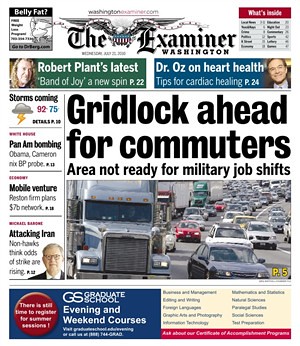
Today’s Examiner has a screaming cover headline about the impact of the military Base Reconsolidation and Closure process. The story, “Region braces for traffic ‘chaos’,” is about how the movement of close-in, transit-connected facilities, to farther out places lacking high quality transit connections is going to cause problems for commuters.
I wrote that 5 years ago, well, less 6 weeks, when the announcements were first made. Too bad the various newspapers (I think back then the Examiner was still the Journal Newspapers) and politicians didn’t think about that then…
Continue reading “Complaining five years later is too G** D*** Late”
America Bikes is a coalition of leaders from the bicycle community advocating for positive outcomes for bicycling and walking in federal transportation.
The Next Mile is our latest project – an online database of what the next bicycle and walking projects should be according to government officials and advocates from around the country.
We asked a simple question, "What are the next five bicycling and walking projects that you want built?" Check out what they said.
[B’ Spokes: Hopefully folks in Maryland will be responding soon.]
Continue reading “America’s To Do List of Bicycle and Pedestrian Projects”
[By way of analogy this is how the police might respond to funding issues if they had the same mentality as MDOT.] The Police department is proud to announce that do to its initiatives it has managed to make money from a Federal grant go further. “By requiring neighborhoods to pay for half the cost of additional patrols we have managed to get more patrols in wealthy neighborhoods where crime is typically low.” said W. T. Funk. “And we are proud to report that the grant money only goes to support the most expensive form of police work, after all if it’s cheep and cost effective why would you need a grant to pay for it?” [But if the goal is to reduce crime shouldn’t the most cost effective be supported where it is needed most?]
When asked about the increase in the crime rate and the seemingly ineffectiveness of the program the Police were quick to point out projects that were done in Baltimore City. But were not those funded by a different program then the one run by your office? we asked. “Well yes, but that is not the point, the point is programs like this can be effective. ” [This is alluding to the fact that the State takes credit for Federal Funded Earmarked projects, in short, if you want funding for a bike/ped project talk to Senator Ben Cardin and forget MDOT.] Mr. Funk also noted that over the next 5 years they will be spending more on police enforcement by adding an additional 115 State Highway Patrol Officers. When asked what effect this will have on local crime Mr. Funk responded “Probably not much but it does show we are committed to reducing crime by spending money at the State level.”
When asked what will happen to the other 2/3 of the grant not yet spent, Mr. Funk said that most likely the reaming unspent funds will have to go back to the Federal government, “It’s not our fault that the neighborhoods are not willing to spend the money to take advantage of the grant.” But you are requiring the highest neighborhood match in the nation. “Yes and we are quite proud of that fact.” retorted Mr. Funk “By doing this we making this funding go further. After all, wouldn’t you rather see expensive stuff being built irregardless of effectiveness over cost effective projects that have a proven history of showing results?”
The way MDOT handles Federal Transportation Enhancement funds is vastly different then typically done in other states. Typically these funds are used at the local level to enhance the existing transportation infrastructure. By going above and beyond Federal policy requirements MDOT has twisted enhancement into big stand alone (capital) projects separate and apart from the existing transportation infrastructure. In a recent article Missed Opportunity what is not pointed out that the landscape panels along Road Island Ave, as well as the medians could be reduced to accommodate a bike lane. This is more expensive then just paint alone but cheaper then trails but to date no such solutions are in the funding mix, in fact the State has in several occasions in the name of bike/ped “improvements” removed bikable shoulders (Strathmore Ave (Bethesda,) Belle Grove Rd and Bestgate Rd) to create deplorable biking conditions almost identical to Road Island Ave. So by making things worst for cyclists the State is claiming they are doing things for us just because they spent money and totally ignored results.
While MDOT’s 2010 Annual Attainment Report (pg 17) Fully admits they have not reached targets of reducing bike/ped injuries and fatalities (maybe next year.) In fact not much has changed in 7 years since adopting some of the “best policies” in the Nation but without funding going to a diverse and practical application of strategies nothing has changed and nothing will change.
Keep in mind that MDOT only controls 5,148 miles of roadway while the counties control 21,160 miles and municipalities control 4,678 miles of roadway, so does it really make sense to say only State roads can receive funding for on-road bike accommodations? (While MDOT does not say that point blank it is only State roads that get bike/ped funding for on-road improvements per their long range report. Not to mention Transportation Enhancement spending (only for trails per State rules but not per the Feds) for the next six years is near equal to what we have in the bank this year without anyone paying a 50% match which would leave us with 5 more years of funding to do more then what is currently on the books. And we are supposed to be impressed with the States position on funding?) The roads that have the highest potential of economically accommodating cyclists are a mix of State and local roads and funding should be available to all per policy laid down by Federal law. In response to Shortchanges in Md. commitment to pedestrians Neil Pedersen penned this letter, which in my opinion does not justify the States policies especially in light that the amount of bikeable roads have not increased, bike/ped injuries and fatalities have not decreased. Even more depressing is how we rank Nationally:


And from the 2010 Benchmarking report:
High to Low Ranking of:
Per Capita Funding to Bike/Ped, Maryland 45
Bicycle Safety, Maryland 36
Pedestrian Safety, Maryland 35
Cycling to Work, Maryland 46
Lastly look at the brown area on the right of unspent Transportation Enhancement funds for Maryland:

We have gotten some talk on improving the Recreational Trail program, let’s see if we can get the same thing going with the Transportation Enhancement program. If you would like to see Baltimore County’s Bike Master Plans really take off by allowing both on-road and off-road bike accommodations to be funded through Federal aid then write Jon Cardin jon.cardin@house.state.md.us

