
| County | Person Type | Total Killed | ||||||||||||
|---|---|---|---|---|---|---|---|---|---|---|---|---|---|---|
| Driver | Passenger | Motorcyclists | Pedestrian | Pedalcyclist | Other/Unknown | |||||||||
| Number | Percent | Number | Percent | Number | Percent | Number | Percent | Number | Percent | Number | Percent | Number | Percent | |
|
ALLEGANY (1) |
7 |
53.8 |
3 |
23.1 |
2 |
15.4 |
1 |
7.7 |
0 |
0 |
0 |
0 |
13 |
2.4 |
|
ANNE ARUNDEL (3) |
23 |
46 |
3 |
6 |
9 |
18 |
14 |
28 |
1 |
2 |
0 |
0 |
50 |
9.1 |
|
BALTIMORE (5) |
41 |
48.8 |
10 |
11.9 |
12 |
14.3 |
21 |
25 |
0 |
0 |
0 |
0 |
84 |
15.4 |
|
CALVERT (9) |
7 |
77.8 |
1 |
11.1 |
1 |
11.1 |
0 |
0 |
0 |
0 |
0 |
0 |
9 |
1.6 |
|
CAROLINE (11) |
2 |
50 |
1 |
25 |
0 |
0 |
1 |
25 |
0 |
0 |
0 |
0 |
4 |
0.7 |
|
CARROLL (13) |
9 |
60 |
2 |
13.3 |
2 |
13.3 |
2 |
13.3 |
0 |
0 |
0 |
0 |
15 |
2.7 |
|
CECIL (15) |
6 |
46.2 |
1 |
7.7 |
3 |
23.1 |
3 |
23.1 |
0 |
0 |
0 |
0 |
13 |
2.4 |
|
CHARLES (17) |
8 |
53.3 |
0 |
0 |
4 |
26.7 |
3 |
20 |
0 |
0 |
0 |
0 |
15 |
2.7 |
|
DORCHESTER (19) |
3 |
33.3 |
4 |
44.4 |
1 |
11.1 |
1 |
11.1 |
0 |
0 |
0 |
0 |
9 |
1.6 |
|
FREDERICK (21) |
13 |
56.5 |
3 |
13 |
5 |
21.7 |
2 |
8.7 |
0 |
0 |
0 |
0 |
23 |
4.2 |
|
GARRETT (23) |
6 |
75 |
2 |
25 |
0 |
0 |
0 |
0 |
0 |
0 |
0 |
0 |
8 |
1.5 |
|
HARFORD (25) |
15 |
57.7 |
7 |
26.9 |
0 |
0 |
4 |
15.4 |
0 |
0 |
0 |
0 |
26 |
4.8 |
|
HOWARD (27) |
13 |
54.2 |
5 |
20.8 |
1 |
4.2 |
3 |
12.5 |
1 |
4.2 |
1 |
4.2 |
24 |
4.4 |
|
KENT (29) |
2 |
100 |
0 |
0 |
0 |
0 |
0 |
0 |
0 |
0 |
0 |
0 |
2 |
0.4 |
|
MONTGOMERY (31) |
18 |
46.2 |
9 |
23.1 |
1 |
2.6 |
9 |
23.1 |
2 |
5.1 |
0 |
0 |
39 |
7.1 |
|
PRINCE GEORGE’S |
40 |
40.8 |
21 |
21.4 |
13 |
13.3 |
23 |
23.5 |
1 |
1 |
0 |
0 |
98 |
17.9 |
|
QUEEN ANNE’S (35) |
6 |
75 |
1 |
12.5 |
0 |
0 |
1 |
12.5 |
0 |
0 |
0 |
0 |
8 |
1.5 |
|
ST. MARY’S (37) |
11 |
68.8 |
0 |
0 |
2 |
12.5 |
1 |
6.3 |
2 |
12.5 |
0 |
0 |
16 |
2.9 |
|
SOMERSET (39) |
4 |
66.7 |
1 |
16.7 |
0 |
0 |
1 |
16.7 |
0 |
0 |
0 |
0 |
6 |
1.1 |
|
TALBOT (41) |
6 |
85.7 |
0 |
0 |
1 |
14.3 |
0 |
0 |
0 |
0 |
0 |
0 |
7 |
1.3 |
|
WASHINGTON (43) |
10 |
66.7 |
2 |
13.3 |
3 |
20 |
0 |
0 |
0 |
0 |
0 |
0 |
15 |
2.7 |
|
WICOMICO (45) |
5 |
38.5 |
1 |
7.7 |
1 |
7.7 |
5 |
38.5 |
0 |
0 |
1 |
7.7 |
13 |
2.4 |
|
WORCESTER (47) |
4 |
33.3 |
0 |
0 |
4 |
33.3 |
2 |
16.7 |
2 |
16.7 |
0 |
0 |
12 |
2.2 |
|
BALTIMORE CITY (510) |
10 |
26.3 |
6 |
15.8 |
4 |
10.5 |
16 |
42.1 |
2 |
5.3 |
0 |
0 |
38 |
6.9 |
|
Total |
269 |
49.2 |
83 |
15.2 |
69 |
12.6 |
113 |
20.7 |
11 |
2 |
2 |
0.4 |
547 |
100 |
StreetSmart safety campaign: ‘Graphic imagery’ says it best

Seriously, does this say motorists slow down, motorists stop for pedestrians or simply pedestrians watch out for cars? Image from TBD, link after the fold.
Continue reading “StreetSmart safety campaign: ‘Graphic imagery’ says it best”
Maryland now #4!
Q: What’s the definition of an angel?
A: A slow pedestrian.
Well that seems to be the case in Maryland the 2009 fatality data has been released and Maryland has moved up the ranking from #6 to #4 highest pedestrian fatality rate in the Nation.
Continue reading “Maryland now #4!”
Why build bike access when no one bikes because of the lack of access?
Harry W. Nice Bridge plan stalled with no funding for construction
By Phyllis Cook
…
Supervisor Cedell Brooks questioned the need for the bridge to have a bicycle/pedestrian path and also wanted to know how much that added to the cost.
“Nobody rides bicycles that much on U.S. 301 because 301 really doesn’t have shoulders to accommodate bicycles,” Brooks said.
Saying the cost range for the bicycle/pedestrian path is estimated at $70 million–$90 million, Smith added, “We are getting direction from Federal Highway (Administration) for any major projects to begin incorporating all modes of transportation on all our highway projects.”
Smith also said that counties on both sides of the river have planning for bike routes in the future, adding there would be connecting points and it would tie into Wayside and Barnesfield parks.
Supervisor James Mullen said he agreed with Brooks, saying “There’s not that much bicycle traffic on the Virginia side.” He added, “Nobody rides a bike on the shoulders.”
Supervisor John LoBuglio also criticized the bicycle/pedestrian path, saying, “I too have reservations about, you know, spending that kind of money in these times, you know, $70-90M. That is a huge amount when we’re basically mostly worried about traffic itself.”
…
*****************************************************************************************************************
[B’ Spokes: My first point is that 10% of the total project cost for bike/ped is not that big of deal. Federal policy (law?) is that you cannot nix the bike/ped portion unless it’s over 20% of the total project costs. Next, bike accommodations have to begin somewhere.]
Continue reading “Why build bike access when no one bikes because of the lack of access?”
MoCo councilmember says not all pedestrian traffic deaths are ‘avoidable’
By Dave Jamieson
The Montgomery County Council just held a transportation subcommittee hearing dealing with pedestrian safety on the county’s roads, where 14 peds were killed last year. When it came to the prospect of slowing auto traffic for the benefit of people on foot, at-large Democratic councilmembers Nancy Floreen and Marc Elrich had very different takes on the subject.
Here’s Ms. Floreen, who lists traffic safety as one of her top priorities:
I’m sorry to be such a downer, but I don’t think we’re doing that great a job. I don’t think there should be any pedestrian deaths. We’re allowing [auto] mobility and speed to dominate the pedestrian existence, as long as we have community design issues that encourage speed… If someone can expect a smooth [and fast] trip to their destination, they’re going to expect it and they’re not going to look out for the pedestrian. We should give greater thought to our design standards. Who’s winning the speed battle? Shouldn’t we do all we can to allow the pedestrians more respect than our systems currently allow?
And here’s her foil, Mr. Elrich:
I don’t agree with Ms. Floreen that all pedestrian fatalities are avoidable. If you try to walk in front of moving cars at 25 miles per hour, [you might get killed]. If people think they can do anything they want do whenever they want, and that a driver can swerve and avoid them, that’s not a reality. People will die as long as they do stupid stuff. You can’t make this world so safe that no one can be harmed. The cost of doing that would be extraordinary.
Continue reading “MoCo councilmember says not all pedestrian traffic deaths are ‘avoidable’”
Who’s in charge of funding for bike/ped projects?
I’ve reported previously how Maryland spends the lowest percentage of Transportation Enhancement (TE) funds on bike/ped projects. Maryland has the highest local match requirement in the nation while $20 million of TE sits unobligated in the bank (update 2010 figures are in and $31M is available less our $6M obligated. We are only planning to spend 20% of the money available in an election year?) Maryland has a ridiculously low maximum project cost for the Recreational Trail Program (RTP), Baltimore Metro has spent NO Congestion Management and Air Quality (CMAQ) funds on bike/ped projects, while other major cities have made use of these funds for bike/ped projects. Recently I reported how Maryland is below the national average on spending Highway Safety Improvement Program (HSIP) funds.
Basically every Federal program that is used to support cycling is grossly underutilized in Maryland.
I don’t know about you but it sounds to me like we have a problem.
So I ran across this in State Law:
§ 2-606. Bicycle and Pedestrian Advisory Committee.
(a) Purpose.- The Governor shall appoint a Bicycle and Pedestrian Advisory Committee (MBPAC) to provide guidance to State agencies concerning:
(1) Funding of bicycle and pedestrian related programs;
…
(h) Meetings.- The Committee shall meet at least quarterly with at least one meeting held in Annapolis.
…
So lets bring this issue to MBPAC and see what they say, quoting the August MBPAC minutes:
"Jim Titus stated that Barry Childress, a local bicycle advocate, claimed that MBPAC did not fulfill all of its statutory requirements. In response Michael Jackson passed out a copy of Section 2-606 of the Transportation Volume of the Annotated Code of Maryland which lists MBPAC’s duties. Upon review of Section 2-606 none of the members other than Jim Titus expressed agreement with Mr. Childress’s statement. Marci Ross proposed that MBPAC consider cutting its meeting schedule from bi-monthly to four meetings per year. Ensuing discussion provided a consensus that this item be continued for discussion at the October meeting."
[Heavy sigh]
To bring my point home I’m going to quote Richard Layman and the research he did for the Western Baltimore County Bike Master Plan:
"State of Maryland transportation enhancement program match requirements. Of all the state participants, Maryland’s requirement for local match, 50%, is the highest. This requirement is significantly higher than all of the states bordering Maryland. West Virginia and DC have a 20% match. Virginia also has a 20% match requirement, but will fully fund projects under $200,000. Delaware requires a 2% match/$100,000 of award, while Pennsylvania does not require match, considering local expenditures on preconstruction planning to satisfy match requirements. By comparison to Maryland, the bordering states have a larger and more geographically diverse number of jurisdictions participating in their enhancement program. It may be worth evaluating Maryland’s program requirements for local jurisdiction participation in the transportation enhancement program, in order to increase the number of jurisdictions actively participating, and to bring the State’s utilization of the available funding closer to 100% of available funds, versus the roughly 80% that is actually obligated." [Note: we have averaged about 80% of appointed funds but the percentage from available funds is much, much lower.]
I’ll copy this to the chair of MBPAC and see if he would like to respond.
Continue reading “Who’s in charge of funding for bike/ped projects?”
Maryland OL DeSouza hurt in crash; lost for season
The Associated Press
COLLEGE PARK, Md. — Maryland offensive lineman Pete DeSouza has broken both legs in a driving accident and will miss the rest of the season.
DeSouza was driving a motor scooter on campus Thursday night when he was hit by a vehicle that was turning left. The redshirt freshman suffered fractured bones in both lower legs in the collision.
DeSouza is expected to undergo surgery on Friday. He is expected to make a full recovery, but is done for the year.
The driver of the car that struck DeSouza was issued a traffic citation, according to report issued by the campus police.
The 6-foot-6, 310-pound DeSouza played five games at right tackle this season and started the last three.
The Terrapins play at Boston College on Saturday.
Continue reading “Maryland OL DeSouza hurt in crash; lost for season”
Maryland Accident Lawyer Information Center
[B’ Spokes : I found the breakdown by jurisdiction and insurance company interesting as well as their blog. Personally I find the self promotion a bit over the top on the pages referenced but still they deserve credit for getting this information out there… now if just more lawyers would talk about what’s right and wrong with the system we might be able to do something about the wrong and be better prepared for what is right and this site is definitely a step in the right direction.]
from Maryland Injury Lawyer Blog
The primary purpose of this website is to provide information to both Maryland auto accident lawyers and to auto accident victims through our Auto Accident Victim Help Center and our critically acclaimed Auto Accident Lawyer Help Center, which is designed to assist the accident lawyer in Maryland in handling accident claims.
This website is considered by many to be the best accident website in the country for both victims and lawyers handling claims. For victims and potential clients, our Maryland accident lawyers provide the information you really need to help you best understand the process and how to maximize the money you receive as compensation: how Maryland accident claims work, their value, how to chose a lawyer, and the details of Maryland accident law and what that means for you.
….
Jurisdictional Analysis
- Baltimore City
- Prince George’s County
- Anne Arundel County
- Frederick County
- Baltimore County
- Montgomery County
- Washington County
- Carroll County
- Hartford County
- Cecil County
- Wicomico County
- Charles County
- Calvert County
- Howard County
- Garrett County
- Talbot County
- Worcester County
Tips on Each Insurance Company
- GEICO
- Allstate
- State Farm
- Nationwide
- Progressive
- USAA
- Erie
- MAIF
- Liberty Mutual
- Ameriprise
- Selective Insurance
- Farmers Insurance
Continue reading “Maryland Accident Lawyer Information Center”
Making the main roads safer
Regarding the Oct. 13 article "Few common links in spate of pedestrian fatalities":
This article was correct that speeding cars are the biggest risk to pedestrians. But the assertion that there were "few common themes" in the six fatal pedestrian crashes that have occurred in the past month was off the mark. While the story focused on the demographics of the victims and the environmental conditions surrounding the crashes, it missed the biggest common factor: Four of the six crashes occurred on multi-lane, high-speed arterial roads.
Nationally, in fact, 56 percent of pedestrian fatalities occur on arterial roads such as Georgia Avenue in Montgomery County or Glebe Road in Arlington County. Arterial roads are especially risky for people on foot because they offer few, if any, pedestrian amenities such as sidewalks and crosswalks and because they encourage motorists to put the pedal to the metal.
Fortunately, communities across the country are beginning to transform those arterials into more pedestrian-friendly boulevards, complete with sidewalks, bicycle lanes and shade trees. But as these recent pedestrian deaths show, we still have a long way to go.
Michelle Ernst, New York
The writer is co-author of the Tri-State Transportation Campaign’s report "Dangerous by Design."
Continue reading “Making the main roads safer”
1/3 of the story isn’t the full story: crossing guard pay and walk to school programs
[B’ Spokes: The short version of this might be how the heck do we get schools, planning, police, local government and state government all working together rather then just saying “This is not my problem to fix.”]
from Rebuilding Place in the Urban Space by Richard Layman
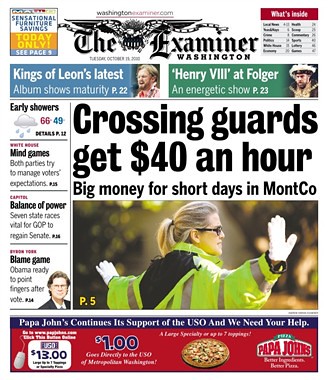
The Examiner writes a pretty narrow story today concerning school crossing guards, making it out as if the crossing guards are making a mint of money at the public expense. See “Being a Montgomery County crossing guard has its benefits – $40 per hour.”
It’s a surprisingly complicated issue.
In the last post, I discussed police departments and pedestrian and accident analysis, but I didn’t get into the details about some of my learnings about the issue. What I used to say was that “police officers aren’t planners, and that’s not their fault, but they do need our help.”
Because they don’t know they aren’t planners, without awareness of the need to bring planners and transportation engineers into the equation when it comes to accident analysis and countermeasure selection, that area of expertise tends to not be part of the analytical system and approach towards traffic safety improvement. (Of course, this is an area where guidance from the FHWA in terms of the national traffic safety program and how it could be restructured would be very helpful.)
There is a similar issue with crossing guards. The way it works, crossing guards are paid for and managed by police departments, not the local school system. (This should change, but that’s another issue too.) When the police department can’t fill the crossing guard position–which is usually the case in most places because the hourly wage is low and the hours are short so most jurisdictions never have enough crossing guards–they are forced to have the shift covered by sworn police officers. While this has some benefits, for the most part, it takes police officers away from other service duties.
So the Examiner article doesn’t discuss this, and how, by paying higher wages, Montgomery County is able to fill most of its crossing guard positions and they don’t have to use police officers for unfilled shifts.
That isn’t the case in Baltimore County.
At one of the planning advisory committee meetings, we were discussing walk to school efforts and how to expand the number of schools promoting and the number of students participating in walk to school efforts, and the police department representative present at the meeting interjected, and explained to us “the problem” from “their perspective,” not ours.
This is from the draft plan that I submitted, although the final text in the posted draft may differ slightly:
The plan advisory committee learned that one of the barriers to expanding walk to school efforts concerns the supply of available crossing guards. School crossing guards are managed by the Police Department, not by the School District. Funds to pay school crossing guards come from the Police Department budget. Because it is part-time work (10 hours/week) for relatively low wages, the Department has a difficult time keeping the 273 required positions filled. For each empty position, sworn police officers fill in, diverting officers from patrol and other duties. The Police Department ends up in the position of discouraging walk to school efforts, because it can’t meet current demand for crossing guards let alone additional demand generated by new walk to school efforts, which would mean that even more police officers are needed to cover school crossing guard functions.
(In Baltimore County, they pay under $15/hour.) The Police Department ends up in the position of discouraging walk to school efforts, because it can’t meet current demand for crossing guards let alone additional demand generated by new walk to school efforts, which would mean that even more police officers are needed to cover school crossing guard functions.
I am using the word “discourage” nicely. They actually tell principals to convert walk to school areas to school bus service zones, in order to reduce the demands on the sworn police officers.
This was the related recommendation in my draft (which was excised from the posted draft):
Address the issue of school crossing guard pay and other incentive programs that will strengthen retention of school crossing guards to reduce demands on other Police Department personnel for school crossing guard coverage. Ensure that when additional crossing guard positions are required, funding is provided to cover the increased cost.
We found this out because, unlike in most bicycle and pedestrian planning efforts, I reached out to the police department and got the traffic safety and traffic enforcement divisions to participate in our planning advisory committee. Plus the accident analysis section of the Crime Analysis section of the police department’s research division provided us data that we asked for with regard to pedestrian and bicycle accidents across the planning area (actually they provided it for the entire county, but I was tasked with a planning effort for only 1/2 of the urban area of the county, about 110 square miles). Some planning efforts get and analyze this information, many do not.
I am surprised that Baltimore County has demands for more crossing guards than Montgomery County (177 according to the Examiner article) and Fairfax County (64 according to the Examiner article). But it is a big school district (110,000 students), just as Montgomery County (130,000 students) and Fairfax County (175,000 students) are large, but Baltimore County is physically larger than either county (Baltimore County is about 640 square miles).
But I imagine that the Baltimore County Police Department wishes they could pay what Montgomery County is paying. They kept asking for more money to address the issue, but it kept getting denied, and they are always in the position of never having enough crossing guards, and constantly directing police officer details from other duties to serve as crossing guards.
The issue comes down to walking to school vs. being bused to school. Higher wages for crossing guards ensures the success of walk to school programs. Sure this comes at a cost. It means you don’t have to buy and operate as many school buses, find school bus drivers (another problem comparable to the problem of finding and retaining school crossing guards), or buy as much diesel fuel.
A new school bus costs about $75,000. Diesel fuel costs close to $3.00/gallon. For a variety of reasons, it makes more financial, health, and transportation sense to direct resources to walk to school programs rather than busing students to school.
In an odd way, the Examiner article, by not telling the whole story, is advocating for buying school buses and diesel fuel and for school bus drivers rather than crossing guards. It’s as if they are on the take from a school bus manufacturing company…
And it’s very disconcerting that Montgomery County Councilmember Marc Elrich accepts the narrative of the story as stated, rather than digging more deeply into the story. From the article:
Of the millions of dollars devoted to crossing guards, 45 percent of the funding is for group insurance plans.
Yes, the how the people get the jobs issue needs to be addressed if it isn’t an open and fair process, but in most respects, the issue shouldn’t be how much people are paid. It’s either that or the school bus and police officer details. The amount of money spent wouldn’t necessarily be reduced, if anything, it would increase.
Resources:
–Helping Johnny Walk to School (report)
–National Center for Safe Routes to School
–The Safe Routes to School National Partnership
– The State of Washington guide, School Walk and Bike Routes: A Guide for Planning and Improving Walk and Bike to School Options for Students