An open letter to Tom Hicks of Maryland’s State Highway Administration

From Bike Delaware

Bike Delaware, our constituent organizations, and bicyclists all over Delaware thank Tom Hicks (above, left), P.E. Director of SHA’s Office of Traffic and Safety, for revising Maryland State Highway Administration’s rumblestrip placement guidelines. Kudos as well to Michael Jackson (above, right), MD’s Department of Transportation’s Director of Bicycle and Pedestrian Access, for answering the call and shuttling this request along.

Bike Delaware first met with MDOT’s District Office on January 22nd 2009, out on Route 273 to investigate first hand what went wrong. Others working in MD bike/ped safety themselves brought bicycles along, to verify that this application (pictured left) did not meet bicycle-friendly guidelines. Today, we can proudly say the manuals have been revised. We are relieved to know that the rumblestrips applied along Route 273 in Cecil County, which prompted our concern as well as those of local racing teams and recreational clubs, will not be repeated on MD roads and highways where bicycling is permitted.

We commend SHA for recognizing this design as problematic in that it created conflicts between drivers and cyclists. Switching to the guidelines accepted as bicycle-friendly according to the AASHTO Guide for the Planning, Design, and Operation of Bicycle Facilities will encourage bicyclists to ride in the correct position on the shoulder and facilitate cooperation between all user groups. Further, it will allow bicyclists to ride behind the rumble strips instead of at the white line, as well as move safely into the lane when cars are turning in front of them or to avoid debris.

This will make cyclists safer and lower the stress level of all road users.

(pictured left: Frank Warnock, Maria Wilburn, Stephanie Yanovitz , and Mary Davidson join MDOT District Officials on Jan. 22, 2009, at the Highs on Route 273. Jeff Butcher was also present)


View the letter to Mr Hicks in pdf
HERE.
See the revised guidelines, including a letter to Bike Delaware in pdf HERE.
Timeline for this issue on Bike Delaware News HERE.

Continue reading “An open letter to Tom Hicks of Maryland’s State Highway Administration”

Alert: The head of Maryland’s Highway Safety Office – improving pedestrian safety?

From Maryland by Vernon Betkey, Jr. , the head of Maryland’s Highway Safety Office as well as Governors Highway Safety Association chairman

Nationally, pedestrian fatalities account for about 12 percent [in Maryland that’s over 20%] of overall traffic deaths, a small but significant portion. Given that we have made so much progress in this area, GHSA is concerned to see this reversal. One factor may be the increased distractions for both pedestrians and drivers. Anyone who travels in a busy city has seen countless pedestrians engrossed in conversation or listening to music while crossing a busy street. Just as drivers need to focus on driving safely, pedestrians need to focus on walking safely – without distractions.

Now compare:

From North Carolina:

Rapid urbanization, a weakened economy, and growing numbers of vulnerable populations (including older pedestrians and socio-economically disadvantaged groups) without other transportation options have challenged the State to keep up with issues specific to pedestrian safety and mobility.

From Nevada:

Like many other places in the southwest, the road network in Clark County consists of arterials that are designed as six lanes with intersections jumping to eight lanes. In urban area that bisects freeways or beltways, intersection can be as large as 12 lanes! Streets are flat with wide lanes that are comfortable for speed and there are few places marked for pedestrians to cross the street. On major arterial streets the norm is to have nowhere for up to a mile stretch for pedestrians to safely cross the street.

Maryland has gone from a ranking of #20 to the currently 4th highest pedestrian fatality rate in the Nation. I really don’t think campaigns like below are working. (And zebra striping crosswalks would not hurt either, two parallel lines and that’s it, sheesh.)
image


So I am joining with Greater Greater Washington and asking those who would like to see a change for the better please write Betkey, his boss Neil Pedersen, and Transportation Secretary Beverley Swaim-Staley — vbetkey@sha.state.md.us,NPedersen@sha.state.md.us,bswaim-staley@mdot.state.md.us

[Note: I rewrote GGW’s article to put a different spin on it. So it might be worth reading David’s article as well.]

Pedestrian deaths largely flat in U.S., Maryland

from Getting There by Michael Dresser
The number of pedestrian deaths in Maryland decreased slightly over the first months of 2010 — but not by enough to stand out as an identifiable trend. The state continued to rank among the most dangerous for pedestrians — with one of the highest rates of such fatalities in the country.
According to the Governors Highway Safety Association, there were 50 pedestrian fatalities in Maryland between January and June last year compared with 54 in the same period of 2009.
The small change reflected a national trend that showed pedestrian deaths almost unchanged despite a strong decline in traffic deaths overall. Nationally, there were 1,891 pedestrian fatalities ion the first six months of 2010 — seven more than in the first half of 2009 for a statistically insignificant 0.4 percent increase. Overall fatalities are estimated by the federal government to have dropped 8 percent during that period.
Maryland was one of only four jurisdictions where pedestrians made up more than 20 percent of the total traffic deaths, the association reported. The others were the District of Columbia, New York and New Jersey. Nationally, 12 percent of those killed on the roads were pedestrians.
Maryland is also one of only three states, plus D.C., where the pedestrian fatality rate is more than 2 per 100,000 residents per year. The others were Florida and Louisiana.
Since 1999, Maryland’s fatality count for pedestrians had bounced between 91 and 116 per year with no clear trend in either direction, said lead researcher James Hedlund.
Continue reading “Pedestrian deaths largely flat in U.S., Maryland”

How to Fix Trail Crossings

WashCycle talks about the confusion of who has the right-of-way at trail crossings. https://www.thewashcycle.com/2011/01/how-to-fix-trail-crossings.html
He has a valid point there is something confusing/contradictory in having a Stop sign with a crosswalk. So just remove the crosswalk.
Interesting solution but I have to take issue with the statement "Traffic lights are expensive". One light is not expensive but I hear you say, but to put a traffic light at every trail intersection would be very expensive. That is just the wrong kind of thinking.
Garrison Keillor has a great skit about a guy who complains to the waiter that there is a fly in his soup. And the waiter responds "There might be a fly in your soup. But there might be a fly in everyone’s soup and we simply do not have the time and resources to check everyone’s soup so we can’t check yours."
We are totally missing the point that we just need to fix where there is a problem, one light at a time and no more, where needed. Unsignalized intersections have a social contract that everyone should be able to negotiate fair and equal treatment of the intersection. When bullies appear and will not let "weaker" users cross, it’s time to call a time out and mechanize who has the right-of-way.
Installing signs on the trail "Dangerous Intersection Ahead" is pure insult. It’s like saying "Ya we know there is a problem but we will not do anything about it." Signing trails with redundant stop messages without the same redundancy telling motorist must stop for trail users puts the responsibility in the wrong place and sends the wrong message. All a light does is automate what is required legal behavior from motorists. Saying a light can’t be installed is like saying motorist are not required to stop for pedestrains in crosswalks. And that kind of thinking spreads till motorist almost never stop for pedestrians in crosswalks.
Like red-light cameras, trail crossing lights need to send a message to motorist that illegal behavior was going on here and everyone needs to take a deep breath and pause for their fellow man and follow the laws even though you thought you could get away with breaking the law at other peoples expense for your own minor convenience. We need to insist that the system accommodates all users and fix where things go horribly wrong. A person is a person wither they are sitting in a car or not. We need to end the thinking "Fast users need to go as fast as possible and cannot be delayed in the slightest. While slower users would not mind going even slower." The reality is fast users can easily make up minor delays, but making it hard on slower users with extra delays on every single block just puts more faster users on the road till the system breaks under the load of just too many people in cars being used for every little thing no matter how short the trip.
All it would take is one signal light a year on a problem trail intersection, till people get it, is that really too much to ask?

Mortified to see that I was listed as the ‘at fault driver’.

From BestLifeInsurancePolicies.com
Right now I am laying in the hospital with a severe hip fracture that could affect me for the rest of my life. I am and avid cyclist, mountain biker and hiker and I am very worried that I will have life long problems associated with this injury that will limit me from participating in my favorite activities.
I have finally obtained a copy of the accident report and was mortified to see that I listed as the ‘at fault driver’. I suffered a minor concussion during the accident, but I can remember every single event that lead to the accident. In short I was T-boned by an suv doing 50mph trying to make the light as I received the left turn green signal. The lone witness’s statement is a complete lie. No tickets were issued for the accident, but as mentioned the report listed me as at fault.
As I am lying here with a broken body, out of work for three months, out of a car, and as it seems out of luck. I am wondering I have any hope for getting my life back and getting some sort of compensation.
The accident occurred in Maryland
Continue reading “Mortified to see that I was listed as the ‘at fault driver’.”

Drunk driver who killed Stan Miller gets eight years prison, then five years probation

By The Daily Randonneur
A group of D.C. Randonneurs and many others who cared about slain cyclist Stan Miller attended the sentencing of Stan’s killer, Quinzy Fraser, today in Rockville. Md. They were among about 75 friends of Stan who appeared, and another 75 or so on behalf of Mr. Fraser.
I’m told by one of those who were there that the judge sentenced Mr. Fraser to the full 10 years allowable for vehicular manslaughter, with two years suspended. Mr. Fraser was also given five years probation.
Both the prosecution and Mr. Fraser’s defense argued their respective cases. It came to light that this was Mr. Fraser’s third drunk driving incident, one more than was commonly known.
Stan died last June 25th when a drunk Fraser, driving his SUV with a .20 blood alcohol content, hit him at high speed on the shoulder of Maryland Rt. 27 during the evening rush hour.
************************************************************************************************************
[B’ Spokes: This is the first conviction of Vehicular Manslaughter that I am aware of. You’ll note the very high bar to prove "driving in a grossly negligent manner." Three prior DUI’s, near three times the legal limit of blood alcohol content, resisting arrest, assaulting a police officer and driving at a high rate of speed.
I also find it interesting that this is not in addition to DUI charges but instead of DUI charges. I am guessing here but perhaps that’s why we rarely see this charge because if you can only charge one or the other you risk not getting a convection if you go for the harder to prove gross negligence. If any lawyers want to chime in on this point, please do.]
Continue reading “Drunk driver who killed Stan Miller gets eight years prison, then five years probation”

BTAG Meeting Next Friday, January 21, 8:30 AM in Bowie

Prince George’s County’s BTAG (Bicycle and Trails Advisory Group) is comprised of citizens and government officials who want to promote bicycling in Prince George’s County and to improve the conditions for people riding bicycles in the county. Anyone is welcome to attend and participate in the quarterly BTAG meetings. The January Quarterly Meeting of BTAG is scheduled for Friday, January 21 from 8:30 AM – 10:30 AM at the Bowie Senior Center.

I encourage anyone interested in bicycling in Prince George’s County to attend the meeting. We will be meeting in the Ceramics Room in the Bowie Senior Center. The Senior Center is located along Health Center Drive near the Bowie Town Center. The senior center is the second building on the left after you turn onto Health Center Drive from Northview Drive. 

Topics submitted so far for the agenda include: 

  • The cycle track concept along US 1 (see note below)
  • The Bowie Heritage Trail 
  • The Potomac Heritage Trail On-Road Bicycle Route Signage Plan 
  • The Dinosaur Trail proposal in northern Prince George ‘ s County 
  • Anacostia River Trail Update 
  • Piscataway Creek MOU 
  • Star Spangled Banner Trail (Croom Road corridor and Cheverly to Bladensburg) 
  • The 2011 Maryland Bicycle and Pedestrian Symposium in Annapolis 

Please contact Fred Shaffer via e-mail or at 301-952-3661 if you have any additional agenda items, questions or would like to follow-up regarding a specific issue. 

Fred Shaffer
Planning Department, M-NCPPC 
Fred.shaffer@ppd.mncppc.org 
301-952-3661 

Note on Cycle Track along US 1: 

Councilmember Olson will probably be at the meeting and he is hoping for support for the cycle track concept on US 1, a cycleway along US 1 that would be separated from motor traffic.  There will be a brief presentation on the proposal which is included in the new US 1 Sector Plan. SHA has written a fairly strongly worded memo against the concept.  But, the hope is that if enough cyclists support the idea, SHA  might reconsider.  The cycle track it is an extremely long-term proposal and the Sector Plan still supports bike lanes in the short and mid-terms.  However, due to the 1) vehicular speeds, 2) traffic volume, and 3) the amount of truck traffic on US 1, the plan supports a separate, dedicated facility for cyclists as part of the long-term vision.  Also, it is hoped that this type of protected, dedicated facility will encourage more people to make some trips by bicycle.  By providing a facility that people feel comfortable on will encourage more people to make trips in the corridor by bike.
Directions from the Capital Beltway to the BTAG meeting: 
Take US 50 East 
After approximately 7 or 8 miles, take MD 197 south. 
Turn right at the first light ( just past the pedestrian bridge) for Northview Drive 
After less than ¼ mile on Northview Drive, turn right at the first light for Health Center Drive. 
The Bowie Senior Center is the second building on the left ( 14900 Health Center Drive ) . 
The Ceramics Room is located past the front desk along the hallway to the right. 


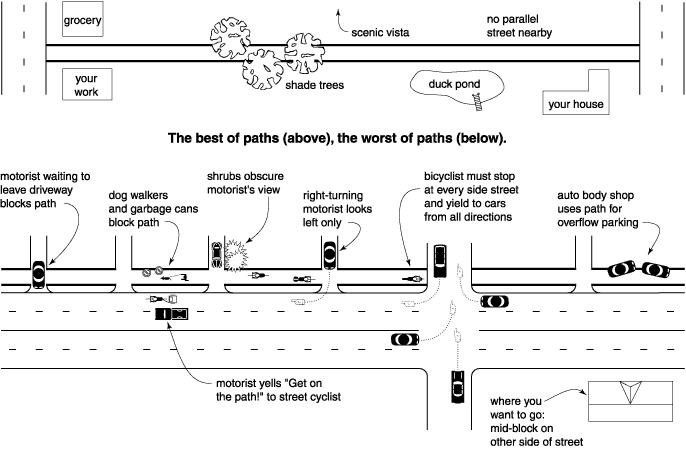
[B’ Spokes: While I have not seen the cycle track design above I will put in a cautionary bit of info:
image
Maryland’s over stress on off-road encourages the worst of off-road facilities (bottom half) over and above more appropriate on-road facilities. And even with the best of paths (top half) most MD paths do not allow for comfortable biking from home to the trail (Per NHTSA survey 89% of bike trips begin at a residence and only 7% at a recreational site), nor do paths generally allow comfortable biking from the trail to work or grocery stories, such an idea is not even in the works. We need a more workable solution then what’s being offered and more verity in the offering of bike facilities at not only the state level but the local level as well.

Additionally: Bicycle Facility Design by Richard C. Moeur, P.E., L.C.I.]
Continue reading “BTAG Meeting Next Friday, January 21, 8:30 AM in Bowie”

Bethesda-Chevy Chase community voices pedestrian concerns

by Sarah Gantz | Staff Writer Gazette
Montgomery County’s Department of Transportation is tapping into neighborhood and community organizations to keep abreast of pedestrian and traffic problems, as its dwindling budget provides less money to address traffic concerns.
Input from neighborhood groups is becoming increasingly valuable to the county’s pedestrian safety initiative, a program launched in 2008 that identifies and addresses high accident incidence areas, builds sidewalks and includes in development projects reports of how the project would affect pedestrian and bicycle safety. The pedestrian safety initiative initially had a budget of almost $5 million in fiscal 2010 that was cut to $3.6 million in fiscal 2011, said Jeff Dunckel, the county’s pedestrian safety coordinator.
"The problem has historically been we’re reactive — where there are problems, we respond," Dunckel said. "We’re changing the program to make it proactive."

Continue reading “Bethesda-Chevy Chase community voices pedestrian concerns”

What if more Marylanders were safe drivers?

from Stop the Maryland Unsafe Driver by Driver
Life might be a little different if more of us drove safely. Thinking about it seems to put all the bad behaviors in perspective. What might it be like if more Marylanders were safe drivers? Wat if more people cared about themselves, their families, the other folks on the road, pedestrians, property, and the animals? We can only imagine…
There would be six-hundred or so fewer dead people every year. This means happier holidays, another year with mom, dad, grandmother, or grandpa, or even the newborn or a teenager. The emergency rooms, ambulance crews, and police officers would be taking time to save lives, fight fires, or catch bad guys. Those six hundred would die a natural death at an older age with a complete life behind them. What a concept. The end result of the driving behavior we choose is entirely up to us. Everyone driving has a decision to make.

Continue reading “What if more Marylanders were safe drivers?”