
3 Feet Wide and Rising

By Michael Byrne – City Paper

What One Less Car does is amazing–and can’t be overstated–but it is largely focused on state issues, and as One Less Car Executive Director Carol Silldorff notes, "I’m a one-person staff." While there is an expectation among many riders in Baltimore that Evans is the be-all end-all of making Baltimore a better place, he is quick to say, "I can do so much, but I can’t do everything." Evans mentions the Mayor’s Bicycle Advisory Committee, a close-knit group of City Hall insiders that makes recommendations to city government. However, "the group is still within the city government," Evans says. "They can only do so much." He then hesitates slightly and adds, "They don’t want to step on any toes."

What Baltimore cyclists need is someone stepping on toes, fighting constantly at City Hall.

It can’t be emphasized enough: Advocacy is inextricably linked to everything that goes into making a city a safe and comfortable place to ride a bike. "Advocacy capacity" is one of six indicators that the Benchmarking Report uses to determine the bike- and walkability of a city. The advocacy force in Baltimore City for cyclists and pedestrians is minimal, ranking in the bottom third of U.S. cities, according to the Alliance for Biking and Walking’s report–despite an actual cycling and pedestrian share in the top third.

The lack of independent local bike advocacy isn’t about money, Evans says. "Look at our two biggest, closest cities, Philadelphia and Washington," he says. "In size and population, we’re pretty similar. [Washington,] D.C. has a phenomenal bike infrastructure and part of the reason is that they have Washington Area Bike Association. In Philadelphia, they have Bicycle Coalition of Greater Philadelphia. These groups have thousands of members."

In short, the advocacy gap in Baltimore gapes. There are many interested parties in Baltimore’s bicycling landscape: the bike repair collective Velocipede, the loose-knit boosters of the North Baltimore Bike Brigade, the Baltimore Bicycling Club, the growing number of bike shops in the city. But none appear to be in the position to take on the load of full-time advocacy. "My feeling is that [the businesses and organizations] are also understaffed," Silldorff adds.
Continue reading “3 Feet Wide and Rising”

Madison Avenue Bicycle Boulevard

image

By North Baltimore Bike Brigade

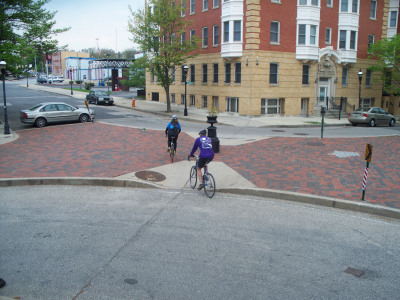
Biking around town, I discovered some very nice street treatments that diverted vehicular traffic but allowed pedestrian and bicycle traffic. Anywhere else in the world, this is a bicycle boulevard treatment. Here in Baltimore, I was taken a little off guard.

The two traffic diverters (Madison at Bloom and Robert), coupled with the Eutaw Marshburn Elementary School form an almost perfect bicycle boulevard. Riding at rush hour this morning presented no traffic north of McMechen and only a couple cars south of McMechen. Took this down to the future MLK, Jr. Sidepath and down around Camden Yards.

So, what do you think? With the community’s approval, should we push for this as a bike boulevard? Yes, Guilford Ave is still in the works, but Madison is already built.
Continue reading “Madison Avenue Bicycle Boulevard”

Dr Nicholas Fortuin, 69, dies while cycling

By Michael O’Riordan

Baltimore, MD – Dr Nicholas Fortuin, a cardiologist and professor of medicine at Johns Hopkins Medical Institute, passed away this weekend [1]. He was riding his bicycle when he collapsed and died. Although the exact cause of death is unknown, colleagues believe he suffered a heart attack. He was 69 years old.

image
Dr Nicholas Fortuin

“It was completely unexpected, very tragic,” Dr Gordon Tomaselli (Johns Hopkins Medical Institute, Baltimore, MD) told heartwire. “One of the things that Nick loved besides teaching and taking care of patients was bicycling. He was a very robust and vigorous guy, so this is really quite a shock to all of us. He’s been a fixture at Hopkins ever since I’ve been here, and I came here in the mid-1980s.”


Continue reading “Dr Nicholas Fortuin, 69, dies while cycling”

MTB TASK FORCE SUBCOMMITTEE 1st MEETING


The committee arrived at six p.m. and since some of the people in the room were fresh faces, we had a brief introduction session. The sub-committee members were: Ralph Cullison, Clarke Howells, Don Outen, Luke Brackett, Rick McClain, Patrick Miller, Paul Kovalcik and David Blum. Dr. Martin Roberge attended as a neutral observer. Penny Troutner attended as a concerned business owner and city resident. Gary Nusinov was secretary.

Penny Troutner stated that doing nothing as suggested is worse than if MORE used its vast resources to help create sustainable trails.

Dr. Roberge told a story of an old carriage road that is no longer used but was left behind from an old farm on a steep hillside. He told of the horrible erosion that occurred because it was just left alone.

Clarke then stated that steps were in place to restore the land with or without MORE or their members. He then stated that any person on these trails could be guilty of trespass, a criminal act.

Don stated that biking is not allowed in any Baltimore County Park. State Parks, regional parks, and other parks throughout the area, yes, but not in their parks. Not based on science, based on what they think a park should be and what the mission is.

When Clarke said the negotiation was between zero access or the old plan, it was stated by MORE members that is not a negotiation, or a compromise or why we were here tonight.

Once the maps were put on the table Clarke stated that he knew of these trails and all of these trails are going to disappear. He asked what MORE’s proposal was and MORE stated that they did not have a proposal because we hoped that we could work together with them. Clarke showed the group a series of maps that outlined slopes and bufferlands and stated that no trails will exist in these areas. When askedby MORE if a sustainable trail could exist in these areas, no answer was given. MORE directly asked Clarke if hikers would be restricted from these same trails. Clarke said he would not comment on other user groups. Penny asked specifically what we could propose and received no reply. Rick asked if it would be out of the question to create a proposal including 20 miles of multi-use trails.
Continue reading “MTB TASK FORCE SUBCOMMITTEE 1st MEETING”

Ride Around the Reservoir Starts Saturday, April 3rd, @9:30 AM!

By popular demand, Ride Around the Reservoir will start two months early for the 2010 season — Saturday, April 3rd, @9:30 AM! Rent a classic beach cruiser bike (three sizes available) for just $2, and sample the classic views around Druid Lake. Kids’ bikes available too! You’ll also enjoy smoother biking this year since the road was just resurfaced!

Every Saturday and Wednesday evenings.

Special bonus: The cherry blossoms along the north part of the lake may be in bloom for opening day.

Location: Druid Hill Park by the Tennis courts.

Google Adds Biking To Google Maps

Via Bike Huger:

Google, who is joining Bike Hugger at the Mobile Social in Austin at SXSW to talk about this exciting new feature (more on that in other posts) has taken a lot of time to develop the much-requested cycling layer for their popular Google Maps tool. No mere add-on, the new functionality provides cyclists with some impressive features thanks to an overhaul in how Google Maps works.

In many ways, Google’s technology will be more accurate and more detailed than anything that regional planning groups or municipal governments tend to provide as it will indicate not only state-designated or city-designated bike lanes and routes, but trails and other bike paths as well.

The Google Map bicycle layer not only displays these key bits of cycling’s connective tissue but routes cyclists on the most efficient (read “least hilly” and “least congested”) This is combined with a newly designed bike-route display on the site that decreases the emphasis on vehicular routes and displays three levels of bike route. A dark-green route indicates a trail that’s bike only (and therefor the safest and most preferred route on Google Maps), light-green to indicate a bike lane that follows a road, and a dotted-green lane that shows roads without designated bike lanes but that are suitable for cyclists.
Continue reading “Google Adds Biking To Google Maps”