

Photo Essay: Cycling through an industrial time machine

Monument to Monument 2011 Ride in Pictures
A 94 mile bike ride from Baltimore to Washington, DC.
Many thanks to Bob W. of the Baltimore Bicycling Club on putting on another great event! Not to mention taking the pictures and the rolling cometary on each one, you almost feel as if you were there. Thanks Bob for the mention and I miss you from time to time as well. I would like to point out what got me started on the route was that no one was willing to drive to DC to see the cherry blossoms, so I biked it.
Think about it, people are starting to go more places and do more things because of the bicycle and the car limits where you want to go because of traffic or parking.
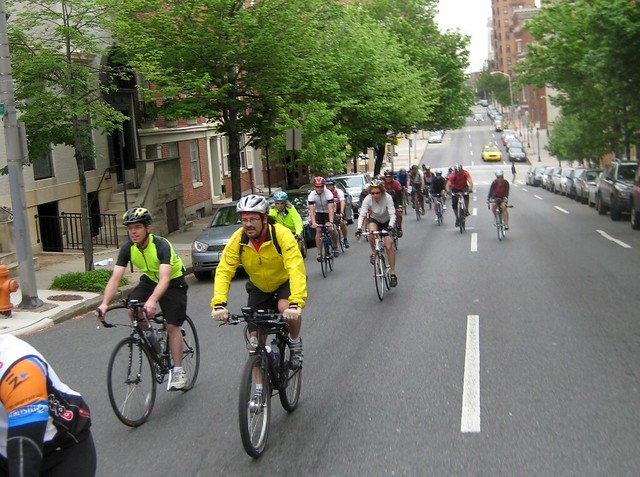
A great showing by a super diverse group of riders. After the morning roll-out we gained at least another 10 riders along the way.
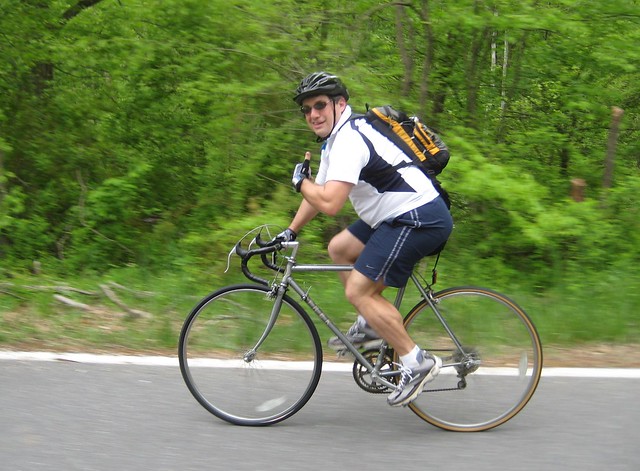
I was super glad Nate Evans braved this ride. He rode steady and strong all day in spite of suffering one of the very few mechanicals- a flat which he fixed before lunch. (along Race rd.)
More photos here: https://www.flickr.com/photos/27976837@N00/sets/72157626631332716/with/5680782790/
Fells Point installs pedestrian crossing with delays now 6 times longer for peds then for cars.
This update is to point out the Baltimore Brew article. Our previous coverage is below the divide.
The point I think the Brew is making; is imagine going into the city’s planing offices and turning off all the elevator indicator lights so you would have no idea if the button you pushed worked or not, wouldn’t that be a great improvement to calling the elevators?
So why do these same people think a button that fails to meet 20th century standards and frustrates the heck out of people is appropriate for people crossing a busy road? Did you forget to press the button or is the button broken because people are banging the heck out of it as it does not do a darn thing when you press it? You don’t know do you? Good, now try and cross the street…. gotcha it wasn’t safe to cross and you almost got killed, ha ha ha.
It really feels like a sick joke when so called “traffic engineers” make these kind of :”improvements” by now requiring people to push a button that came straight from the 1936 film Flash Gordon:

look closely at the rocket ship control panel, those are are crossing buttons used in Baltimore. 😉
“City Department of Transportation deputy director Jamie Kendrick acknowledged there’s been a change – “we repaired the pedestrian push buttons and vehicle detectors” — but says it’s for the better.“Pedestrians again, as before, now have to push the button to get the walk indications,” Kendrick wrote, in an email to The Brew. ”
Yep, still using 1936 technology because we never got the memo we should think about upgrading. :s
Rebecca Smith, founder of the Downtown Baltimore Family Alliance writes a wonderful letter to Michael Dresser explaining the problem with the problem with the new pedestrian signals.
https://weblogs.baltimoresun.com/news/traffic/2011/04/fells_point_fights_pedestrian.html
The problem is much like what David Hembrow wrote about in The significance of signal timing that treats bicyclists and pedestrians as second class road users
https://www.baltimorespokes.org/article.php?story=20110417203902165
But here the pedestrian signal timing is such that you can’t cross when the signal is green for cars and you can’t cross when the signal red and then finally you have 4 seconds to get across the road, that is assuming you pressed that button.
Seriously, don’t walk in Baltimore, we have the highest count of pedestrians in traffic crashes then any other county.
42% of our traffic fatalities are pedestrians.
Like Rebecca we are wondering where is the City’s Complete Street Policy is in all this.
Continue reading “Fells Point installs pedestrian crossing with delays now 6 times longer for peds then for cars.”
Nathan Krasnopoler May 1, 2011 Update
Nathan has had nine facial surgeries. The burns on his face are mostly covered with skin. He is still healing. There are bandages on part of his face, but some of the grafted skin is visible. The burns have done permanent damage – He has lost his right eye and is wearing an eye patch. There is only so much the plastic surgeons and eye doctors could do for him. Nathan is still completely unresponsive to us, just as he has been since the accident.
Thank you all for your continued support and thoughts. Things are not really changing, so we have not provided any recent updates. Today’s is to catch you up on Nathan.
— Mitchell
Continue reading “Nathan Krasnopoler May 1, 2011 Update”
Kinetic Art Sculpture Race May 7th
via Proteus newsletter
It’s that time of year for the Kinetic Art Sculpture Race
Store hours Saturday, May 7th will be 2pm-6pm.

We are opening late Saturday for our annual shop outing to Baltimore’s Kinetic Art Sculpture Race! It’s the most amazing event of the year. Last years’ champion, Candy Haus was pedaled by one of our favorite customers!
There is no better a celebration of all things bicycle powered. It’s a great day for folks of all ages. Come join us!
Sincerely,
Jill DiMauro
Proteus Bicycles
Nate Evans:The “outcry” from cycling advocates was definitely not widespread. (About Nathan Krasnopoler’s crash)
from Issues with City Paper’s “Bike Issue”
from Bike Baltimore by Nate Evans
3. The “outcry” from cycling advocates was definitely not widespread. A few letters to editors, blog posts or emails to me does not constitute bike advocacy. “Complaining because you care” also does not constitute advocacy. Seeking an audience with decision makers to express concerns and offer assistance in creating a safer environment is advocacy.
But …
from Basics of Bicycle Advocacy
Build constituency—It is important to generate a network of individuals who share your goals. Politicians react to constituent interests. If you generate a network of people who lend support to your goals, you will be much more successful than acting as an individual, no matter how worthy your project may be.
And on letters to the editor, there is no doubt in my mind that Jeffery Marks and Michael Dresser have done more to educate motorists and create a safer cycling environment then anything the City has done to date. Education and outreach to those who need it most is bicycle advocacy!
It seems rather ironic that Nate seems to be critical of the very tools and mythology that established his job in the first place. But don’t get me wrong Nate is a wonderful guy and no doubt he was very instrumental in a favorable outcome as was the Mayor’s Bicycle Advisory Committee and Mary Pat Clarke. And maybe we could have sat on our hands and let them carry the ball… maybe… but what if the early statement “the investigation of the accident concluded that the cyclist was at fault because he rode into the car.” really stuck like it did for Alice Swanson in DC… But I don’t think that is the real issue Nate is trying to get at.
I’m going to stick my neck out a bit and read between the lines, Nate seems a bit over justifying police statements as misquotes or more to the point the police are finally starting to work with us and just in the nick of time I might add, just a month or two before Nathan’s crash. So we finally have something good going and it will probably not do us any good to dig up “old” issues. Fair enough but still Nate’s definition of what’s not bicycle advocacy needs work but I will agree what he does define as bicycle advocacy is very desirable.
I should also note that the City Paper was over critical on the City’s approach to establishing bike lanes. The way Baltimore is doing it is the most economical way to do it, seriously do people have a problem with that?
My only complaint is on one way streets have the bike lanes on the left side of the street. No stupid buses to play leap frog with, lower risk door zone, drivers know were the left side of their honk’n big SUV is a lot better then the right side.
Continue reading “Nate Evans:The “outcry” from cycling advocates was definitely not widespread. (About Nathan Krasnopoler’s crash)”
Baltimore could be bicycle city
by Paul Day, Baltimore
I’m often amazed at home much time and money is spent on transit expansions that never happen. Look at the Regional Rail System plan. It’s a great plan, but it’s been nearly 10 years and no movement. The problem with large bureaucracies is they mistake planning for building.
Expanding transit is important, but let’s not neglect projects that are cheaper, easier to build, and serve more people. Transit projects are incredibly expensive and take decades. For a fraction of the cost of the Red Line, we could build an amazing bike lane network that far outperforms Portland and Washington and serves every corner of the city and beyond. We could become the nation’s top cycling city.
We could even use a chunk of that money to serve low-income communities through a low-cost bike sharing system, cycling education and more secure bike parking facilities. More people biking won’t happen in any substantial way without better infrastructure, outreach and security.
Portland says it’s spent only $60 million on its amazing bike infrastructure. Just a mile of highway costs about the same. The Red Line will cost the state over $230 million, and that’s not counting $1.5 billion in federal funds. This is a no brainer, people.
With more bike infrastructure, we’re solving our budget, obesity, traffic and environmental crises in one fell swoop. Let’s not pass up this opportunity to be No.1 at something without breaking the bank.
Cycling and recycling, Orioles’ Jeremy Guthrie pitches in [video]
“Is it dangerous? It’s dangerous if you give drivers too much credit.”
Continue reading “Cycling and recycling, Orioles’ Jeremy Guthrie pitches in “
Returning Champion
“Gravity goddess” Marla Streb is pulled back to Baltimore

Rarah
By Van Smith – City Paper
…
She became a world-class contender in single-track downhill—in which, just as in downhill ski-racing, “you start at the top of a mountain and they time you as you go down, one at a time, a very treacherous course with jumps, and you get to the bottom in about five minutes,” she says. In her 16-year career, she won three national and two world championships, broke 24 bones, and wrote two books about it—a training guide and a memoir, Downhill: The Life Story of a Gravity Goddess.
…
“We are hoping to open up a bike-themed café with indoor, unlimited free parking, possibly selling retail bikes, and a full liquor license,” Streb explains. “We want to do fresh-roasted coffee in the morning and then stay open all the way into the nighttime. We’re still looking for a property—we’re under contract for one, but it’s a bumpy road.”
…
Streb also tends to a company, Streb Trail Systems (STS), that she and her husband founded in the mid-2000s in Costa Rica. It designs mountain-bike trails for resorts and communities. “We created a nice trail system in Puerto Rico for a nature park called Toro Verde,” she explains. Its first U.S. project has been here in Maryland, putting together a trail plan for Mount St. Mary’s University in Emmittsburg.
In the two months since Streb returned to Baltimore, she’s also been laying the groundwork for becoming a local bike advocate. “I’m meeting with city planners,” she says, “because I really want to improve on the bike-ability of this city.” She’s happy to see that there are bike lanes on some of the city’s main thoroughfares, and finds her Fells Point neighborhood is suitably bike-friendly, but she believes much more can be done to accommodate and promote bike-based city living.
“If more and more people see a mom riding her kids,” as they see Streb do, using her “cargo bike”—an extra-long bicycle with a bucket up front, big enough for two kids and a lot of groceries—“then they’re going to think about doing it themselves. It’s a snowball effect. And as more people do it, the city will need to just create space for it [on the streets]. Cyclists are paying the same taxes the drivers are paying, except what cyclists are doing is greener and it’s healthier. I’d love to do anything I can do to help people understand.”