
Yo Hopkins, this is how you do it. (ref: https://www.baltimorespokes.org/article.php?story=20120908155605576 )
**********************************************************************************
By Mary Ann Horne, East Orlando Sun
Students aren’t the only ones cautioned to pay attention as Orange County heads back to school Aug. 20. The new school year also will bring important—and possibly expensive—lessons for drivers.
Law enforcement agencies are getting serious with motorists who don’t yield to pedestrians at crosswalks, as Florida law requires. Penalties for failing to yield include a fine of $164 and three driver’s license points.
This high-profile crackdown, known as Operation Best Foot Forward, is part of a community-wide effort to cut pedestrian deaths and injuries in half during the next five years in Orlando and Orange County.
…
https://www.eosun.com/news/2012/aug/15/yield-pedestrians-or-else/
Multi-lane, high-speed roadways made uncontrolled pedestrian crosswalks unsafe. – The solution
Featured Case Study: Rectangular Rapid Flashing Beacons in St. Petersburg
Problem
Multi-lane, high-speed roadways made uncontrolled pedestrian crosswalks unsafe. The motorist yielding compliance rates were less than 2% overall at these crosswalks.
Background
Motorists often fail to yield to pedestrians in crosswalks. Many serious pedestrian-vehicle crashes happen at uncontrolled mid-block crossings. When motorists do stop for pedestrians, other motorists sometimes try to pass the stopped motorist. This situation can lead to “multiple-threat” crashes. The City of St. Petersburg, Florida has over 100 uncontrolled crosswalks, and as of 2003 its pedestrian injury rate of 49.23 per 100,000 people was higher than both the county’s and the state’s rates.

Solution
In 2003, the City of St. Petersburg listed enhancements to uncontrolled crosswalks as a top priority in its CityTrails – Bicycle Pedestrian Master Plan.
At that time, a vendor offered to install a new traffic control device, the Rectangular Rapid Flash Beacon (RRFB), under crosswalk signs at two uncontrolled crosswalk locations. RRFBs are user-actuated rectangular amber LEDs that produce a wig-wag flash sequence to warn motorists to yield to pedestrians in the crosswalk. The City agreed to let the vendor install the RRFBs, and it conducted studies at the two crosswalks and analyzed the results.
RRFBs were an attractive alternative to traffic signals and hybrid signals because their cost of $10,000-$15,000 for the purchase and installation of two units was significantly less expensive than other options. The solar power needed to operate the LED beacons also reduced operating costs.
The City, under Permission to Experiment, compared pedestrian crossing compliance of the RRFBs to dual overhead round amber flashing beacons and side-mounted round flashing beacons at the two crosswalks. Both of these round beacons produced disappointing yielding compliance rates of 15.5% for the dual overhead round beacons and 11.5% for the side-mounted round beacons. The City experimented with two-beacon RRFB systems and four-beacon RRFB systems at the same crosswalks, for comparison. Four-beacon systems allowed for the placement of beacons in the center median, which gave motorists traveling on inside lanes of multi-lane roadways a better view of activated beacons. In all cases, there were yield markings at 30 feet in advance of the crosswalks that were used in conjunction with the RRFBs to alert motorists of upcoming crosswalks and to encourage them to stop in advance of the crosswalk to reduce the chance of a screening crash.

Results
The initial success of the RRFBs at the two crosswalks led the City to install 17 more RRFBs and conduct a two-year review of the 19 crosswalks, during which over 16,000 individual crossings were evaluated. As a result of this two-year study, it was determined that RRFBs led to sustained yielding over time. The baseline yielding percentage prior to the installation of RRFBs was 2%. The graph below shows the average yielding compliance results over time at the sites. Please note that the averages at 7, 30, 90, 270, and 365 days used data from all 19 sites, while the average at 60 days was compiled with data from 17 sites, the average at 180 days was compiled with data from 13 sites, and the average at 730 days was compiled with data from 17 sites.

The RRFBs performed equally well at night. One site at 1st Street just south of 37th Avenue North had a yielding percentage of 99.4% at night when using the four-beacon system. The yielding compliance rate was dramatically higher than the baseline nighttime percentage of 4.8%. This increase in yielding percentage at night can probably be attributed to LED lights being very visible at night.
The research also showed that the four-beacon system produced a statistically significant increase in motorist yielding compared with the two-beacon system. The average increase in yielding from the baseline to a two-beacon system was 18.2% to 81.2%, while the four-beacon system led to an average increase in yielding of 87.8%. RRFBs improved the yielding distance as well. There was a 9% increase over the baseline in yielding at greater than 30 feet in advance of the crosswalk when using the four-beacon system, and yielding at greater than 100 feet in advance of the crosswalk almost doubled. Greater yielding distances made crosswalks safer for pedestrians because the pedestrians had a better view of approaching vehicles in all oncoming lanes. The increases in yielding percentages and yielding distances also led to fewer vehicles attempting to pass yielding vehicles.
The installation of RRFBs and advance yield markings greatly improved mid-block crossing safety in St. Petersburg. As of May 2012, the City of St. Petersburg had 42 RRFBs with advance yield markings in place with another 20 to 30 scheduled for 2014.
For contacts and references, please go to www.walkinginfo.org/library/details.cfm?id=4766.
More bicyclists means fewer accidents, Phila. finds
By Paul Nussbaum, Inquirer Staff Writer
As the number of bicyclists on Philadelphia streets has risen, cyclists and city officials have seen a counterintuitive result: The number of bike crashes and deaths has declined.
This "safety in numbers" phenomenon has been documented elsewhere, and safety experts believe it is because motorists become more alert to cyclists when there are more of them.
Since 2002, the number of cyclists on many Center City streets has more than doubled, according to tallies at key intersections, and the percentage of bike commuters has also doubled. In 2002, there were six bicyclists killed in accidents with motor vehicles; last year, there were two such deaths. Traffic crashes involving bikes in Philadelphia have fallen from a high of 1,040 in 1998 to 553 in 2010.
…
https://articles.philly.com/2012-09-16/business/33881208_1_bike-sales-bike-lanes-bicycle-coalition
Study: 10% More Smart Growth = 20% Less Driving
by Angie Schmitt, Streets blog
A professor at San Francisco State University recently developed an econometric model to study how smart growth affects travel behavior. His finding: quite a bit.
…
“This is a huge impact,” said Chattopadhyay. “Success is gradual and long lasting."
…
https://dc.streetsblog.org/2012/09/17/study-10-more-smart-growth-20-less-driving/
Bicycling as traffic calming
[B’ Spokes: Richard Layman has a nice summary of (pioneering) resources on this topic in particular this one which never accrued to me before. The problem with typical crosswalk besides drivers rarely yielding is that pedestrians do not have a solid right-of-way, drivers are turning right or left across their path. So how do we dial up accommodating pedestrians (i.e. people)? From https://urbanplacesandspaces.blogspot.com/2012/09/bicycling-as-traffic-calming.html]

There needs to be more “Barnes Dance” pedestrian scramble intersections, where pedestrian movement is prioritized over cars and the pavement treatment needs to emphasize this, like in Pasadena or Oakland, California–DC has such an intersection, but there is no special treatment of the crosswalks, in particular the diagonal crosswalks. If there were, it would emphasize the importance of pedestrians.
Barnes “Dance” intersection treatment, Oakland, California, from the Streetsblog entry “Eyes on the Street: History of Oakland Chinatown’s Barnes Dance Intersection.” The entry has some great photos.
Enjoy yourself as you and the road make beautiful love together
If a driver honks and shouts "Get off the [expletive] road!" What he means is…
[Warning language content] https://www.bicyclemeditations.org/road.html
Is “Forgiveness” Just for Auto Drivers?
by Bill Lindeke, streets.mn
There’s been a rash of pedestrian accidents lately. When these accidents get reported in the paper or batted around the water cooler, there are often underlying assumptions about blame. The stories typically imply that victim was intoxicated, in the wrong place, young, old, or unhelmeted (for bicyclsits). Because we all drive almost all the time, and we all assume equal responsibility for our automobile system, our kneejerk reaction is to blame the victim. (E.g. the Strib’s recent subheadline: “distraction, inattentiveness blamed for deadly collisions”)
This is the wrong approach. We should be blaming the road.
…
It’s particularly interesting to me because transportation engineers and road designers have long had a different approach to designing roads. “Forgiveness” is a concept taught in engineering programs. It basically means that, to ensure safety, roads should be designed to allow for people to NOT be on their best behavior.
,,,
This concept makes a lot of sense, until you start to consider that designing a forgiving road means designing an unforgiving sidewalk.
…
Thankfully, urban road design has turned a corner, and cities around the country are starting to realize that making roads less forgiving might make them safer for everyone. (The Compelte Streets movement is a great example of this.)
…
Read more: https://www.streets.mn/2012/09/11/is-forgiveness-just-for-auto-drivers/
No seriously, if you are a cycling advocate read this.
Parents Remain In Denial About Childhood Obesity Epidemic
[B’ Spokes: The first step in solving a problem is recognizing there is a problem and I have seen far too many unconcerned parents about their children’s weight.]
*****************************************************************************
ATLANTA, Sept. 5, 2012 /PRNewswire/ — A behavioral insights research study commissioned by Children’s Healthcare of Atlanta suggests that while the majority of Georgia parents recognized the severity of the childhood obesity epidemic in the state, parents of overweight and obese children still don’t believe the issue affects their family. With Georgia having the second highest childhood obesity rate in the country, Children’s has kicked off the latest initiative of its Strong4Life movement called "The Talk" to jump-start a personalization of the issue for these parents.
With childhood obesity reaching epidemic rates in the country, it’s not surprising that parents now fear The Talk about weight and body issues with their kids more than the talks about sex and drugs.
…
The behavioral insights research study completed in February 2012 included surveys with 1,043 families with children 0 – 11 years old, representing a true cross-section of Georgia, including children classified as normal weight, overweight and obese (according to the CDC’s BMI classifications). From those families, 42 percent of families were identified with overweight or obese kids. Of those 42 percent of families’ surveyed with overweight or obese children, 76 percent misclassified their children as either underweight or normal weight.
…
https://www.prnewswire.com/news-releases/parents-remain-in-denial-about-childhood-obesity-epidemic-168525386.html
via CenterLines, the e-newsletter of the National Center for Bicycling & Walking.
Three-quarters of driving instructors think cycle awareness should be part of driving test
[B’ Spokes: It is my assertion that cycling proficiency should be part of drivers’ ed as it is the parents not schools that teach kids how to cycle and it’s too easy for parents to undo what schools teach (if schools here teach anything of significance about cycling… e.g. walk bike in crosswalks… like that’s going to be a life long lesson with significant impact on safety over time.)]
******************************************************************************
by Sarah Barth, road.cc
More than 75 per cent of driving instructors believe that a cycle awareness module should be part of the driving test in Britain.
…
On the flipside, even more instructors – 88 per cent – thought that cyclists should have some sort of training.
"The Government should reintroduce cycling proficiency in schools or at least facilitate partnerships between schools and The National Standards for Cycle Training, which was established as a unified cycle training program to promote road safety," said Ian McIntosh, CEO of RED.
…
https://road.cc/content/news/66588-three-quarters-driving-instructors-think-cycle-awareness-should-be-part-driving
WEAR & TEAR
[B’ Spokes: If you do decide to toss your bike please consider giving it to Velocipede Bike Project ]
I bike pretty much everyday. And biking is great. Until it’s not. Then I have to come to terms with reality.
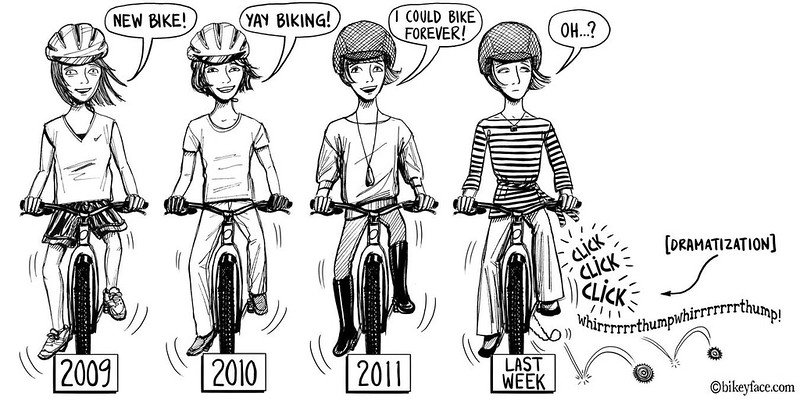
Yes, I biked so much I basically wore out my bike.
While I’m flattered to be stronger than metal (apparently,) repairs are always easy to put off. Biking is free, right? Nope. Because if it’s free, you’re doing it wrong.
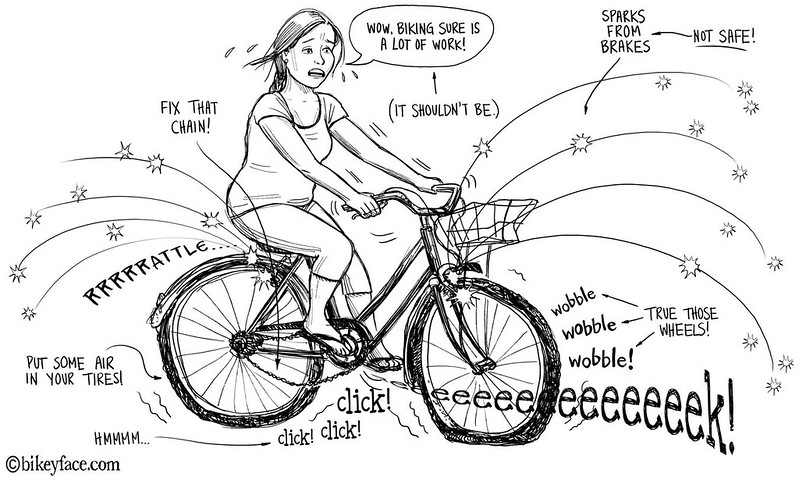
And risking your safety! So plan to put some money into your bike if you rely on it. For under $100 you could get the basics covered: lube, chain,wheels, lights, brakes. Still cheaper than a car or subway.
But if that’s too much cash you could always fix things this way:
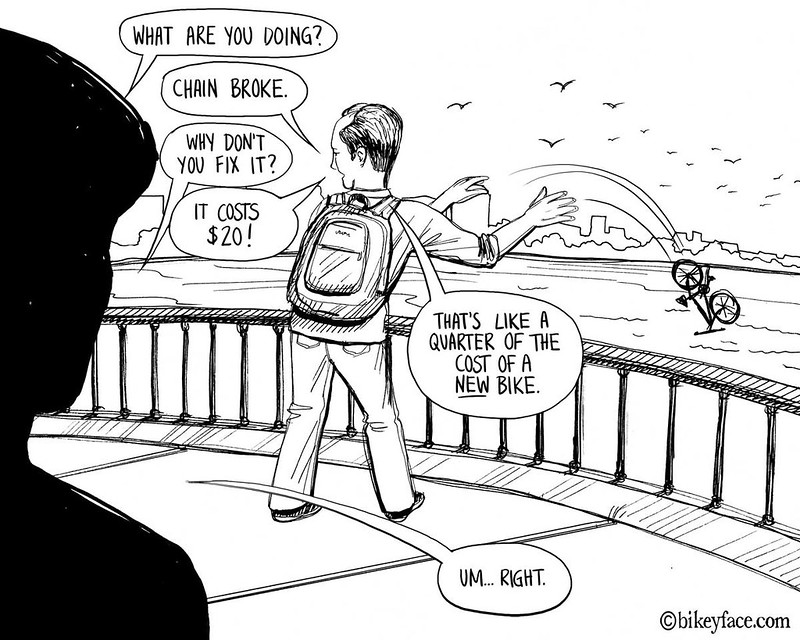
No, seriously, go to your local bike shop and get things squared away! It’s worth it.