EIGHTHINCH – Fixed Gear Conversions Made Easy from EighthInch on Vimeo.

Biking in Baltimore
B’ Spokes: To be a little more clear, I personally encourage helmet use but so called "safety" messages that begin and end with just wear a helmet are wrong, and that needs to stop!
***********************************************************************************************
By ELISABETH ROSENTHAL, New York Times
…
In the United States the notion that bike helmets promote health and safety by preventing head injuries is taken as pretty near God’s truth. Un-helmeted cyclists are regarded as irresponsible, like people who smoke. Cities are aggressive in helmet promotion.
But many European health experts have taken a very different view: Yes, there are studies that show that if you fall off a bicycle at a certain speed and hit your head, a helmet can reduce your risk of serious head injury. But such falls off bikes are rare — exceedingly so in mature urban cycling systems.
On the other hand, many researchers say, if you force or pressure people to wear helmets, you discourage them from riding bicycles. That means more obesity, heart disease and diabetes. And — Catch-22 — a result is fewer ordinary cyclists on the road, which makes it harder to develop a safe bicycling network. The safest biking cities are places like Amsterdam and Copenhagen, where middle-aged commuters are mainstay riders and the fraction of adults in helmets is minuscule.
“Pushing helmets really kills cycling and bike-sharing in particular because it promotes a sense of danger that just isn’t justified — in fact, cycling has many health benefits,” says Piet de Jong, a professor in the department of applied finance and actuarial studies at Macquarie University in Sydney. He studied the issue with mathematical modeling, and concludes that the benefits may outweigh the risks by 20 to 1.
…
https://www.nytimes.com/2012/09/30/sunday-review/to-encourage-biking-cities-forget-about-helmets.html?smid=fb-share#h[ItUCaa,1]
[B’ Spokes: In case some wonder what I would like to see in crash repoting, this article covers that well.]
By Stop and Move
…
Many things can be said about the story, but this is what caught my eye:
The driver was eastbound on Clinton Avenue as the woman and the girl
were in an unmarked crosswalk walking to the north side of the street.
I don’t know if it was the reporter, Jim Guy who noted this, or if it was brought to his attention by Police Sgt. Anthony Dewall who was interviewed for the article but….
Well done.
Not enough people understand that in California [and Maryland], an unmarked crosswalk exists at every single intersection and has the same legal standing as a marked one. That is, the pedestrian has the right of way, and the vehicles must stop.
Noting the law doesn’t change the unfortunate collision, but it DOES affect perception. And that actually means a lot.
When a pedestrian is hit, and an article is published, it seems like there exists a rule which demands that crosswalk status be mentioned. Driver speed? Who cares. Road design? Not relevant. Motorists being distracted? Not news. But were the pedestrians inside the magical crosswalk? That is key. No pedestrian injury story can be written without including a line about the crosswalk.
It’s like how every bike collision story MUST include reference to a helmet (or lack of).
Personally, I don’t get it. In many ways, focusing on helmets and crosswalks but not things like speed and driver distraction simply helps to toss blame towards the victim. It doesn’t matter if it’s not the intention of the reporter, it’s the result.
Take the following example.
1) “A mother and child were hit by a pickup truck today. They were not in the crosswalk”
Reaction: It’s all their fault! How dare they! Idiots! They had it coming!
Once that’s put in the story, it’s like it becomes the only variable. Does it matter if the motorist was speeding? No. Does it matter that in California, if the closest intersection is unsignalized, a pedestrian may cross at any point? No. The victims must be blamed. If only they’d been inside the magical unmarked crosswalk, only then would everything be ok.
2) “A mother and child were hit by a pickup truck today. It was unclear if they were in a crosswalk”
Reaction: They probably were jaywalking! I see it all the time! They had it coming!
Just by implying that they MAY have been breaking the law, blame is placed on them, even though the motorist may have actually been breaking the law by speeding or doing something else.
3) “A mother and child were hit by a pickup truck today. They were in the crosswalk”
Reaction: Motorists need to me more careful!
In this case, by stating the facts as 3, instead of what they usually do as in 2, makes a huge difference in how the case is perceived.
So that is good to see.
Of course, imagine if newspapers used the same “question” technique on motorists that they do usually with pedestrians:
4) “A mother and child were hit by a pickup truck
today. They were in the crosswalk. It was unclear if the motorist had
been speeding recklessly or texting at the time”
Reaction: Lynch him now! Death is not good enough for this criminal!
Like questioning the status of the crosswalk, questioning the drivers’ actions isn’t actually blaming him for that stuff, but implying it may have happened is strong enough.
It’s also good to see the police acknowledge it was the motorist who should get the blame. many times, you see “the victims should have been paying more attention!”
Police Sgt. Anthony Dewall said the driver, who has not been identified,
could have avoided running into the woman had he been more attentive.
“When another vehicle is stopped, it should bring some attention to you as to why the other vehicle is stopped,” he said.
Dewall said the driver would be cited for not stopping as well as being unlicensed. His truck will also be impounded.
Continue reading “[Reporter] actually mentions "unmarked crosswalk" in report”
[B’ Spokes: Just to note the speed limit around Hopkins is 35 mph with many, many drivers doing 45 mph. The following is why enforcing speed limits is important.]
by Angie Schmitt, Streets Blog
Get hit by a car traveling 20 miles per hour, and the odds are 19 to 1 that you, the pedestrian, will live to see another walk around the block. … And if a driver hits you at 40 miles per hour, there’s almost a nine in ten chance that you won’t survive.

Image: UK DOT/The Greater Marin
Yet when people die in traffic on local streets designed for vehicle speeds of 40 mph or higher, the conditions that produced a potentially fatal situation in the first place are rarely discussed.
…
via Roads Were Not Built for Cars
REG: Cyclists have bled us white, the bastards. They don’t pay road tax, they run red lights. And what have they ever given us in return?
XERXES: Pneumatic tyres.
REG: What?
XERXES: Pneumatic tyres.
REG: Oh. Yeah, yeah. They did give us that. Uh, that’s true. Yeah.
COMMANDO #3: And ball bearings.
REG: Yeah. All right. I’ll grant you pneumatic tyres and ball bearings are two things that the cyclists have done.
MATTHIAS: And the roads.
REG: Well, yeah. Obviously the roads. I mean, the roads go without saying, don’t they? But apart from pneumatic tyres, ball bearings, and the roads…
COMMANDO: Lightweight steel tubing.
XERXES: Chain driven differential gears.
COMMANDOS: Huh? Heh? Huh…
COMMANDO #2: Dust-free highways. Tractors. And spark plugs.
COMMANDOS: Ohh…
REG: Yeah, yeah. All right. Fair enough.
COMMANDO #1: And central Government administration of roads.
COMMANDOS: Oh, yes. Yeah…
FRANCIS: Cars and planes.
REG: Cars and planes?
FRANCIS: Yeah, America’s first car was built by the Duryea brothers: they were bicycle builders first. And powered flight, Reg, that was developed by the Wright Brothers: they owned a bike shop and built bikes.
REG: All right, but apart from the pneumatic tyre, ball bearings, differential gears, roads, motoring, and aviation, what have cyclists ever done for us?
+++++++++++++
REFERENCES…
Continue reading “MOTORISTS’ FRONT OF JUDEA: What Have The Cyclists Ever Done for Us? [à la Monty Python]”
By Bob Mionske, Bicycling
Cyclists ride for a lot of different reasons. For some, it’s for the love of sport. For others, it’s is an economical way to stretch a tight budget. There’s also the environmental benefit.
And of course, many people ride for their health. A new study, published in the British medical journal The Lancet, identifies physical inactivity as one of the leading causes of premature death. How bad is it? Consider these statistics:
• Inactivity causes 5.3 million deaths per year—from diseases such as diabetes, heart disease, and breast and colon cancer.
• That’s more than the number of deaths caused by smoking.
• Inactivity is the cause of 1 in 10 deaths.
• People in higher-income countries are the least active.
According to the Centers for Disease Control and Prevention (CDC), Adults should engage in moderate exercise—for example, brisk walking, cycling, or even gardening—for at least 150 minutes each week. In the U.S., 43 percent of us don’t meet that minimum requirement. In Europe, it’s 35 percent. Worldwide, one-third of all people live a sedentary lifestyle—and for teenagers, the number rises to over 80 percent.
Pedro Hallal, a professor who led the Lancet study, said “The global challenge is clear—make physical activity a public health priority throughout the world to improve health and reduce the burden of disease.”
Which brings us back to—what else?—bicycling. Want to get some exercise in every day? Try bike commuting. If someone you know wants to ease into getting around by bike, the 1-Mile Solution is the perfect way to get started.
But despite cycling’s many benefits, there’s one big problem we must contend with when we’re trying to get people off their couches: The roads we ride on can be a hostile environment. There are several reasons for this.
First, road infrastructure is usually biased towards the automobile, and often fails to take cyclists into account at all. Even though it is legal to ride on most roads, the more biased towards automobile traffic the road infrastructure is, the more intimidating the road will feel to all but the most intrepid of cyclists. As Professor Lindsey Davies (president of the UK Faculty of Public Health) observed in response to the study on inactivity, “We need to do all we can to make it easy for people to look after their health and get active as part of their daily lives. Our environment has a significant part to play. For example, people who feel unsafe in their local park will be less likely to use it.” The same goes for our roads.
Second, our laws are usually biased towards motorists. Consider, for example, the driver who passes dangerously close to a cyclist, and injures or kills the cyclist. In too many states, the motorist will at most be ticketed for a relatively minor offense, like making an unsafe pass. And that only happens when an officer is concerned enough to write a ticket.
When a motorist is severely injured or killed in a traffic “accident,” the circumstances are usually so extreme that serious charges may be filed. But all it takes to injure or kill a cyclist is a moment’s inattention, a bit of bad judgment, a careless act. An “accident.” The message sent to drivers and cyclists alike is that our lives are worth little to nothing. “Was the cyclist wearing a helmet?” people ask, subtly shifting the blame from the careless driver to his victim. In contrast, in countries where cyclists’ lives are valued, the law places the burden of safety where it belongs—on the driver. This makes the roads safer for cyclists and drivers alike, and is one factor in getting more people on bikes.
Third, too many motorists, including many law enforcement officers, have only vague notions of what the laws on bicycling are. They may, for example, think you are breaking the law by riding on the road instead of the sidewalk, or by taking the lane. This confusion raises the hostility level of motorists, and too often results in unjust law enforcement by officers who aren’t really sure what the law is.
Finally, many motorists feel entitled to threaten us, and even jeopardize our lives, with hostile and aggressive behavior, simply because they do not believe that we have any right to use the roads.
….
https://bicycling.com/blogs/roadrights/2012/09/28/a-matter-of-life-and-death/2/
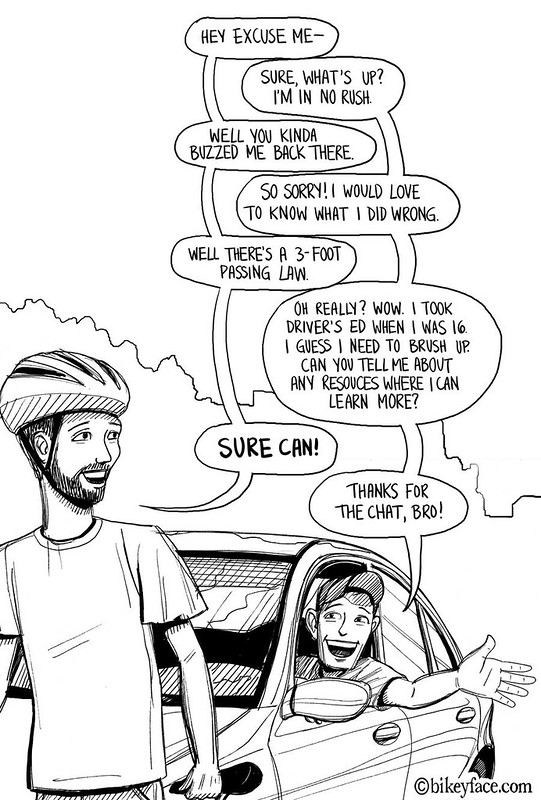
Bikeyface has another great post. Motorist honking… even when they use words they really do not do much better. (You have to see her illustrations!)
https://bikeyface.com/2012/09/20/thick-skin/
But I have to share the last frame as I think it makes a strong point why we need better motorists education:
After all, does this ever happen?
https://dc.streetsblog.org/2012/09/27/lahood-incorrectly-blames-80-percent-of-pedestrians-for-their-own-deaths/
B’ Spokes: I recommend reading the article linked above but I really have to say, If we were talking about motorists making left turns that killed this many, we would get left turn lanes with specialized left turn lights not a "Look before you make a left turn" campaign.
Enough with the trying to shoehorn bikes and peds into car centric infrastructure!
[B’ Spokes: Lots of thoughts went through my head while reading this. If you have an interest in traffic psychology then this is good. I’ll pull out one highlight.]
****************************************************************************************************************
Jon Sutton interviews Ian Walker about how psychology can assist non-car drivers
…
Pedestrians
‘If we think cyclists are ignored by researchers, pedestrians have it even worse. Of the little that is published on pedestrians, almost all of it can be construed as supporting the societal status quo in which pedestrians are firmly held as second-class to people in motor vehicles. Analyses tend to look at why pedestrians are so “reckless” as to “jaywalk” away from their designated crossing areas, rather than to study what I would argue are much more fundamental questions about the social, environmental and health consequences of obliging healthy and harmless walkers to yield priority to inactive and polluting drivers. Ian Roberts and Carolyn Coggan looked at this in a 1994 paper (see tinyurl.com/735bl96) – little has changed.’
…
Continue reading “Vulnerable road users”
By Diana Nelson Jones / Pittsburgh Post-Gazette
…
The civic association has formally requested that the city paint crosswalks at that intersection and reports on its blog — blogski.phcapgh.org — that while it "didn’t initiate this action and doesn’t know who did, we share the concern that motivated it."
Alexis Miller, president of the civic association, said the group has been "voicing concerns on behalf of the community for over a year. The response from the city was that it doesn’t have the means to paint crosswalks at every four-way stop intersection and that it prioritizes based on pedestrian traffic," she said.
…
"The fact that people painted the crosswalks themselves says more than I can say," she added. "People are willing to take action into their own hands. The city said that it would be removed."
…
"I’m proud of this neighborhood, of people who don’t hesitate to do what’s right. I saw the aftermath of an accident" between a van and a car near the intersection a few months ago. "I know cars speed through here. It’s a shame people don’t recognize this is a neighborhood and take the time to be careful."
…
"I love it. Honestly, a lot of people cut through here and don’t realize there are people walking. I think it’s awesome that people here take action when the city doesn’t."
…
Continue reading “Dear crosswalk vigilantes: Thank you! You made my day.”