Via Streets Blog


Biking in Baltimore
Via Streets Blog
[B’ Spokes: America’s obsession with "safe crashing" has gotten so perverse. Just as cycling should NOT be just wear a helmet, end of story, driving a car should not be about "I need a safe car to protect me from all the other idiots out there." We need harder driver licence test and we need stricter traffic enforcement with zero tolerance of traffic fatalities. Death should not be acceptable just so people can go really fast on roads that are not freeways.]
****************************************************************************************
By eric, Eric Peters Autos
The government enacts laws – or issues regulatory fatwas – requiring that new cars comply with various “safety” standards. Ironically, the result of these standards – in terms of vehicle design and otherwise – may just be cars that are less safe to actually drive.
…
But reduced glass area means decreased visibility
,,,
it is very hard to see cross traffic coming at you from either side – making it much more dangerous to enter a busy intersection. Blind spots are larger, too
…
But that Band-Aid [back-up cameras] causes its own slew of problems, including limited peripheral view and a distorted view relative to what a functioning human eye connected to an operating human brain would otherwise perceive. It is much harder (if not impossible) to see a kid on a bike coming down the sidewalk into the path of the backing-up car – because the camera has a limited field of vision. It can’t “see” the kid until the kid is within its narrow field of vision. By which time, it is already too late.
…
Driving around on three normal-sized tires and one skinny minny often results in a very evil-handling (and braking) car. … But, your car got one-tenth of an MPG better gas mileage.
…
https://ericpetersautos.com/2012/10/24/how-safety-requirements-may-make-your-car-less-actually-safe/
[B’ Spokes: I’ll start off with this: The cheapest and best time to add bike lanes is when the street “goes dark” during resurfacing.
Yet a bikeway was not recognized by the State Highway Administration. That is to say during resurfacing SHA removed the bikable shoulder from one half of the roadway when they could for the same money center the new striping to accommodate cyclists on both sides of the road. The short version is SHA has a policy that they don’t have to think about cyclists when resurfacing (but at least we get the requirement to accommodate cyclists on new projects where practicable and feasible.)
My point here, just as cyclists led the Good Road Movement in the 1880’s that lead to the creation of paved roads, we need to put pressure to keep the roads in good repair by more frequent repaving. It’s not just that cyclists love a good smooth road (we do) but roads in poor condition can cause injuries and law suits.
A Mill Valley man who fell off his bicycle during a charity ride through Petaluma last August is suing the city and says that the poor condition of the road is directly responsible for his injuries.
…
Claims and lawsuits against the city for road conditions make up roughly 25 percent of all legal actions by residents, a number that increased by 70 percent between 2009 and 2010, according to Ron Blanquie, the city’s risk manager.
…
https://millvalley.patch.com/articles/mill-valley-man-sues-petaluma-after-bike-incident
And it’s not just cyclists Potholes, Poor Roads Cost Motorists $335 Per Year
And the most damning of all, not keeping the road in good repair wastes tax payer money, as the following article points out.
Conclusion: We need to demand a fix it first mentality when it comes to our roads and we need to demand that they reverse decades long of ignoring cyclists in ALL road projects. It just makes economic sense to think about accommodating cyclists during road resurfacing projects then the current SHA policy of non-requirement to think about cyclists when doing a resurfacing project.
(Note the following was found via Envision Baltimore, subscribe to their newsletter.)]
by Brad Plumer, Washington Post
…
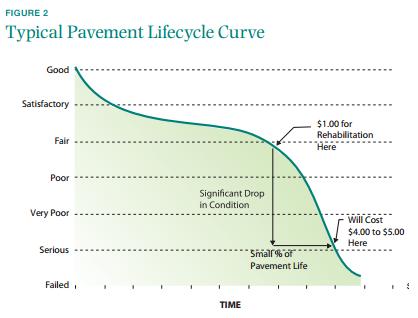
Among other things, there’s a solid economic case for making repairs a much higher priority. As Kahn and Levinson explain, road pavement tends to deteriorate slowly at first but then more quickly over time. It’s much, much cheaper to repair a road early on, when it’s still in “fair” condition, than when it drops down to “serious” condition. And that’s to say nothing of data suggesting that poor road conditions are a “significant factor” in one-third of all fatal crashes , and cause extra wear and tear on cars.
…
Continue reading “‘We don’t need to build more highways out in the suburbs’”
By CHARLES MAROHN, Strong towns
After sixty years of the Suburban Experiment, we have a conditioned response to congestion on our streets: we add automobile capacity. We widen streets, add turning areas, remove parking and add additional lanes. Economists tell us that congestion costs us billions of dollars a year. What if that was backwards? What if congestion was the essential ingredient our cities needed to prosper?
…
We also intuitively understand the economic impact of fighting congestion. With each increase of automobile mobility, we see new investments occurring. Strips malls, big box stores and new housing subdivisions, all signs of progress made possible by increasing automobile mobility. Investment responds to the increase in mobility and coalesces where it can be put to most efficient use. This means the big box retailer is able to compete at a lower price than the corner hardware store. The chain grocer is able to offer a wider selection than the corner grocer. The national coffee shop is able to offer the brand recognition not available to ma and pa.
…
Need a gallon of milk? In an America of Strong Towns, you can get in your car and drive or — if the cost in terms of your time or quality of experience is worth more to you than you would choose to give up in dollar wealth — you can walk down the street to the corner grocer. Today that is considered quaint, but stop wasting enormous sums of money fighting congestion and now that becomes a real choice. Am I going to sit in my car for half an hour on clogged streets to save two dimes on milk or will I just walk up the block?
…
And please understand what I’m saying: We can actually spend lots less, have a government that is smaller and more effective and see a ton of local investment — stuff that will make a city wealthier and more prosperous over the long run — while providing small business opportunities and a growing, stable and diverse workforce. This is a vision for a New America, one much more closely tied to the best of our heritage than the current consumption-centric, faux incarnation of the American Dream.
https://www.strongtowns.org/journal/2012/10/23/embracing-congestion.html
[B’ Spokes: My comments proceed by "->"]
************************************************
by Jim Walsh, The Arizona Republic
After spending decades building wide streets, Valley cities are retrofitting them to improve bicycle and pedestrian safety, cut down on chronic accidents and shift to a healthier, less stressful way of life.
Phoenix, Peoria, Glendale, Scottsdale, Gilbert, Tempe and Mesa have joined a national trend by shifting their design philosophy to seek transportation equality for pedestrians and bicyclists by reconfiguring streets with wider sidewalks, more landscaping, bridges and a few specialized crossings.
National and state statistics show Arizona has a chronic problem with pedestrian deaths. Phoenix ranks fourth on a list of cities with the highest percentage of pedestrian fatalities, behind New York City, Los Angeles and Chicago, according to federal statistics.
…
->[Just to note that in 2009 pedestrian road fatalities Maryland ranked the 4th highest and Arizona the 8th highest in pedestrian fatality rate. ]
Among the unique additions across the Valley is the HAWK, which stands for High-Intensity Activated Crosswalk. Its three lights are activated by a pedestrian in the intersection and are displayed just long enough for a pedestrian to cross. It doesn’t hold up traffic as long as a conventional traffic signal.
->[Please note that AZ is not without it’s traffic lights every mile just like Maryland, HAWK is to accommodate the pedestrian desire line in between major roads, sometimes inaccurately referred to as jaywalking.]
Other efforts to make streets safer include:
Peoria widened sidewalks near several schools and installed two-stage crossings, with pedestrian refuge islands to improve safety, near three high schools. A HAWK was added near Desert Harbor Elementary School at 91st Avenue and Tumblewood Drive. Underpasses separate pedestrians and bicyclists from traffic on major roads along the New River multiuse path.
…
->[Did you catch that? A grade separated trail, no major road crossings at all.]
Glendale installed two HAWKs. One, near 63rd Avenue and Loop 101, connects with a bridge over the freeway to promote bicycle and pedestrian use along a path. The second allows pedestrians to cross from an apartment complex to a shopping center in the 6500 block of West Glendale Avenue. Glendale High School is also nearby.
…
->[A bike/ped bridge over a freeway? Can you imagine that happening in Maryland?]
Valley cities still lag Tucson, which has made a science of pedestrian safety and attracted national acclaim from a federal study for pioneering the HAWK.
Valley cities combined have 24 HAWKs in use or planned, while Tucson has more than 100 after inventing them 12 years ago and using a transit tax to pay for them.
…
"I think there is a recognition that to have a more sustainable community, you have to have less reliance on the automobile," said Kay Fitzpatrick, senior research engineer for the Texas Transportation Institute who authored a July 2010 study that showed the HAWK reduced pedestrian collisions by 69 percent.
…
Arizona’s bleak pedestrian-fatality statistics show residents have reason to fear crossing major streets.
Crash Facts, an annual report on highway crashes produced by the Arizona Department of Transportation, recorded 153 pedestrians killed statewide in 1997, 166 killed in 2001 and 154 killed in 2011.
->[For Maryland 107 in 1997, 101 in 2001 and 101 in 2010 (2011 is not up yet on FARS.) And just to note 114 pedestrians were killed in 2009. So while we have seen a decrease in road fatalities primarily for auto drivers we have yet to see that reduction in pedestrian fatalities, despite being called for in the decade old State’s Bicycle and Pedestrian Access Master Plan and state laws requiring appropriate funding levels for pedestrians (and cyclists.) ]
Nationally, pedestrian fatalities dropped from 5,321 in 1997 to 4,280 in 2010, a 19.5 percent decrease, according to the latest statistics from the National Highway Traffic Safety Administration.
…
Tucson uses a variety of street crossings that sound like a collection of birds. They include:
HAWKs: Usually used midblock or near schools and business shopping centers, they help pedestrians safely cross wide streets where there is a clear source of foot traffic, such as an apartment complex, and a popular destination, such as a grocery store. Shoppers use a HAWK to cross Scottsdale Road between Kierland Commons and the Scottsdale Quarter, two popular shopping malls. The cost can range from $100,000 to $200,000, depending upon extent of wiring and utility work.
Pelicans: Two-stage crossings that help pedestrians cross narrower arterials. Pedestrians cross to a raised island in the median, then use a second crosswalk to reach their destination. The cost is $15,000-$25,000.
Toucans: Short for "two can cross," they allow pedestrians and bicyclists to cross at the same time. It has separate lanes, with a green bicycle logo marking the bicycle lane.
PUFIN: Stands for "pedestrian user-friendly intersection." Pedestrians trigger stoplights by pushing a button. A sensor keeps the lights on longer to allow a slow-moving pedestrian to cross safely.
…
https://www.azcentral.com/arizonarepublic/news/articles/2012/10/02/20121002arizona-road-safety-focus-switches-pedestrians.html
Continue reading “Arizona road-safety focus switches to pedestrians”
BY PETE DONOHUE / NEW YORK DAILY NEWS
Business booms along the streets and avenues the city has refashioned with plazas, protected bicycle lanes and Select Bus Service routes, according to a report Mayor Bloomberg’s administration released Tuesday.
…
On 8th and 9th Aves., between 23rd and 31st Sts., the city created a curbside bicycle lane that is separated from traffic by parking spots and pedestrian safety islands. Sales receipts for businesses were up as much as 49% three years after the project was completed, compared with the full year before the changes, according to the report, "Measuring the Street: New Metrics for 21st Century Sts." The boroughwide increase was just 3%, the study says.
…
https://www.nydailynews.com/new-york/-article-1.1190648
By Eric Jaffe, The Atlantic Cities
In the past few weeks, the long march toward equal road rights for urban bike riders took two big steps forward. In late February, Berkeley instituted a law protecting riders from harassment by granting them the right to civil action, and last week San Francisco officials gave preliminary approval to legislation that requires commercial buildings to let riders take their bikes inside if there’s no bike parking outside. Both laws are the second of their kind in American cities — and perhaps prelude to a wider trend.
Berkeley’s anti-harassment law gives riders the option of filing a civil suit against any driver who assaults, threatens, injures, or intentionally (and maliciously) distracts them. Those acts were already illegal, of course, but they could only be prosecuted as criminal offenses before the new legislation. A successful suit under the new law will require offenders to pay three times the damages or $1,000, whichever is more, as well as attorney’s fees and any other awards.
The city modeled its law on a similar one in Los Angeles — the first city to pass an anti-harassment ordinance for bike riders — which went into effect last September. Before these laws riders were left at the mercy of an urban police force often reluctant to bring criminal charges against drivers who harassed bicyclists. Writing for Streetsblog last fall, attorney Ross Hirsch said the anti-harassment law is "a recognition that that criminal enforcement of harassment and battery laws that currently outlaw certain behavior is essentially non-existent."
…
https://www.theatlanticcities.com/commute/2012/03/california-bikers-rights-movement-continues/1483/
by Angie Schmitt, Streets Blog
Just a few generations ago, streets were places of commerce and play, places to socialize, places where public life happened. The author of the Chicago-based Get Around Blog just finished reading Peter Norton’s book, Fighting Traffic, which outlines in fascinating-yet-depressing detail how the rise of the automobile rudely interrupted this whole way of life.

Children playing in the streets in New York City circa 1900. Image: Apostasies
We’re not going to delve too deeply into history except to offer this quote from a judge, shortly after cars came on the scene: “It won’t be long before children won’t have any rights at all in the streets.”
The Get Around Blog takes the opportunity to show just how far we’ve traveled from the notion of the streets as a public space:
In the century since the automobile first muscled its way to the top of society’s transportation food chain, we have legislated other modes of transportation into a thin sliver of grudgingly reserved leftover space: pedestrians may cross the street at the occasional crosswalk; bicyclists, while technically allowed to operate in the same space and under the same restrictions and protections as cars, are mostly just in the way (and liable to be harassed) if they don’t yield space; and transit users in all but a handful of North American cities suffer poor service and shabby facilities. To add insult to injury, we often turn a blind eye even when cars overstep their formal bounds.
…
This is to say nothing of on-street parking – the notion that one has the unquestioned right to store their private property in the public way. A few years ago, I interned for a non-profit downtown civic organization in the small town where I grew up. The city was mulling a proposal to remove median parking from the road that separates the downtown from the the Snake River in order to improve access to the popular parkland along the banks. Item #1 on every person’s list of complaints: where am I going to park my car when I go to work? That’s not to say I don’t understand their concern, but this illustrates how far we’ve gone down this uncharted path: where once we railed against the car’s invasion of our public space, we now rebuff nearly all attempts to re-allocate even a modicum of roadway to truly public use.
https://streetsblog.net/2012/10/24/remembering-when-our-streets-belonged-to-everyone/