
By SARAH GOODYEAR, The Atlantic Cities
…
The same holds true for depression and other mood problems. People who ride bicycles are almost ridiculously eager – and I include myself in this company – to tell you about how getting on the bike and riding for transportation or for pleasure elevates their mood and helps calm anxiety. It’s one of the reasons that people become so passionately attached to their bicycles. Yet scientists still don’t fully understand why this might be so.
John Ratey, a professor of psychiatry at Harvard University, is one of the people who is trying to figure it out. His 2008 book, Spark: The Revolutionary New Science of Exercise and the Brain, looked at the link between exercise and learning, mood, aging, ADHD, and a host of other mental functions. In an interview with The Independent, Ratey discussed why cycling might be a particularly effective way to both exercise our bodies and sharpen our minds:
…
Cycling, says Ratey, is "like taking a little bit of Prozac and a little bit of Ritalin."
…
https://www.theatlanticcities.com/commute/2013/02/why-we-need-more-research-cycling-and-brain-science/4624/
Relevant to the mandatory helmet discussion

Leaving the Car Behind: Making Cities Walkable [video]
Mayor of New York says roads are not for cars. And cyclists and pedestrians are “more important” than motorists
Via Roads Were Not Built for Cars
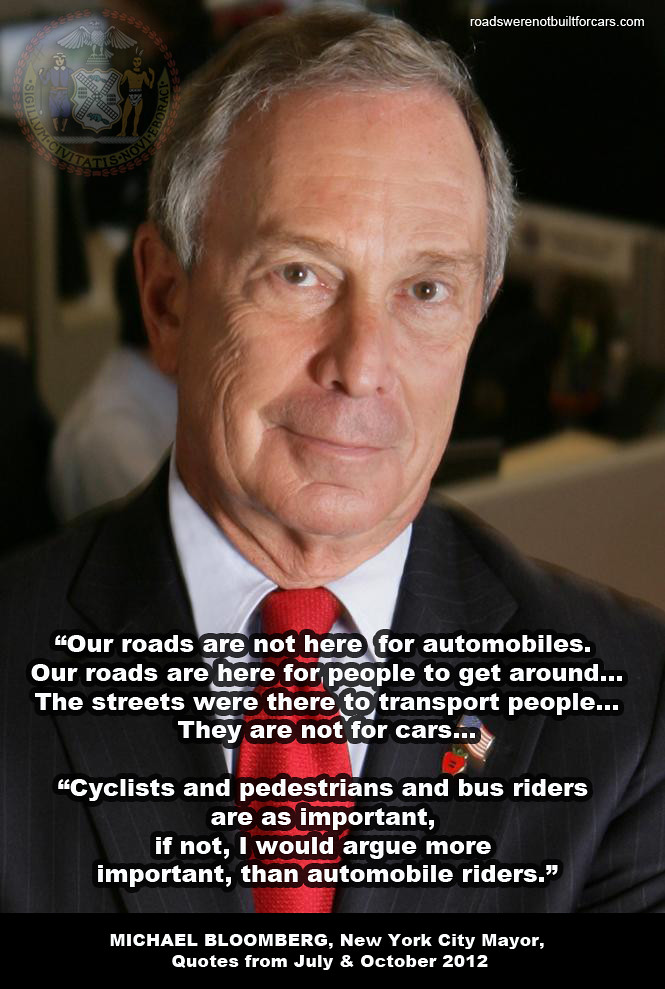
Back in July, Michael Bloomberg, Mayor of New York City, cut the ribbon on a new 20mph ‘slow zone’ in New York and said:
“Our roads are not here for automobiles. Our roads are here for people to get around.”
At a conference earlier this week Bloomberg went further. He told delegates at the Designing Cities conference – hosted by city Department of Transportation Commissioner Janette Sadik-Khan – that:
“The streets were there to transport people. They are not for cars…Cyclists and pedestrians and bus riders are as important, if not, I would argue more important, than automobile riders.”
How dare cyclist hog the road.

If cars were transparent this is what a “crowded” road would look like. People need to realize that (over) accommodating the motor vehicle is a huge waste of resources.
See other views of Street space efficiency by Beyond DC
Bicycling reduces the risk of developing heart disease

Why Transpo Bureaucrats Need to Take More Risks
[B’ Spokes: In short if they never fail they are not doing it right.]
by Angie Schmitt, Streets Blog
Last month, Slate wondered how Washington, D.C. ended up with the best bike-sharing system in the country. The answer was, essentially, vision: Local leaders had it, and they were able to win financial support from the federal government.
But that kind of boldness is too a rare thing in public agencies, says Jarrett Walker at Human Transit. He shares the above video with D.C. Planning Director Harriet Tregoning, who urges government officials not to shy away from risk taking. Walker says her advice is highly applicable to transit planning:
Her discussion of Capital Bikeshare, which failed in its first incarnation and succeeded in its second, is an incisive challenge to the bureaucratic mind, and it’s directly related to transit improvements.
Tregoning’s story here is basically that the first bikeshare system failed because it was too small, too hesitant, while the second one succeeded because it was far bigger, bolder, riskier. Many of the government cultures I’ve known would have decided, based on the first round, never to try bikeshare again. It took courage to say that maybe the lesson was that some things just can’t be done as tiny demonstration projects. You have to build the courage to actually do them, at the natural scale at which they start to work.
Transit network redesign is exactly like that. It’s hard to do in hesitant, reversible phases, because it’s all so interconnected, and because a network doesn’t start to work until it’s all there.
…
https://streetsblog.net/2013/02/04/why-transpo-bureaucrats-need-to-take-more-risks/
Improved signage ;)

[B’ Spokes: I would love to see more signs like this going around then a push for anything goes sidewalk riding.]
Continue reading “Improved signage ;)”
The Diminishing Returns of Highway Building
by Angie Schmitt, Streets Blog
Today on the Streetsblog Network, David Levinson at the Transportationist presents some interesting explanations about why so much American road building is a poor use of funds:

In this image, the black lines represent roads and the blue dotted line represents a traveler. At some point, adding additional roads is subject to diminishing returns, saving people less time per dollar invested. Image: David Levinson
We are not building much new transportation in the US not just because the costs are too high, but because the benefits are too low.
…
https://streetsblog.net/2013/01/10/the-diminishing-returns-of-highway-building/
