
By Lloyd Alter, Tree hugger
I wasn’t going to write about this. It’s just another cyclist killed in Toronto by a truck, where the 25 year old woman was pulled under the wheels of a trailer and had her lower body crushed and took almost a week to die. There are only so many posts you can write about the need for sideguards on trucks, about how little they cost and how easy it would be to do yet the government doesn’t demand them, even though in Britain they reduced deaths by 61%. Even China insists on them. I was looking for analogy; Toyota is recalling millions of cars right now because there might be spiders in the airbags even though nobody has been hurt, but are they recalling trucks even though dozens have been killed? Of course not.
…
https://www.treehugger.com/bikes/another-cyclist-dies-because-north-american-trucks-dont-have-sideguards.html
&&&&&&&&&&&&&&&&&&&&&&&&&&&&&&&&&&&&&&&&&&&&&&&&&&&&&&&&&&&&&&&&&&&&&&&&&&&&&&&&
B’ Spokes: there is also the commercial driver training that is woefully lacking in detail on common mistakes drivers of large trucks make and what should be done to compensate.
Why Bicyclists should be allowed on some trails in some Wilderness*
by Jim Hasenauer, Wilderness Bicycling
Mountain bicycling is a human powered, environmentally sustainable, outdoor recreation that is compatible with the philosophy, history and future of Wilderness. Mountain bicyclists are drawn to wild places, to exploration, to self sufficiency and to traveling under their own power through challenging terrain.
The ban on bicycles in Wilderness is philosophically and historically flawed. It harms a significant number of bicyclists who are being discriminated against. It weakens the environmental and outdoor recreation communities and therefore reduces protection of wild places. Lifting the system-wide ban and creating regulatory language that would allow bicyclists on some trails in some Wilderness is the best public policy.
…
Historical Justification
Some people think that bicycles are banned from Wilderness because they are machines, but the legislative and regulatory history does not bear that out. Bicycles are machines, but (as is discussed on this site) only in the way that oarlocks, hiking poles, ski bindings, some climbing equipment, kayak rudders or even soft-soled shoes are. They lever human effort, but ultimately they are human powered, not “propelled by a non-living power source” as 1966 Wilderness regulations define “mechanical transport”.
…
https://www.wildernessbicycling.org/bikesbelong/bikesbelong.html
Heart Disease, Traffic Jams and ADHD Share One Simple Solution: Drive Less
by Elly Blue, Streets Blog
This is an excerpt from “Bikenomics: How Bicycling Can Save the Economy,” by Elly Blue (Microcosm Publishing, December 1, 2013, bikenomics.com). See our interview with Elly from spring 2013.
Car exhaust is no laughing matter. Nearly half of residents in major urban areas in North America live close enough to highways and other large roads to experience serious problems as a result. Exposure to car emissions worsens and may cause asthma and other lung conditions, including lung cancer. There is evidence to suggest that it leads to hardening of the arteries and thence to heart disease. One study has found an increased risk of heart attacks while in traffic, either while driving or using public transportation. Breathing car exhaust may increase the risk of developing diabetes; it is certain, however, that people who have diabetes suffer disproportionately from the effects of air pollution.
The worst effects of breathing polluted air are experienced where it is densest: in traffic. Spending time on and near highways, freeways, and other busy roads is terrible for your health. How near is a question that is still being studied, but researchers believe that the effects are worst within either a fifth or a third of a mile. People in cars or buses are exposed to considerably more air pollution, perhaps because of, rather than despite, being in a closed space. People walking and bicycling on or next to roads breathe more air, but inhale somewhat less pollution; and cyclists have been found to have even less risk if they are on paths that are separated from the road.
…
Children are particularly at risk, beginning before birth. Air pollution affects prenatal development, and a recent study suggests that exposure to air pollution such as diesel particulates, mercury, and lead may put a child at risk for autism. A separate study found double the rate of autism among children who live within 1,000 feet of a freeway in several major cities. Air pollution has also been linked, tentatively, to hyperactivity in kids and childhood cancers. And kids who have high daily exposure to car exhaust score lower on intelligence tests and have more depression, anxiety, and attention problems. This isn’t just a matter of where children live – one in three public schools in the U.S. are within a quarter mile of a highway, well within the danger zone.
…
https://dc.streetsblog.org/2013/10/18/heart-disease-traffic-jams-and-adhd-share-one-simple-solution-drive-less/
WalkBikeDoBetter PSA [video]
[B’ Spokes: Of course the real issue is our roads are perceived as unsafe so few can feel comfortable venturing outside their homes. And the issue behind the issue is that too many in DOT feel the road should be made unsafe for cyclists and pedestrians, after all that’s how it has been done since the 1950’s. :/ While this video is great we also need to be shaming DOTs for their lack of motivation in making things better.]
The dangers of dooring
B’ Spokes: You’ll note that a featured story here shows a cyclist in a bike lane getting doored. I like bike lanes as much as the next guy but if they can’t be fully out of the door zone something different should be done. And no I don’t think "You can always bring a civil suit." Is much of a deterrent nor does it serve much in the way of informing the general public about the issue.
And the bigger issue is we have motorists who want us to ride far right in the door zone and think we are being very rude, if not illegal when we ride out of the door zone. In a discussion with our Director of Bicycle and Pedestrian Access who does have some background in law said that a car door is only considered a hazard (the lawful requirement we need in order to avoid) when a person is present in the car. There is a lot I can say about that but this news report should suffice as a good enough rebuttal.
https://www.cbc.ca/player/News/TV%20Shows/The%20National/ID/2412614582/
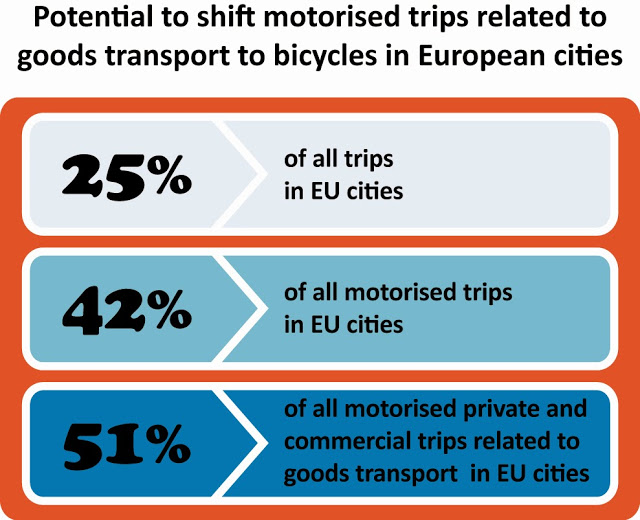
The Massive Potential of Shifting Trips from Car to Bike
NATCO Urban Street Design Guide

B’ Spokes: A typical Baltimore downtown street with cyclist “encouraged” to ride in door zones, ramps that put wheelchair users into the path of cross street traffic and low visibility crosswalks. But can it be improved?

For this and more: https://nacto.org/usdg/
“Bikes vs Cars” Director Fredrik Gertten Sets Out to Expose the Car Lobby
B’ Spokes: More detail about a film project that could be very instrumental in changing how we look at transportation. Please help their Kickstarter campaign if you can.]
https://dc.streetsblog.org/2013/10/17/bikes-vs-cars-director-fredrik-gertten-sets-out-to-expose-the-car-lobby/
Kickstarter: https://www.kickstarter.com/projects/fredrik-gertten/bikes-vs-cars-we-are-many
Janette Sadik-Khan’s TED Talk: “You Can Remake Your Streets”
by Angie Schmitt, Streets Blog
In the six years that Janette Sadik-Khan has headed the New York City Department of Transportation, streets have been transformed. Across the five boroughs, 26 acres of asphalt were converted into 50 pedestrian plazas. New bus lanes are speeding transit trips on major thoroughfares in Manhattan, the Bronx, Staten Island, and soon Brooklyn. The city added dozens of miles of protected on-street bike lanes — groundbreaking designs for an American city — and 350 miles of bikeways overall. The biggest bike-share system in the country launched this May, and now regularly sees 40,000 trips per day.
…
These changes have improved safety, boosted retail performance, and elicited impressive public approval ratings despite TV and tabloid coverage that tended to be outlandishly negative. Sadik-Khan emphasized that it wouldn’t have been possible to accomplish so much in such a short time frame if it weren’t for the original stroke of genius: the decision to test things out to see what succeeds.
“The temporary materials are important because we were able to show how it worked,” she says…
…
https://dc.streetsblog.org/2013/10/17/janette-sadik-khans-ted-talk-you-can-remake-your-streets/
*******************************************************************************************************
[B’ Spokes: I’ll stress with a little paint (a temporary material) we can and should try some innovative designs over a trial period. If they don’t perform well then take them away, at least we can learn what does and does not work here. We need more experiments and a lot less of what I perceive as "Because of some mysterious calculations all done in my head we can’t accommodate bicyclists here." ]
ADVOCATES DELIVER BIKE/PED STRATEGIES/METRICS TO US DOT
-> According to a Sept. 11th Alliance for Biking and Walking article, "Last week, the US Department of Transportation released their draft strategic plan, a document that will determine how the DOT will manage the United States’ transportation over the next five years. But there was a slight problem: the plan lacked vision for bicycling and walking…So state and local biking and walking advocacy organizations in the United States kicked into high gear. With help and policy recommendations from our friends at the League of American Bicyclists and the Safe Routes to School National Partnership, state and local advocates joined onto a letter asking the US DOT to incorporate real strategic reforms for better biking and walking in the U.S. (https://bit.ly/18XWiHV). In a resounding show of support, over 80 organizations signed on…
"Here’s what we told the US DOT:
* Don’t just pay lip service to safety. We urged the Department to set a hard goal to reduce bicyclist and pedestrian roadway fatalities by 50 percent by 2020.
* Build livable communities by building spaces where people have the option to walk and bike. We encouraged the Department to set a goal to increase bicycle mode share nationally to 5% by 2025 and pedestrian mode share nationally to 25% by 2025.
* Help create new projects that incorporate the needs of all people, not only people in cars. We urged regulators to implement a Complete Streets approach when designing safety measures…"
Source: https://bit.ly/1fB0N2d
from CenterLines, the e-newsletter of the National Center for Bicycling & Walking.