89% of cyclists traveled in a safe and legal manner

By Leighton Walter Kille, Journalists Resource

Walking, bicycling

  • Between 2000 and 2009, on average 6,067 pedestrians and bicyclists died on U.S. highways and in collisions with other modes of transport. Of these, 4,930 died when hit by cars and trucks operated by private users, 545 deaths resulted from collisions with commercial carriers, and 592 from commercial users not on highways.
  • In all, fatalities of pedestrians and bicyclists make up nearly 15% of annual average highway fatalities. More than 90% of pedestrian fatalities occurred in collisions with automobiles and light trucks.
  • A related study on risk factors for on-road cycling commuters indicated that prior to car-bicycle accidents, 89% of cyclists were traveled in a safe and legal manner. In addition, vehicle drivers were at fault in 87% of the events.

U.S. transportation safety over time: Cars, planes, trains, walking, cycling

America’s next big rip-off: Cars are the next subprime crisis!

[B’ Spokes: This concerns me because if we design the right to travel solely around the automobile then government is subtily coercing the financially vulnerable into making a big mistake.]
************************************************************
With financial firms now pushing strongly into auto loans, here’s how Congress is helping car dealers rip you off
https://www.salon.com/2013/11/27/americas_next_big_rip_off_car_loans/

Cops do the darndest things, when it comes to dealing with cyclists and pedestrians

Treehugger list these recent stories:
* You can’t walk your kids to school in Cumberland County.
* Charlotte grandma cited for letting kids ride bikes on the street
* In New York, they ticket you for riding in the bike lane
* In London, man carrying kids in cargo bike gets stopped by cops
https://www.treehugger.com/bikes/cops-do-darndest-things-when-it-comes-deailng-bicyclists-and-pedestrians.html

4 things U.S. college towns could teach planners about biking

by Michael Andersen, Bike Portland
Here’s a secret you won’t hear often: The United States has many cities where biking is far more popular than in Portland.

Davis, Calif. – 19.1% of workers commute by bike

Universities breed 20-minute neighborhoods.

Universities create car-free spaces.

Universities use public spaces to enable density.

Universities charge for auto parking.

https://bikeportland.org/2013/11/20/4-things-college-towns-could-teach-portland-about-biking-97418

NYC DOT Shares Its Five Principles for Designing Safer Streets

by Ben Fried, Streets Blog

  • Make the street easy to use by accommodating desire lines and minimizing the complexity of driving, walking, and biking, thus reducing crash risk by providing a direct, simple way to move through the street network.
  • Create safety in numbers, which makes vulnerable street users such as pedestrians and cyclists more visible. The same design principle, applied to arterial streets when traffic is light, reduces the opportunity for excessive speeds.
  • Make the invisible visible by putting users where they can see each other.
  • Choose quality over quantity so that roadway and intersection geometries serve the first three design principles.
  • Look beyond the (immediate) problem by expanding the focus area if solutions at a particular location can’t be addressed in isolation.

https://www.streetsblog.org/2013/11/21/nyc-dot-shares-its-five-principles-for-designing-safer-streets

Activists Take Brooklyn Speed Limit Into Own Hands, Install 20mph Signs in Park Slope

By KATE HINDS, WNYC
Calling it "a gift to the city," a group of activists changed the speed limit in Park Slope this weekend by hanging rogue 20 mph speed limit signs along Prospect Park West.
Safe streets activists with the group Right of Way installed the signs on Saturday night around 10pm. Organizer Keegan Stephan says the group was motivated by recent pedestrian deaths — and statistics showing a lower speed limit save lives.
"A pedestrian hit by a car going 20 mph has a 95% chance of survival," he said, who added that a WNYC map showed the city could lower the speed limit to 20 miles per hour across two-thirds of city under current state law. "We don’t understand why they’re not, (so) we took it upon ourselves."

https://www.wnyc.org/story/d-i-y-20mph-speed-limit-signs-line-brooklyn-streets/?utm_source=sharedUrl&utm_media=metatag&utm_campaign=sharedUrl

The Bypass of Commerce

By NATHANIEL M. HOOD, Strong Towns
We have a cultural misunderstanding about the economic benefits of mobility.
There is no better example than the State of Minnesota’s new $300 million “Corridors of Commerce” program designed to foster “economic growth with transportation investments.” This is a noble goal and it’s worked well in the past, so why not keep it up?
First, we built highways that connected places that were never before directly connected. This was an enormous benefit to rural populations and opened up to more marketplaces. Towns that were once a 5 hour journey apart turned into an easy 1 hour trip. There is no question that this created an economic benefit.
But, we’ve continued building and expanding this roadway system to much diminishing return. The Corridors of Commerce project is just another example of this misapplication of limited transportation dollars.

https://www.strongtowns.org/journal/2013/11/20/the-bypass-of-commerce.html

A Law Like No Other

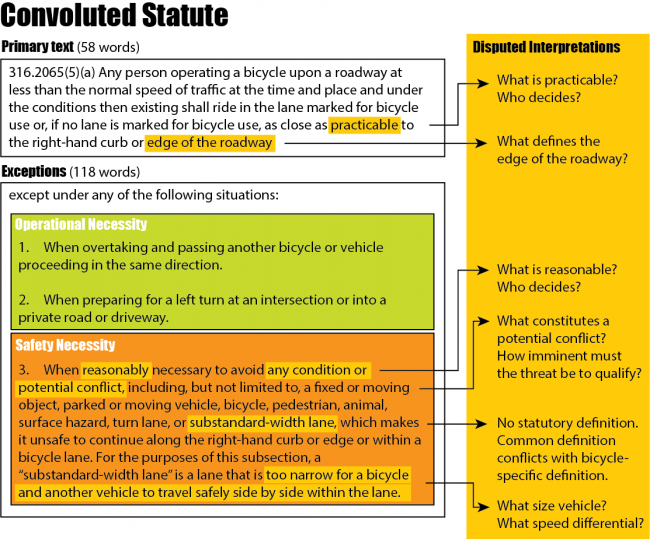
[B’ Spokes: A very good explanation of what’s wrong with our “Ride as Far Right as Practicable” law. I’ll add something to this argument, bicycling law does makes no mention of maintaining a straight and predictable course. A Baltimore City Police stopped me once for not riding far right (translation not riding in the parking space of three cars.) I asked if he thought weaving in and out of traffic was safer?

As typical, here are some highlights:]


by Keri, Commute Orlando

Most laws are clear and reinforce safety.

Most traffic laws have a clear purpose — to reinforce the rules of movement that make roadway users predictable to one another. These laws don’t interfere with road users’ ability to travel safely. They’re barely even noticeable to the conscientious driver, who appreciates enforcement of them because that makes the system safer for him.

When a normal traffic citation is challenged, it is challenged on the basis of whether or not the driver was breaking a clearly defined law. Did the driver make a complete stop at the stop sign? Did the driver enter the intersection before or after the light turned red. Was the driver going faster than the speed limit? Interpretation of the law itself is not the issue. The issue is whether or not the police officer accurately witnessed the infraction. In many cases, people contest traffic citations in the hope that the officer won’t show up in court (providing automatic dismissal), or they seek to have the points removed from their record. No one would ever argue that they were speeding or running a red light because it was safer.

Bicyclists are the only vehicle drivers who must defend themselves to an officer or judge for driving defensively.

image

image

image

In every scenario, the bicyclist suffers some loss, even though he was operating lawfully!

https://commuteorlando.com/wordpress/2013/11/19/a-law-like-no-other/