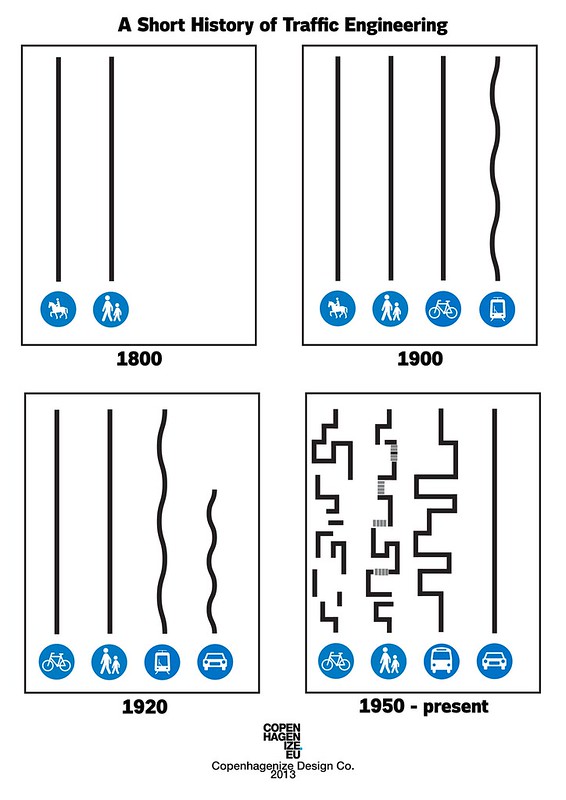
 Attribution Some rights reserved by Mikael Colville-Andersen
Via The Copenhagenize Guide to Liveable Cities (And my friend Bob)
[B’ Spokes: Because we all know the fast need to go faster and the slow don’t mind going even slower. :/ ]

Biking in Baltimore
Attribution Some rights reserved by Mikael Colville-Andersen
Via The Copenhagenize Guide to Liveable Cities (And my friend Bob)
[B’ Spokes: Because we all know the fast need to go faster and the slow don’t mind going even slower. :/ ]
British Cycling policy advisor says it’s time to stop distracting helmet arguments and concentrate on real safety issues
by John Stevenson, Road CC
…
Talking to road.cc at the London Bike Show, Boardman said, “I think the helmet issue is a massive red herring. It’s not even in the top 10 of things you need to do to keep cycling safe or more widely, save the most lives.”
You’re being shot at, put on body armour
Boardman returned to an analogy he has made before, and which even he admits is a bit melodramatic, though it gets the point across
“It’s a bit like saying ‘people are sniping at you going down this street, so put some body armour on,’” he said.
Government encouragement to wear helmets was therefore “a big campaign to get people to wear body armour, by the people who should be stopping the shooting.”
Widespread use of helmets, he said, sends the wrong message.
“Once you see somebody wearing body armour, even if there’s no shooting, you think ‘Christ I’m not going down there if they’re wearing body armour to go down that street.’ It scares people off.”
…
https://road.cc/content/news/111258-chris-boardman-helmets-not-even-top-10-things-keep-cycling-safe
By Jonathan Krall, Alexandria Times
While not intentional, biking and walking upset the transit social order. According to conventional thinking, roads are for cars, slow drivers are “bad drivers,” and cyclists and pedestrians should stay out of the way.
The idea that roads should be safe and effective for all users — the concept known as complete streets — aims to upend this social order, moving cars from first to last.
The longstanding order of the road is governed not by laws, but by socially enforced rules. For example, one might voluntarily drive below the speed limit on the Beltway.
That would be perfectly legal but likely would garner honks, flashing headlights and rude gestures. As everyone knows, appropriate driving speeds begin at the speed limit and extend upward, not downward. The power of these rules is such that police rarely issue a ticket, photographic or otherwise, for driving up to 10 mph above the speed limit.
All this came to mind the other day, when I was bicycling in violation of the social order. I was riding in the center of a narrow lane when a driver started honking at me. Shortly thereafter, he pulled alongside me and helpfully explained that cyclists are not allowed in the street unless they can ride at the speed limit.
This struck me as quite the head-scratcher. After all, isn’t the speed limit an upper limit? Those of us with Internet access have certainly read that cyclists should not be allowed on the road unless they “obey the law.” Riding at a typical bicycle speed surely complies with the law. Nevertheless, I’ve been told — even by friends — that cyclists must ride at the speed limit.
As it turns out, the speed limit is the single point of intersection between socially acceptable driving speeds and socially acceptable bicycling speeds. Cyclists who do not ride this tightrope — and that would be all of them — are in violation of at least one of these social conventions.
Despite endless discussions about safety and the law, increasingly it is clear to me that many people get upset by social rather than legal violations of the rules. While the majority of drivers remain polite, a vocal minority is extremely attached to the status quo.
As old gives way to new, outdated ideas fall by the wayside. One of these is that automobile traffic is an unstoppable force. As a pedestrian, it is up to me to get out of the way or suffer the consequences. As a cyclist, there is no point in asking for bike lanes because they would simply put me in harm’s way.
The complete-streets concept recognizes that individual drivers, cyclists and pedestrians rule traffic. Each is able to slow down and even stop to avoid a crash. Complete streets are updated streets, often with narrower traffic lanes that have been demonstrated to slow motorized traffic. With complete streets, pedestrians come first, followed by transit, cyclists and cars.
…
Responding to the failure of the automobile to deliver promises of speed and freedom to 100 percent of the population, people take up walking and bicycling
…
A 2012 nationwide poll, reported by McCann, showed that “63 percent of Americans would like to address traffic congestion by improving public transportation and designing communities for easier walking and bicycling.” While frustrating for some, these changes are supported by a majority of residents. The new social order, it seems, is here to stay.
https://alextimes.com/2014/02/move-along-upending-the-social-order-on-our-roads/
Via Bicycle Law
What if there was something you could do to improve your health and fitness, save money, reduce our dependence on foreign oil, improve air quality, and reduce your carbon footprint, all at the same time—would you do it?
Maybe that’s a bit of preaching to the choir here, but that’s the idea behind The 1-Mile Solution. As Andy Cline explains,
The idea is simple: Find your home on a map…Draw a circle with a 1-mile radius around your home. Try to replace one car trip per week within that circle by riding a bicycle or walking. At an easy riding pace you can travel one mile on a bicycle in about seven minutes. Walking takes about 20 minutes at an easy pace.
Now I know Legally Speaking readers generally put in their miles every week, but the concept here is a little different. According to Two-Wheeled Wonder, an article published in the March/April issue of Sierra, “nearly half of all trips in the United States are three miles or less; more than a quarter are less than a mile.” As the Sierra article notes,
Short car trips are, naturally, the easiest to replace with a bike trip (or even walking). Mile for mile, they are also the most polluting. Engines running cold produce four times the carbon monoxide and twice the volatile organic compounds of engines running hot. And smog-forming (and carcinogenic) VOCs continue to evaporate from an engine until it cools off, whether the engine’s been running for five minutes or five hours.
Discussing the Impact of the 1-Mile Solution. Andy Cline cites research from Professor Chandra Bhat that reveals that “the transportation sector accounts for about one-third of all human-generated greenhouse gas emissions. Within that sector, travel by personal vehicles accounts for nearly two-thirds of those emissions.”
With the 1-Mile Solution, Cline proposes a simple means for each of us to reduce the impacts associated with these short trips—once a week, make a trip make a trip of one mile or less from your home by bicycle, or on foot, rather than by car. As Cline observes,
You start out small. You commit to one trip per week by foot or on a bicycle within a 1-mile radius of home. One mile is not far. At a modest pace it’s a 20-minute walk (great exercise!) or a 6-minute bicycle ride. The idea, of course, is that we’ll all see how easy one mile is and then begin replacing two trips per week. Then three. And soon enough, we’re routinely walking and riding within the circle.
Some of us are already making our short trips by bike; others have yet to make the change, or have friends and family who make all of their short trips by car. Because it’s so easy, the 1-Mile Solution is the kind of change that almost anybody can incorporate into their lives. As the year draws to an end, and a new year begins, that’s something to think about.
Wishing all of you a very happy new year,
Bob
(Research and drafting provided by Rick Bernardi, J.D.)
This article, The 1-Mile Solution, originally published on Dec. 31, 2008 on VeloNews.
https://www.bicyclelaw.com/articles/a.cfm/legally-speaking-the-1-mile-solution

[B’ Spokes: What amazes me is how many think 2 miles on a bike is too far for a human to travel under their own power unless they are uber fit.]
Continue reading “Ride your bike”
by Tanya Snyder, Streets Blog
Enforcement of jaywalking doesn’t improve pedestrian safety. So what will? Tom Vanderbilt, best-selling author of Traffic: Why We Drive the Way We Do, gave a succinct answer in a New York Times op-ed this weekend. Our cities will be safer to walk in when we have “better walking infrastructure, slower car speeds and more pedestrians.”
It’s that simple. Police departments in cities around the country — including, disappointingly, Bill de Blasio’s New York — crack down on pedestrians who break the letter of the law even though, Vanderbilt says, “more pedestrians generally are killed in urban areas by cars violating their right of way than are rogue pedestrians violating vehicles’ right of way.”
…
But his larger point is indisputable: Blaming pedestrians for the destruction wrought by motorists is disastrously misguided. Drivers need to be held responsible for any crash they could have reasonably prevented, no matter what the pedestrian was doing. The fact that the most vulnerable and least destructive people on the streets are getting hefty fines from police is ludicrous. If we want to make our streets safer for people walking, we will design our streets to welcome and protect them.
https://dc.streetsblog.org/2014/02/03/tom-vanderbilt-in-nyt-jaywalking-tickets-dont-make-streets-safer/
By Carmela Fragomeni, The Spec
…
New Hope has three bikes — two cargoes and a box model that rides like a normal bicycle — and plans to have three more by April.
The bikes are part of a pilot project launching April 1 with $6,500 from the Hamilton Community Foundation, Hibma says.
The project is specific to the Crown Point neighbourhood, bordered by Burlington Street to the Mountain and from Gage to Kenilworth avenues.
The Cargo Bike Sharing idea came from people’s interest in borrowing a similar cargo bike New Hope built from an old ice cream trike used to teach bike safety and give tune-ups at local schools, Hibma said.
The bikes will be rented for mostly a few hours at a time for a cost cheaper than daily bus fare, he added.
[B’ Spokes: There is a lot of interest among those in Government to support tourism. The reason is simple, it’s outside money spent locally. What I will assert is the reverse of tourism is overly supporting the automobile because it’s local money that goes away from the localities and the state.]
******************************************************************************
Via The Union of Concerned Scientists
Vehicle owners, on average, spend almost as much on gas as on the vehicle itself—benefiting oil companies and virtually no one else.
…
The results are clear. Your gas money doesn’t support your local gas station, nor does it benefit you financially, even if you own oil company stock. Most of the money you spend at the pump goes directly to one place: oil companies.
…
Out of the more than $22,000 spent on gas over the lifetime of an average vehicle bought in 2011, oil companies rake in about $15,000.
Of the remainder, 14 percent of the money spent on gasoline goes to taxes that help pay for roads and transportation services, 10 percent to refining costs, and 8 percent to distribution and marketing.
Gas stations average only three to five cents of profit from each gallon of gasoline sold. They make more profit off the bottled water and candy you buy inside than off the fuel you buy outside.
…
You gain virtually nothing in return—even if you own stock in oil companies
Regardless of how many shares you may own in oil companies, your oil use does not benefit your bottom line.
Say you have $20,000 invested in ExxonMobil, the largest publicly traded oil company in the world. If you spent $1,700 on gas from ExxonMobil over the course of a year, your fuel purchase would yield far less than a penny in stock earnings. Even if you had $1 million invested, you would still get less than one cent in return after spending almost $2,000 on gasoline.
…
https://www.ucsusa.org/clean_vehicles/smart-transportation-solutions/better-fuel-efficiency/where-your-gas-money-goes.html
By Lloyd Alter, Treehugger.
…
For most Gen Y buyers, also known as Millennials, skipping a vehicle purchase is preferable to forgoing technology. Smartphones, laptops and tablet devices compete for their dollars and are higher priorities than vehicle purchases, said Joe Vitale, an automotive consultant with Deloitte. Financing, parking, servicing and insuring a vehicle all add up to a commitment that cash-strapped Millennials aren’t ready to make, he said. “A vehicle is really a discretionary purchase and a secondary need versus an iPhone, mobile phone or personal computer,” Vitale said.
…
Driving isn’t fun anymore.
Finally, it has to be pointed out that driving just isn’t as much fun as it used to be. The roads are clogged, the parking is hard to find, you don’t pick people up by cruising down Main Street anymore, you can’t fiddle with your car because they have turned into computers. To get all anecdotal, I used to take my Volkswagen Beetles apart on the side of the road if I had to fix something. I used to drive everywhere and never had trouble finding parking. I still have a sports car (an 89 Miata) but I never use it in the city, I bike everywhere year round. It’s faster, cheaper, good exercise and frankly, a lot more fun than driving in downtown Toronto. When we go anywhere now, I let my wife drive so that I can look at my iPad and catch up on my reading.
…
[B’ Spokes: I’ll note that now I am driving a bit I find using my bike routes a lot more pleasant then the typical car route. Being a cyclist has more benefits then what first meets the eye. 😉 ]
By Lloyd Alter. Treehugger
We have been writing so much lately about helmet laws and people on bikes getting squished that you might think that cycling is dangerous. In fact, the opposite is true; Karin Olafson suggests in Momentum Magazine that bicycling is a form of preventative health care. She writes:
"The US Centers for Disease Control and Prevention (CDC) has identified the positive impact of making cities more bike-friendly: “integrating health-enhancing choices into transportation policy has the potential to save lives by preventing chronic diseases, reducing and preventing motor-vehicle-related injury and deaths, improving environmental health, while stimulating economic development, and ensuring access for all people.” The CDC also recognized that a lack of efficient transportation alternatives to driving and a fear of biking in heavy traffic only encouraged people to continue to drive all or most of the time."
She claims that with safe bike routes that encouraged people to ride, "billions of health care dollars saved."
…
https://www.treehugger.com/bikes/bicycling-form-preventative-health-care.html
 ©
©