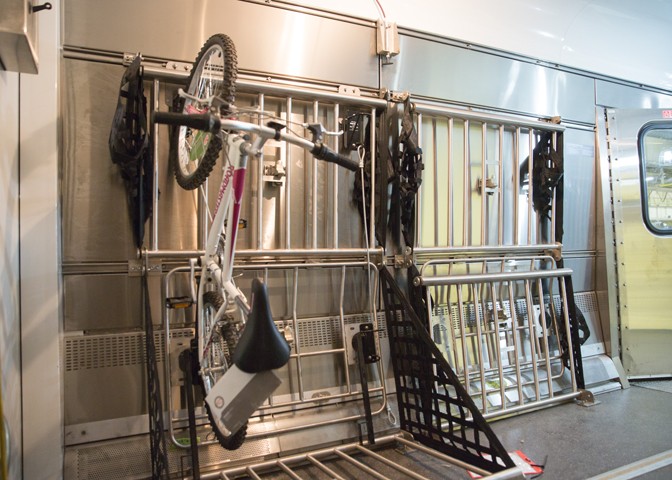
Read more: https://blog.amtrak.com/2014/06/new-baggage-cars/
Biking in Baltimore
Via Willamette Week

By Bob Mionske, Bicycle Law
I recently had the opportunity to talk with North Carolina bicycle accident lawyer Ann Groninger. Ann had recently written a well-received article about being buzzed on a morning ride. Or I should say, it was well-received by cyclists, all of whom have had similar experiences on the road. But some motorists had a different reaction, expressing their disdain for “scofflaw cyclists” (despite the fact that Ann had been riding lawfully, and was nearly hit by a “scofflaw driver”), or worse, expressing a thinly-veiled intent to assault cyclists with their vehicles. Before writing about her own brush with near-disaster, Ann had written another excellent article asking “Are bicycle crashes accidents?” Ann had also written about personalizing the consequences of bicycle crashes—in this case, the impact that a negligent driver had on the cyclist she hit, and on his widow.
It was clear from Ann’s articles that she wants drivers to understand that, in her words, “these stories personalize the consequences of taking unnecessary risks when driving”… “what I want to talk about is the value of human life and how people can take it so lightly…by riding my bike on the road, especially alone, I am putting my life in the hands of people who don’t care about it and are willing to take pretty big risks with it.” For Ann, these stories “should be a daily wake-up call” for anyone with a conscience.
…
Ann: Riding a bike was such an important part of my childhood, and I think most peoples’ childhoods. For many reasons – safety, more indoor options, more organized activities – I think it’s tougher for kids these days to just get out and ride. A lot of them will miss that unique feeling of freedom a bike gives you, which is sad.
Also, young kids today are tomorrow’s drivers. If we can teach our kids respect for the road while riding their bikes they will hopefully carry that respect over to driving a car.
…
https://www.bicyclelaw.com/blog/index.cfm/2014/6/13/The-Bike-Law-Interview-Ann-Groninger-Bike-Law-North-Carolina-On-Raising-The-Next-Generation
By Joseph Rose, Oregon Live
Is there any activity that helps people of all languages discover new curse words more than assembling Ikea furniture?
Well, put on your bike helmet and get out the swear jar: The Swedish-based home furnishings company is getting into the bicycle business.
Meet the Folkvänlig, an $1,000 electric bicycle that it hopes will get more commuters out of their cars in cities worldwide. The product’s name is derived from the Swedish words for people and friendly.
Here are the details (or “detaljernas”):
…
https://www.oregonlive.com/commuting/index.ssf/2014/05/ikea_to_sell_electric_bicycle.html
“We found that people are in the best mood while they are bicycling compared to any other mode of transportation,” said Eric Morris, lead author on the study and assistant professor in Clemson’s planning, development and preservation department.
https://newsstand.clemson.edu/mediarelations/study-finds-how-mode-of-transportation-affects-how-we-feel/
by Angie Schmitt. Streets Blog
Of all the places we encounter throughout the day, intersections have perhaps the most strictly prescribed rules. But the way people actually behave at intersections differs a great deal, depending on the mode of transportation, the place, the time of day — all sorts of factors.
Adonia Lugo at Urban Adonia says she’s seen observance of these rules vary wildly from city to city, and it got her thinking about why people negotiate some intersections differently than others:
There are laws, there are stripes, there are bollards, and then there are all these randos doing what they think is best. As a street ethnographer, I have observed that some intersections are more “elastic” than others, and this flexibility comes from people’s attitudes rather than road design.
When I first started bike commuting in Portland, the heart of Law Abiding Cyclist Country, I got really jazzed about always stopping at stop signs and red lights. It made sense to me that I could make drivers take me seriously by behaving predictably. I’d grown up in a place where jaywalking meant running across the street, because pedestrians having priority was more theoretical than real. So it followed that, using this new mode of transport, I should do what the signs told me to do…
Now I’m in Washington, D.C, and wow, I look like a country mouse when I hesitate at intersections. Every time I pull up on a bike or on foot at a corner, others stream past me. The signals here seem to be more suggestions than anything else. Drivers, too, inch forward as much as they can, sometimes being halfway through the intersection before the light turns green.
Since I’ve observed so many other bike users and pedestrians, and as I noted, even motorists, making the point, it’s hard for me to ignore the logic of pressing forward into empty space. Traffic signals should guarantee right of way, from a predictability standpoint, but should they impede the flow of people when there’s no right of way to protect?
I know that a lot of our road design standards have been developed through years of liability lawsuits and efforts to control safety. It’s just weird to me that the reality, as seen from the everyday scale of ethnography, is a lot more pragmatic. If we really want to promote active transportation, shouldn’t we legitimize the greater elasticity walking and biking afford? Does it really make sense to limit these modes according to the car-based paradigm of traffic engineering?
https://streetsblog.net/2014/05/27/what-makes-some-intersections-more-elastic-than-others/
By Richard Layman, Rebuilding Place in the Urban Space
I pissed off some people a couple days ago when I commented that three presenters (from Ontario, UK and Australia) providing guidance to US stakeholders about creating a national bike strategy didn’t have much to offer us.
So I have been thinking about what should be included in the introductory components to a US national bike strategy plan.
Sure, some of these places have more bike commuters than we do nationally, but the US is a lot more suburban and gasoline is taxed much less, which makes a huge difference, which was captured in an article by John Pucher, “Why Canadians cycle more than Americans: A comparative analysis of bicycling trends and policies” from Transport Policy journal:
In spite of their colder climate, Canadians cycle about three times more than Americans. The main reasons for this difference are Canada’s higher urban densities and mixed-use development, shorter trip distances, lower incomes, higher costs of owning, driving and parking a car, safer cycling conditions, and more extensive cycling infrastructure and training programs. Most of these factors result from differences between Canada and the United States in their transport and land-use policies, and not from intrinsic differences in history, culture or resource availability.
It should be no surprise that the US and the UK (e.g., “Britons unmoved by pro-cycling campaigns: Most regard bicycles not as legitimate form of transport but as children’s toys or preserve of hobbyists, research finds,” Guardian), given the prevalence of the “vehicular cycling” concept, have significantly fewer people cycling for transportation compared to countries where sustainable mobility is actively promoted.
That doesn’t mean we can’t learn from those places.
…
2. Change how DC Government benchmarks its policies and regulations against the nation’s leading cities with the aim of adopting best and leading practices, rather than being content with making changes that still lag best practice.
[B’ Spokes: It amazes me how many in government are content in areas where we are below average. We need benchmarks that can help put us above average, at least a little bit. ]
…
2. Transportation Physics and Mobility Throughput. This is pretty basic, that you can move more people by walking or transit or biking in the same amount of space used by cars. E.g.
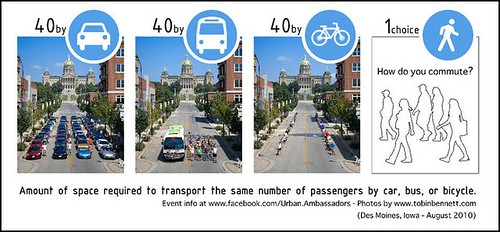
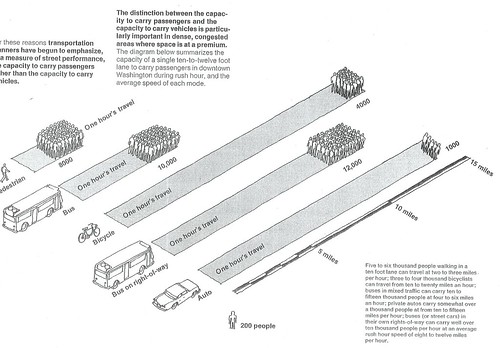
Mobility efficiency diagram. Central Washington Transportation and Civic Design Study, 1977.
…
https://urbanplacesandspaces.blogspot.com/2014/03/what-should-us-national-bike-strategy.html
[B’ Spokes: I highly recommend that the planers and advocates read the whole thing.]