The Critical Ten

[B’ Spokes: I’m posting this because I think the speed limit on the most northern part of Roland Ave (where Tom was killed) is too high. Why does anyone “need” to travel 35 mph for ~ 1/2 mile when the rest of the street is 25 mph?]


By Bill Lindeke, Streets MN

The problem is that for a good urban street, this muddy “middle ground” between ‘walkable’ and ‘driver’s paradise’ can sometimes be the worst of both worlds.


image

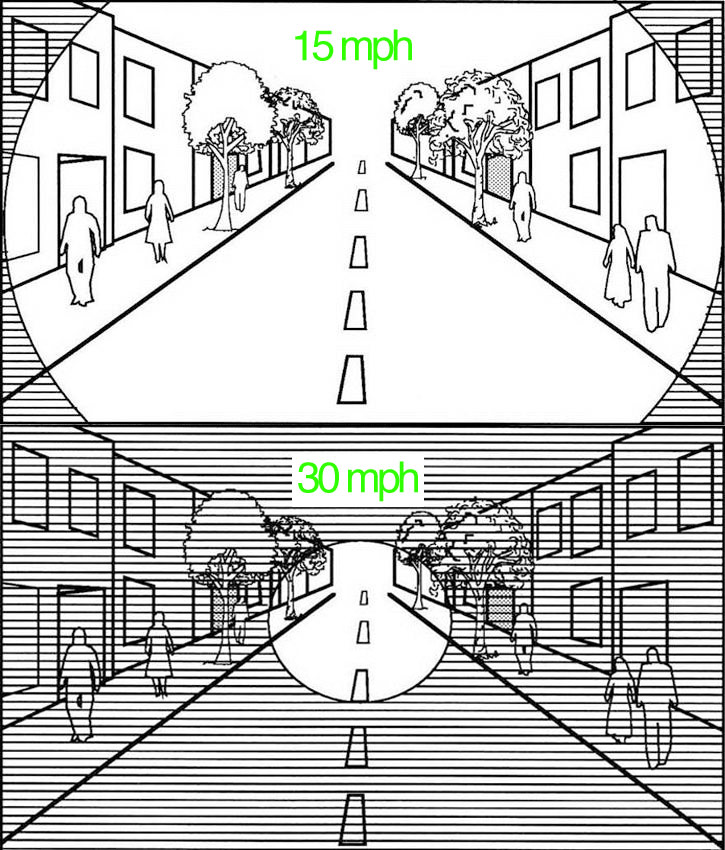
The Critical Difference Between 30 and 20

I’m talking about traffic speed. If you look at the average speed of traffic on a urban commercial streets, there are a lot of things that begin to change when you slow down cars from the 30 to 35 mile per hour range into the 20 to 25 mile per hour range. Most importantly, perception, reaction time, and crash outcomes are far better at 20 than at 30 mph, while traffic flow doesn’t seem to change very much.

image

https://streets.mn/2015/04/02/the-critical-ten/

TRANSPORTATION ENGINEERS QUESTION USE OF COMMON PRACTICES & METRICS

-> This month, for at least the second time in a year, the Institute of Transportation Engineers has challenged its members to rethink common practices and metrics that are often thought of as objective and unbiased, but that convey values that arent necessarily in line with the greater public interest. In particular, these values emphasize the movement of vehicles above all other interests.
In an op-ed for this months ITE Journal (https://bit.ly/1yUOu8l), Jason DeGray, a licensed engineer and a member of the groups advocacy committee… argues that conventional approaches to engineering, developed over years of outward suburban growth, are particularly biased toward motorized road users–most noticeably in urban areas.
A feature article in the ITE Journals August 2014 issue, titled Decisions, Values, and Data: Understanding Bias in Transportation Performance Measures (https://bit.ly/1CeAI1D), gives an example of one such metric–level of service–explains precisely how it reflects values and biases inherent to transportation design… [https://bit.ly/1c5G4WK]

Toward Zero Traffic Deaths like it’s 1975 :/

by Angie Schmitt, Streets Blog

The document was produced by the American Association of State Highway and Transportation Officials (the body represents state DOTs), in coordination with the Federal Highway Administration and a number of safety and law enforcement groups. Take a look at what they’re proposing and it’s clear the mentality of these institutions hasn’t evolved much in the past 40 years, even as America falls farther behind countries with far safer streets.

All fine ideas that make a difference, but this formula leaves out many other strategies adopted by countries like Germany, Japan, and the UK — countries where the per capita traffic fatality rate is less than half the rate in America.

https://usa.streetsblog.org/2015/03/20/the-american-highway-safety-establishment-warms-up-some-leftovers/

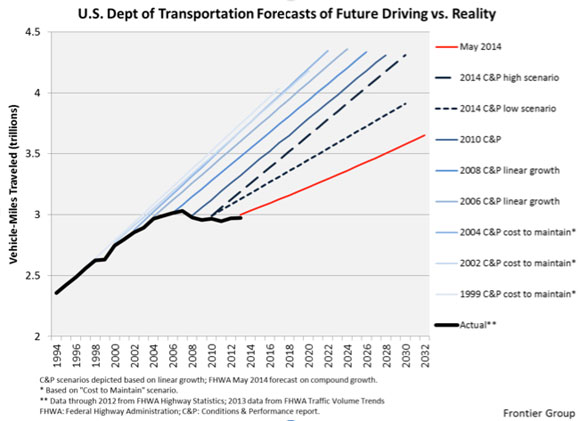
The Feds Quietly Acknowledge the Driving Boom Is Over

by Phineas Baxandall, Streets blog

image

Some states, like Washington and Maryland, have begun to ratchet down their forecasts of future VMT.

https://usa.streetsblog.org/2015/01/07/the-feds-quietly-acknowledge-the-driving-boom-is-over/


[B’ Spokes: While true I have seen words in some annual report that MDOT is no longer making predictions as Vehicle Miles Traveled has leveled off since 2005. but as a friend pointed out, just look at the new road projects and there are the wild traffic predictions. And I will assert these wild predictions are keeping the state from making much progress in accommodating bicyclists.]

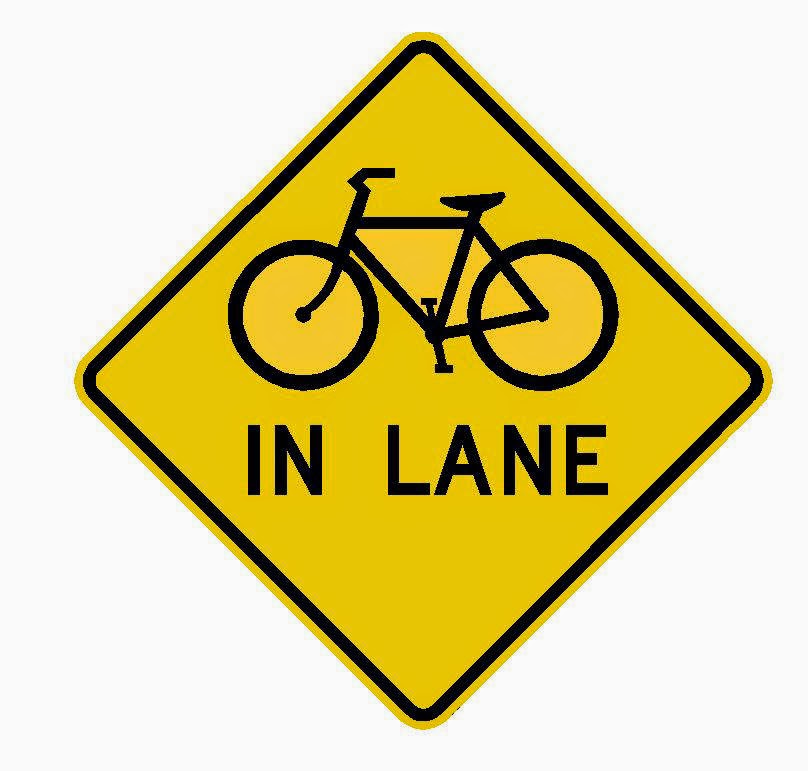
DelDOT to install "Bicycles IN LANE" signs at key I95 crossings

[B’ Spokes: This is a lot better than our standard dual sign that reads “Bikes Share the Road.”]


By Frank Warnock, 1st State Bikes

image

Thanks to a successful petition drive – and a Chief Traffic Engineer who takes a pro-active approach toward bicycle and pedestrian safety – a new and unique bicycle warning sign is heading for approval. Working with 1st State BIKES advocates, Mark Luszcz (P.E, DelDOT) designed the sign that will give Delaware another 1st on the national stage, rolling out the words “IN LANE” in conjunction with the standard bicycle warning sign (bicycle symbol on yellow sign).

https://www.1stbikes.org/2015/01/deldot-to-install-bicycles-in-lane.html

Does Speeding Really Get You There Any Faster?

By Eric Ravenscraft, Life Hacker

Distance Speed Limit Speed +10 Time (in minutes) Time w/Speeding Savings
15 35 45 25.71 20 5.71
15 45 55 20 16.36 3.64
15 55 65 16.36 13.85 2.51

https://lifehacker.com/does-speeding-really-get-you-there-any-faster-1556767685


[B’ Spokes: And this does not take into account traffic lights, which are the great equalizer of speeds. I’ll note when I was in Arizona and began driving almost everyone drove the speed limit there with a few exceptions. Driving here it’s flipped, few drive the speed limit. Here I take my life in hands doing the speed limit on the freeways as cars come up behind me doing 20+ the speed limit. Of course I am used to that riding my bike, so no big deal really but it is kind of ironic that I can have a longer line of cars behind me trying to pass driving then what I have ever had riding my bike.

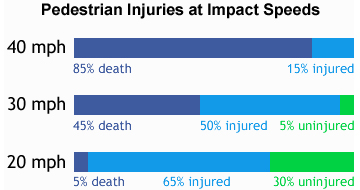
But what I really want to point out that the chance for survival from being hit by a car is cut in half when when the vehicle is traveling 40 vs 30 mph.
image

My thoughts today have been on the tragic death of Tom Palermo, sure DUI is bad, texting is bad all of which lead to the driver striking Tom but I’ll give you this thought… it was the speed of the vehicle that killed Tom. Traffic enforcement is a joke in this state especially those that can help improve the safety of bicyclists and pedestrians. Crosswalk stings, virtually nonexistent enforcement of the 3 foot passing rule, again nonexistent. At least come out twice a year and make some effort, some news, some something, please! ]

Many ‘Healthy Obese’ Don’t Stay Healthy

by Nicholas Bakalar, New York Times
"’Healthy obesity’ is quite a misleading term,” said the lead author, Joshua A. Bell, a doctoral candidate at University College London. “It sounds safe, but we know that it’s only healthy in a relative sense. The healthy obese become unhealthy and progress into the highest risk group. This is a real challenge to the idea that the obese can be healthy in the long term.”
https://well.blogs.nytimes.com/2015/01/07/many-healthy-obese-dont-stay-healthy/

Seeking more than a few good transportation engineers

By Robert Steuteville, Better! Cities & Towns
Traffic engineers and transportation planners are aware of the research favoring walkability, they know that complete streets work, and yet many are unwilling to face the logical implications: Their long-held practices need to change.
We need more than a few good transportation engineers.
Janette Sadik-Khan was a rare Department of Transportation official, under former New York City Mayor Michael Bloomberg, who challenged long-held practices. She pushed hard to make the city’s streets and public spaces better for people outside of motorized vehicles.

Knowing the futility of finding better solutions that way, Sadik-Khan was clever. When a big change was warranted, she proposed the idea as a temporary test. Traffic studies are notoriously unreliable—they often overestimate traffic substantially, contributing to the design of larger, faster streets and roads that discourage walking and induce more traffic. The system is guaranteed to confirm conventional practice. Traffic studies often delay projects for years and raise costs.
A temporary test project, instead, generates real-world data in real time. When these tests worked, the city made the changes permanent. Then new changes were proposed.
In that way Times Square and many other places in New York City were substantially improved. Half of the space in Times Square is now given to people to enjoy. Business is up, safety is improved, and the traffic still flows. One of the top three tourist attractions in the world now has better transportation balance. Using the old system, such a result is hard to imagine.

https://bettercities.net/news-opinion/blogs/robert-steuteville/21381/seeking-more-few-good-transportation-engineers

Scientific Proof That Cars and Cities Just Don’t Mix

by SHANE PHILLIPS, Planetizen

These findings have a few interesting implications. For example, they may help explain the "war on cars" furor of the past several years. It’s easy to imagine how some individuals, so married to their windshield perspective, could see any attempt to improve active or public transportation as a direct attack on their person. Those people on the street are so threatening and unpleasant, after all. Why should the city cater to people like that? Transit and active transportation advocates, meanwhile, are baffled by the vitriol of the Dorothy Rabinowitzes of the world because the streetside perception of our changing cities has generally been positive.

https://www.planetizen.com/node/66686

How I Became an Urban Monster in Just 10 Minutes

A car is often—even usually—the wrong tool for the job in a dense urban setting. And using the wrong tool makes you frustrated and impatient.
By SARAH GOODYEAR, City Lab
https://www.citylab.com/commute/2014/12/how-i-became-an-urban-monster-in-just-10-minutes/384128/
**********************************************************************************************************************
[B’ Spokes: After being car free for 2 decades and just starting to drive again, I can relate to this article. Those of you that drive everyday I have no idea how you manage. Luckily I can still do what I need to do most days by bike so I am managing just fine.]