
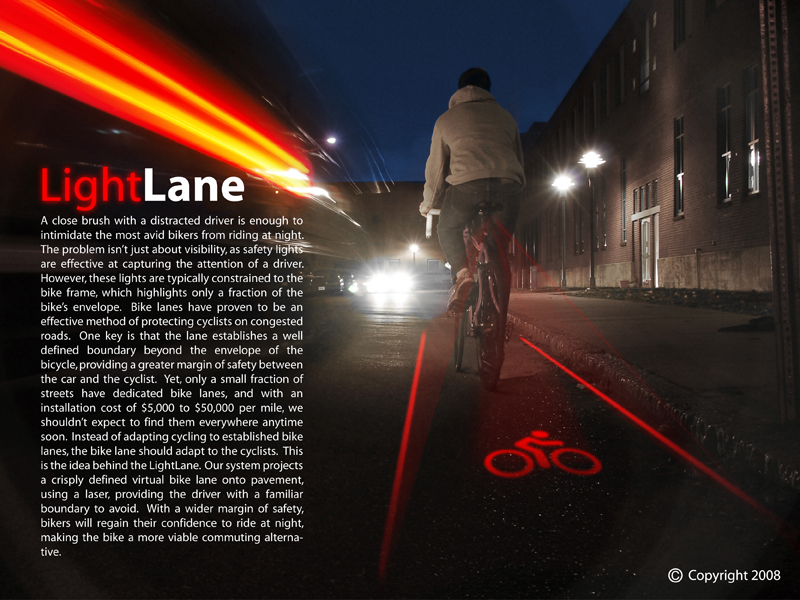
LightLane
Poll: Most Americans Want Stimulus to Emphasize Road and Bridge Repair and Transit, Not New Road Construction, Poll Finds
WASHINGTON – As Congress takes up debate over an economic stimulus package, a new poll shows that most Americans would rather use federal dollars to repair highways and bridges and improve public transportation than expand highways through new construction.
In addition, fully 80 percent of respondents said stimulus investments should not only create jobs, but also help the goals of reducing oil dependency, improving the environment and increasing transportation options, even if the job creation took longer. Only 20 percent agreed that stimulus funds should include only “road and bridge projects that can be started right away and create an immediate boost to the economy”.
Continue reading “Poll: Most Americans Want Stimulus to Emphasize Road and Bridge Repair and Transit, Not New Road Construction, Poll Finds”
The unfortunate byproduct of our travel system
| Cause of Mortality for Ages 0-19 | Rate per 100,000 population |
| MVT Traffic-related (All) | 9.1 |
| MVT-Occupant | 4.6 |
| MVT-Unspecified | 3.1 |
| MVT-Pedal Cyclist | 0.2 |
| MVT-Pedestrian | 0.9 |
| MVT-Other | 0.3 |
Leading Causes of Unintentional Injury Death among Children 0 to 19
| Rank | Less Than 1 (n = 5,883) | 1 to 4 (n = 10,203) | 5 to 9 (n = 7,144) | 10 to 14 (n = 9,088) | 15 to 19 (n = 40,734) |
| 1 | Suffocation 66% | MVT-related 31% | MVT-related 53% | MVT-related 58% | MVT-related 76% |
| 2 | MVT-related 14% | Drowning 27% | Other Injuries 15% | Other Injuries 18% | Other Injuries 9% |
Continue reading “The unfortunate byproduct of our travel system”
Cycling For Everyone – Part 3
By John Pucher
…
Motorist training in the Netherlands, Denmark, and Germany is far more extensive, thorough, and costlier than in North America:
* Drivers are required to take a minimum number of hours of driving instruction with private firms at a cost of at least 1,500 euros (US $2,500).
* Licenses are not awarded until the age of 18, two years older than in most American states.
* Both the written and driving portions of the licensing tests are so rigorous that many applicants fail one or more times before passing.
* Additional hours of driving lessons are required after each failure.
* For the first few years, licenses are provisional and can be revoked for dangerous driving.
Continue reading “Cycling For Everyone – Part 3”
Legally Speaking with Bob Mionske – Turning with a blind eye
…
But there’s another way of looking at some of these responses. The London Bicycle Activist reports that Truck and bus drivers working for the London Borough of Lambeth “are receiving training sessions in cycling road safety in a bid to prevent collisions involving cyclists and HGVs [Heavy Goods Vehicle].” The program involves classroom training and signs in trucks and buses warning drivers about the danger their vehicles pose to cyclists. The training program doesn’t stop there — with the assistance of Cycle Training UK, drivers are also receiving on-road training on bicycles “to give them greater understanding about cycling.”
While the training program for Lambeth truck and bus drivers is mandatory, training is not required for Lambeth cyclists. Nevertheless, Cycle training is also available to any resident of Lambeth who wants it, again in partnership between the Borough and Cycle Training UK.
The contrasts between European and American approaches to cycling safety are interesting:
• In Portland, bike boxes—an idea borrowed from European cities—were installed at problem intersections following the deaths of two Portland cyclists.
• In Portland, city trucks were fitted with safety guards. In contrast, in Europe, all trucks, whether public or private, have been required to be fitted with safety guards since 1989.
• In Portland, cyclists were invited into truck cabs to see how hard it is for drivers to see cyclists. In London, drivers were required to take on-road cycle training to see what it’s like to ride a bike. While it certainly can’t hurt for cyclists to gain perspective on what it’s like to drive a truck, the Portland approach implies that the truck drivers involved in the fatal accidents were not at fault, while the London approach implies that truck drivers have a duty of care to avoid hitting cyclists.
• In Portland, cyclists are told not to ride in the blind spot of trucks — and in fact, in Brett Jarolimek’s crash, a massive blind spot created by the damaged side mirror on the truck was a major factor in the collision. In Europe, all heavy trucks are required, as of March 31 of this year, to be fitted with equipment that eliminates blind spots.
• In Portland, neither driver faced criminal charges, and only one of the drivers received a traffic citation for violating the cyclist’s right of way. The driver who turned into Brett Jarolimek’s path was not cited, because the Portland Police invented a non-existent requirement that the driver had to be aware of the cyclist in order to violate his right of way — an interesting decision on the part of the Portland Police, given that the driver’s mirror was non-functional, in violation of the law. Whether either driver will be found negligent would be a matter for a jury to decide. In contrast, in the Netherlands, a driver is presumed to be negligent in any collision involving a cyclist, unless the driver can introduce evidence rebutting that presumption.
While it’s been heartening to see some of the positive changes that have taken place in Portland as a result of the tragic and needless deaths of two Portland cyclists, it’s also obvious, when compared to what our counterparts in the UK and Europe are doing, that there’s so much more we could be doing to protect cyclists in this country. The Borough of Lambeth provides one innovative example — when drivers know what the road is like from our perspective, they’re likely to be more careful with our lives.
Bob
Continue reading “Legally Speaking with Bob Mionske – Turning with a blind eye”
Prototype Bicycle Hooks Being Tested on Metro-North M-7 Train Cars
[Note that is NOT our MTA as if you couldn’t tell.]
,,,
"Metro-North has always been bicycle-friendly, with certain weekend trains designated to serve popular cycling destinations and in supporting numerous bike rallies and special events by providing extra, bicycle-only cars," said Metro-North President Howard Permut. "This pilot is a natural extension or our effort to promote sustainable mobility within our region."
If the pilot is successful, Metro-North will determine next steps on the M-8s with ConnDOT and on the M-7s with Long Island Rail Road, which has a large fleet of M-7s.
…
The hooks are located in the area designated for wheelchairs, which will continue to have first priority in this space. Prominent signs will specify that cyclists must remove bicycles if the area is needed for a customer in a wheelchair. Feedback on the proposal also is being sought from wheel chair users.
Metro-North is an advocate for transportation that’s safe, efficient, adaptable, and as pollution-free as possible. It’s no surprise that bicyclists and Metro-North have always had a close and supportive relationship.
More than 60 of our train stations have accommodations for people who bicycle to our stations with bicycle racks or lockers. Signs especially aimed for bicyclists – in terms of where and how best to board trains – are installed at stations that have proven very popular with cyclists.
The railroad recently amended its bicycle policy to allow cyclists to bring folding bikes aboard all trains, including peak trains, without a permit, because when folded, they are treated as regular luggage.
Metro-North also relaxes bicycle permit rules to accommodate more than 10 bike events throughout New York City, Westchester, Putnam, and Dutchess Counties, such as the Five-Boro Bike Tour, The New York Century Bike Tour, Tour de Bronx, Tour de Putnam and the Bloomin’ Metric Bicycle Tour.
Metro-North continues to work with bicycle clubs and touring groups to create special brochures to inform and encourage cyclists to use our trains, and have run extra trains as well adding extra train cars to serve our cycling friends for special tours and races.
Continue reading “Prototype Bicycle Hooks Being Tested on Metro-North M-7 Train Cars”
Not-So-Free Ride
Americans drive too much. This isn’t a political or moral argument; it’s an economic one. How so?
Because there are all sorts of costs associated with driving that the actual driver doesn’t pay. Such a condition is known to economists as a negative externality: the behavior of Person A (we’ll call him Arthur) damages the welfare of Person Z (Zelda), but Zelda has no control over Arthur’s actions. If Arthur feels like driving an extra 50 miles today, he doesn’t need to ask Zelda; he just hops in the car and goes. And because Arthur doesn’t pay the true costs of his driving, he drives too much.
What are the negative externalities of driving? To name just three: congestion, carbon emissions and traffic accidents. Every time Arthur gets in a car, it becomes more likely that Zelda — and millions of others — will suffer in each of those areas.
Which of these externalities is the most costly to U.S. society? According to current estimates, carbon emissions from driving impose a societal cost of about $20 billion a year. That sounds like an awful lot until you consider congestion: a Texas Transportation Institute study found that wasted fuel and lost productivity due to congestion cost us $78 billion a year. The damage to people and property from auto accidents, meanwhile, is by far the worst. In a 2006 paper, the economists Aaron Edlin and Pinar Karaca-Mandic argued that accidents impose a true unpaid cost of about $220 billion a year. (And that’s even though the accident rate has fallen significantly over the past 10 years, from 2.72 accidents per million miles driven to 1.98 per million; overall miles driven, however, keep rising.) So, with roughly three trillion miles driven each year producing more than $300 billion in externality costs, drivers should probably be taxed at least an extra 10 cents per mile if we want them to pay the full societal cost of their driving.
Continue reading “Not-So-Free Ride”
James Howard Kunstler: The tragedy of suburbia
The space around us says something, something like "abandon all hope, resistance is futile." This is a very funny talk about public space and how its failed.
Continue reading “James Howard Kunstler: The tragedy of suburbia”
Wall Street Journal suggests going carfree to save money
Posted by Elly Blue of Bike Portland on January 5th, 2009 at 10:20 am
“Whether you drive a hybrid or an SUV, your car is a cash-guzzler. Families trying to save real money should consider going without.”
It may be a true sign of change when the Wall Street Journal suggests that giving up your car could be good for your personal finances and the economy as a whole.
In his December 22 column, A real auto bailout: Escape your car, WSJ staff columnist Brett Arends wrote:
Last week, the auto industry finally got its bailout.
But is it time for Americans to rescue their own finances from their cars?
…Forget lattes and store-brand cereal. If you really want to see where your money is going, take a closer look at your car. Foreign or domestic, it doesn’t matter. It’s a cash guzzler, and it is probably costing you more than anything else except your home.
Continue reading “Wall Street Journal suggests going carfree to save money”