
From Trans Secretary LaHood –
On Wednesday, I had the pleasure of addressing the National Bike Summit. I was invited to speak as a member of the Obama administration, but I have been a supporter of bicycling for many years and was a member of the Congressional Bike Caucus when I was in Congress.
Still, I don’t think the League of American Bicyclists knew what to expect when they invited me to their summit.
I hope they were pleasantly surprised because I am committed to investing in programs that encourage bikes to coexist with other modes and to safely share our roads and bridges. And there’s strong support in Congress for these goals as well.
In the Department of Transportation, bicyclists have a full partner in working toward livable communities. We’re excited that the Federal Highway Administration is looking at best practices in Europe to improve safety and mobility for walkers and cyclists. We’re excited that a federally funded pilot project to study the effects of improved walking and bicycling facilities in four communities is underway. I think I conveyed that excitement to the summit, judging by the early response (BikePortland.org, Streetsblog.org)
I welcome the vigor of the bicycling community in advocating for bike-friendly measures in the upcoming authorization bill, CLEAN-TEA. Bicycles are a critical part of a cleaner, greener future in American transportation, so keep those wheels spinning.
Continue reading “Cyclists are important users of transportation systems”
London’s Cycling Design Standards: A Model for NYC or here?
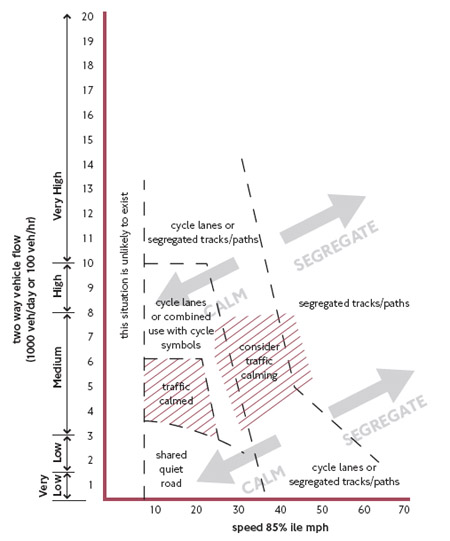
As New York City begins fulfilling its commitment to build 200 miles of new bicycle lanes over the next three years, the question will increasingly arise: What kind of bike lane should go where? Currently, DOT seems not to have any set of guidelines to answer that question. So, take a look at how the City of London does it.
Transportation Alternatives’ bike program director Noah Budnick pointed me to the London Cycling Design Standards book. It is a remarkable document and, perhaps, a great model for New York City to follow.
The chart below can be found in Chapter 4, page 62. With vehicle volume on one axis and speed on the other, it establishes a general set of rules for when a street should have a physically-separated, “segregated” bike lane versus when bikes should mix with “calmed” motor vehicle traffic. Note that London has long-since stopped debating whether or not physically-separated bike lanes are a good and necessary thing.
Continue reading “London’s Cycling Design Standards: A Model for NYC or here?”
B:C:Clettes vs. Sexy Back on Youtube
I wear a helmet so you can drive like an idiot. And because it looks smart.
Continue reading “B:C:Clettes vs. Sexy Back on Youtube”
Auto Bailout? Nothing new!
by Peter Saint James
Is bailing out auto manufacturers really such a new and radical idea? Or should we perhaps consider carmakers wards of the state already?
Many people believe that gas taxes and other auto-generated revenue pick up the bills for roads and other auto-related expenses. Nothing could be further from the truth. Some researchers conclude that if gas taxes really paid for what many people think they pay for, pump prices would probably be somewhere around $25 per gallon.
If you paid that much for gas, you would probably eliminate a lot of trips you make now. Wouldn’t you realize they aren’t cost effective? For example, you would probably refuse to pay so much to drive a couple of miles just to get a bag or two of groceries, wouldn’t you? Wouldn’t everyone do things in better, easier, cheaper ways? How would this change the way our cities look and feel?
Driving really does cost that much. Driving is not cost effective. You pay those expenses through taxes and other means and only because you don’t know you’re paying them and have to pay them to keep from going to jail. If you did know and had a choice, you’d probably stop. You’re not that stupid, are you? You’d probably see it’s not worth it, wouldn’t you? Is that why the costs are hidden so well?
So how much do autos cost? What are the real figures? Does anyone know for sure?
We can figure out impossible numbers like how many molecules exist in the universe, how many stars in Andromeda Galaxy, and other enormous numbers, but we can’t seem to get a handle on auto expenses. Many researchers, including me, have tried. A whole government agency was set up just to get that number. Everyone comes up with different totals. Even the same person comes up with different numbers on different attempts. Many argue that their figures are right, but in reality everyone has points to be taken into consideration. Transportation is so divorced from reality, so alien from sound economic and accounting principles, that getting exact figures remains nearly impossible.
Here are just a few of the complex, controversial problems.
Gas taxes don’t fully pay road building and maintenance expenses. Most road money comes out of general funds. That’s easy. We can find most of that money.
But what about other government activities and agencies? Gas taxes don’t fund them, but autos obviously inflict some or all of their costs. Most police agencies don’t get much from gas taxes if anything at all. Yet don’t most of them regulate traffic, search for stolen cars, and so on? About half of fire department calls are to cars, not houses or businesses. That’s auto expense, isn’t it?
And look at bigger agencies. EPA deals with pollution. Cars cause significant pollution. What portion of EPA budget should be considered auto expense?
Continue reading “Auto Bailout? Nothing new!”
The Wild Bunch (NYC)
…
Though bikers are hated, pedestrian deaths and injuries on Ninth Avenue in Chelsea immediately declined in the area of the physically separated bike lane, as reported on streetsblog.org, news blog of the Livable Streets Initiative, which advocates creating sustainable cities. In December, Community Board 4 voted in favor of creating a bike lane on Eighth Avenue between 14th and 23rd Streets.
…
The Brooklyn Bridge is an important front in the bike publicity war; it is a place where bikes are losing. The essential conflict can be grossly caricatured like this: Guys dressed as if they are in the Pyrenees stage of the Tour de France try to set speed records as Italian tourists linger in the middle of the bridge to get a photo of their cousin, Paolo, backed by the Empire State Building.
Bikers won’t stop, fearing they will lose a few tenths of a second off their times; and tourists from former Soviet republics confuse the phrase “Get out of the bike lane, you jerk” with “Enjoy your stay.”
…
Continue reading “The Wild Bunch (NYC)”
Bike ‘Contrails’ to Create DIY Bike Routes

Contrail is a tool for developing bicycle communities. As you ride,
contrail leaves a faint chalk line behind your bike. The goal is to
encourage a new cycle of biking participation by allowing the biking
community to leave a unique mark on the road and to reclaim this crucial
shared space.
Continue reading “Bike ‘Contrails’ to Create DIY Bike Routes”
Bicycling on water? – all the power to them

Create Complete Streets with Economic Stimulus Spending

This monthly newsletter issued by the National Complete Streets Coalition provides a roundup of news related to complete streets policies — policies to ensure that the entire right of way is routinely designed and operated to enable safe access for all users. Please pass it around! And visit www.completestreets.org to stay informed.

Create Complete Streets with Economic Stimulus SpendingThe recently passed American Recovery and Reinvestment Act (ARRA) included $48 billion for transportation infrastructure investments. Of that $48 billion, more than $27.5 billion are in funding categories that make funds eligible for use in projects with complete streets elements, and another $3.8 billion are available for bicycle and pedestrian infrastructure. The ARRA funding should not be used to expand a system of roads that do not provide safe travel for people who are walking, bicycling, and taking public transportation along a corridor. Too many streets around the country are designed to be wide and fast, without sufficient sidewalks, crosswalks, safe bus facilities, or bicycle lanes. Incomplete streets are dangerous and create barriers for people to get to jobs, school, the doctor, and fully participate in civic life. State and city governments should spend the stimulus money on infrastructure that serves all citizens safely and efficiently. The National Complete Streets Coalition created a new repository of resources for communities interested in identifying opportunities for building complete streets with ARRA funding: www.completestreets.org/stimulus.html. Check in frequently, as it will be updated often with new information and materials. |
Location is everything in adverting

T4America Platform
As Congress develops the next transportation authorization, these six priorities should guide them.
1 Establish Accountability for Responsible Investment
Under the current system, most federal transportation dollars go to state departments of transportation, with
few questions asked. DOTs remain largely geared toward building highways between metropolitan areas rather
than providing multiple options for mobility within metropolitan areas. This is despite the fact that the United
States population is highly urbanized, with 80 percent of us living in metropolitan areas and 85 percent of our
nation’s economic activity occurring within them. The current law assigns metropolitan areas responsibility for
transportation planning, but it does not give them real authority to implement those plans.
Continue reading “T4America Platform”