
Wide, tree-lined sidewalks. A row of parked cars to buffer pedestrians from traffic. A physically separated bike lane. These are just a few of the qualities I and other urban design types tend look for when defining a ‘good’ street, meaning one pleasant and safe for walking and biking.
Imagine my surprise then, when I returned this past winter to Tokyo, land of my upbringing and pedestrian and transit mecca, and realized that the streets I walked every day as a kid looked nothing like the "complete streets" I had come to idealize.
…
Yet, despite all these supposedly less-than-desirable conditions, people in Tokyo walk. A lot. My family was caught in pedestrian gridlock on the day after New Year’s, in the shopping district of Harajuku. There were so many people trying to walk through a (admittedly narrow) space that we literally could not move for ten minutes.
In New York, I complain that the four blocks between my apartment and the subway have no street trees. But in Tokyo, I have no problem walking fifteen minutes basically IN the street to the train station, with nary a street tree in sight the entire way.
In New York, I rarely ride my bicycle because even on quieter side streets (forget about avenues), I’m in constant fear of being hit from behind by a speeding SUV or doored by one of the cars parked along the curb. In Tokyo, children ride their bikes to school, housewives to the grocery store, commuters to the train station, and nobody bothers with helmets.
So why the differences in environments? The first, and perhaps most obvious, reason for this is the well-known traffic engineering concept of "shared space." This idea states that having pedestrians, bicyclists and drivers share the space of the roadway with little separation results in improved safety for all because it forces various road users to constantly be aware of each other. Motorists drive slower and round corners cautiously because they expect pedestrians or bicyclists to pop up out of blind spots. Pedestrians and bicyclists have priority, but are aware that cars may be coming at any time, and move out of their way.
…
*////////////////////////////////////////////////////////////////////////*
We talk about built environment a lot, but rarely about driver behavior, and when we do, we talk about manipulating that behavior through the built environment. But there are other factors that influence how drivers behave.
Continue reading “Spotlight Vol. 8, No. 4: From Tokyo to Brooklyn: Good Streets and What Defines Them”
Suggest a Feature for Google Maps!
The Google Maps Help section has a ‘Send Feedback‘ link that allows you to vote for new features you want to see on Google Maps. One of them is called ‘Add bike trail information and biking directions’. Please feel free to head on over the click the ‘Suggest’ button next to this feature.
To navigate there from Google Maps, click the Help link in the top-right, then ‘Send Feedback’ on the right.
The ideal would be to vote for (’Suggest’) just the ‘biking directions’ feature — that would probably help make it stand out a bit better — but feel free to vote for other features you really really really want, too. 🙂
Continue reading “Suggest a Feature for Google Maps!”
Police detention for riding a bike at night and forgetting to turn on your lights

A federal jury Thursday found in favor of two Portland officers, determining they used reasonable force in their arrest and detention of a St. Johns woman who was riding her bike at night without a light on Aug. 6, 2003.
That’s right, it is reasonable to pull someone from their home and detain them for not turning on their bike lights rather then just issuing a ticket. After all doesn’t this 67 year old women look like a threat to society?
Continue reading “Police detention for riding a bike at night and forgetting to turn on your lights”
Idaho Stop law hearing
For those of you who don’t know about the Idaho stop law it allows bicycle operators to enter a stop-sign controlled intersection without stopping when safe, and once they’ve yielded to all other traffic. Transportation planners and law enforcement officials from Idaho say that this law has been on the books there since the 1980s without incident.
Read more to find out about Portland’s struggle for the same law.
Continue reading “Idaho Stop law hearing”
Bill encourages safe bicycling
Grant would make it easier for cities to start bike programs
By Kate Golden | JUNEAU EMPIRE
If only the Legislature could do something about the weather.
Two lawmakers have introduced a bill this session aimed at encouraging more people to ride bicycles.
House Bill 132, from Reps. Paul Seaton, R-Homer, and Max Gruenberg, D-Anchorage, creates a grant program that would help cities and nonprofits start bike repair, loaner or safety programs and pay for bicycle-related road improvements. The bill will be heard in the House Transportation committee at 1 p.m. Thursday.
Despite the winter, Alaska ranks sixth in the nation in the proportion of people biking to work, according to Bob Laurie, Alaska Department of Transportation’s bicycle advocate. (The state ranks first in the percentage who walk to work.) Yet the American League of Bicyclists ranked the state 43rd in overall bike-friendliness, and Sitka is the state’s only officially bike-friendly community.
Laurie listed some of the biggest challenges facing Alaska communities in making themselves cycle-commute-friendly: Shoulders on the road, secure parking, places to shower, and education and enforcement of riders and motorists. All of those things take money, which the proposed grant program could help fund.
Continue reading “Bill encourages safe bicycling”
Who Stops at Stop Signs?
This is video of an intersection, (I think located in or near Iowa City, Iowa), that was watched for only 5 minutes. I counted a total of eleven motor vehicles that did not stop when and where they were supposed to. Some didn’t stop at all, they just rolled through the intersection.
The official count is 2 passed by stopping where and when they were suppsoed to and 9that did not, but I counted an additional 2 in the video. It is ironic that bicyclists are chastised for not stopping and yet here we have over 10 motorists not stopping.
Continue reading “Who Stops at Stop Signs?”
National Bike Summit 2009
National Bike Summit 2009 – a huge success
(3.17.09) Thanks to everyone that made it to the National Bike Summit this year – we had record attendance, a strong program, and some good specific asks of our elected representatives. In total, 580 registrants from 47 states and four countries (Canada, Denmark, Czech Republic and the USA) visited more than 350 Congressional offices on Thursday, March 12. Follow up to your visits is essential; please make sure you have written your thank you notes, and followed up with the offices on their commitments.
Transportation Secretary Ray LaHood addressed the opening plenary, noting that the DOT will be "a full partner in working toward livable communities". The Secretary was followed by Representatives Blumenauer (D-OR), Lipinski (D-IL) and Matsui (D-CA). Congressman Oberstar (D-MN) spoke at the Summit dinner, and Representatives Petri (R-WI), Coble (R-NC), McCaul (R-TX) and Kissell (D-NC) made remarks at the Congressional Breakfast and/or Reception.
Even if you were not able to attend this year, the League encourages you to ask your members of Congress to support the Complete Streets Act of 2009 (S. 584, introduced by Senator Harkin, and H.R. 1443, introduced by Representative Matsui) and the CLEAN-TEA: The Clean, Low-Emission Affordable, New Transportation Efficiency Act (S. 575, introduced by Senators Carper and Specter, and H.R. 1329, introduced by Representatives Blumenauer, Tauscher and LaTourette) that were introduced for the Summit.
Continue reading “National Bike Summit 2009”
CLEAN TEA INTRODUCED, BILL AIMED AT CREATING A MORE EFFICIENT TRANSPORTATION SYSTEM
Sen. Tom Carper said: “Today, we fund our transportation system through a gas tax, meaning we pay for roads and transit by burning gasoline. When people drive less, our transportation budgets dry up. This means states and localities that reduce oil use, lower greenhouse emissions and save their constituents money end up getting their budgets cut. But CLEAN TEA reverses this negative funding policy by sending money to states and localities based on how much they reduce emissions. Now, we in the Congress have the great opportunity to address many national problems at once – finding additional funding for transportation infrastructure, building money-saving transportation alternatives and lowering greenhouse gas emissions from the transportation sector.”
“Reducing emissions from the transportation sector will not only help us achieve our global warming goals, but will provide additional benefits to the environment, public health, the economy, and quality of life,” said Rep. Earl Blumenauer. This legislation will help finance our shift to a low-carbon transportation system that provides transportation choices, creates safe and healthy communities, and saves consumers money. I look forward to working with my colleagues to ensure that any climate legislation we advance in the House recognizes the opportunities provided by the transportation sector.”
“This bill represents an important step in lowering our nation’s greenhouse gas emissions, reducing our dependence on foreign oil and promoting transportation mobility,” Sen. Arlen Specter said. “Since transportation accounts for one-third of greenhouse gas emissions, it stands to reason that revenue generated from a cap-and-trade system should be devoted to creating a more sustainable transportation future.”
“Transportation accounts for 30 percent of our greenhouse gas emissions. CLEAN TEA addresses the difficulty of reducing these emissions by investing in strategies that make our transportation system more efficient and in transportation alternatives, such as mass transit,” said Rep. Melissa Bean. “This bill is a great example of how pro-growth and environmentally conscious policy can come together.”
“CLEAN TEA can’t come soon enough for our mass transit infrastructure,” Rep Mark Kirk said. “By investing in energy-saving projects like commuter rail, we’ll save money at the gas pump, decrease congestion and reduce greenhouse gases. Most importantly, we’ll create thousands of jobs throughout the country.”
“CLEAN TEA is a good benchmark to start the debate on climate change legislation. We cannot effectively address climate change without reducing the transportation sector’s contribution to greenhouse gas emissions,” Rep. Ellen Tauscher said. “This bill follows in the wake of historic legislation in California to address climate change by linking it to land use and transportation policy.”
Continue reading “CLEAN TEA INTRODUCED, BILL AIMED AT CREATING A MORE EFFICIENT TRANSPORTATION SYSTEM”
Portland Auditor’s survey: Fewer cars, more bikes, and safer streets
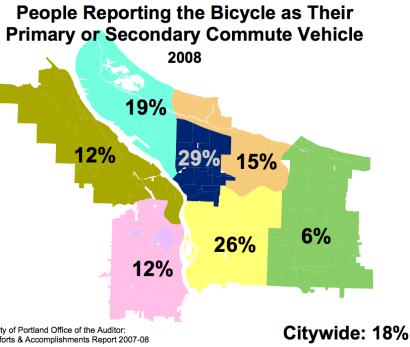
– In 2008, there were 140 “traffic injuries” to individuals on bicycles. That’s down from 196 in 2007 and it’s the lowest number since the survey was taken in 1999. The same goes for pedestrian injuries; there were 123 in 2008, down from 191 in 2007. There was also a major drop in the amount of individuals injured while operating an automobile; the survey reports 4,428 injured, compared to 5,429 in 2007.
Continue reading “Portland Auditor’s survey: Fewer cars, more bikes, and safer streets”
Speakers at the National Bike Summit
UPDATE: see comment for updated links
Here are videos of the morning speakers at the National Bike Summit on Wednesday, March 11.
US DOT Secretary Ray LaHood
https://video.google.com/videoplay?docid=-5323865082882842828
US Representative Earl Blumenauer (OR-3rd)
https://video.google.com/videoplay?docid=-5527072340327644893
US Representative Daniel Lipinski (IL-3rd)
https://video.google.com/videoplay?docid=-2784701150857668849
US Representative Doris Matsui (CA-5th)
https://video.google.com/videoplay?docid=5225171971519783674
Continue reading “Speakers at the National Bike Summit”