
In this video there is a narrow lane present which the motorists needs to use a portion of the left lane to overtake a cyclist with three feet of width clearance.
This is what you can expect from motorists because there are no laws which require a motorist to move over to the other lane to overtake a cyclist. They only need to provide three feet of clearance.
It is ambiguous for me to try to define what is three feet as all they pass me. Clearly some don’t and some are questionable. Some motorists simply move over to the other lane and allow the maximum clearance. What constitutes as a "safe three feet overtaking" is left up to someone who won’t get hurt.
By law the two lane positions are correct, The first position to the right resulted in at least one close pass with a cargo van.
The second lane position to the left, yields better results in my opinion. [For] The person who is subject to death and injury.
This is a good example of why a cyclist may choose to use the law and move to the left to communicate to the motorists that this is a narrow lane and a motorist will need to use a portion of the left lane to overtake the cyclist as the video shows, and provide better visibility for the motorists.
Continue reading “Taking the lane on a 4 lane road”
Anti-Veloism: Weird, Creepy Bike Hate
Obviously, not everybody likes cyclists. In fact, lots of people actually hate cyclists. If you ride a bicycle you’ve undoubtedly experienced the sting of anti-veloism at least once. Some anti-veloist attacks are fairly straightforward, like when an irate motorist yells at you for being "in the way." Others though are downright bizarre, and can be so strange that instead of being angry you just find yourself confused. A reader recently forwarded me an instance of the latter from Madison, Wisconsin.
In this case, the anti-veloism took the form of a skit on a WJJ0 99.4 radio program. Basically, some guy with a goofy Harry Shearer radio voice says he’s sick of bicyclists, or "spandex cowboys." He then segues into some skit which is a parody of a hunting show, in which the host goes to the "Wisconsin Bicycle Trail of Death," where he kills bicycles instead of deer "because we feel they’re flamers and they should be shot at!" He then launches into some weird homoerotic reverie in which he positions himself near someplace "gay and retarded" because that’s where cyclists like to congregate. Once he spies some effeminate male cyclists, he then shoots them and excitedly declares that he "bagged me a nancy boy!" Then the host comes back and says that "if motorcyclists…if we did what bicyclists do we’d be in jail and our bikes impounded." Then they go to commercial.
Continue reading “Anti-Veloism: Weird, Creepy Bike Hate”
Back to the Grid: John Norquist on How to Fix National Transpo Policy
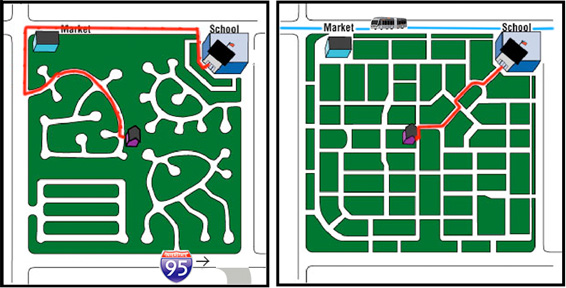
…
The Congress for the New Urbanism has some intriguing answers. During the stimulus debate, CNU proposed a new type of federal road funding that would help to build connected grids — the kind of streets that livable communities are made of. The proposal didn’t make it into the stimulus package before the bill got rushed out the door, but the upcoming federal transportation bill will provide another chance. CNU President John Norquist — a four-term mayor of Milwaukee who first got into politics as an anti-freeway advocate — was down in DC last Thursday to share his ideas with Congress. Streetsblog spoke to him afterward about what’s broken with national transportation policy and how to fix it. Here’s the first part of our interview.
…
If the debate is about transit versus roads — and currently the battle lines are drawn at 20 percent funding for transit, 80 percent for roads — it’s a really limited debate. It leaves out the whole discussion of what kind of roads to build. So if you have a city with boulevards and avenues and no freeways, it’s going to be a lot more valuable. You look at Vancouver, they have no freeways whatsoever, and they have a fabulously intense and valuable real estate and job market. And then you look at the places that have invested all the money in the giant road segments and they tend to be degraded. It’s not roads versus transit — it’s good street networks-plus-transit versus mindless building of out-of-scale roads. I mean they’re basically putting rural roads into urbanized areas and it’s counterproductive, it reduces the value of the economy, it destroys jobs, destroys real estate value. For what, so you can drive fast at two in the morning when you’re drunk?
Freeways don’t work in rush hour; they’re slower. Like in Washington, DC, Connecticut Avenue is faster at rush hour than the Potomac Freeway. The Potomac Freeway goes down to about two to six miles an hour during the peak hour, whereas Connecticut Avenue goes down to about eight to thirteen miles an hour. So you’re really talking about the federal government investing billions and billions of dollars in stuff that reduces the value of the economy. How bad is that?
Continue reading “Back to the Grid: John Norquist on How to Fix National Transpo Policy”
Ashford Shared Space Video
‘Shared space’ seeks to change the ‘mental maps’ that drivers create and alert them to a different environment in which pedestrians and cyclists have equal priority. The keys to this are low speeds, a narrow carriageway and the removal of the typical visual clues for drivers, such as information signs and pedestrian guard railing.
The ‘shared space’ philosophy builds on the work of Hans Monderman in Holland and has already been used in changes recently completed in Kensington High Street
Continue reading “Ashford Shared Space Video”
Fear, intimidation, and decision making
by Raphael Clemente
As one who uses a bicycle for the vast majority of my trips around town, I am often struck by the crazy behavior and strange reactions of some automobile drivers. I am not implying that people who drive cars are evil or by virtue of riding a bicycle for transportation that I am better than anyone else. But some drivers are intent on using their vehicles to barge their way through situations using intimidation and fear as a means of influencing others.
…
Freedom from Fear
…
Undoubtedly, one of the most common deterrents to bicycling is fear. Fear of motorists. Notice I said “motorists,” not “cars” or “traffic.” When people talk about bike safety, especially those who are afraid to bike on the roads, they aren’t much concerned about potholes or dogs or sand on the corner or their ability to control the bike. They fear the motorist they can’t see and who supposedly can’t see them. This fear is based on the belief that a significant number of motorists are likely to hit bicyclists while overtaking them. Does it happen? Yes. Is it common? Not at all.
Beliefs are survival tools our brains use when we don’t have sufficient direct sensory information to make a decision. Good beliefs can protect us from potential dangers. Bad beliefs mislead us into being fearless when we should be wary or fearing the wrong things. While I sit at my desk in my office I believe my bike is sitting in the bike locker where I locked it and left it, even though I have no evidence to support that belief. It’s not until I go out there, open the locker and look inside that I know my bike is actually there. I couldn’t function sanely if I spent the day believing my locker was being broken into. Conversely, if I believed no one would wish to steal my bike, I wouldn’t bother locking it and would again sit at my desk believing it was still there.
What kinds of events contribute to our beliefs about bicycle safety? First and most common is sensory information — observation of the motorists and bicyclists around us. Such observations often convince people that bicycling is unsafe. It only takes a few incidents of carelessness or rudeness by motorists to convince some that cycling is a dangerous activity even though most interactions with motorists are non-threatening. We humans are easily startled when something big comes rushing up from behind us. Think — predator! Even after 25 years of cycling an overtaking car still occasionally startles me.
Second are the lies that motorists tell when they have treated cyclists poorly. Catch up to a motorist after one has nearly sideswiped you and you’ll most likely hear one of the following lies: A) “I didn’t see you.” B) “You belong on the sidewalk.” C) “You’re supposed to ride all the way to the right.”
Third are stories about crashes. The media does not report “20,000 people rode their bikes today and none of them were hit by motorists.” They usually report that someone has been killed while cycling and make little or no effort to explain why the crash occurred.
The fourth way is through statistical data on bicyclist-versus-motorist crashes. Here again the information is skewed toward the negative. The statistical data people receive through the media is vague and misleading.
My purpose on these pages is to show you why proper cycling on roads is quite safe and can be accomplished by normal adults. I’ll be covering a few statistics (okay, a lot of statistics) my own experiences, the skills and practices necessary for safer cycling, and some reasoning about the motorist’s perspective.
Continue reading “Fear, intimidation, and decision making”
Bike safety bill likely dead this year, lawmaker says
[This could easily have been written about here as well.]
By JENNIFER JACOBS
…
Des Moines police say the driver was clearly at fault, but no traffic ticket was issued.
It’s cases like this that trouble cycling advocates. They’re pushing for state legislation that would offer bicyclists more protection – and heavier penalties for drivers who break the law.
But the new legislation likely won’t become law this year, a key Democrat said today.
The bill, Senate File 117, passed the Iowa Senate last month, but probably won’t pass the House in the few remaining weeks of the session, said Rep. Brian Quirk, D-New Hampton.
That’s frustrating to Iowans like Sherman, a 48-year-old software developer who has been riding competitively since 1986.
“I understand they’ve got big fish to fry with the budget, but this costs nothing,” Sherman said. “I can’t see how they’re going to be voted out of office because they voted for safety. What these guys are cowering at I don’t know.”
Quirk said he doesn’t oppose the bill, but one sticking point is that the it would prohibit a driver from depriving a bicycle of the full use of a lane if the lane isn’t wide enough for them to share
“You have liability issues when you give a bicyclist full lane privileges,” he said.
Continue reading “Bike safety bill likely dead this year, lawmaker says”
What does Rush Limbaugh have to say about bicycling?
"Frankly, if the door opens into a bicycle rider I won’t care. I think they ought to be off the streets and on the sidewalk. Don’t misunderstand here, you bike riders, do not misunderstand this, but I mean if you’re going to get in the street, get over there, get over as far right in the lane as you can. You ought to see Saturday morning where I live. It looks like a swarm of mosquitoes. It causes you to take an alternate route. And so now poor bike riders, some old codger opens the car door, bam! The bike rider does a head flip over the door. I haven’t seen that. Now they want to fine you for not only opening the door, you don’t close it soon enough, you get a $50 fine in Madison, Wisconsin. (laughing)"
Continue reading “What does Rush Limbaugh have to say about bicycling?”
Clyde police won’t charge man who ran down cyclist
A recent collision that left a bicyclist with numerous broken bones, nearly 100 stitches in his face, permanently deaf in one ear, and leaking brain fluid through a fracture in his skull cannot understand why the driver who nearly killed him won’t be issued a citation.
Roger Hinson is a Clyde native, now living in Springfield, Mo. Dauring a recent visit with his mother in Clyde, the avid cyclist was struck by a truck driven by James Welch. While Welch’s driving history cites numerous infractions, this most recent incident will not be one of them.
Clyde Police Chief Derek Dendy, who investigated the collision, said Welch isn’t being cited “because that’s not something I would normally do … unless (the at-fault driver) is impaired or there’s a problem with the accident. We do not issue citations. It’s just not how we do things here.”
…
Continue reading “Clyde police won’t charge man who ran down cyclist”
In Va., Vision of Suburbia at a Crossroads
By Eric M. Weiss – Washington Post Staff Writer
Sunday, March 22, 2009; Page A01
Virginia is taking aim at one of the most enduring symbols of suburbia: the cul-de-sac.
The state has decided that all new subdivisions must have through streets linking them with neighboring subdivisions, schools and shopping areas. State officials say the new regulations will improve safety and accessibility and save money: No more single entrances and exits onto clogged secondary roads. Quicker responses by emergency vehicles. Lower road maintenance costs for governments.
…
Continue reading “In Va., Vision of Suburbia at a Crossroads”
Death Rides On My Left – urban bicycle commuting
I am a bicycle commuter. I am not a certified safety instructor. This video represents real world conditions. Not some imaginary utopian world that bicyclist hope to create. The statistics are only approximate. Don’t get bogged down in the numbers. The important message is riding in the road has risk. These are some of the most common risk you will face. Much of the advice is for motorist. Motorist do not yield to bicycles in the bike lane and they should be. Cyclist are as much at fault as motorist for the situations in which we find ourselves. If you trust motorist to do the right thing and drive safely you will be disapointed. Part of the reason I am so obsessed with safety in my videos is it is so F**king crazy on the road. I have had way to many close calls. I make these videos for my own safety awareness. I have discovered that filming helps me discover my own mistakes. Hopefully others can learn from my mistakes too.
Continue reading “Death Rides On My Left – urban bicycle commuting”