
Traffic pollution was identified as a significant problem
Exposure to traffic pollution could affect the development of babies in the womb, US researchers have warned.
They found the higher a mother’s level of exposure in early and late pregnancy, the more likely it was that the baby would not grow properly.
…
[Baltimore Spokes: Note that being in a car you are exposed to more traffic pollution then if you are riding your bike in traffic.]
Continue reading “Pollution link with birth weight”
Running red lights is a problem
…
Well, according to field research conducted by the city of Portland, there are indeed a lot of scofflaws blowing through stop signs around town.
We’re talking about commuters who apparently have a total disregard for safety and the law, coming to a full stop at intersections only 22 percent of the time.
See! It’s those dang bicyclists with their neon-colored jackets, self-righteous attitudes and ripped calves, right? Right!? Actually, no. Those were automobile drivers.
"The law says a complete cessation of motion is required," said Greg Raisman, traffic safety specialist for the Portland Bureau of Transportation. "I think a lot of the time, people think they stop. But they were watching the wheels."
"They" were the Bureau of Transportation’s data-collection team, which camped out at various stop-signed intersections in 2006 and 2007. The monitors recorded a "full stop" whenever the wheels on a car, bike, minivan, truck or any other vehicle came to a complete halt, even for just a second.
Although automobile drivers weren’t as dismissive of stop signs as cyclists, who stopped just 7 percent of the time, you’d think the study might erase some of the nasty stereotypes that they have of bike riders.
Don’t count on it, said Randy Blazak, a Portland State University sociologist.
…
Continue reading “Running red lights is a problem”
Sample complete street policy
While this is pretty good I would like to see things more objective then subjective. Primarily use of a Latent Demand tool to determine if density is high enough to warrant the cost of bike/ped facilities. Secondly, roads should have a BLOC of C or greater not a fixed extra width margin (I don’t want to ride on a 4′ shoulder next to 60mph truck traffic and we don’t need a 14′ shoulder on low speed low traffic residential streets, BLOC helps figure out what is appropriate under different conditions.) And as a concession perhaps tie the max cost (e.g. 20% of project cost) in with the Latent Demand score; 20% if high, 10% if mid range and 5% if low.
Continue reading “Sample complete street policy”
NYC Bike study – By DC examiner
I really have to question the conclusions of DC Examiner on the NYC bike crash study.
Only one fatal crash with a motor vehicle occurred when a bicyclist was in a marked bicycle lane. Bicycle lanes aren’t a luxury; they’re a necessity. Riders should use bike lanes when possible.
A total of ten other fatalities occurred near a bike line per the report, why were these cyclist out of the bike lane? We don’t know but I seriously doubt that it was because the cyclists had no reason what so ever. Cars parking in bike lanes is a major problem in NYC and IMHO cyclists weaving in out of hazards is a problem while I support bike lanes I would not make the same assertion as this author, if anything to me this says that NYC should get cranking on keeping those bike lanes clear. IMHO
it is hazardous for cyclists to pick their path x feet from available space on the right, it should be a straight line (x feet from the stripe on your left that avoids upcoming hazards on your right.) Also bike lanes that I have seen in NYC do not solve the intersection problem, extra care needs to be applied at intersections for bike facilities and not just dumping cyclists into an undefined space and expect them to fend for themselves. There is nothing here that supports bike lanes make cycling safer, just as sidewalk riding is safe till you have to leave the sidewalk to cross a road, bike lanes are similar but with the exception that you can be seen by and merge with turning traffic. This works as long as it is clear that is the expected behavior. If the expected behavior is that cyclists must stay out of the way of motorists at all costs you get accidents when their pathways merge.
Nearly all the bicyclists who died–97 percent of them–were not wearing a helmet. A good reminder that cyclists really ought to wear a helmet. As I’ve written about before,
there’s a lot more to bike safety than helmets. That said, urban
cyclists who leave home without them should be aware of the risk.
While I do encourage wearing a helmet, helmets do not prevent crashes, preventing crashes should be the priority not “safe” crashing, this looks like the only point we see eye to eye on.
Nearly all bicyclist fatalities–92 percent of them–occurred as a result of crashes with motor vehicles. Protected bike paths free of traffic are critical.
I do not agree with this conclusion especially since the author just asserted that regular bike lanes are safe, I will assert that just as j-walking is the result of poor to nonexistent accommodations for pedestrians as well as poor to unsafe driver behavior around pedestrians it is the lack of accommodations and the lack of enforcement of traffic laws that make our public roadways unsafe for the vulnerable user. Protected bike paths do not solve the intersection problem and sometimes they can make it worse.
Climate Ride 2009
**The 2nd Annual Brita Climate Ride invites you to pedal your way to a new energy future!**
More than two hundred cyclists will join together from September 26 – 30, 2009 to embark on a journey from New York City to the steps of the U.S. Capitol in Washington, DC. We’ll be making a powerful statement about the need for renewable energy and climate change awareness throughout this beautiful 300-mile bicycle ride.
As a valued member of the green community, we invite you to participate in this historic event. Here are five good reasons why you’ll want to sign up:
- Be Part of a Grassroots Effort – You’ll meet everyone from knowledgeable renewable energy experts, scientists and climate activists, to recent college graduates and everyday folks committed to making a difference.
- Make an Important Statement – As you wind through the Delaware River Valley, Valley Forge, and Amish Country, your congressional representatives await your arrival at our nation’s Capitol. There, you’ll have the opportunity to voice your concerns and encourage action.
- It’s a Climate Conference on Wheels – Hear informative talks each evening after a day of enthusiastic cycling through beautiful countryside. Discuss climate science, green technology, and solutions to the climate crisis while re-energizing for the next day’s ride.
- The Time is Now – We’re at a climatic tipping point. With the upcoming COP15 United Nations Climate Change Conference in Copenhagen in December, the 2009 Brita Climate Ride is more timely than ever.
- It’s Fun! – This unforgettable, fully-supported event allows you the chance to unite with fellow cyclists while having the time of your life. Experienced leaders mind all the logistics, so you can strike up new friendships, network, and engage in stimulating conversation.
Are you ready to ride? Take five minutes to explore the Climate Ride website . We’ve posted photos and videos from the 2008 Ride that will entice and excite you – we guarantee it! Mark your calendar and register here. For a limited time, early registrants will receive a discounted sign-up fee of $60 (regularly $100) through May 1st. We have a number of fundraising prizes and incentives this year including an all-expense paid trip to the COP15 Conference in Denmark!
The Brita Climate Ride supports essential climate projects at two beneficiary organizations. Focus the Nation and Clean Air – Cool Planet . When you become a 2009 Climate Rider your fundraising effort (minimum $2,400) helps support their projects. In order to accommodate more riders, we’ve doubled the number of available openings to 250. They will fill up fast, so register today, and we’ll see you there!

A solution to the world’s urban transportation problems could lie in two wheels not four
OK we knew that for a long time but coming from GM? Of course their vision on how to do more with less involves a chair, two wheels and a motor. While I would love to see more appropriate sized transportation options there is sort of an image problem as soon as you put a seat on a Segway, the prototype sort of looks like a souped wheelchair with wheelie and roll bars.
Here is Streetsbolg’s take:
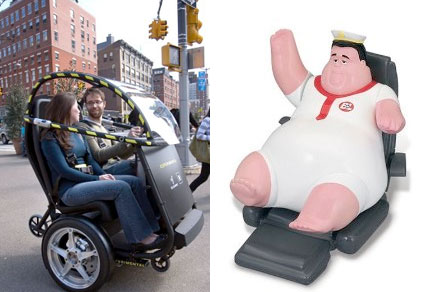
Continue reading “A solution to the world’s urban transportation problems could lie in two wheels not four”
Calif woman gets 6 years for fatal texting crash
{This is interesting because so far killing cyclists while texting has not resulted in much of anything in terms of punishment for the motorists.}
REDDING, Calif. – A woman who crashed into a line of stopped vehicles while text-messaging on her cell phone has been sentenced to six years in a California prison for killing a woman in one of the vehicles.
Deborah Matis-Engle was sentenced Friday by a judge in Redding, Calif.
Investigators said Deborah Matis-Engle was speeding and text messaging when she slammed into the vehicles stopped at a construction zone in August 2007.
Shasta County prosecutor Stephanie Bridgett said the 49-year-old woman had paid several bills by cell phone in the moments before the crash.
She was in the middle of one of those transactions when she struck a vehicle that burst into flames, killing 46-year-old Petra Winn.
Defense attorney Jeffrey Stotter said he will appeal.
Continue reading “Calif woman gets 6 years for fatal texting crash”
TV (Suspected) Thief on a bike arrested
Some people are concerned about bike trails bring in thieves, maybe they have a point but apparently thieves on bikes are also easier to catch (look suspicious longer.)
Continue reading “TV (Suspected) Thief on a bike arrested”
Use Stop Signs for Training
TRY THIS ON YOUR NEXT RIDE
From RoadBikeRider.com:
Don’t you hate traffic signals? Just when you’re in the groove, there’s the dreaded word: STOP
The worst case: a stop sign in the middle of a great descent.
It’s important to obey traffic signals, of course. Running stop signs and red lights is dangerous and sends the wrong message to motorists, even if they don’t drive over you.
Some motorists get peeved and aggressive when they see cyclists ignoring signals. "You guys break the law," goes their thinking, "so you don’t deserve any respect from me." Be aware of your responsibilities as a road user, as well as your rights.
And don’t regard stop signs only as a nuisance. Let’s see how to use them for a training benefit.
After all, stopping means starting again — accelerating up to speed. This is a good thing for at least 6 reasons:
* It encourages you to stand, relieving saddle pressure on nerves and blood vessels to restore circulation.
* It stretches your legs and back, lessening stiffness.
* It works the muscles of your torso, arms and shoulders if you sprint forcefully.
* Accelerating hard fires your fast-twitch muscle fibers, contributing to well-rounded fitness. Repeated efforts can help you become a faster sprinter.
* If you’re a racer, particularly a criterium rider or time trialist, starts from stops can improve your out-of-saddle bike-handling technique.
* Stop lights that make you wait for a minute are a chance to work on your trackstand — balancing at a standstill with feet on the pedals — assuming that won’t PO gramps in his Buick waiting behind you.
Continue reading “Use Stop Signs for Training”
Creating bikeable, "permeable" urban street grids
As just a few minor examples of the changing realities which are now affecting New Haven, national firefighters’ groups used to be opposed to narrower, slower-speed streets, but they now recognize that many more lives can be saved with them — even if response times are slightly prolonged or emergency responders need some re-training. Public health organizations used to focus mostly on nutrition, health care and education policies, but have now identified transportation and walkable neighborhoods as arguably the most critical issue to promoting community health. Economic development officials increasingly focus on walkability, transit, livability, connectivity and the number of intersections per square mile, rather than on the volume of traffic or number of parking spaces within a certain radius. Transportation planners used to project rising traffic counts; the latest 2009 data has shown an approximately 30% decrease in congestion just over the past year alone. Cycling advocacy groups used to focus mostly on greenways, rail-trails, rural touring routes and bike lanes, but now increasingly focus on creating bikeable, "permeable" urban street grids where traffic speeds max out at around 20 MPH, with a variety of facilities contemplated to serve different user types. Even ConnDOT has been designing streets in new ways. Cities that have adopted these new viewpoints have been witnessing very dramatic changes in short periods of time.
Continue reading “Creating bikeable, "permeable" urban street grids”