ROUND UP FOLDER BIKE FEST

ROUND UP FOLDER BIKE FEST June 5-6-7, 2009

image

It’s time once again to explore the world of
folder bikes with our annual ROUND UP
JUNE 5-6-7, 2009


Come to Trophy Bikes Philadelphia for folder demos, rides and rallies, and a folder bike-on-rail excursion. Whether you’re a folder geek or new to folders, you’ll enjoy this weekend.

•  As always, the ROUND UP is FREE


If you ride a Bike Friday, a Brompton, a Birdy, a Dahon, Moulton or Strida–come and take part. If you’ve wondered why folder bikes are the fastest-growing thing on two wheels, stop in for a test fold.

The ROUND UP is held during the same weekend as the TD BANK PHILADELPHIA INTERNATIONAL CYCLING CHAMPIONSHIP— America’s biggest one-day bike race–on Sunday, June 7th.

That means you can see top-flight road racers, a bike expo and much more!

Continue reading “ROUND UP FOLDER BIKE FEST”

Wheels Gone Wild: Enter the Express Bike Contest

SOME PEOPLE HAVE CHILDREN. Some have pets. And then some have bikes. So in honor of National Bike Month, we want to see the equivalent of your baby pictures: photos of your sweet, tricked-out ride.
Whether you saddle up on a trike, recumbent, tandem, unicycle or traditional two-wheeler — with some unconventional touches worth touting — we know the riders of this town are off the chain.
Come on, those yellow-jacket colored tires (that just happen to match your Fuji Roubaix’s frame) deserve more of an audience than whoever happens to be sauntering by on the sidewalk. Perhaps your Trek’s wheels are packed to the rims with a wild collection of spoke cards. Or maybe your claim to cycle fame is using your frame as a canvas for outrageous art. Whatever the means, you know your pedals are unparalleled.
E-mail a high-resolution snapshot (at least 300dpi) of your pride and joy — and means of transportation — to bike"at"readexpress.com by Tuesday, May 19, at midnight. We’ll feature our favorite rides in an upcoming issue. Include your name, age, city of residence and why your bike makes you one of the coolest spokespeople in the D.C. area.
Continue reading “Wheels Gone Wild: Enter the Express Bike Contest”

Put Up or Shut Up!

by Freemason Cyclist
This is for anyone who thinks cyclists should never ride on public roadways and should only be confined to sidewalks and trails. This is for anyone who constantly says to cyclists get off of the roadways and on the sidewalks and paths. This is light of the recent vulgar, threatening, rude, crude and bad comments made on certain newspaper web sites about cyclists who were hit and injured by drivers.
First I’m going to say; put up or shut up!
Now let me explain that. Anyone with this attitude loves to run their mouths with all kinds of B.S. rhetoric, yet take no action to resolve the problem. Here is an opportunity to put your money where your mouths are.
Do I have a deal for you!
If you want me and other cyclists off of the public roadways then do more then just spout your B.S. rhetoric. Here is how you can do that. Push for and get legislation passed that will provide funding at the local, county, state and federal levels to provide for every piece and bit of infrastructure needed to provide for cyclists nationwide. Provide for wide sidewalks paths that will accommodate cyclists and pedestrians in every neighborhood. Provide for crossings with smooth transitions were the paths cross the roadways. Provide for traffic light controlled intersections that work well enough to allow the path users to safely cross, whether they be pedestrians or cyclists.
Continue reading “Put Up or Shut Up!”

Chairmen Rockefeller and Lautenberg Introduce National Surface Transportation Policy Bill

WASHINGTON, D.C.- Today, Senator John D. (Jay) Rockefeller, IV (D-WV), Chairman of the Senate Committee on Commerce, Science, and Transportation, and Senator Frank Lautenberg (D-NJ), Chairman of the Subcommittee on Surface Transportation, introduced The Federal Surface Transportation Policy and Planning Act of 2009. This important legislation establishes a comprehensive and unifying mission for the nation’s surface transportation system.
“The United States’ population is projected to rise to 420 million people by 2050, a 50 percent increase from the year 2000. This growth will only exacerbate the congestion and mobility challenges that plague our national surface transportation system today. We need to establish a blueprint for a 21st century surface transportation system,” said Chairman Rockefeller. “This bill does just that. I look forward to working with my Senate colleagues on this blueprint as we move forward on reauthorizing and reforming the surface transportation programs.”
“A national surface transportation policy for our country is long overdue,” Senator Lautenberg said. “We need a transportation policy that reestablishes our leadership throughout the world when it comes to transportation – and meets our country’s transportation demands for generations to come. This legislation will establish a national policy that improves safety, reduces congestion, creates jobs, and protects our environment.”
BACKGROUND
The surface transportation programs authorized under the Safe, Accountable, Flexible, Efficient Transportation Equity Act: a Legacy for Users (SAFETEA-LU) enacted in 2005 will expire at the end of this September. The National Surface Transportation Policy and Revenue Study Commission created by SAFETEA-LU and other transportation policy experts have called for the creation of a cohesive national policy with performance-based outcomes, and a fundamental restructuring of the federal surface transportation programs. The Federal Surface Transportation Policy and Planning Act of 2009 establishes the foundation for making these reforms.
This introduction of The Federal Surface Transportation Policy and Planning Act of 2009 follows President Obama’s proclamation of the week of May 10th as National Transportation Week in recognition of the importance of the transportation infrastructure to our nation’s economy and security.
Summary of The Federal Surface Transportation Policy and Planning Act of 2009
The Federal Surface Transportation Policy and Planning Act of 2009 would lay out a strategic, integrated plan that will address the challenges to our national infrastructure and federal programs.
Major Goals of The Federal Surface Transportation Policy and Planning Act of 2009
• Reduce national per capita motor vehicle miles traveled on an annual basis;
• Reduce national motor vehicle-related fatalities by 50 percent by 2030;
• Reduce national surface transportation-generated carbon dioxide levels by 40 percent by 2030;
• Reduce national surface transportation delays per capita on an annual basis;
• Increase the percentage of system-critical surface transportation assets that are in a state of good repair by 20 percent by 2030;
• Increase the total usage of public transportation, intercity passenger rail services, and non-motorized transportation on an annual basis;
• Increase the proportion of national freight transportation provided by non-highway or multimodal services by 10 percent by 2020; and
• Reduce passenger and freight transportation delays and congestion at international points of entry on an annual basis.
Continue reading “Chairmen Rockefeller and Lautenberg Introduce National Surface Transportation Policy Bill”

Senate Bill Steers Away From the Car

By Alec MacGillis
Washington Post Staff Writer
Thursday, May 14, 2009
As stimulus spending on highways and bridges ramps up, Senate Democrats are submitting legislation today that suggests the nation’s transportation policy is headed for a major overhaul, with a strong emphasis on reducing automobile use and carbon emissions and boosting public transit, inter-city rail and rail freight service.
Sen. John D. Rockefeller IV (D-W.Va.), chairman of the Commerce, Science and Transportation Committee, and Sen. Frank Lautenberg (D-N.J.) are introducing legislation that they say lays out the guidelines of what they expect the next five-year federal transportation spending plan to accomplish. Their goal is to influence the House Transportation and Infrastructure Committee, which is responsible for drafting the spending plan. The House plan is expected in early June, and the bill is due for reauthorization this fall.
Among other goals, the Senate legislation decrees that the plan must reduce per capita motor vehicle miles traveled on an annual basis, reduce national surface transportation-generated carbon dioxide levels by 40 percent by 2030, and increase the proportion of national freight provided by means other than trucks by 10 percent by 2020.
"A national surface transportation policy for our country is long overdue," Lautenberg said. "We need a transportation policy that reestablishes our leadership throughout the world when it comes to transportation — and meets our country’s transportation demands for generations to come."
There was disappointment among both highway boosters and transit advocates that initial versions of the economic stimulus package provided $35 billion for transportation projects, less than five percent of the package. Transit advocates were cheered, though, when the White House added $8 billion for high-speed rail at the last minute.
The focus for those trying to ascertain the administration’s transportation agenda has since turned to the five-year bill, which is expected to cost at least $400 billion. One big question is how the government plans to fund transportation spending, with revenue from the gas tax increasingly falling short. The new Senate bill does not address that problem.
Another big question is how much the bill will provide for public transportation. As it now stands, 80 percent of federal transportation money goes to highways. But David Goldberg, an official with the advocacy group Transportation for America, said Congress and the White House are sending signs that the new plan could represent a major break. The White House has already said it hopes to spend $1 billion per year on high-speed rail.
"We are optimistic," Goldberg said.
Continue reading “Senate Bill Steers Away From the Car”

AARP Calls for Streets to Accommodate Older Citizens

Road Planners Display Blind Spot for Oncoming Generation of Older Drivers
Update Design Guidelines and Complete Streets Will Accommodate Everyone, AARP Report Challenges
WASHINGTON, DC–Two-thirds of transportation planners and engineers have yet to begin addressing older people in their street planning; yet by 2025, 64 million people will be over age 65 according to census projections and by 2030 a quarter of all U.S. drivers will be 65+. This is the alarm raised by “Planning Complete Streets for the Aging of America” a major new report on roadway safety and the aging of the American population from AARP’s Public Policy Institute. The full report can be found here: https://www.aarp.org/[…]/2009_02_streets.html.
Streets, sidewalks and roadways designed to achieve “Complete Streets” can make getting around safer for everyone, the report suggests. Yet in a poll of adults age 50+ also conducted for the report, two in five said their neighborhood sidewalks were inadequate (although, by 2030, 20% of those age 65+ will not be drivers). Nearly half said they could not cross main roads close to their home safely, preventing many from walking, bicycling or taking the bus. But safer, more accessible streets won’t happen until federal, state and local authorities and planners wake up to the need for roads that address the challenges of the coming age wave, the report charges.
“Improvements can reduce older driver crashes and pedestrian injuries without adversely affecting traffic; in many instances, local travel flow and accessibility are improved,” said Nancy LeaMond, AARP Executive Vice President for Social Impact. “But while a growing number of states and localities have Complete Streets policies, too few have been built. Furthermore, an outdated bias in engineering practices competes with current local desire for user-friendly “Complete Streets” design.
The report recommends that federal, state, and local highway and street design guidelines serve older people by 1) reducing vehicle travel speeds at intersections where older drivers and pedestrians need more time to make decisions and execute changes, 2) making the physical layout of roads, crosswalks and sidewalks easier to navigate, and 3) making it easier for older drivers and pedestrians to notice, read, understand and respond to visual cues and information.
Continue reading “AARP Calls for Streets to Accommodate Older Citizens”

Vision Zero NYC: Ending the Body Count

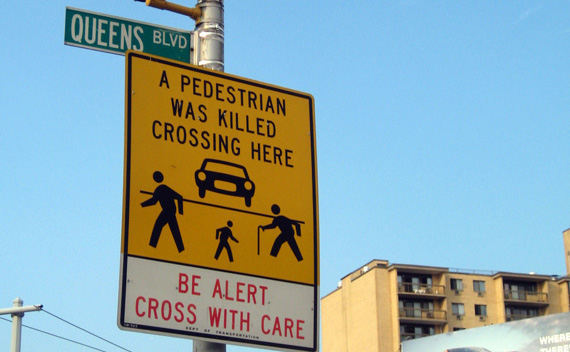
[Baltimore Spokes: Note the “blame the victim” sign.]
image

More than 250 New Yorkers are killed in automobile-related crashes every year, and it’s not unusual for City officials to tout these historically low numbers as evidence that they are doing their jobs well, as if exchanging 250 lives is a reasonable trade for mobility. Only in transportation is this somehow acceptable. This past spring, two construction cranes toppled over in separate incidents, killing six people and injuring several others. This prompted the Department of Buildings to declare war on falling cranes. Clearly, objects crashing down on city streets are a serious hazard to people, legitimizing such a hard stance. Automobiles moving at high speeds are the horizontal counterparts of falling cranes and building debris.

Continue reading “Vision Zero NYC: Ending the Body Count”

My commute sucks

image
Sign the Petition!

See-sawing gas prices, crazy crowded roads, noxious fumes – who would love their commute?

Not us. Join Americans all over the country, in big cities and in small towns, who are making their voices heard in Washington. Tell Congress: “My commute sucks and it’s not getting any better. Stop pouring billions into a broken system. Transportation shouldn’t be an expensive, dirty burden. Fix it, clean it, make it work!”
Continue reading “My commute sucks”

BIG BOOST FOR CYCLING, WALKING IN NJDOT PLAN

[Baltimore Spoke: It would be nice if MD even had such a report, even nicer if they could say they had an increase and say they were concerned about the recent surges in pedestrian fatalities. ]
-> According to an article in the May 8th Mobilizing the Region E-Mail, "While New Jersey DOT’s planned FY2010 Capital Program devotes more money towards road widening projects than in the past, it also provides almost 50% more funding for bicycle and pedestrian projects than last year’s capital program did. These types of projects now represent about 2% of the total highway program, up from 1.5% last year.
"This is obviously tremendous news for New Jersey’s cycling community, and especially timely given recent surges in bicyclist and pedestrian fatalities. NJDOT deserves credit for making bicycling and walking a funding priority. About 12% of all trips in the state were on foot or bicycle in 2001, according to the Federal Highway Administration…"
Continue reading “BIG BOOST FOR CYCLING, WALKING IN NJDOT PLAN”