
New Frames for New Ages

A (rather long) essay reflecting on the book Fighting Traffic by Peter D. Norton (MIT Press, 2008)

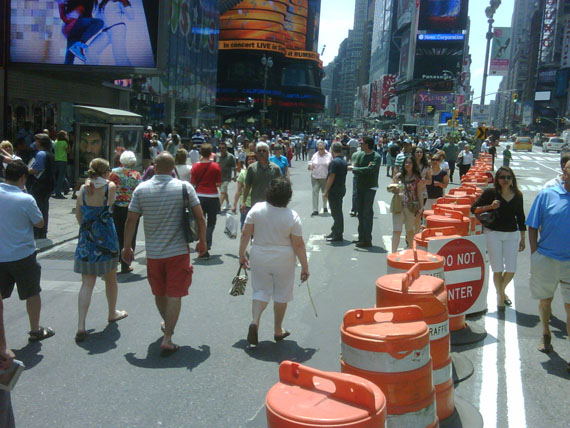
The street is an extremely important symbol because your whole enculturation experience is geared around keeping you out of the street.  “Just remember: Look left, look right, look left again… No ball games… Don’t talk to strangers… Keep out of the road.”   The idea is to keep everyone indoors.  So, when you come to challenge the powers that be, inevitably you find yourself on the curbstone of indifference, wondering “should I play it safe and stay on the sidewalks, or should I go into the street?”  And it is the ones who are taking the most risks that will ultimately effect the change in society.

The car system steals the street from under us and sells it back for the price of gasoline.  It privileges time over space, corrupting and reducing both to an obsession with speed or, in economic lingo, “turnover.”  It doesn’t matter who “drives” this system, for its movements are already pre-determined.

– from the website of the London advocacy group “Take Back the Streets”

* * * * *

Imagine you are a member of the majority, and a powerful minority has managed to get the laws changed in such a way as to significantly curtail one of your essential liberties.  What’s more, they then proceeded to abuse your remaining rights and make your life miserable.  As a result, a couple decades later, your majority has become a minority.

There’s no need to imagine.  This is what happened to pedestrians (and to a lesser extent bicyclists) in these United States in the 1920s.
Continue reading “New Frames for New Ages”

Cars Are Like Cigarettes; The New Pariah


Sometimes I feel like I am flying when I ride my bike. It’s exciting to turn a corner and suddenly find myself in a sea of other bicyclists. They seem to share this feeling of self-empowerment. In love with the knowledge that, as they pass through the air that surrounds them, they are not polluting what we all share and breathe. Bicyclists are free from the petroleum products that have compromised our global environment. They don’t have to worry about paying for parking, tipping valets, car insurance, car inspections or car maintenance. And this makes them smile. And, as an added bonus, bicyclists are less tense than the people belted into their metal, four-wheeled boxes.
The statistical truth is that 90% of trips made in cars are less than five miles from our homes. A very comfortable journey made on a bicycle. In addition to saving the aforementioned automobile expenses, riding a bike–just a couple hours a week–will reduce a person’s risk of heart attack and stroke by 50%, not to mention reduce the risks of obesity and diabetes, two of the biggest killers in the United States. The more people that ride bikes, the safer it gets to share the road with pedestrians and cars.
Continue reading “Cars Are Like Cigarettes; The New Pariah”

VTA Leads Bicycle and Pedestrian Network in Santa Clara County

By LINH HOANG, Public Relations Supervisor, Santa Clara Valley Transportation Authority, San Jose, CA
When people think about the Santa Clara Valley Transportation Authority (VTA), it’s usually synonymous with images of buses and light rail. However, VTA is also a Congestion Management Agency, and therefore supports the bicycle and pedestrian communities by working with the Santa Clara County and 15 cities to enhance additional trails, bicycle and pedestrian programs and policies, and design and construction of bicycle and pedestrian pathways, trails, sidewalks, bridges, ramps, bicycle lockers, storage and gates.
“VTA is more than bus and light rail. We work diligently to create an environment that allows Silicon Valley residents to have options when they bike,” said Chief Congestion Management Agency Officer John Ristow.
As the region’s Congestion Management Agency, VTA works across many areas, including transportation programming and land use planning, in its efforts to enhance and promote the bicycle and pedestrian communities. The authority identifies cross-county bicycle corridors to plan and implement a seamless bicycle and pedestrian travel network that is continuous across city and county boundaries.
VTA, in striving to promote a greener lifestyle for the communities it serves, also has created an environment that welcomes bicyclists and pedestrians on bus and light rail. Bicycles are allowed on all VTA coaches, and electronic bike lockers are also available. Many light rail lines can drop off passengers directly to the bicycle and pedestrian trails highlighted by the Bikeways Map produced and distributed by VTA. The map has gained popularity among the region’s bicycle and pedestrian communities and has been in high demand.
Continue reading “VTA Leads Bicycle and Pedestrian Network in Santa Clara County”

Bicycle still beats subway & taxi in Queens-to-midtown rush-hour race

image
When it comes to getting around the city, two wheels are still better than four.

For the fifth year in a row, cycling ruled the road in Transportation Alternatives’ annual commuter race Thursday, with a biker beating a straphanger and a cabbie.

It took librarian Rachel Myers 20 minutes and 15 seconds to pedal 4.2 miles from Sunnyside, Queens, to Columbus Circle during the morning rush.

“Woo hoo!” the 29-year-old Brooklynite shouted, pumping her fist in the air. “Just goes to show that bikes rule this city!”

Subway rider Dan Hendrick – who hopped the No. 7 in Sunnyside and transferred to the No. 1 at Times Square – arrived 15 minutes later.

Hendrick, 38, usually rides the rails to work at the New York League of Conservation Voters, but he may be switching to pedal power.

“Twenty minutes saved is a lot in the morning,” he said. “I could really use that time to get a latte or something.”

A yellow cab rolled up to the finish line 27 minutes after Myers, costing passenger Willie Thompson $30 and precious commuting time.

“I always thought [cabs] were the fastest,” said Thompson, 30, a nonprofit e-marketer from Flatbush, Brooklyn.

“But it was so slow, it was brutal. I’m exhausted from sitting so long!”
Continue reading “Bicycle still beats subway & taxi in Queens-to-midtown rush-hour race”

In the Future, the City’s Streets Are to Behave

By DAVID W. CHEN – New York Times
Imagine narrow European-style roadways shared by pedestrians, cyclists and cars, all traveling at low speeds. Sidewalks made of recycled rubber in different colors under sleek energy-efficient lamps. Mini-islands jutting into the street, topped by trees and landscaping, designed to further slow traffic and add a dash of green.
This is what New York City streets could look like, according to the Bloomberg administration, which has issued the city’s first street design manual in an effort to make over the utilitarian 1970s-style streetscape that dominates the city.
The Department of Transportation will begin reviewing development plans to see whether they align with the 232-page manual’s guidelines, and promises that projects with these features will win approval quickly.
“Lots of things have changed in 40 years, but this part of our infrastructure hasn’t,” said Janette Sadik-Khan, the city’s transportation commissioner. “If we’re going to be a world-class city, we need guidelines that lay out the operating instructions of how we get there.”
The manual, to be released on Wednesday, culminates nearly two years of work involving more than a dozen agencies led by the Department of Transportation. By offering “a single framework and playbook,” as Mayor Michael R. Bloomberg says in the introduction, the manual promises to simplify the design process and reduce the costs for city agencies, urban planners, developers and community groups.
Urban planners say that the document is long overdue, and that it promises to be as much a map to the future as it is a handbook for the present: getting people to think about streets as not just thoroughfares for cars, but as public spaces incorporating safety, aesthetics, environmental and community concerns.
Continue reading “In the Future, the City’s Streets Are to Behave”

German kiddie traffic court

I’ve head about this program there where police set-up a speed trap in front of a school, and when they pull over drivers, the motorist has to go before a journey of juniors and example why s/he was speeding.
This is what my friend who told me about it said:
A group of young kids plus a police officer, and I assume a teacher or other chaperone, stands on the sidewalk near a school. The police pull over speeders. Instead of giving them regular speeding tickets, they’re forced to explain to the group of kids why they were speeding in front of the school. I don’t remember whether the kids deliberated and decided whether or not to give the drivers real or fake tickets. Perhaps they made them take literature on why speeding is bad. Since they’re small kids, I’m guessing they probably weren’t outside for too long. I may also be misremembering, but I seem to recall that many of the drivers sent to kiddie court were parents of kids at the school. I would think that this would be much more effective than doing it somewhere away from the school, because they will be reminded of the experience every time they see these kids again at the school.
Continue reading “German kiddie traffic court”

All Wheels 4 Fibromyalgia RAAM

[I always liked rooting for the home team and here are some friends of ours racing and raising money for a cause.]

Campaign Progress

Goal:
$50,000.00
Achieved:
$37,875.00

Make a gift!

76 percent of goal achieved.


All Wheels for Fibromyalgia
 
A cycling team of four cyclists and 12 crew members will race nonstop for 3,000 miles across the United States in the world’s toughest bicycle race the Race Across America (RAAM). The race begins on June 20, 2009 in Oceanside, Calif. and ends in Annapolis, Maryland. The objective is to complete this coast-to-coast race in the fastest time the goal is 7 days!
 
The team’s endeavor, however, goes beyond completing this rigorous race. All Wheels 4 Fibromyalgia is partnering with the National Fibromyalgia Association, and select sponsors in a shared ambition to raise awareness of fibromyalgia, a complex pain disorder that affects an estimated 10 million women, men and children in the U.S.
 
All Wheels 4 Fibromyalgia will be raising funds to support fibromyalgia research and community-based education programs for individuals affected by the disorder. The team’s goal is to raise $50,000 by June 20. You can help them in their quest by making a tax-deductible donation in any amount to the National Fibromyalgia Association.
 
Thank you to our sponsors
 
Pfizer
 
Euro RSCG Life
Weisscomm Partners 
Sportsmark
 
Chico Chandler
 
 
powerbar 150
 
5 Hour Energy 
Scarsin
 
Pactimo

Continue reading “All Wheels 4 Fibromyalgia RAAM”

All road users should have to do 100 hours on other modes of transport.

By Flip Shelton

Cyclists are killed by cars and trucks, so car and truck drivers who don’t ride a bike should pay more on their registration to cover this cost.

The ancient Greek philosopher Plato said: "No law or ordinance is mightier than understanding." The biggest problem we have on the road is a lack of understanding.
Many drivers don’t realise the anxiety they cause by driving too close, or too quickly, or honking. They don’t know because they have never been in our cleats, so to speak. That’s quite understandable — often it is impossible to imagine a situation if you haven’t been there.
And to those people I say, get on a bike and ride the roads for some first-hand experience.
Continue reading “All road users should have to do 100 hours on other modes of transport.”