
Long Island has the two most dangerous roads in the region for pedestrians, the Hempstead Turnpike and Sunrise Highway. Respectively, 15 and 12 pedestrians perished on the roadways between 2005 and 2007, continuing a long-term trend of Nassau and Suffolk Counties having some of the most dangerous roads in New York.
But the numbers didn’t stop NYSDOT’s Long Island regional office, Region 10, from eliminating its Local Safe Streets and Traffic Calming Grant Program. The program, established in 2000, provided $2.7 million a year for pedestrian and bike projects throughout Nassau and Suffolk Counties (see MTR # 292). It has paid for over 40 projects in towns including Oyster Bay and Great Neck.
No public announcements related to the program had been made since 2006, so MTR recently inquired about the projects the program has funded.
In response, we received an email from a Region 10 spokesperson that said the program was “under review” (read: eliminated) but that it had succeeded in “providing examples for municipalities to emulate on their roads” (read: towns should pay for pedestrian and bicycle projects themselves).
The most troubling part of the communication was the reasoning behind the decision, which demonstrated a complete misunderstanding of the Highway Safety Improvement Program (HSIP), the federal program authorized under SAFETEA-LU that funded the local safe streets grants. According to the spokesperson, these funds “can only be used on roads on the federal-aid highway system” and “require a 20% local match.”
In fact, the HSIP funding guidelines say that “funds may be used for projects on any public road or publicly owned bicycle and pedestrian pathway or trail … the Federal share is 90 percent, except that the Federal share is 100% for certain safety improvements listed in 23 USC 120(c).
Continue reading “Long Island NYSDOT Office Kills Pedestrian Safety Program”
Then & Now | Street Fight
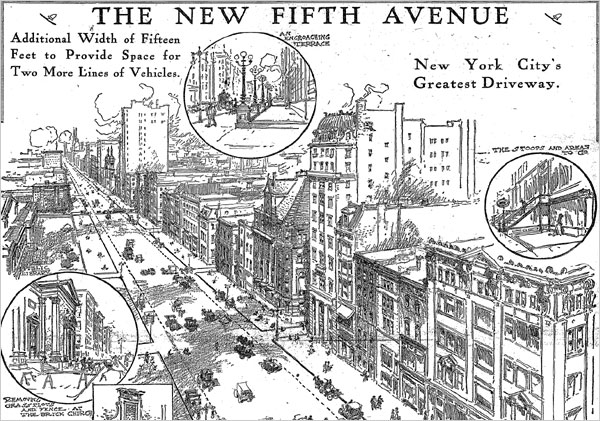
Interesting contrast how New York City once nibbled away sidewalks to make room for cars and now they are closing roads to make room for pedestrians.
Continue reading “Then & Now | Street Fight”
Pedalpalooza Bike Kiss-In
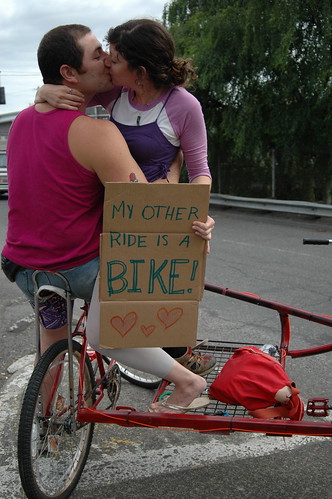
The Bicycle Kiss-in…what better way to show the world how much fun riding a bike can be? Slogans included:
“Liplock Not Gridlock”
“Sucking Face Instead of Sucking Gas”
“If You Were Biking, You’d Be Making Out By Now”
and the great: “My Other Ride is a Bike!”
Continue reading “Pedalpalooza Bike Kiss-In”
Cyclists Can Breathe Easy
A Dutch study has proved, yet again, that the level of dangerous microparticles are higher inside cars than on bikes.
I posted about how Traffic Kills More People Than Traffic Accidents before, but this recent survey reconfirms the science.
Despite the air pollution it is healthier to cycle in traffic than sitting in a car. The levels of particles in the air are greater inside a vehicle than on the bike lanes. So even though a cyclist breathes in more air than a motorist, the concentration of microparticles is lower for the cyclist.
The health benefits of cycling greatly overshadow the harm caused by breathing polluted air, the study adds.
Continue reading “Cyclists Can Breathe Easy”
Law Enforcement Bias and the 3ft Law
Officer re 3′ passing law: “It’s very hard to do. The officer has to be in the right place and he has to observe a vehicle not giving the cyclist three feet. And if there’s on coming traffic, it’s hard for the motorist” said Dusty Stokes of the Hamilton County Sheriff’s Department."
Excuse me? Hard for the motorist? …
Continue reading “Law Enforcement Bias and the 3ft Law”
Breaking news: Transportation bill released

Capitol Hill is buzzing with the news: just moments ago, a new transportation bill was released, and the Obama administration is pushing Congress to pass a funding plan quickly. Why the rush? Transportation funding is running out. But we can’t afford to keep throwing money at transportation agencies unable to show progress on the issues that matter to us all: Affordable ways to get around; alternatives to congestion; reducing our oil dependency; protecting the climate; safe and vibrant communities and access to jobs. Tell Congress: No new money without a real, sustainable plan. The National Highway Trust Fund – which pays for road work, bike and pedestrian facilities and transit projects – will run out of money in August. With funds drying up, the pressure to throw more money at our problems is growing. Some in Congress are poised to take money from other needs to prop up the trust fund, which comes from gas taxes. They would prefer to go on spending our tax dollars without a real plan. But more money with no strings attached is not the answer. The U.S. hasn’t had a vision for transportation policy in decades. We’ve been trying to build our way out of a congested and inefficient system with no accountability and no actual plan to link our roads, trains, buses, bikeways and pedestrian-friendly streets. The result? Longer, more frustrating, less safe and increasingly expensive commutes for all of us. But now we have an opportunity for change. We must ensure that our country’s transportation investments strengthen our economy, our environment and our health. Tell your representative we need real reform before we throw more money at our problems. Don’t let Congress make the same mistakes it’s made in the past. We must fund transportation, and we must do it right this time. Thank you for your support at this crucial moment. Sincerely, Ilana Preuss |
If I can ride a 3-speed across the country, everyone can be riding their bikes more to work and to the store.
Last year when we gave Ryan Van Duzer a 3-speed commuter bike to thank him for years of support around the Tour de Fat – he jokingly said he’d ride it across the country. We all chuckled and walked away but Ryan called us this spring and said he was going to ride the 3-speed 3,000 miles – from San Diego to Washington DC – to raise money for Community Cycles in Boulder.
Who are we to get in the way of a young man following his folly?
So, this is Ryan’s coast-to-coast adventure. He’ll be blogging, tweeting and uploading videos along the way. He wants you to come out and ride with him so check back often to see when he’ll be pedaling through your town – he needs your support and a place to wash his sox.
As Ryan says, "If I can ride a 3-speed across the country, everyone can be riding their bikes more to work and to the store."
Ride on, Duzer. We totally agree. We’ll see you in DC late summer.
Continue reading “If I can ride a 3-speed across the country, everyone can be riding their bikes more to work and to the store.”
Lessons for the United States
Public policy can play a major role in reshaping America’s transportation system. The German experience offers five lessons to the United States for improving transportation sustainability through changes in travel behavior:
* Get the Price Right in order to encourage the use of less polluting cars, driving at non-peak hours and more use of public transportation
* Integrate Transit, Cycling, and Walking as Viable Alternatives to the Car, as a necessary measure to make any sort of car-restrictive measures publicly and politically feasible
* Fully Coordinate and Integrate Planning for Land Use and Transportation to discourage car-dependent sprawl and promote transit-oriented development
* Public Information and Education to Make Changes Feasible are essential in conveying the benefits of more sustainable policies and enforcing their results over the long term
* Implement Policies in Stages with a Long Term Perspective because it takes considerable time to gather the necessary public and political support and to develop appropriate measures.
Continue reading “Lessons for the United States”
More on the "right to drive"
…
CYCLISTS FLOUT COMMON SENSE, ENDANGER THOSE IN CARS ON MOUNTAIN ROADS IN THE NAME OF SELFISHNESS; CARS WILL BE FORCED TO CROSS DOUBLE YELLOW LINES ON DANGEROUS LIMITED VISIBILITY ROADS DUE TO THE EXPANDED RIGHTS OF CYCLISTS.
Yadda, yadda, yadda. Where to begin? Give the author credit for getting the spelling right, at least.
Let’s start with the Universal Right of Speed, a part of the vehicle code so obscure that no one has been able to find it. URS states that drivers in motor vehicles have the inalienable right to drive as fast as they want whenever they want. Speed limits are merely advisory and can be ignored if there are no law enforcement vehicles in the immediate area. Drivers may operate at or above the speed limit even when the road ahead is obscured by terrain, fog, rain, snow, or smoke. Anything that forces them to slow down (other than a police car parked alongside the road) is most likely illegal, unconstitutional, and immoral.
…
Motorists who say it is too dangerous for bicyclists to be on the public roads as they are likely to be hit by a car, are simply roadway bullies exactly like the playground bully who says, "This is my playground and I am bigger than you, and if you get hurt it is your own fault." They are simply blaming the victim.
We had similar comments on a news article here after a motorist killed two cyclists last week. ‘Bicyclists shouldn’t use ABC Road because it’s four lanes with heavy, high-speed traffic.’ And of course, someone else chimed in with ‘cyclists shouldn’t use XYZ Road because it’s only two lanes with hills and curves.’ The underlying complaint is that ‘cyclists shouldn’t use the road I’m on -they should go somewhere else.’
Continue reading “More on the "right to drive"”
Complete Street Quotes
“Transportation systems dramatically affect the design of communities in which we live, in turn the design of our communities affects our ability to engage in healthy behaviors. Transportation systems, therefore, can be used to support healthy communities essentially by allowing people to use all modes of transportation to move through the community they occupy in a safe and efficient way.”
– Dr. Ileana Arias, Director of the National Center for Injury Prevention and Control of the Centers for Disease Control and Prevention, at June 5’s briefing on Complete Streets: Integrating Safety and Livability into the Next Transportation Bill
“The signing of this Executive Order is just one in a number of steps that we are taking to make Philadelphia an even better place to walk, bike and take SEPTA. Making it easy for residents, commuters and visitors to choose to not use their cars is among the most meaningful contributions the City can make toward our goal of becoming America’s number one green city.”
– Philadelphia Mayor Michael Nutter, in the accompanying press release
“The widespread lack of physical activity in our nation has played a major part in the perpetuation of the obesity epidemic. A key factor contributing to the lack of physical activity is the absence of infrastructure to support or encourage pedestrian and bicycle travel as modes of transportation. The result of our collective inactivity has burdened New York State with over $6 billion annually in medical costs. That is why this bill is so important.”
– New York State Assemblyman Sam Hoyt, in Buffalo Rising