
…
Extensive research shows the dangers of distracted driving. Studies say that drivers using phones are four times as likely to cause a crash as other drivers, and the likelihood that they will crash is equal to that of someone with a .08 percent blood alcohol level, the point at which drivers are generally considered intoxicated. Research also shows that hands-free devices do not eliminate the risks, and may worsen them by suggesting that the behavior is safe.
A 2003 Harvard study estimated that cellphone distractions caused 2,600 traffic deaths every year, and 330,000 accidents that result in moderate or severe injuries.
Yet Americans have largely ignored that research. Instead, they increasingly use phones, navigation devices and even laptops to turn their cars into mobile offices, chat rooms and entertainment centers, making roads more dangerous.
A disconnect between perception and reality worsens the problem. New studies show that drivers overestimate their own ability to safely multitask, even as they worry about the dangers of others doing it.
Device makers and auto companies acknowledge the risks of multitasking behind the wheel, but they aggressively develop and market gadgets that cause distractions.
Police in almost half of all states make no attempt to gather data on the problem. They are not required to ask drivers who cause accidents whether they were distracted by a phone or other device. Even when officers do ask, some drivers are not forthcoming.
The federal government warns against talking on a cellphone while driving, but no state legislature has banned it. This year, state legislators introduced about 170 bills to address distracted driving, but passed fewer than 10.
Continue reading “Drivers and Legislators Dismiss Cellphone Risks”
Cyclist Sues for Opened Car Door
Here’s a new skirmish between bikers and motorists: A Southeast Portland cyclist is suing a woman for opening a car door directly in her path, allegedly causing a collision and permanent injuries.
According to a lawsuit filed July 8 in Multnomah County Circuit Court, Kristin Ragnarsson was riding eastbound on Southeast Stark Street on July 3, 2008.
As Ragnarsson passed the intersection with Southeast 28th Avenue, the lawsuit says, Judith Latourette-Meyers of Clackamas County had her vehicle parked at the curb on the south side of Stark. According to the lawsuit, Latourette-Meyers opened her driver-side door “directly into the path” of Ragnarsson’s bike.
Ragnarsson suffered injuries to her head, back, left hip and right hand, the lawsuit says, including a cut to her right index finger and a broken metacarpal. The injury to her right hand is permanent, the lawsuit says.
The suit, filed by Vancouver lawyer Daniel Jacobs, seeks $12,765.96 for medical bills, plus up to $100,000 for pain and suffering.
Latourette-Meyers could not be reached for comment.
Continue reading “Cyclist Sues for Opened Car Door”
A Strategy for Traffic Safety
[Baltimore Spokes: Something very similar could be written about Baltimore.]
Despite acres of new pedestrian space and a 1,800-mile bicycle network in
development, in 2007 there were still 79,510 car crashes in our city, including
11,035 incidents of a motor vehicle hitting a pedestrian. In 2007, 273 people
were killed in car crashes and the majority of them were pedestrians. Being
struck by a car while walking remains the number two cause of injury-related
death for New York City adults over 45, second only to an accidental fall, and
it is the number one injury-related cause of death for New York City children
under 14. It is increasingly evident that the fatal consequences of New York
City streets are reliant on more than infrastructure. What good is a crosswalk
with a car blocking it? What use are red lights when 1.23 million vehicles
speed through them every day? This everyday behavior terrifies New Yorkers.
The lack of action to counter this behavior is a problem. As the number of
pedestrians, cyclists and drivers killed in New York City car crashes remains
unchanged, the number of summons issued for the most dangerous traffic
violations is actually declining. Transportation Alternatives’ Executive Order:
A Mayoral Strategy for Traffic Safety outlines the breadth of the problem,
and on the basis of our expertise, offers extensive recommendations towards
a solution. Mayor Bloomberg, we strongly urge you to recognize the problem
of traffic safety; please read, consider and act on the recommendations
outlined herein.
In the month of October 2008, there were 16 reported instances in which a
vehicle crashed into a person. Between October 1 and October 24 alone,
seven people were struck by cars and were fortunate enough to survive. In
those same 24 days, motor vehicle drivers killed 11 pedestrians and 2 cyclists:
five of the drivers hit and ran; one drove on a suspended license; none of the
drivers were charged with a crime. Had the moving violations that caused
these deaths, the speeding, red light running and failure to yield not resulted
in a crash, it is extremely unlikely that any of the drivers’ illegal actions
would have been caught. However these fatalities are not the only disastrous
effect of the failure to enforce moving violations. For every fatality, there are
hundreds of crashes that cause debilitating injury, for every injury there are
thousands of terrifying crashes, and for every crash there are millions of New
Yorkers whose quality of life suffers under the toll of dangerous traffic in their
community.
Australian Cyclists Save Millions in Health Care
A recent report entitled Cycling: Getting Australia Moving indicates that by improving their health, cyclists saved about $227.2 million Australian per year.
…
Other economic benefits of cycling include a reduction in congestion which saves about $63.9 million AUD and $9.3 million saved by limiting greenhouse gas production and other “externalities.”
Continue reading “Australian Cyclists Save Millions in Health Care”
Americans fatter than ever, CDC says
WASHINGTON – Americans are getting heavier than ever, with more than 26 percent of the population now fully obese, the US government said yesterday.
Despite warnings that the population must stop layering on the fat and frightening statistics that show two-thirds of Americans are overweight or obese, the weight trend continues, the US Centers for Disease Control and Prevention reported.
“The proportion of US adults who are obese increased to 26.1 percent in 2008 compared to 25.6 percent in 2007,’’ the CDC said in a statement.
“If this trend continues we will likely see increases in healthcare costs for obesity-related diseases,’’ said the CDC’s Liping Pan, who headed the study.
“Obesity is a major risk factor for many chronic diseases such as heart disease and diabetes,’’ the CDC’s Dr. William Dietz said in a statement. “As obesity increases among all age groups, we are seeing chronic diseases in much younger adults.’’
“For example, we now see young adults who suffer from heart disease risk factors and other conditions such as type 2 diabetes that were unheard of in the past.’’
Continue reading “Americans fatter than ever, CDC says”
Ad wars, who is paying their way?
New full-train MAX ad asks: Should cyclists pay road tax?

New question: ‘Should motorists pay a medical tax?’

[Baltimore Spokes: Maryland’s cost of car cashes comes to $9 Billion total with Baltimore City having the highest cost per capita in the state. Car crashes cost on average ~$90,000 per crash.]
Continue reading “Ad wars, who is paying their way?”
Drivers asked to test alternative to fuel tax
[Baltimore Spokes: Note how are cars paying for roads is the tax system is "irrevocably broken"?]
ALBUQUERQUE, N.M. (AP) — Researchers are looking for 1,500 drivers in six cities, including Albuquerque, to test an on-board computer system that taxes motorists based on miles driven rather than fuel taxes paid at the pump.
That mileage-based tax is being considered by the University of Iowa Public Policy Center in a $16.5 million study for the U.S. Department of Transportation to determine whether it’s a viable option for paying for surface transportation, including roads and railroads, in the future.
The gas tax over the long term "is irrevocably broken and something is going to have to be done," said Jon Kuhl, a University of Iowa professor of electrical and computer engineering and principle investigator on the study.
…
Continue reading “Drivers asked to test alternative to fuel tax”
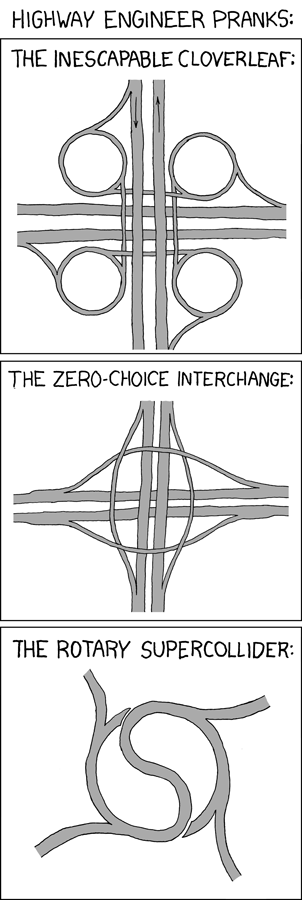
I am always looking for creative road ideas ;)
4 Cases Of How Tearing Down A Highway Can Relieve Traffic Jams
…
One example is reducing traffic congestion by eliminating roads. Though our transportation planners still operate from the orthodoxy that the best way to untangle traffic is to build more roads, doing so actually proves counterproductive in some cases. There is even a mathematical theorem to explain why: “The Braess Paradox” (which sounds rather like a Robert Ludlum title) established that the addition of extra capacity to a road network often results in increased congestion and longer travel times. The reason has to do with the complex effects of individual drivers all trying to optimize their routes. The Braess paradox is not just an arcane bit of theory either – it plays frequently in real world situation.
Likewise, there is the phenomenon of induced demand – or the “if you build it, they will come” effect. In short, fancy new roads encourage people to drive more miles, as well as seeding new sprawl-style development that shifts new users onto them.
Of course, improving congestion is not the main reason why a city would want to knock down a poorly planned highway–the reasons for that are plentiful, and might include improving citizen health, restoring the local environment, and energizing the regional economy. More efficient traffic flow is just a wonderful side benefit.
Sound dubious? Here are several examples of how three cities (and their drivers) have fared better after highways that should never have been built in the first place were taken down.
CASE 1: Seoul, South Korea – Cheonggycheon highway
CASE 2: Portland, Oregon – Harbor Drive
CASE 3: San Francisco – Embarcadero Freeway
CASE 4: San Francisco – Central Freeway
Continue reading “4 Cases Of How Tearing Down A Highway Can Relieve Traffic Jams”
Loudoun bikers stop sign charges dismissed; Landau successfully represents “MS-8″ Lovettsville cyclists in Leesburg Traffic Cour
This morning Doug Landau represented 2 of the bikers who were ticketed for rolling through a stop sign in Loudoun County. But the details of their ride are turning heads all over Virginia, as reported in prior posts.
On Sunday June 11th, a total of eight cyclists were stopped for this offense (Virginia Code 46.2-821) during the MS ride, by a police officer whose car was parked a full 300 feet away, with orange cones near the 7-11 “rest stop.” As the cyclists approached the stop signs, located on an open, rural road, they slowed down, looked both ways, saw no traffic and continued on their route around the “squircle” (a squared off traffic circle with 4 stop signs and a sidewalk running through the center). Rather than follow some of the cyclists through the middle of the square, these experienced bicycle riders thought going around the “squircle” would be safer. The police officer, who the cyclists thought was waving on participants in the Multiple Sclerosis charity ride, then proceeded to ticket them for not coming to a complete stop. No warning. Just a citation for a moving violation, with 4 points and a large fine as well!
Continue reading “Loudoun bikers stop sign charges dismissed; Landau successfully represents “MS-8″ Lovettsville cyclists in Leesburg Traffic Cour”