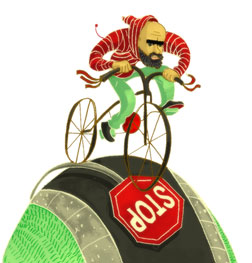
Think about raging bulls


Colville-Andersen’s second goal is to “always sell bicycles positively”. He compared the marketing of bicycles to that of cars:

“You never hear them [car industry] talking negatively about their product at all. Never. They’ll never tell you that driving is considered to be the most difficult task homo sapiens have had to master. This is actually true, hunting mammoths is nothing compared to driving a car. They’ll never tell you that the level of dangerous hydorcarbon particles in the air are actually higher inside the car than if you ride a bike next to them… They never tell you your risk of head injury is higher in a car than on a bicycle and at no point have we ever seen the car industry promote motorist helmets.”

A key to making cycling mainstream, according to Colville-Andersen, is to address the dangers of the automobile. He equated the car with a bull running around a china shop.

“Someone has let a sacred bull in society’s China shop… We can all agree that there is a bull in the china shop, we can all be realistic and think the bull’s not going anywhere (it’s gotten too big to fit out the door now). So we bubble wrap all the pieces of expensive china and meanwhile the bull just knocked over eight shelves in aisle 9 and took a shit on the floor. It’s strange, we’ve developed this fantastic capacity to completely and utterly ignore the bull.”

Continuing with the bull/car comparison, he said that knowing that there’s a bull in the china shop, people should do something to “limit its destructive capabilities” such as “castrate it to make it calmer, tie it down, or build a fence around it.”

Colville-Andersen’s third goal is to simply address “the bull”, meaning, if cities really want to attain high levels of bicycle use, they must begin to acknowledge that the cars are causing havoc and their power and dominance on the urban landscape must be reigned in.

On a similar note, Colville-Andersen said he dreams about a day when cars have warning labels similar to those mandated on cigarette packages:

“Imagine if we woke up and all the cars had warning labels on 30% of their surface area [that’s the law for cigs]. Imagine what would happen to the mindsets of our population. After two months you’d have people opening their garage, looking at the car, looking at the bike and saying, ‘I’m not going to risk my life, I’m taking the bike’”.

The role of the bicycling “subculture” was also addressed by Colville-Andersen. He feels that in order to “mainstream bicycling” it needs to be re-branded as a “normal, borderline boring transport option.” To do this he feels like cities should “focus less on subcultures”.

Continue reading “Think about raging bulls”

Bikes and cars: Can we share the road?

With more bikes on the road, drivers are frustrated — and cyclists are at risk. Now’s the time for changes.
By Christie Aschwanden – Los Angeles Times
Mandeville Canyon Road is a two-lane, dead-end road that twists and climbs for six miles through a quiet Brentwood neighborhood. "It’s perfect for bicycling — like honey to bears," says Jeffrey Courion, former public policy director for Velo Club La Grange, a bicycle touring and racing club.
But with just one lane in each direction and limited visibility in some places, the road has also become a flash point for conflicts between motorists and cyclists. "It’s a problem of people competing for space," Courion says.
That competition turned ugly in July 2008. Brentwood doctor Christopher Thomas Thompson is currently facing trial in the L.A. County Superior Court, charged with four felony counts related to a collision with two bicyclists in Mandeville Canyon. The injured cyclists allege that Thompson deliberately pulled in front of them, then slammed on his brakes, intending to hurt them. Thompson’s attorney argues that the cyclists had yelled profanities at Thompson and were to blame for the accident.
The number of people riding bicycles has exploded in recent years. U.S. census statistics released in September show a 43% increase in bike commuting nationwide between 2000 and 2008, and Courion’s bike club, which often rides in Mandeville Canyon, has seen its numbers nearly double to nearly 500 in the last several years.
This surge of new bicycles on the road frustrates some motorists, leading to antagonism and altercations of which the Mandeville Canyon incident is an extreme example. And though data suggest that cycling fatalities have actually fallen nationwide, one new study suggests that the injuries cyclists suffer in traffic accidents are becoming more severe.
The city of Los Angeles is currently updating its own bicycle infrastructure plan. Even as it does so, cycling experts and enthusiasts can’t agree on how to make the roads more bicycle-safe. Some advocate for more dedicated infrastructure, such as bike lanes. Others believe that people riding bicycles belong on the roads just as surely as do cars — and that the key to greater safety is people cycling in a manner that reflects that right.
Continue reading “Bikes and cars: Can we share the road?”

Mass Transit vs. Bike Infrastructure

[The following story makes me think can we really have mass transit when there are no sidewalks? Can we really have walking as transportation or an extension of mass transit with poles in the middle of the sidewalk? Can we create great places to live surrounded by car sewers? Are great places to live solely defined by all the things that you have to drive too? The attention to detail for all modes of travel especially biking and walking has to get to the planning table.]


From Washington, DC’s K Street to SF’s Van Ness, and East Bay/Oakland’s
Telegraph Ave BRT, it seems like bike infrastructure continues to get cut
out of the picture not because it makes any sense to cut it, but because
advocates of all stripes are all too willing to accept that bikes are not,
and cannot be, ‘serious transportation’. These are ‘transit corridors’,
dontchaknow, and by definition that means stuff that pollutes and makes loud
noises and can reach very high top speeds, if not very high average speeds.
Oh, and it’s obvious that buses always have and always will move more people
than bikes can/will.

Like Le Corbu’s Towers in the Park, there is a certain seductiveness to this
Jetsons-like vision of high-tech transitways filled with gleaming, zooming
biarticulated buses and shiny new hybrids and e-cars of various types, while
relegating the humans to their rightful refuges — aka ‘sidewalks’.

But once we move this vision from the vague, happy-faced, brightly-colored,
and clean-looking drawing boards out into the real and dirty world of
everyday street life in the city, that seductiveness can then be seen as
vanity, ego, and frivolity.

We can have transitways without the required walk and bike infrastructure,
but that will not deliver us decent places to live.
Continue reading “Mass Transit vs. Bike Infrastructure”

People outraged driver who struck and killed couple won’t be charged

BEXAR COUNTY, TEXAS — A day after a couple was killed while riding a bicycle, people are outraged that the driver who hit them probably will not face any criminal charges.
Greg and Alexandra Bruehler were riding a bicycle built for two on the shoulder of Hwy. 16, north of Helotes, Thursday morning when deputies say a man in a pickup veered off the road and hit them.
"He looked off, he was looking at something else and realized the curve in the road came a lot faster than what he anticipated," explained Deputy Chief Dale Bennett of the Bexar County Sheriff’s Office.
Both Greg and Alexandra were wearing helmets, but they did not survive their injuries. Alexandra died at the scene. Greg died at University Hospital a short time later. The couple leaves behind their 7-year-old daughter, Kylie.
Dozens of people who have written comments on News 4 WOAI’s Web site (woaitv.com) are furious that the driver is not being charged and that deputies are calling it just an accident. It turns out, the Bexar County Sheriff’s Office is also dealing with a lot of angry e-mails and phone calls.
Deputy Chief Bennett told News 4 WOAI the office’s hands are tied. He said under current law, unless a driver is drunk or high, it is difficult to prove recklessness. And legally, charges can not be filed for "an unfortunate accident."
"Was he texting? Was he on the phone? What was the issue? Why was he distracted? Why did he go off the road? Driver inattention…is basically what it amounts to," Deputy Chief Bennett said. "And there’s nothing we can do about drivers not paying attention."
The driver’s name has not been released.
"At the scene, he was a wreck," said Deputy Chief Bennett.
According to deputies, even if the driver had been texting or using his cell phone, that would not be enough to file charges against him. The deputies said until the laws are changed, there is nothing they can do.
Continue reading “People outraged driver who struck and killed couple won’t be charged”

LA road rage trial begins.

After one cyclist slammed into the rear of his car and vaulted over it into oncoming traffic, and another crashed through his rear window, Dr. Christopher Thomas Thompson called 911 and told the operator, “They’ll tell you they are seriously injured, but they’re not.”
Prosecutors presented a recording of the call on Friday during the opening day of testimony in Thompson’s trial on assault with a dangerous weapon and other charges. The trial continues Monday in Los Angeles County Superior Court. .
Prosecutors say Thompson, 60, a former ER doctor, purposefully braked in front of the two riders as they descended Mandeville Canyon Road on July 4, 2008.
Cyclist Christian Stoehr hit the back of Thompson’s Infiniti sedan and went over the top into the other lane. His injuries included a grade-3 shoulder separation and road rash. Ron Peterson went through the rear window; the impact broke his nose, nearly severing it, and shattered several of his teeth. More than 90 stitches were required to reattach his nose.
In opening statements Friday, Thompson’s defense attorney Peter Swarth said the collision was an unfortunate accident and not the result of any intentional action. He said Dr. Thompson had been saving lives for more than 30 years and would never deliberately hurt anyone. He told the jury there are two sides to every story and insisted that the facts of the case would exonerate his client, provided jurors kept open minds and didn’t decide the case prematurely.
Earlier incidents will be examined
District Attorney Mary Stone promised jurors that she would present evidence about the Fourth of July incident, including the tape of the 911 call, in which Thompson can be heard telling one of the cyclists to get his bike out of the road before downplaying the extent of their injuries. Stone told jurors she would also present evidence from two prior episodes on the same road, allegedly involving Thompson, the owner of a medical records company who lives on the road.

Continue reading “LA road rage trial begins.”

Cycling plan to blame drivers for all crashes

MINISTERS are considering making motorists legally responsible for accidents involving cyclists or pedestrians, even if they are not at fault.
Government advisers are pushing for changes in the civil law that will make the most powerful vehicle involved in a collision automatically liable for insurance and compensation purposes.
The move, intended to encourage greater take-up of environmentally friendly modes of transport, is likely to anger some drivers, many of whom already perceive themselves to be the victims of moneyspinning speed cameras and overzealous traffic wardens.
Many will argue that it is the risky behaviour of some cyclists — particularly those who jump red lights and ride the wrong way along one-way streets — that is to blame for a significant number of crashes.
However, policy-makers believe radical action is required to get people out of cars and onto bicycles or to walk more. Only 1%-2% of journeys are at present made by bike.
Other proposals to promote greener — and healthier — transport include the imposition of blanket 20mph zones on residential streets.
Continue reading “Cycling plan to blame drivers for all crashes”

Stop Means Stop

How do we get bikers to obey traffic laws?
By Christopher Beam – Slate
image
Heading home from work yesterday, I ran five red lights and three stop signs, went the wrong way down a one-way street, and took a left across two lanes of oncoming traffic. My excuse: I was on a bike.

I’m far from the only menace on two wheels. A colleague was recently slapped with a moving violation after breezing through a stop sign. My roommate was pulled over 30 feet from our house for the same infraction. And driving around Washington, D.C., recently, I saw a cop scribbling out a ticket to a bewildered biker.

I had never heard of a biker getting ticketed in D.C. Has there been a sudden crackdown? “I’m not specifically aware of any stepped-up enforcement,” says Metropolitan Police Department spokesman Kenny Bryson. Eric Gilliland, a lawyer for the Washington Area Bicyclist Association, disagrees with the policeman’s take. Bike ticketing “comes and goes in waves,” Gilliland says, but the rate has gone up over the last five years.

Something felt wrong. It wasn’t injustice, exactly—all of these bikers broke the law. But was their behavior any great public-safety risk? Even after hearing about the spate of tickets, I haven’t changed my behavior. What’s the point of traffic laws for bikes? And if there is a point, is there any way to get me and my stop sign-flouting cohort to follow the rules of the road?

Bikes occupy a gray area of the law. They’re neither cars nor pedestrians. Most states do carve out special laws for bikes, but not enough to avoid confusion. Take this scenario: I’m approaching a stop sign on my bike. There are clearly no cars coming from either direction. Do I come to a complete stop? Can I cautiously slide through? The traffic laws say full stop. But in practice, few bikers hit the brake, put their foot on the ground, and then start pedaling again. Are they criminals?

The D.C. Code recognizes the special status of bikes. Bikes shall follow all traffic laws, the code says, except for rules that “can have no reasonable application to a bicycle operator.” Presumably, this refers to laws governing highways, some sidewalks, and other non-bicycle-friendly turf. It doesn’t apply to the stop-sign scenario, even though some bicycle advocates argue that stop signs “have no reasonable application to a bicycle operator.”
Continue reading “Stop Means Stop”

Fatalities Up, Summonses Down

[I would not be surprised if the same thing could be said here.]

The NYPD keeps traffic moving, but at what cost?


Bicyclist and pedestrian traffic fatalities are up, while traffic summonses are down: that’s the terrifying fact buried deep in the numbers of this year’s Mayor’s Management Report.

Since fiscal year 2007, the total number of moving violations issued by the NYPD has decreased by just less than two percent, while the number of bicyclists and pedestrians killed on New York City’s streets has increased by more than two percent, according to the biannual tome whose publication is mandated by the City Charter.

Although far fewer motorists and passengers died on city streets last year than in previous ones, the increase in pedestrian and bicyclist deaths, concurrent with a decrease in summonsing activity, is a troubling trend, particularly given the bicycle and pedestrian-friendly efforts of other City agencies.

In a series of landmark (PDF) reports (PDF) issued earlier this year, Transportation Alternatives called attention to various failings in the NYPD’s approach to reporting traffic violations. Some of these criticisms have already brought about change, at least in this year’s MMR. The NYPD now lists, “Enhance traffic safety for city residents”, as its second highest priority. Unfortunately, T.A.’s more fundamental concern — the actual safety of New Yorkers on the street — has yet to change with the NYPD’s words on paper.

Continue reading “Fatalities Up, Summonses Down”