
Continue reading “Webster’s Word of the Year 2009: distracted driving”
No criticism of Cash for Clunkers says LaHood
"This was the most wildly successful program ever, selling 800,000 cars in less than 30 days, You see no criticism of Cash for Clunkers in America." – U.S. Transportation Secretary Ray LaHood
Ya right.
"It [Cash for Clunkers] has proved to be a highly successful vehicle marketing tool," said Tim Evans, energy analyst for Citi Futures Perspective in New York. "But you would need a microscope to see the demand impact for gasoline from this program because it involves a relatively small number of vehicles."
But the DoE loans in question were approved to encourage the development of alternative energy and biofuels, two "green job" creators that have influential allies on Capitol Hill. Senate Energy Committee Chairman Jeff Bingaman (D-NM) is already criticizing the shift [to Cash for Clunkers] as a raid on the clean-energy pot, and Renewable Fuels Association chief Bob Dineen said he wants Congress to promptly put the $2 billion back home at the DoE:
& By Jeff Jacoby – Boston Globe
Q: CONGRESSMAN, was “Cash for Clunkers’’ a success?
….
A: I have to go, but let me say this: If Cash for Clunkers were as dubious as you suggest, it wouldn’t have had so many takers.
Q: Oh, for heaven’s sake, congressman: If you give away money, won’t people always line up to take it?
Continue reading “No criticism of Cash for Clunkers says LaHood”
A TwoWheeling Court Victory in CBus!
By Douglas Morgan
Yesterday I defended a young man named Michael in Franklin County Municipal Court. Michael had been cited for "taking the lane" on High Street, i.e. riding in the center of the lane, rather than to the right side of the lane. Experienced cyclists like Michael know that this is the safest way to ride on narrow city streets–riding to the right side of a narrow lane invites motorists to pass in the lane which can have deadly consequences. The Columbus traffic code was amended within the last 2 years to specifically address this issue, but it seems law enforcement officers are either unfamiliar with the new law or unwilling to apply it.
…
I then took a tape measure and extended it 11 ft, 3 inches (the width of the lane) and laid it on the floor in front of the bench and asked the police officer to join me standing by the tape. I then asked the officer exactly where in the lane he thought Michael should have been riding? He said about 1 1/2 feet from the curb. "So you think that bicyclists should be required to ride over these corrogated metal sewer grates?" I asked, handing him a photo of one of those dangerous grates. "Yes," he replied, "I think it’s safe for them to do that." Of course, cyclists know that these grates are very hazardous, especially when wet, and noone I know would feel safe riding over them, but I let this go for the time being and stepped off 1 1/2 ft of the tape. "OK, officer, how much space in the lane does the cyclist need to ride safely in this location?" After much discussion, the officer agreed that 3-4 ft should be sufficient to allow for the width of the bicycle and the cyclist and room to maneuver around road hazards, so I stepped off another 3 feet. "And what do you think a safe passing distance is for an automobile to pass a bicyclist?" I asked the officer. "I always give a bicyclist about 6 ft clearance," he replied. (Boy, don’t we wish all motorists were this generous?) So I stepped off 6 more feet.
The officer and I were looking down at what remained of the lane width–less than a foot. "Officer, how wide is your cruiser?" I asked. "Don’t know," he replied. "Do you think you could squeeze it through there," I asked pointing at the 9 inches remaining on the tape measure. "No," he replied. " "No more questions, your Honor," I said. The prosecution rested.
…
Continue reading “A TwoWheeling Court Victory in CBus!”
New diet plan for Arlington residents
Take the Car-Free Diet Skeptics Challenge
If you love your car, but also love saving money, improving your health and helping the environment, Arlington County is looking for you.
The Car-Free Diet Skeptics Challenge is designed for Arlington County residents that currently drive their cars CFD_Skeptics_resize frequently, but are willing to attempt car-free living for 30 days. You do not have to go 100% car-free for the entire 30 days, but you do have to try. If you are chosen as one of the final Skeptics, you will communicate online about all of your transportation experiences during the 30-day challenge. You’ll be given several items to use during the challenge that will make going car free easier. And if you successfully complete the challenge, you’ll receive more car free related items. If you are already on the Car-Free Diet, but know a friend, neighbor, or family member who needs to go on the diet, be sure to tell them about this challenge.
Continue reading “New diet plan for Arlington residents”
Despite Risks, Internet Creeps Onto Car Dashboards
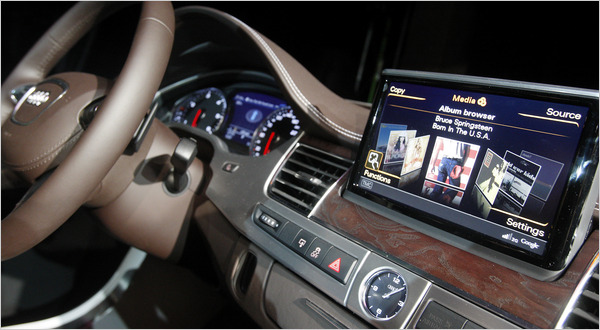
LAS VEGAS — To the dismay of safety advocates already worried about driver distraction, automakers and high-tech companies have found a new place to put sophisticated Internet-connected computers: the front seat.
…
Safety advocates say the companies behind these technologies are tone-deaf to mounting research showing the risks of distracted driving — and to a growing national debate about the use of mobile devices in cars and how to avoid the thousands of wrecks and injuries this distraction causes each year.
“This is irresponsible at best and pernicious at worst,” Nicholas A. Ashford, a professor of technology and policy at the Massachusetts Institute of Technology, said of the new efforts to marry cars and computers. “Unfortunately and sadly, it is a continuation of the pursuit of profit over safety — for both drivers and pedestrians.”
…
“We are trying to make that driving experience one that is very engaging,” said Jim Buczkowski, the director of global electrical and electronics systems engineering at Ford.
…
“But they’re totally ignoring one of the key issues of the future of driving, which is distracted driving.”
…
Charlie Klauer, a researcher at the Virginia Tech Transportation Institute, says motorists face a much greater crash risk when looking at a screen, even if it is just a simple GPS map. She says the overall danger for drivers will rise as screens deliver additional streams of data.
The longer a motorist looks away from the road, “the risk of crash or near crash goes up exponentially — not a linear increase, but exponentially,” Ms. Klauer said. “So when you start introducing things like e-mail, Internet access, restaurant options or anything like that, the risk goes up.”
Regulators worry about the developments, too. Ray LaHood, the transportation secretary, said the companies involved were on the wrong track.
“The idea they’re going to load automobiles up with all kinds of ways to be distracted — that’s not the direction we’re going, and I will speak out against it,” he said.
…
“Because a lot of this is so new, there’s not a ton of regulatory testing that’s required, like would be required with crash testing,” Mr. Stertz said. He added that the company was also hoping to avoid legal troubles, saying, “It could be a legal issue if someone gets into a car accident and the cops blame the car company for a system that’s too elaborate.”
…
Continue reading “Despite Risks, Internet Creeps Onto Car Dashboards”
Triumph Over Adversity

By Rochelle Maruch Miller
Dodi Blumstein doesn’t have time for the pain. Personifying the triumph of the human spirit, the indefatigable Far Rockaway resident is persevering against all odds and emerging a champion. Back in 1997, Dodi was 14 and had just completed ninth grade at Bais Yakov of Baltimore. A sports enthusiast blessed with an infectious zest for life, she approached each new day with a sense of optimism rare in someone of her age. Eagerly anticipating a summer filled with friendships, adventures and myriad athletic challenges and events, Dodi embarked upon what she hoped would be the summer of much content.
But on August 14 of that summer, Dodi fell while hiking. The accident impacted greatly on the lives of Dodi and her family. Without any warning, the lively teenager who had been at the peak of athletic endurance, mastering every challenge with agility and facile was now disabled and suffering excruciating, undetermined pain.
…
It was through her involvement with Achilles that Dodi became interested in riding a hand-cycled wheelchair bike. She is vigorously training in Central Park twice a week, riding approximately six miles and lifting weights, building her strength and endurance as she prepares to “give back” for the greater good, specifically, competing in the Team Lifeline marathon to benefit Camp Simcha Special.
…
Dodi is very excited about the opportunity to give back to Chai Lifeline for all the support and succor they have given her and her family over the past nine years. “Riding this hand-cycle bike gives me a sense of freedom I haven’t known since I was 14, before I got injured twelve years ago. Reaching this point is a milestone for me—I’m literally moving forward with my life.”
…
Continue reading “Triumph Over Adversity”
EPA Air Chief: We Need to Do More to Reduce VMT
by Elana Schor
Obama administration officials "need to align together" to work on reducing the nation’s total vehicle miles traveled — work that should go beyond a pending congressional climate bill — the Environmental Protection Agency’s (EPA) air-quality chief said today.
GinaMcCarthy.jpgGina McCarthy, EPA’s top air pollution regulator. (Photo: CECE)
Gina McCarthy, EPA’s assistant administrator for air and radiation, acknowledged in a speech at EMBARQ’s transportation conference that her agency as "less effective" working alone on crafting strategies to cut VMT.
McCarthy called for federal agencies to work together on a coordinated approach to transportation policy that makes economic and environmental factors an essential part of the mix.
"When we say transportation, everybody thinks ‘car’," McCarthy said. "That’s a challenge for us as individuals, as a society — and clearly it’s a challenge for me, as someone who’s supposed to deliver clean air to breathe."
…
Continue reading “EPA Air Chief: We Need to Do More to Reduce VMT”
Your Car Will Not Save Your Planet
by
Today on the Streetsblog Network, member blog Riding in Riverside sets out to explode the myth of the “wundercar” — a vehicle powered by sustainable fuels that will allow us to hold onto our driving lifestyle and all its accoutrements, while saving the planet and feeling “green.”
That kind of futuristic fantasy isn’t going to solve our problems, writes the blog’s Justin Nelson. The answer, he argues, lies instead in older patterns of development and mobility:
 This is not an environmental silver bullet. (Photo: bindermichi via Flickr)
[E]ven if we were to devise a perfect car, one made out of recycled tires
and printer paper, one that harnesses photosynthesis to not only be
carbon-neutral, but actually make energy from atmospheric C02, even if
we could make a car with no direct environmental impact, it would still
be an environmental and social disaster. Our waterways are contaminated
by engine fluids and lubricants that run off of road surfaces. Our
natural groundwater tables are falling because rainwater is unable to
penetrate pavement.Cars still allow sprawling development that eats up
wild lands and spits out bland suburbia. Species’ ranges in the few
precious areas of wilderness that we have are disrupted by highways. We
would still live in a society where we shut ourselves off from one
another in our own private boxes, promoting inequality and a lack of
respect for shared humanity. We would still leave our inner cities to
dangle. Our streets would still be unsafe places for children to play,
and we would still kill thousands every year in automobile crashes.
Alternative fuels are, on a perfect day, a solution to only a few of
the myriad problems that cars cause.On the other hand, instead
of pursuing unproven technologies in a desperate last-ditch attempt to
hang on to the way of life we’ve been living for the last 50 or so
years, why don’t we look ahead and try to build a better world.… Instead of a risky gamble to maintain a failing
lifestyle, we should spend our resources on forging a bright future
based around principles of city-building as old as cities themselves.
BBC bike comedy broadcast
Very funny half hour broadcast: https://www.bbc.co.uk/programmes/b00mbz1c
Traffic? What traffic…
Kolelinia Lets You Ride Your Bicycle Over the Air

Kolelinia—a system that allows you to ride your bike above the traffic—looks like a crazy idea until you check out the engineering behind it. Then you will realize that it’s not only cool, but it can work too.