
New Report Links Homeowners’ Auto Dependence With Foreclosure Risk
Homeowners in car-dependent areas without access to alternative transportation are at greater risk of foreclosure, according to a report released yesterday by the Natural Resources Defense Council (NRDC) that calls for mortgage underwriting standards to begin taking so-called "location-efficiency" into account.
…
Continue reading “New Report Links Homeowners’ Auto Dependence With Foreclosure Risk”
A Bike-Ped State of the Union: 9.6% of Trips, 1.2% of Federal Funding
by Elana Schor on January 28, 2010
With the nation still digesting the State of the Union address, the Alliance for Biking & Walking picked an auspicious day to release their biennial Benchmarking report on America’s bike-ped behavior. The group’s bottom-line conclusion: federal transportation funding continues to disproportionately shortchange travelers powered by their own two feet.
 (Chart: Alliance for Biking & Walking)
The Alliance crunched numbers from all 50 states to determine how much of their federal transportation dollars are spent on improving bike-ped infrastructure, access, and safety.
Overall, the report found that biking and walking account for 9.6 percent of all U.S. trips (0.9 percent of that share from biking, 8.7 percent from walking) but just 1.2 percent of federal transport spending.
That gap was exacerbated in recent months by a cancellation of transportation funding that occurred when Congress failed to pass a new six-year federal bill in the fall. Many states trimmed disproportionately from their Transportation Enhancements funds, which come from Washington’s highway program and account for about half of federal bike-ped spending.
But that doesn’t mean states are entirely losing ground when it comes to bike-ped improvements. Since the Alliance’s last report in 2007, the number of states setting goals to boost walking and biking has risen by 44 percent — while the number of states working on decreasing bike-ped fatalities has increased by 78 percent.
The Alliance also singled out states doing particularly well — and poorly — at encouraging residents to walk and bike. Some of the highest-achieving states may come as a surprise (Alaska, home of the “bridge to nowhere,” is tops for walking to work). Check out a few winners and losers after the jump, and download the Alliance’s complete Benchmarking report right here.
Continue reading “A Bike-Ped State of the Union: 9.6% of Trips, 1.2% of Federal Funding”
The Bicycle Kitchen

The Bicycle Kitchen is a dedicated room for our resident’s bikes, with everything you need to store, repair and maintain your ride. Located just inside the main entry, it gives you a convenient place to securely store your bike – which frees up space in your home and makes getting on the road a snap. And the Kitchen’s decked out repair area has all the tools you need to keep your bike rolling – pumps, tools and a repair station are all at your disposal, which is a great resource, considering the miles of bike paths and lanes just outside your door.
The Enforcement of Imaginary Laws
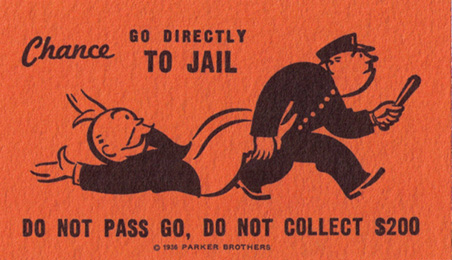
[Some interesting cases]
…
The unwarranted traffic stop
I think Richard Moeur’s story is exemplary in both his handling and its outcome. I got several good take-aways from it:
- Ask the officer’s intentions. Find out what he is requesting (ride on the sidewalk, ride on the edge of the road, ride on a different road).
- Resist the urge to discuss the law right away and ask for a name and badge number
- If the opportunity presents, be armed with a copy of the statutes (you can get one free here)
- If the officer asks why you were riding where you were, present the pertinent talking points (know your talking points, I suspect most of our readers do)

In my opinion, it’s better to not get a citation than to have to deal with one in court (even if you win). In the event that the officer does not respond favorably to your roadside defense, the best course may be finding a way to comply without compromising your safety, then deal with educating the officer via contact with the department.
[I’ll note that I had success with “Excuse me, but are you requiring me to ride in an unsafe and illegal manner?” When ordered to ride on the sidewalk.]
…
Continue reading “The Enforcement of Imaginary Laws”
Motorists Tell Nick The Bicycle-Commuter To Bike On Sidewalks
If Tampa police do not know Florida bicycle laws and believe bicyclists should bike on sidewalks, no wonder motorists follow that lead and harass bicyclists on the road by yelling at them to get off the road and bike on the sidewalks.
…
Continue reading “Motorists Tell Nick The Bicycle-Commuter To Bike On Sidewalks”
Virginia to Oregon – 4,000 miles – slide show in 6 min.
Beyonce Takes Up Bike Riding
BEYONCE keeps a low profile on her days off by riding around on a bicycle.
The Irreplaceable hitmaker admits she has taken to two wheels to travel around cities when she is away on tour and she enjoys the anonymity being on a bike gives her.
She tells Billboard, “I started riding a bike on my days off with others like my assistant and stylist.
“It’s amazing how I’m able to ride around on a bike. People kind of see it’s me but since I’m on a bike, they think, ‘No, it’s not her.’ And by the time they realise it’s me, I’m already gone. It’s great to do something normal every day. It keeps me grounded.”
Continue reading “Beyonce Takes Up Bike Riding”
Surface Transportation Projects – what’s the goal?
Federal surface transportation policy is distinguished by its almost complete lack of performance accountability. Currently, the funding allocations for the major programs (for example, National Highway System, Interstate Maintenance Program, and Surface Transportation Program) are based largely on formulas reflecting factors such as state lane miles and amount of vehicle miles traveled. As a result, while there is substantial process-based accountability for how federal funds are used, there is woefully little attention paid to results. Performance measurement, evaluation, and benchmarking are notably absent from surface transportation funding. Transportation agencies at all levels of government face virtually no accountability for results. This is one reason why so many voters are reluctant to support increased gas taxes. As such, any efforts to improve the surface transportation system will require that DOT allocate at least a modest share of highway trust funds should be allocated to states based on relative progress in three facets: congestion relief predominantly, but also vehicle emissions, and safety.
…
Continue reading “Surface Transportation Projects – what’s the goal?”
Can’t stop phoning while driving
BY BRUCE SICELOFF – Staff Writer
Like father, like daughter – only more so.
Tyler Strandberg of Rocky Mount has a hard time getting her mind off her BlackBerry when she drives.
She has crashed three cars in the past three years.
Each time, she was distracted from her driving because she was typing text messages or talking on the phone.
"Sometimes I will zone out and forget I’m driving," said Tyler, 23. "If I’m on the phone talking about something that takes up all my focus, I’m looking straight ahead – but not even seeing what’s there."
Her dad, Buckley Strandberg, worries that she will never curb her dangerous habit.
But Buckley, an insurance executive, confesses his own weakness for Blackberry and Bluetooth. He feels compelled to conduct business by phone and e-mail on long, lonely drives between his offices in Rocky Mount and Nags Head.
"That’s more than two hours," said Buckley, 49. "I’m not just going to sit there in the car. I get a lot of work done on that straight, dead stretch of U.S. 64.
"And if I run off the road, there are rumble strips that divert me back onto the road. That has happened occasionally. They seem to work, those rumble strips."
Buckley and Tyler Strandberg contacted The News & Observer to come clean about a problem they share with each other – and with a lot of us. They expressed embarrassment but spoke candidly about how they rely on their phones when they drive, and how they try to reduce their risks.
As many as 60 percent of drivers use their phones occasionally, researchers say, and 11 percent are on the phone at any one time. Cell phone use is a deadly distraction that causes as many as 28 percent of all traffic crashes, the National Safety Council says.
…
Continue reading “Can’t stop phoning while driving”