
Editorial: When it comes to family biking, size matters

Posted by Jonathan Maus (Publisher/Editor)
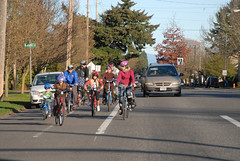
Family biking-8

An impromptu group family ride led
to realizations about the size and quality
of our bikeways.
(Photos © J. Maus)

A few weekends ago my girls and I, and several other families, planned to attend a local event. Since it was a sunny day, the location of the event was fairly close, and we all tend to bike frequently anyways, it turned into an impromptu group ride. There were kids (youngest was age 7) riding bikes on their own, kids in tag-alongs, and adults with various types of family cargo bikes. There were about 13 of us in all.

While I enjoyed the company of friends and the pleasant ride, being the bike geek that I am, I also couldn’t help from noticing a few other things.

The first thing I noticed is that a group of families riding together really catches people’s attention. In Portland, 10-15 people riding a bike is no big deal (especially during the morning and evening rush hours), but when there are little kids in the mix, people really take notice.

I kept thinking how cool it was that this wasn’t an organized ride, it just so happened that we all decided to ride our bikes to the same place (I hope someday seeing a bunch of families on bikes doesn’t draw so many stares).
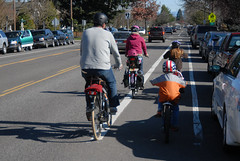
Family biking-2

Standard bike lanes can be a tight
squeeze when riding with kids.

It also struck me how inadequate standard bike lanes are when riding with kids. Why? At just four or five feet wide, it’s nearly impossible to ride next to a small child — which, as a father of a 7-year old who is just learning to mix with traffic, is something I feel compelled to do. With parked cars on one side and traffic going 35 mph on the other, there was sort of an evolutionary magnet pulling me alongside my daughter as if to create a little cocoon of safety around her (see photo at right).

Continue reading “Editorial: When it comes to family biking, size matters”

When did it become the responsibility of the federal DOT to build sidewalks?

by

[Sen Kit Bond (R-MO)] only dug in his heels, arguing that Americans had shown their
eagerness to use roads and bridges but would not embrace rail or
walkable infrastructure. “When did it become the responsibility of the
federal DOT to
build sidewalks?”

From streetsblog

LaHood then reminded him Congress set up dedicated funding for pedestrian improvements nearly 20 years ago.

Continue reading “When did it become the responsibility of the federal DOT to build sidewalks?”

Washington Examiner Trash Talks Bikes, the League Responds

What they said:

The Washington Examiner’s “Daily Outrage” attacked Senator Menendez Wednesday, February 24 for supporting, along with his fellow senator from New Jersey, a $2.3 million upgrade to bicycle paths that will connect New Jersey to Pennsylvania. The editorial states that, “the grant comes from $1.5 billion in transportation funds awarded as part of the federal stimulus. Unless the new economy means we’re using rickshaws for shipping, it’s unclear how bike paths will ‘stimulate’ the economy.”

What’s the issue:
The paper fails to recognize bicycling as a legitimate form of transportation for starters, but also misses the point of theTIGER grants. According to  Secretary LaHood the purpose of the TIGER funds was to:

help build high-priority innovative transportation projects that were difficult to fund through traditional programs – projects that create jobs, stimulate economic activity and help develop livable communities…From freight rail to streetcars, from roadways to waterways to bikeways, we are affirming the truly multi-modal nature of American transportation.

What are the facts:
The bicycle industry supports nearly 1.1 million jobs and generates an estimated $17.7 billion in federal, state, and local taxes. This includes the over 140 bike shops and major bike manufacturer in New Jersey. Bike facilities are great at stimulating the ever more competitive tourism dollars. For example, the Outer Banks area of North Carolina saw a 9 to 1 return on their investment in bike paths and widened shoulders.

TIGER grants were also about sustainable, innovative designs that improve livability. Something that increases lanes on existing highways doesn’t do enough.

What they could have said:
The Washington Examiner should be promoting the new direction of the Department of Transportation in taking livability and multi-modal initiatives into consideration. It is a (literal) breathe of fresh air. Not only could they have applauded the funding award, but they should have urged Senator Menendez to join the Senate Bike Caucus to further become involved in making America bicycle-friendly.

We urge New Jersey League members to contact Senator Menendez to thank him for his support of the funding and to continue to support future pro-bike economic stimulus initiatives. Also, contact Washington Examiner editors to let them know that bicycling is important to our economy.

Continue reading “Washington Examiner Trash Talks Bikes, the League Responds”

A new public health-care option — smarter transportation planning


How we best do this within the scope of health-care reform requires rigorous policy, psychology and marketing synergies. However, we also need to step outside that frame to realize the prescription we need centers on the nexus of land-use and transportation planning. We need a new kind of public option — one that allows us to live the healthy lifestyles we aspire to by designing our region with health in mind. We all want to live, work and play in safe places with easy access to transportation options, parks and open spaces and the markets, schools and amenities we all use.
We are, for now, literally stuck in traffic. A prominent study in the American Journal of Preventive Medicine demonstrates that the more time we spend in our cars, the more we weigh. And the average Puget Sound resident spends nearly one 40-hour workweek a year simply stuck in traffic — so that’s a lot of weight.

Continue reading “A new public health-care option — smarter transportation planning”

Would you eat that?


The pollution that makes snow so ugly after a few days on the street doesn’t magically appear whenever it snows. It’s always there, produced by our litany of motorized vehicles. It floats around the air we breathe for a while before settling on the ground, or in the water. Every time you walk behind a truck or big SUV and get a whiff of exhaust, you’re essentially taking a big bite out of a delicious soot-flavored snowcone.
But that’s just the cost of doing business in a modern civilization… right?
Continue reading “Would you eat that?”

Five Ways to Solve Global Warming Without Wall Street

By Friends of the Earth

There are plenty of common-sense ways to solve global warming that would not invite Wall Street manipulation, but would put us on a path to cut pollution to healthy levels and create the clean economy of the future.
Here are five ways policymakers, activists and ordinary citizens can get to work — without Wall Street:
#1 – Stop subsidizing fossil fuels. The federal budget contains more than $30 billion in subsidies that prop up big oil and other fossil fuel special interests. If we end these subsidies and channel the money to clean, renewable energy sources, we can cut the pollution causing global warming and create clean energy jobs.
Continue reading “Five Ways to Solve Global Warming Without Wall Street”

Future Lies In Moving Away From The Car

by Boston Biker
People will sometimes ask me, “Why do you hate cars so much?” The truth is I don’t hate cars. They are useful to some people (delivery trucks, people with disabilities). The car itself is not the problem, it is what happens to society when everyone owns a car that is the problem. Cars are simply a representation of two real problems.
1. The burning of gasoline for transportation.
2. The idea that a car = freedom.
[Follow the link for an explanation.]
Continue reading “Future Lies In Moving Away From The Car”

Mayor Moncrief’s State of the City Address: Car-Centric Planning a Blunder

by Fort Worthology

Business as usual is dead!
North Texas requires a transportation overhaul. No more Band-Aids, no more patches—a complete overhaul!

Frankly, I’m tired of talking about this. This afternoon, workers at BNSF…employees at Lockheed Martin or Bell Textron…even many of you in this room will leave work and then sit…and sit…and sit in traffic. It’s a frustrating daily routine that carries a great cost once you consider the impacts to our quality of life, our environment, our air, and our ability to attract and keep new business investment.
If this is a mobility crisis—and I believe it is—then it must be treated like one!

Continue reading “Mayor Moncrief’s State of the City Address: Car-Centric Planning a Blunder”

‘Scofflaw cyclists,’ the law and motorist outrage

By Paul Thornton

As a bike/bus commuter myself, this oft-expressed sentiment, a total non-sequitur, infuriates me. Yes, cyclists sometimes do blow through stop signs as if they were riding on a bike path, and I cringe every time I watch a helmet-free rider plow through a red light straight into a busy intersection. Why? Safety concerns aside, the widespread perception that we’re a lawless bunch has been used by a few vigilante motorists as an excuse to act aggressively toward me (and I do obey stop signs and red lights, per California Vehicle Code Sections 21200 and 21202).
Which brings me to my point: The widely held view of cyclists’ incivility justifies neither the life-threatening rage we sometimes receive from motorists who think we have no right to the road nor the indifference some of us receive from police. None of this is to say that the vast majority of motorists don’t treat cyclists with respect. And the same holds true for cyclists: Nearly all of us, for the most part, obey the law in the interest of our own safety. The obvious difference is that the occasional scofflaw bike rider usually results in a brief moment of inconvenience for drivers, whereas the occasional aggressive motorist can mean serious injury — or worse — for us.
Continue reading “‘Scofflaw cyclists,’ the law and motorist outrage”