
Posted by admin In: Business Finance
There may be several reasons to encourage your employees to seek alternate transportation to work. Whether it’s carpooling, taking public transportation, walking or biking, the benefits of not driving a car everyday are substantial. The most notable benefit is the reduced strain on the environment. Cutting back on driving not only reduces our countries dependence on crude oil, but also reduces our carbon footprint. However, by taking an extra step—and asking your employees ride a bike to work—your company will have pride knowing that its also contributing to the physical health and well-being of the employees that participate.
How to Encourage Your Employees to Bike to Work: Getting Started
Marilyn Bryant, executive director of the non-profit Sacramento Transportation Management Association (STMA) in Sacramento, California, suggests writing down a general idea of what you would like your bike program to look like.
A large part of the program must center around making biking more convenient for participants. So offering a secure place for bike storage, or a place for workers to shower and change and store clothing goes a long way.
The Association, which supports cycling as a method to reduce traffic congestion and air pollution, offers Sacramento-based businesses a survey to determine their level of bicycle friendliness. If you score high enough, the association encourages you to apply for certification as a Sacramento Region Bicycle-Friendly Business. If not, you can contact the group to learn how to become more bicycle friendly. Below are several of the questions from the STMA survey. Ask yourself the following question in order to build a picture in your mind of the program you’d like to have:
…
Continue reading “How to Encourage Your Employees to Bike to Work”
NHTSA’s distracted driving policy and rumble strips
from Bikeleague.org Blog by Darren
To raise awareness about the dangers of driving while distracted, the National Highway Traffic Safety Administration (NHTSA) has posted their distracted driving policy statement and frequently asked questions on their website.
The statement starts with this, “The primary responsibility of the driver is to operate a motor vehicle safely. The task of driving requires full attention and focus. Drivers should resist engaging in any activity that takes their eyes and attention off the road for more than a couple of seconds. In some circumstances even a second or two can make all the difference in a driver being able to avoid a crash.” The Frequently asked questions then offer a good summary of distracted driving’s risks and research.
On the whole it’s a good primer on distracted driving and worth reading, but I have one bone to pick. After a strong opening about how safe driving is a driver’s primary responsibility, the FAQs suggests that states take do something that diverts attention away from driver responsibility and can create a lot of problems for cyclists: installing rumble strips.
Here’s the offending passage:
States can take some steps immediately to reduce the risks of distracted driving. One example is installing rumble strips along roads to get the attention of drivers before they leave the roadway and/or deviate from their lane.
Rumble strips occupy the best part of the shoulder to bike on and can force cyclists onto the debris-ridden outer edge of the shoulder or into high speed travel lanes. The stimulus law has created greater urgency for cyclists to speak out against the proliferation of rumble stripping because the America Reinvestment and Recovery Act (ARRA) has provided funds that states can use to install rumble strips. (Google “ARRA rumble strips” for examples.) Plans for the strips stretch beyond interstates and limited access highways to slower otherwise bike-friendly roads and threaten thousands of miles of good bicycling routes.
Notwithstanding the insertion of rumble strips into the discussion, NHTSA has put together a strong statement on distracted driving. Again, it’s worth a read. And while you’re on the topic, you can check out our report, Distracted Driving: a Bicycling Advocate’s Resource.
~Darren Flusche
League Policy Analyst
Continue reading “NHTSA’s distracted driving policy and rumble strips”
No free parking — not even for parking lot employees
Kristin Rushowy Staff Reporter
There is no such thing as free parking — even if you work at a parking lot.
While the Toronto Parking Authority put up a fine fight, it has lost its appeal to overturn a tax court ruling that says employees who park their own cars for free while on the job must claim it as a taxable benefit.
“You are hearing more and more of a taxable benefit being applied to parking,” said Gwyn Thomas, president of the parking authority, adding he wasn’t surprised by the ruling.
Employees park their personal vehicles at lots for a variety of reasons, he added.
“We have shifts — day shifts and night shifts — and employees parking in lots to work … it was all for business.”
But, if they park without paying, it’s a taxable benefit, the tax court has ruled.
….
Continue reading “No free parking — not even for parking lot employees”
Why We Focus on Unsafe Cycling and Not Unsafe Driving

from Streetsblog.net by Sarah Goodyear
Things would be different if bicycle safety training were elementary. (Photo: Bike Portland via Flickr)
This morning on Sustainable Savannah, a post about double standards.
John Bennett writes that at two recent meetings in Savannah about improved bicycle facilities, the discussion turned to unsafe cycling practices, such as wrong-way riding, riding without lights, and riding on sidewalks. While Bennett is concerned about those things as well, he wonders why discussions of investment in bike infrastructure almost inevitably turn to the question of unsafe cycling:
Are similar suggestions about combating unsafe driving ever prompted by discussions of new roadways? I can’t remember a single instance. All sorts of elected officials had all sorts of things to say at the groundbreaking for the fifth phase of the Truman Parkway last month, but did any mention the need to educate motorists about speeding or aggressive driving? Car crashes, too often resulting in fatalities, are a regular occurrences on the existing portions of the limited access freeway. Wouldn’t a groundbreaking ceremony present an excellent opportunity to warn about the dangers of distracted or impaired driving and call for new programs to better educate motorists who use the Truman Parkway?
Again, I appreciate any concern expressed for the most vulnerable road users, but I’m curious about the requisite safety discussions that accompany our conversations about bicycling. Is there a subtle expectation that as cyclists we must earn, through good behavior, any new infrastructure made available to us, no matter how small? Is this expectation self-imposed? I must admit, I’ve caught myself thinking (and sometimes saying) things along these lines. Meanwhile, as motorists we enjoy colossal new facilities ($67.5 million in the case of Truman Parkway Phase Five), without being asked to consider how to ensure their safe and responsible use.
I think part of the concern about safe riding practices stems from the lack of consensus — among people who ride and people who don’t — about just exactly what safe cycling is. Safe driving practices are far more standardized and codified, because driving is a mode of transport that every American is expected to use at some point in his or her life. People on bicycles are forced, because of a mishmash of infrastructure and regulations, to make things up as they go along. Which is why there is so much disagreement about the practice known as “salmoning.” (Speaking of which, what do you think of “zebras”?)
It doesn’t have to be like this, of course. In a country with extensive bike tradition and infrastructure, such as the Netherlands, citizens are educated from an early age about how to ride. This means that everyone knows what “safe cycling” means — people on bikes, people on foot and people in cars. And there’s no need to fret about “cyclist safety” every time a new bike path is built.
As you head into the weekend, give some thought to slowing things down. Both Boston Biker and Let’s Go Ride a Bike have posts today about the pleasures of riding at a more leisurely pace.
Continue reading “Why We Focus on Unsafe Cycling and Not Unsafe Driving”
VA Cyclist Does What Many Would Like To
By Washcycle
A cyclist in Abingdon, VA was brushed by a 19-year old driver (intentionally, he thinks) – not enough to make him fall, but enough to rub off some of the bike’s paint. So the cyclist went looking for the car at the nearby campus. He found it, called the cops and got the guy charged with "reckless driving and, later, hit and run with property damage". So satisfying.
Continue reading “VA Cyclist Does What Many Would Like To”
The Persistence of Bike Salmon
from Streetsblog.net
 This sign is in London. Do you think anyone got the message? (Photo: Salim Virji via Flickr)
Over the weekend on CommuteOrlando Blog, Keri McCaffrey posted a video showing a bicyclist riding in the wrong direction on a Florida street. After pointing out how this might have ended badly for the rider, she poses the question “Why do they do this?”:
Riding against traffic accounts for 45 percent of bike-v-car crashes in Orlando. The majority of those are intersection crashes because the bicyclist comes from an unexpected direction.… Despite the numerous conflicts people experience from this behavior, they don’t connect the dots. Why?
And how do we change that?
McCaffrey and many others on CommuteOrlando Blog practice “vehicular cycling,” a style of riding in which the cyclist essentially acts like any other vehicle on the road. There’s a long and ongoing debate between vehicular cyclists — who often oppose the construction of bike-specific infrastructure — and those who believe that striped bike lanes and similar facilities are a good way to get more people out biking, thereby achieving safety in numbers and a more welcoming environment for people who might feel reluctant to ride otherwise. There’s no need to reopen that debate here.
But you don’t have to be a vehicular cyclist to wonder, as McCaffrey does, “Why do people do this?” As the streets of New York fill up with spring cyclists, the number of “salmon” is rising — and quite often, they are endangering other bikers as well as themselves with their wrong-way riding. It’s one of the most frustrating and hazardous phenomena I encounter on my bike on a regular basis.
Why do you think people persist in this behavior? Is it simply because they can’t be bothered to ride a block further to get to a street that goes the right way? Do you have any ideas about how to get them to stop?
…
Everyone Is Trying To Kill Me… Says BSNYC
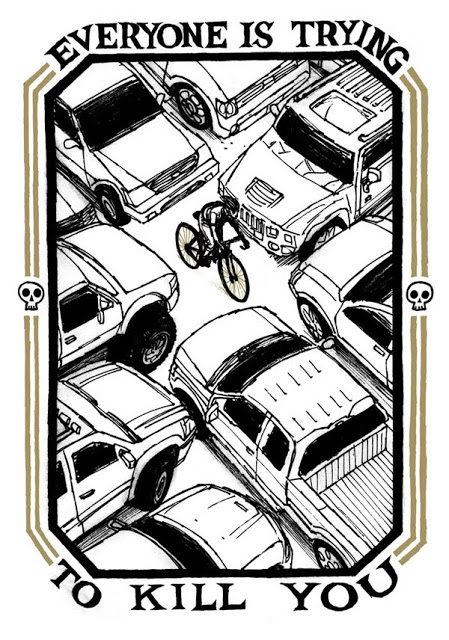
An illustration from Bike Snob’s new book. And please motorists stop make cycling feel this way.
Continue reading “Everyone Is Trying To Kill Me… Says BSNYC”
In Dallas, a Community Transforms a Street [video]
With about a thousand bucks and some elbow grease, neighborhood residents transformed a rundown city block for two days, creating a vibrant streetscape — a truly complete street. They painted a cycle track, opened a pop-up café in an empty storefront, put up some outdoor seating and calmed traffic. It’s a brilliant example of how, with a minimal amount of money and a full commitment from the community, places can be transformed quite literally overnight, revealing a wealth of untapped economic and social potential.
Continue reading “In Dallas, a Community Transforms a Street “
A Department Bulletin to Help Officers Understand Cyclist Safety and Lane Use
The following text was created for the Orlando Police Department Bulletin. This was an initiative by Officer Bill Edgar, a member of our officer advisory panel. If you would like to duplicate it for distribution in your department, please contact us and we will send you the text and illustrations.
(Page 1)

It may not look right because you don’t see it very often, but this is legal and it’s the safest position for a bicycle driver
But don’t cyclists have to ride as far right as practicable?
316.2065(5)(a)(3) states that a cyclist does NOT have to stay right: “When reasonably necessary to avoid any condition, including, but not limited to, a fixed or moving object, parked or moving vehicle, bicycle, pedestrian, animal, surface hazard, or substandard-width lane, that makes it unsafe to continue along the right-hand curb or edge. For the purposes of this subsection, a “substandard-width lane” is a lane that is too narrow for a bicycle and another vehicle to travel safely side by side within the lane.”
FDOT has determined that 14ft is the minimum width which allows most motor vehicles to pass cyclists within the travel lane. (See second page for diagram.)
The lane pictured above is 13ft wide. Most of the lanes in Orlando are 10-12ft wide. Bicycle drivers are not required to keep right, and are encouraged, for their safety, to occupy enough lane that motorists recognize they must change lanes to pass. By riding this way, cyclists can avoid road hazards, operate more predictably, encourage overtaking motorists to pass safely and discourage common motorist mistakes that result in crashes.
Continue reading “A Department Bulletin to Help Officers Understand Cyclist Safety and Lane Use”
The space required to transport 60 people

By car, bus or bicycle