
By Jan Mueller
Senior Policy Associate, Environmental and Energy Study Institute
…
First, the cost of U.S. dependence on oil has become intolerably high—in terms of lives lost and dollars sent abroad, let alone other economic, public health, and environmental costs. Second, the limits of America’s financial and economic resources have become painfully clear.
…
If we are serious about reducing our dependence on oil and making the best use of limited resources, we need to invest in a transportation system that moves people and freight in the most cost and energy efficient way possible.
…
The old “fix-it-first” issue was analogous to asking whether you should build an addition to your house before you fixed the leaks in the roof. Given the nation’s uncertain financial future, however, the question now is more akin to asking whether it makes sense to build that addition if you might never have enough money to fix the roof.
…
[B’ Spokes: Note that the “fix-it-first” issue has been to date more about how to get more money from the Feds so they could add capacity over actually fixing things first.]
…
Not only has the current system for funding transportation through fuel taxes proven inadequate, it also provides the wrong signal to transportation agencies.
…
Continue reading “Oil, Dollars, and Sense”
Safe Passage Needed for Pedestrians & Cyclists
The intersection at 273 and Brownleaf Road in Newark, Delaware is a dangerous intersection for pedestrians and bicyclists. A bicycle is not able to trip the traffic sensor, nor is there a pedestrian crosswalk and signal to allow safe passage on this major Newark arterial road. This is particularly troubling to many cyclists since Brownleaf Road is part of the official Delaware bike route.
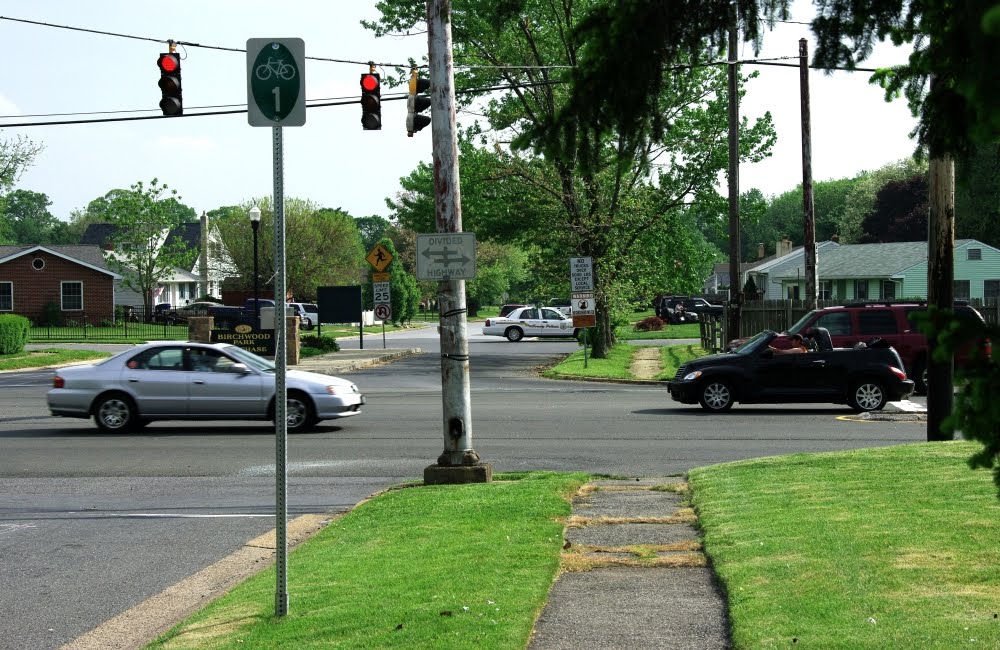
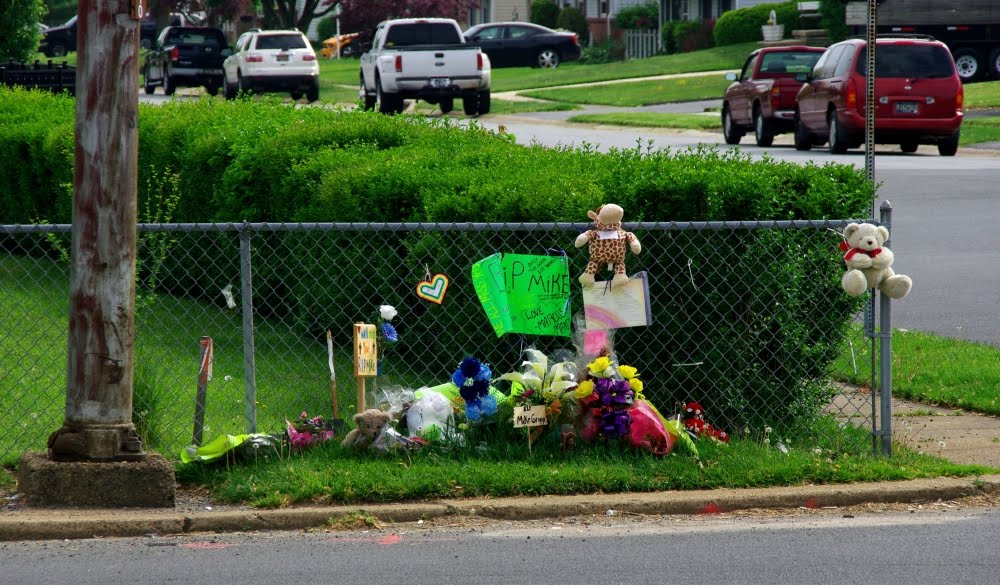
Less than a month ago, a pedestrian, sixteen year old Michael Gropp, was killed at this intersection by a speeding car that ran a red light.
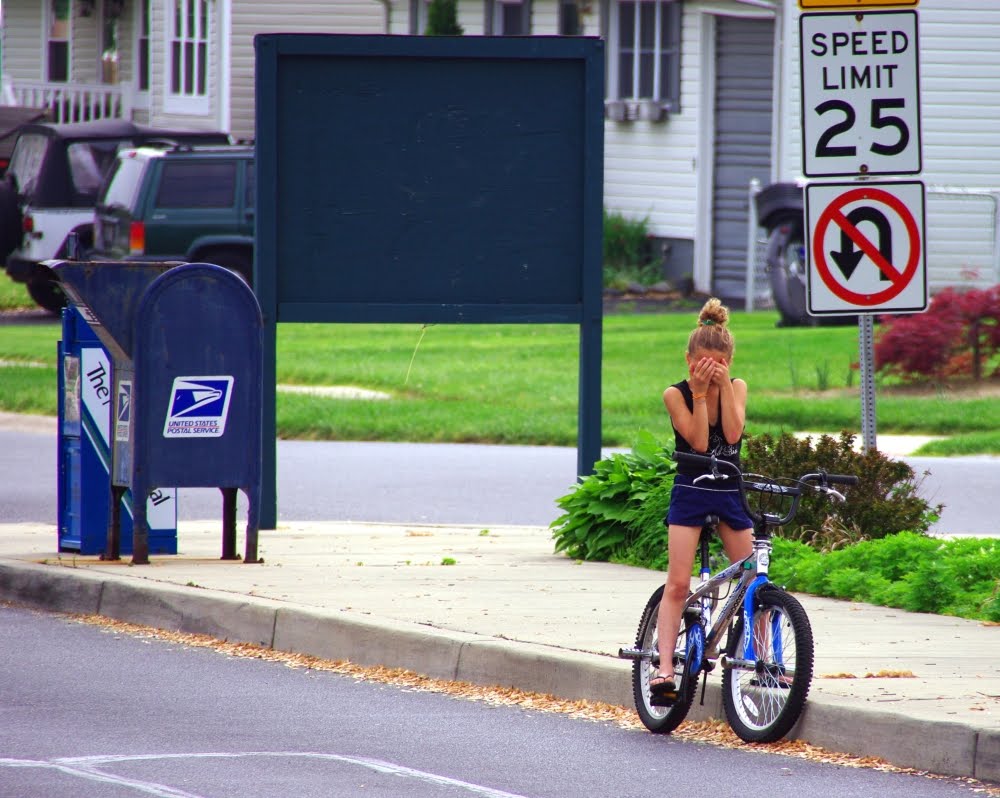
Today, on a Sunday afternoon, a little girl waits in frustration and the 85 degree heat for a car to come along to trip the traffic signal. She waits in vain for quite some time.
Continue reading “Safe Passage Needed for Pedestrians & Cyclists”
Penn Ave. Bike Lanes: AAA is crushing us
In a couple of stories about the new Pennsylvania Ave NW bike lanes that are opening this week one thing is clear: AAA is kicking our asses. Seriously, how are they able to get in several unsubstantiated, anti-bike facility quotes while neither Fox nor News8 even interviews WABA? The Fox article is like an advocacy piece for them.
Two new bicycle lanes have opened up on Pennsylvania Avenue this
weekend. However, AAA claims adding more lanes could make D.C. traffic
worse than it already is. AAA is also concerned about a plan to add bike
lanes to four other major streets.
I’d like AAA to produce at least one study showing a negative link between bike lanes and congestion. I don’t think there is one. I’ve looked. There is a study out of New York that shows that “the only way to prevent crippling congestion, is for more people to
walk, bike, and take public transportation.” Other cities are turning to bike lanes to actually END congestion.
The auto agency believes
those lanes will take away lanes used by cars
So AAA is OK with bike lanes as long as they don’t take away lanes used
by cars. Prepare to be disappointed AAA.
as well as increase
gridlock.
Maybe this is the writer’s fault – and not AAA’s – but gridlock is absolutely not caused by bicyclists. It’s caused by scofflaw drivers who move into the intersection even though they can’t clear it; and left immobile, blocking cross-traffic when the light changes. I’ve never seen a cyclist doing this. If gridlock is the problem, cracking down on scofflaw drivers is the solution.
AAA is urging anyone concerned to take part in the public
comment period which ends on May 15.
And then they presented another opinion…no wait, they didn’t. They just added
To publicly comment or leave
feedback on this issue, CLICK
HERE.
Yes, by all means, please do.
The News 8 story was longer, but no better.
While some drivers didn’t mind, others were driven crazy by it.
“It’s bad enough with the cabs running you over and you can’t hardly
cross the street!” said Sandra Powell.Northeast’s Sandra Powell works at the National Archives in downtown
D.C. She says her commute typically takes just under an hour, but she’s
worried her commute time will double because of the bike lanes.Powell stated, “The people of Washington D.C. should not have to go
through this!”
The only explanation for Powell’s nonsensical responses is that she was literally driven crazy by this. Double her commute time? That seems excessive. She also fails to note that even if there is a negative impact on traffic for some people of Washington, DC, there might be a positive impact on others.
AAA got in some more choice quotes
“As opposed to doing open heart surgery to open the clogged arteries and
traffic arterials in the city, you clog them even more,” said Townsend.
I’m not following this analogy. What is sticking to the sides of roads to “clog” them? It isn’t bikes. When traffic is clogged, cyclists are either filtering past cars or choosing not to.
Townsend emphasizes that only 2.5 percent of residents bike to work.
Which is why we need more bike lanes to encourage more people to bike.
Townsend stated, “They’re taking so much from so many to give to so
few.”
Is he talking about how we subsidize driving? I agree, it’s wrong to take from the majority who don’t drive and give it to the minority that do.
Gabe Klein defended the policy
Klein said, “We’re not gonna cram bike lanes or a cycle track onto a
street that’s already overpopulated with automobiles.”
That might be exactly where we need bike lanes and cycle tracks.
The Examiner joined the pile-on with an anti-bike lane opinion piece in response to Ray LaHood’s defense of bike lanes
I ride the bus to work in D.C. every day, and I’d just like to make an
observation about our bicycle lanes. I usually ride down Georgia Avenue,
which flows well at rush hour right up until you cross Florida Avenue.
That’s where you lose a lane of traffic to — you guessed it — a bicycle
lane.
Ummm, no. They did not take out a lane of traffic to add those bike lanes (on what is really 7th street). They used the door zone of the parking lane to make those.
Mind you, it’s entirely possible that people bike in that lane
sometimes, but I’ve never seen it happen.
Ummm, he’s not paying attention. I’ve ridden this road at rush hour and it is a packed with cyclists. I waited at the light once with six other cyclists (and we weren’t riding together or anything).
What I have seen is the other rush-hour result of the bicycle lane:
Dozens of vehicles idling in the bottle-neck behind too-short traffic
lights and left-turners.
It sounds like the problem is the light cycle and left turns, not bike lanes.
The same can be said for the one-way section of
9th Street downtown from I to E Street, where a dedicated bus and bike
lane (usually empty) contributes to massive, box-blocking backups among
cars headed for the National Mall and the 9th Street Tunnel.
Looking but Not Seeing
from Bikeleague.org Blog by Darren
…
The bottom line is that drivers talking on cell phones may look at you but not see you. Here’s chilling section of the paper:
Inattention Blindness – Vision is the most important sense we use for safe driving. It’s the source of the majority of information when driving. Yet, drivers using hands-free and handheld cell phones have a tendency to “look at” but not “see” objects. Estimates indicate drivers using cell phones look at but fail to see up to 50 percent of the information in their driving environment. Cognitive distraction contributes to a withdrawal of attention from the visual scene, where all the information the driver sees is not processed. This may be due to…how our brains compensate for receiving too much information by not sending some visual information to the working memory. When this happens, drivers are not aware of the filtered information and cannot act on it.
…
Continue reading “Looking but Not Seeing”
If an oil rich place wants to create more walkable communities, what’s our excuse?
The Abu Dhabi Urban Planning Council (UPC) in February released the Urban Street Design Manual, a 172-page guidebook that outlines design standards to create more walkable communities in Abu Dhabi, the largest and most oil-rich of the seven members of the United Arab Emirates. With its population expected to double to at least three million people by 2030, Abu Dhabi recognizes a need to prepare for a sustainable future, with a focus on transport and urban planning solutions.
…
Continue reading “If an oil rich place wants to create more walkable communities, what’s our excuse?”
Analysis of Google’s Bike-There Feature: Part I
from Streetsblog.net by Utility Cycling
…
Behind the Scenes — How Google’s Bike Maps Work
The push to get Google to incorporate bike directions into Google Maps has been going strong for quite some time now, but Google reports that adding such directions presented quite the engineering challenge. Google uses a few key features to develop the algorithm that generates a bike route, using the already-existing network of streets in their mapping system, which are summarized below.
1. Bike Trails – These show in dark green when you generate a Bike-There map. Google worked directly with the Rails-to-Trails Conservancy to find as many trails to incorporate as possible. The algorithm is weighted to send cyclists on trails as much as possible, as long as it doesn’t send them too far out of the way.
2. Bike Lanes – Google has information about dedicated bike lanes for 150 U.S. cities, which they used to build into the algorithm. Bike lanes appear on a Bike-There map in bright green, and they are also weighted as a priority in the algorithm.
3. Recommended Routes – These are routes from cities that have information about other good roads for cycling, which may not have an official bike lane. These roads are indicated by a dashed green line in the Bike-There map.
4. Uphill Slopes – In order to avoid hills (because, according to Google, nobody likes riding up hills… though I beg to differ…), Google developed a model that takes into account power (exerted by the cyclist), the slope of the road, wind-resistance, and speed. If the model shows that a given route requires an inordinate amount of exertion (aka too much power required) and will be too slow for time efficiency, Google will send you on an alternate route that avoids the climb. I could not find out what Google defines as “too slow” or “unreasonable degree of exertion”.
5. Downhill slopes – The model will also help cyclists avoid roads with too much downhill or descending, which can be tiring or disconcerting due to the unnecessary amount of braking required.
6. Busy roads – In order to keep cyclists off busy roads, the algorithm basically uses the inverse of the Drive-There algorithm in order to avoid arterials and freeways.
7. Intersections – Lastly, the algorithm avoids busy intersections with heavy traffic (car) and long waits.
…
Review of Google’s Bike-There Features
…
Continue reading “Analysis of Google’s Bike-There Feature: Part I”
Crossing the street [video] … and without enforcement this could be our future
Via How We Drive
Hernando Today: Bicyclist injured after being chased by dogs
Hernando Today: Bicyclist injured after being chased by dogs
By HERNANDO TODAY STAFF
Published: April 7, 2010
BROOKSVILLE – A bicyclist was injured Tuesday morning after two dogs chased after him, causing him to flip over along Mondon Hill Road, deputies said.
Allen Hughes, 65, was riding along the road with a group of bicyclists when two brown dogs sprinted toward them and ran into Hughes’ bike, according to the Hernando County Sheriff’s Office.
Hughes said he was unable to avoid hitting the dogs and one of them went between his front tire and the rim of his bicycle and that caused him to flip over, according to the incident report.
While on the ground, Hughes was run over by another bicyclist, deputies said.
He was treated at Brooksville Regional Hospital for an injured right shoulder and right hip, according to the sheriff’s office.
Contact was made with the dog owner, Roderick Miller, who lives at 23451 Mondon Hill Road. He said his dogs run freely on his property and have been in the roadway before, deputies said.
No charges were filed.
Continue reading “Hernando Today: Bicyclist injured after being chased by dogs”
Bike advocate files suit over crash
…
The suit is a matter of principle, the 63-year-old former Eugene city councilor said. Nicholson alleged that the Connecticut- based insurance corporation rebuffed his direct efforts to obtain such compensation.
“If this woman had run a red light and fractured the side of my car, I don’t think the attitude would be the same,” he said. “They seem to have the attitude that when a car hits a cyclist, it ought to be free. I expected to be responded to and that they would consider it a serious issue.”
…
Continue reading “Bike advocate files suit over crash”
May is Bike Month!
This year National Bike Month could hardly come at a more auspicious moment. Consider the timeliness of enjoying the simple pleasure of a bike ride:
- Crude oil is spewing uncontrollably into the Gulf creating a bona fide ecological disaster
- Gas prices are inexorably rising toward the three dollar a gallon mark
- The First Lady’s “Let’s Move” initiative begs for kids to get back on their bikes and unplug themselves from their myriad electronic devices
- Transportation Secretary Ray LaHood is tearing up the country in support of livability – with bicycling at the core of his message
- Climate and transportation legislation remains “imminent” (and long overdue) in the United States Congress
- The Centers for Disease Control and Prevention just launched new recommendations for improving health through transportation policy…totally new territory in Government collaboration
- And more and more people are, in fact, getting on their bikes and riding.
So let’s celebrate!

In the next 30 days, you’ll see a new group of designated Bicycle Friendly Communities announced (tomorrow, in fact); a testament to the commitment of Mayors and community leaders to making their communities better places to bike.
On Monday, a National Physical Activity Plan will be launched, setting ambitious targets for getting people to bikes for short, every day trips.
Bike to Work Week and Bike to Work Day (May 21) are fast approaching and will see unprecedented media coverage (my prediction…).
The competitive urge in all of us will be satisfied by the Tour of California.
A time for reflection comes May 19th with the annual Ride of Silence; hope and inspiration is the hallmark of the Ride 2 Recovery event from DC to Virginia Beach, when you can ride with recovering military veterans.
IMBA’s Mountain Bike Summit starts next week; Delaware is hosting a state bike summit…
So much to do! Enjoy!
