BTA Oregon Provides Free Online Bike-Ped Curriculum

By
Jeremy Grandstaff
on April 30, 2010

imageTeaching the next generation about the benefits of bicycling and walking just got easier for Oregon educators.

The Bicycle Transportation Alliance (BTA) and Oregon Safe Routes to School have partnered to develop and produce the Neighborhood Navigators curriculum, and they are now distributing it online, free of charge to educators.

Focusing on efficient and healthy transportation choices, pedestrian safety, and community and neighborhood design, the curriculum includes age-appropriate lessons and skill practice activities for students in kindergarten through eighth grade.

For more information and to access the Neighborhood Navigators curriculum, visit BTA at https://www.bta4bikes.org.

Image from Neighborhood Navigators Grades 4-5 Curriculum
Article courtesy of Jacob Knight

Continue reading “BTA Oregon Provides Free Online Bike-Ped Curriculum”

Turning battered bikes into forensic dramas

By Patrick May

And each little scar on the mountain bike’s tortured frame is a clue for the bike detective trying to solve this mystery: How exactly did the guy riding this thing through a San Francisco intersection come to die?
"This bike is a little snapshot of time," says LaRiviere, 52, a self-taught, self-described "bike nut" who has built a national reputation reconstructing bicycle accidents in legal cases. Through a prism of scrapes, nicks and tire bruises, he sees this particular tragedy on instant replay: "The cyclist saw the semi-truck turning in front of him. He had three-quarters of a second to turn the bike to the right. The truck driver didn’t see him."
The witness who said the bike ran into the truck was wrong, says LaRiviere, taking another midafternoon sip of his Coors Light. Evidence at the scene and damage to the bike contradict that. As the trucker cut him off, the cyclist "was pedaling for his life."
Turning battered aluminum and shredded rubber into plot points in forensic dramas, LaRiviere has worked on more than 700 cases in the past 28 years, testifying before juries, fact-finding his way through product-liability claims, and helping his clients piece together that split-second chain of events leading to a bicycle-involved injury or death.

Continue reading “Turning battered bikes into forensic dramas”

Centers for Disease Control: Transportation Reform is Health Reform

from Streetsblog Capitol Hill by Elana Schor

The CDC brief, quietly released late last month, offers seven recommendations aimed at making public health a greater priority for transportation policymakers:
* Pass road safety laws, such as those requiring child safety harnesses and prohibiting texting behind the wheel;
* Increase funding for air quality improvement projects and clean diesel projects that limit vehicle emissions;
* Encourage more transit-oriented development and transit expansion;
* Require streetscapes to be designed for bicyclists and pedestrians as well as drivers, the principle known as "complete streets";
* Support local planning and zoning rules that promote mixed-use construction in denser neighborhoods;
* Revamp road design practices to minimize auto speeds and increase pedestrian and bicyclist safety;
* Increase data collection and research about the transportation-health relationship
In addition, the CDC outlines the grim consequences that can be expected from the nation’s transportation status quo:
* Physical activity and active transportation have declined compared to previous generations. The lack of physical activity is a major contributor to the steady rise in rates of obesity, diabetes, heart disease, stroke and other chronic health conditions in the United States.
* Motor vehicle crashes continue to be the leading cause of injury-related death for many age groups. Pedestrians and bicyclists are at an even greater risk of death from crashes than those who travel by motor vehicles.
* Many Americans view walking and bicycling within their communities as unsafe because of traffic and the lack of sidewalks, crosswalks, and bicycle facilities.
* Although using public transportation has historically been safer than highway travel in light duty vehicles, highway travel has grown more quickly than other modes of travel.
* A lack of efficient alternatives to automobile travel disproportionately affects vulnerable populations such as the poor, the elderly, people who have disabilities and children by limiting access to jobs, health care, social interaction, and healthy foods.
* Although motor vehicle emissions have decreased significantly over the past three decades, air pollution from motor vehicles continues to contribute to the degradation of our environment and adverse respiratory and cardiovascular health effects.
* Transportation accounts for approximately one-third of all U.S. greenhouse gas emissions contributing to climate change.
Continue reading “Centers for Disease Control: Transportation Reform is Health Reform”

MTA Tests Cameras to Deter Illegal Use of Bus Lanes

by Matthew Schuerman
NEW YORK, NY April 27, 2010 —New York City Transit will try out mobile video cameras in a move that may eventually lead to ticketing more drivers who illegally use bus-only lanes. Over the next 10 months the agency will test the cameras by mounting them on the front of two buses on the Bx12 line in the Bronx.
The Bx12 is the city’s first Select Bus Service route, a special limited-stop route that uses various innovations to reduce travel time by 20 percent. Steve Plochochi, a transit official, says drivers who use bus lanes slow down buses, "because as cars and taxis move in and out of the lane, that interrupts our flow of traffic."
State law doesn’t allow buses to use mobile cameras to crack down on drivers. A bill was introduced to change that. In the meantime, the pilot project won’t use the information to ticket drivers.
Instead, the trial period will test software to distinguish between cars traveling in the bus lane, which is illegal, and those merely making a quick stop or a right turn, which is legal.
Continue reading “MTA Tests Cameras to Deter Illegal Use of Bus Lanes”

God Bless Copenhagen

from Cycle Jerk

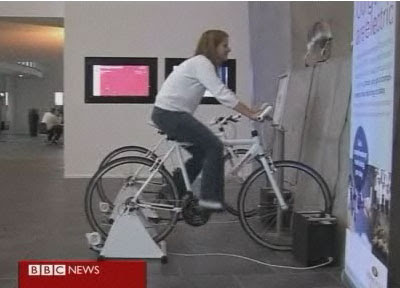
A hotel in Copenhagen is offering guests the chance to earn a free meal if they are willing to put some effort into powering the building. via BBC
image

The deal is if a guest generates 10 watts of power for the hotel they get a free meal at the hotel restaurant. If the food is decent and full of carbs that’s a pretty good deal. 

Continue reading “God Bless Copenhagen”

LAB responds to AAA complaint about bike lanes


Of course, there are some detractors. AAA has come out and said they’ll bring the city to a grinding halt…although a quick look at Pennsylvania Avenue today suggests that tour buses and taxis are doing an excellent job already of bunging up the travel lanes as well as the parking lanes, and that despite the construction zone extending beyond the width of the eventual bike lanes themselves, the street seems to be working just fine.
Indeed, evidence from city after city in this country and the rest of the world suggests that
a) AAA’s favored approach of adding more and more lanes ad infinitum hasn’t worked for 50 years (all it’s done is get even more people stuck in the same traffic jams) and probably isn’t going to start working today all of sudden
b) Putting in better bike infrastructure really does generate more bike traffic and either reduce or slow the increase in car traffic – look at Portland over the last 15 years, New York City in the last two as classic examples
c) When travel lanes or capacity is reduced, traffic goes away. People find other ways or other modes; or they don’t make the trip. Happens every time a bridge goes out, or a major construction project blocks off a major artery – people adapt.
d) And by even AAA’s survey indications, a lot of people will adapt by going by bike. That’s a good thing. That’ll reduce congestion; make more room for delivery vehicles and tourist buses and taxis.
The reaction of AAA is unfortunate, if not utterly predictable. And maybe it’s good that after years of really not having to worry about bikes because we weren’t making much inroad (sic) into their territory…maybe now they are getting a little flustered with such an iconic and visible street as Pennsylvania Avenue having bike lanes. We are starting to succeed and make a difference.
What AAA and others fail to see is that we’re not proposing a zero-sum game. We’re not trying to do away with cars, nor are we anti-car. Cars will have a critical role to play in our transportation system into the forseeable future…but not as the ONLY means of getting around, and not as the ONLY, exclusive user of the public realm to the detriment of almost everything else – clear air, health, climate, safety, energy etc. Great cities and great streets have choice. They enjoy and celebrate diversity. They feature PEOPLE not traffic. They have balance. Altering the balance of traffic on Pennsylvania Ave won’t choke it or bring it to a halt – it will bring it to life. And the nation’s real Main Street (not the ghastly DC Beltway, as AAA would have you believe it is) deserves to be brought to life again.
Andy Clarke
President, League of American Bicyclists
Continue reading “LAB responds to AAA complaint about bike lanes”