
by Ben Fried
…
Automakers have been equating cars to “the national theme of freedom” for the better part of a century, so I think advocates for sustainable transportation and livable streets are well-served by flipping that argument on its head, as Carlson suggests. It’s not a tortured line of reasoning by any means. Generations of car-centric planning have, after all, yoked Americans to a transportation system that constrains the most basic elements of our lives — our time, our health, our finances, our ability to socialize with friends and neighbors.
In addition to liberating people from hellish commutes, as Carlson describes, reducing car-dependence means freedom from spending more and more of our household budgets on transportation; freedom from sedentary lifestyles that are contributing to skyrocketing rates of obesity and diabetes; freedom from worrying about the safety of walking or biking. Freedom, eventually, from having to extract and use oil in ways that pose catastrophic risks to the environment.
…
Continue reading “The Freedom to Not Drive”
NYC Children Die from Injuries at Half the National Rate
June 29, 2010 – Children in New York City die from injuries at half the national rate, according to a new report from the Health Department. From 2001 to 2008, the city recorded 4.2 injury deaths each year for every 100,000 children between 1 and 12 years old. The national rate was 8.9 deaths per 100,000 children. The city’s advantage stems mainly from a lower risk of transportation-related fatalities. Children die in traffic accidents in New York City at less than one third the national rate, due to New Yorkers’ high reliance on public transportation. …
Continue reading “NYC Children Die from Injuries at Half the National Rate”
Gas taxes give us a break at the pump
By Dennis Cauchon, USA TODAY
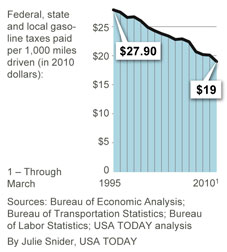
When drivers hit the road in large numbers for the Fourth of July holiday, they will have something extra to celebrate — the lowest gasoline taxes since the early days of the automobile.
Holiday drivers will pay less than ever at the pump for upkeep of the nation’s roads — just $19 in gas taxes for every 1,000 miles driven, a USA TODAY analysis finds. That’s a new low in inflation-adjusted dollars, half what drivers paid in 1975.
Another measure of the trend: Americans spent just 46 cents on gas taxes for every $100 of income in the first quarter of 2010. That’s the lowest rate since the government began keeping track in 1929. By comparison, Americans spent $1.18 in 1970 on gas taxes out of every $100 earned.
Although the federal gas tax — 18.4 cents per gallon — hasn’t changed since 1993, tax collections are down because today’s vehicles go farther on a gallon of gas, cutting tax collections while increasing wear and tear on highways. Inflation since 1993 has eroded the value of the tax to maintain roads.
“The gas tax isn’t going to work as the user fee to finance the highway system in the 21st century,” says Robert Poole, transportation policy director at the free-market Reason Foundation.
…
Continue reading “Gas taxes give us a break at the pump”
A Little Biking May Help Premenopausal Women Stay Slim
By Alan Mozes
HealthDay Reporter
MONDAY, June 28 (HealthDay News) — Riding a bike is as effective as walking briskly at helping premenopausal women keep from gaining more weight, a new study reveals.
Click here to find out more!
Biking is particularly helpful at keeping pounds off such women who are overweight or obese, said study lead author Anne C. Lusk, a research fellow in the department of nutrition at the Harvard School of Public Health in Boston.
"Women of normal body weight can certainly benefit from biking," she noted. "But specifically for overweight and obese premenopausal women, bicycling just two to three hours per week makes them 46 percent less likely to gain more than 5 percent of their initial body weight over the long run."
Researchers also found that slow walking — walking less than three miles an hour — does not help control weight.
…
Continue reading “A Little Biking May Help Premenopausal Women Stay Slim”
Sustainable Trail Design
No matter where I travel, I always see some unique “bike thing” that maybe I can bring home to B’more. Out of town this weekend, I got to do some mountain biking on some very technical & well designed trails. While these two trail systems were in very different terrain, they both exhibited fun challenges with resistance to rain & wear.
 There’s a common misconception that mountain bikers just want to shred and ignore environmental impact; but in reality it is the mountain bike community who have promoted trails that last when designed properly. IMBA (International Mountain Bicycling Association) encourages environmental standards through their Sustainable Trail Design Guidelines and through local affiliates that do much of the trail maintenance.
My first ride started with a road climb up to the ridge of The Western Slope of Massanutten where rocky trails drop over a 1000′ to the adjacent valley. The Shenandoah Valley Bicycling Coalition works with public & private land owners to construct and maintain an intricate network of trails here. Local rocks were used to construct tabletops, rolling grade dips, trail armoring, and stream crossings which divert rainwater and provide riders with opportunities to catch some air. On my climb up the Pink Trail, I passed Tim, a local maintainer, who indicated this trail was only a year old and was so well designed that it didn’t need any maintenance. That’s quite a challenge considering the amount of bike traffic I saw. Not to mention, the black bear traffic I saw using the trails.
 Heading back towards Baltimore, I stopped at Wakefield Park in Fairfax County, VA. Utilizing the rolling terrain and power line easement, MORE (Mid-Atlantic Off Road Enthusiasts) worked with the county and utility companies to design world class trails as several mountain bike races are held here annually. (MORE also maintains many local trails like Loch Raven and Patapsco.) After the long climbs of Massanutten, Wakefield was no problem and down-right fun. Here I enjoyed a series of insloped turns, boardwalks and jumps.
If you would like to join a group ride or help maintain area trails, visit MORE’s website and check the calendar.
$7-a-gallon gas?
By BEN LIEBERMAN
President Obama has a solution to the Gulf oil spill: $7-a-gallon gas.
That’s a Harvard University study’s estimate of the per-gallon price of the president’s global-warming agenda. And Obama made clear this week that this agenda is a part of his plan for addressing the Gulf mess.
So what does global-warming legislation have to do with the oil spill?
Good question, because such measures wouldn’t do a thing to clean up the oil or fix the problems that led to the leak.
The answer can be found in Obama Chief of Staff Rahm Emanuel’s now-famous words, "You never want a serious crisis to go to waste — and what I mean by that is it’s an opportunity to do things that you think you could not do before."
…
Continue reading “$7-a-gallon gas?”
It’s not safe outside

Well it was bound to happen, video games expounding the dangers of outdoor activities.
Continue reading “It’s not safe outside”
Get out of the way then calmly walk away

Cars Cause Congestion
Komanoff found that every car entering the CBD causes an average of 3.23 person-hours of delays. Multiply that by $39.53—a weighted average of vehicles’ time value within and outside the CBD—and it turns out that the average weekday vehicle journey costs other New Yorkers $128 in lost time.
He translates all traffic impacts—delays, collisions, injuries, air pollution—into dollars and cents; that way, it’s easy for users to compare the benefits and costs of different plans. He has even come up with a plan of his own that would, according to his calculations, collect $1.3 billion in motorist tolls per year—all of which would be spent on improving public transit—and save $2.5 billion in time costs by reducing delays. To that, add $190 million from decreased mortality as a result of making streets more bicycle- and pedestrian-friendly, $83 million in collision damage reduction, and $34 million in lower CO2 emissions.
he produced a detailed statistical analysis of pedestrian and cyclist deaths—it showed that casualties are not random, unpredictable accidents but the foreseeable result of given traffic conditions.
Continue reading “Cars Cause Congestion”
To Address Demand for Oil, We Must Focus on Transportation
by Earl Blumenauer
…
The truth is that we are drilling 150 miles offshore and one mile below the earth’s surface because we have run out of accessible oil. Most shocking is how small a difference this oil makes to our energy needs. The 35-60,000 barrels spewing daily from the Gulf floor would be enough to power our nation’s cars for just four minutes.
…
Continue reading “To Address Demand for Oil, We Must Focus on Transportation”