Via Witkop Justice Observations
legal observations from a Rockville Maryland lawyer who has a criminal and civil trial practice
Hard work and perseverance nets injured cyclist good settlement
Recently a young woman who was a victim of a bicycle accident came to me. She was riding her bicycle southbound on 18th St between parked cars and traffic. It was rush hour and the traffic was moving forward slowly, stopping and starting. Ahead of her coming the opposite direction was the defendant car driver. He made a left and cut into her lane and struck her with the front of his vehicle in her left knee. At the time of the accident it was daytime and she was traveling probably 10 mph in a 25 mph zone. She was knocked to the ground and suffered a knee injury and significant bruising.
The driver of the car did not speak to her and seemed preoccupied with the damage to his sport utility vehicle. People around the scene helped the fallen bicyclist. I only had one witness who actually saw the accident and she was not cooperative with my investigation. An ambulance came and she was taken to the hospital. She suffered a non-fracture injury to her left knee and was put on crutches and released. She recovered and after approximately 1 1/2 years after the accident she is still having some knee problems.
She hired a lawyer for settlement purposes and the insurance company denied liability. The claimed that their driver was not at fault for the accident and further, that she was at fault for riding between parked cars and moving traffic.
After her first lawyer could not resolve the case, she came to me. I did not bother calling the insurance company. I did not ask them to reconsider their position. I merely filed suit in the Superior Court of the District of Columbia.
Filing suit was the easy part. The defendant driver was a lawyer who actually had a high-ranking government position. My process server tried to serve him at home. The defendant lawyer lived in an expensive house and had servants. The servants would claim that the defendant was not home and service failed. I tried to have him served as his government office and his secretary would not accept service or let my process server see him. Finally I was able to serve him by certified mail through his mail room.
Of course the insurance company again denied liability. I went to the accident scene and took measurements and photographs. It was clear to me that the defendant was negligent in his driving. They took the deposition of my client. Prior to the deposition I spoke at length with my client and had her also go to the accident scene so the facts would be clear in her mind and she could speak with confidence. I talked with there as to what questions she could anticipate from the insurance company lawyer. At her deposition she was very credible and sympathetic.
I took the deposition of the defendant lawyer and he could not understand how this accident could possibly be his fault. He stated that he was angry at the bicyclist because she could’ve killed herself. He believed that the fact that she was silent after the accident was an indication that she was planning to sue him. Most importantly, he testified that when he looked to the right he only looked approximately 15 feet because after that his line of vision was cut off. He began moving his car and ran over the bicyclist. I was able to preserve the argument that he should not have moved at all because he could not look far enough up the road. His testimony looked fairly poor for him.
Through the assistance of the Washington area bicycle Association I was able to find a regulation which permits "lane splitting". There is a regulation which allows bicyclists to go between parked cars and traffic as long as it is done safely.
I provided this information to the insurance company lawyer and they finally accepted liability and made a very low offer. After a period of negotiation we were able to get the offer into a reasonable area. Even the court appointed mediator believed that the plaintiff secured a good settlement.
It took many hours of work which included visiting the accident scene, chasing down witnesses and getting their statements, preparing my client for her deposition, preparing for the deposition of the defendant, researching applicable law but the result was worth it: we turned the case around from zero to significant money for my client for the injury she suffered.
Continue reading “It should not be this hard recovering damages when you are left crossed”
TASERED CYCLIST SETTLES LAWSUIT
FROM: STEVE MAGAS, The Bike Lawyer
On August 19, 2008, bicyclist Anthony Patrick, from Huntington, West Virginia, was Tasered by Lawrence County, Ohio Deputy Charles Hammonds and Chesapeake Police Department Dennis Gibson. Patrick was riding his bicycle with another rider when Deputy Hammonds told Patrick to get off the road. Patrick told Hammonds he had as much right to be on the road as the deputy. A series of events unfolded thereafter which ended with Patrick be Tasered, arrested and charged with a series of “crimes” including “Riding a Bicycle on the Roadway,” resisting arrest, failing to obey a lawful order and other crimes.
Patrick retained a criminal lawyer and fought the criminal charges, filing a Motion to Dismiss. After a hearing at which Deputy Hammonds was the only witness, the court issued a written opinion holding that the Deputy’s order to stop was “unlawful” as Patrick had done nothing wrong. The court pointed out that cyclists have the right to use the roads and are permitted by law to ride side by side. While the court stated that cyclists should act courteously towards other traffic, cyclists riding two abreast do not legally have to move to a single file line or otherwise give way to motorized traffic and it was improper for Deputy Hammonds to order Patrick off the road. The Court also reaffirmed the landmark holding of Trotwood v. Selz, finding that a bicycle being operated at a reasonable speed for a bicycle is not “impeding traffic.” After the Court’s ruling in Patrick’s favor, the Prosecuting Attorney dismissed all charges against Patrick.
Steve Magas, The Bike Lawyer, represented Tony Patrick in a civil rights lawsuit filed against Deputy Hammonds, Officer Gibson, the Sheriff, the Police Chief and the City of Chesapeake in the United States District Court, Southern District of Ohio, Western Division. This case, Patrick v. Lawless, et al., included claims of excessive force, negligence, assault and battery, false arrest and false imprisonment, seeking compensatory and punitive damages. Defendants denied liability and discovery proceeded, including the taking of several key depositions, and it was learned that key evidence – including a videotape from the scene of the Tasering – had never been provided to Patrick’s criminal or civil lawyers.
All parties reported to the United States Federal District Courthouse in Cincinnati for a Settlement Conference with Judge Barrett on July 1, 2010. Following several hours of negotiations, a settlement was reached. While the settlement figure is confidential, Tony Patrick was very pleased with the outcome and feels justice was done.
Continue reading “TASERED CYCLIST SETTLES LAWSUIT”
The Finger
[B’ Spokes: I will strongly assert if you use the finger you are admitting being powerless, think and act differently!]
by
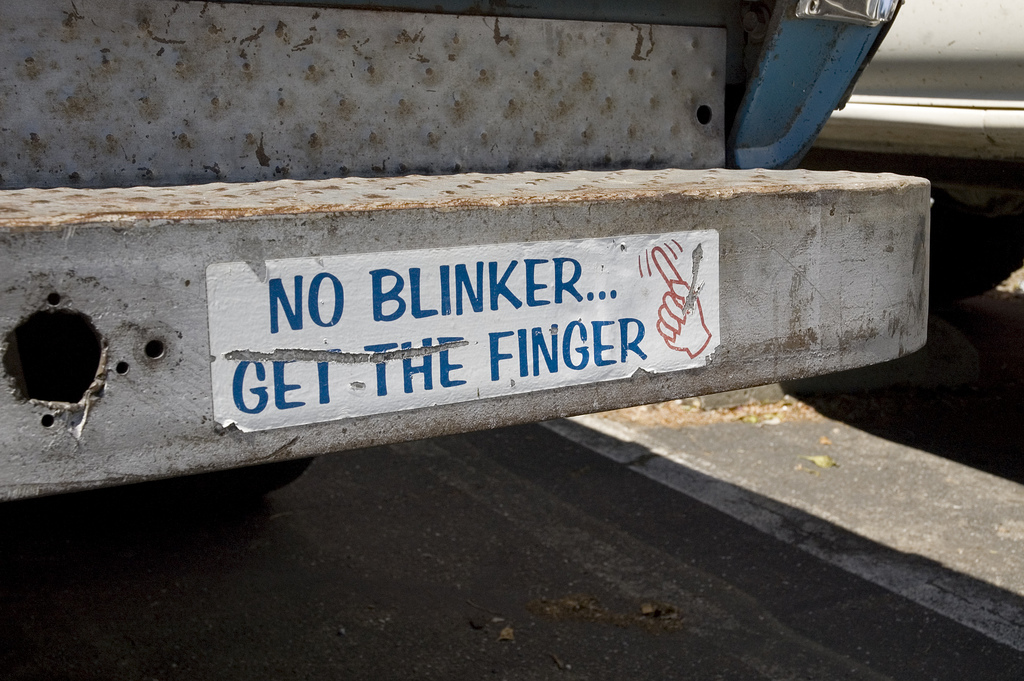
Photo by Silent (e)/Flickr
There is the suggestion that poetry is underrepresented on this blog. Hence I give you:
The Finger
by Charles Bukowski
the drivers of automobiles
have very little recourse or
originality.
when upset with
another
driver
they often give him the
FINGER.
…(more)
MPD Chief Cathy Lanier on Bicycle Sensitivity Training for Officers
by washcycle
From Kojo Nnamdi yesterday. It starts at 30:00.
A woman called in who had been ticketed after a crash with a parking enforcement officer. She claimed that all of the witnesses agreed that the driver was at fault, but the officer cited her instead and threatened to write her a ticket for not wearing a helmet. Then she asked, with Kojo’s help, what the MPD was doing "for sensitivity training towards bicycles for officers?"
[ Cathy Lanier: Bicycles, and the pedicabs and segways are becoming a bigger and bigger issue in the city. We do do bicycle enforcement. There are regulations for bicycle, just like there are traffic regulations, the bicycle regulations are enforced by the officers. So sometimes we enforce against the bicyclists and sometimes we enforce against the motoring public because there are violations on both sides. But, y’know, this is a rapidly expanding pedestrian-style neighbor… community. All of Washington, DC. The number of bicyclists and segwayists and foot traffic around the city is just really skyrocketing, so we all have to all kind of work together here and build some tolerance for each other and I would say in terms of the officer’s rudeness, if you are ever not satisfied with an interaction with a police officer I would encourage please to reach out to us and let us know and you can do that through our website also or through a District commander.]
Sort of a non-answer, but later around 35:00 she talks about how low traffic fatalities have been and the challenge of protecting pedestrians and bicyclists…and then distracted bicyclists.
Continue reading “MPD Chief Cathy Lanier on Bicycle Sensitivity Training for Officers”
Judge’s Decision on NYPD Parade Rules Tinted By Windshield Perspective
[B’ Spokes: It really irks me when judges get the law wrong.]
by Ben Fried
A federal judge yesterday upheld NYPD rules which effectively outlaw bicycle rides with 50 or more cyclists that proceed without a permit. The case is closely associated with police crackdowns on Critical Mass but affects any group ride of sufficient size.
In his 54-page decision in favor of NYPD and the city of New York [PDF], District Court Judge Lewis Kaplan, a Staten Island native who holds a JD from Harvard Law (Class of 1969), dismissed the case put forward by the Five Borough Bicycle Club, Columbia history professor Kenneth T. Jackson (who organizes educational nighttime rides for students), and several Critical Mass participants. The cyclists’ attorneys argued that the NYPD permit rules violate First Amendment rights to free speech and assembly, and that police have selectively issued citations to cyclists who have not broken any traffic laws.
Judge Kaplan rejected these claims across the board. One of the more fascinating aspects of Kaplan’s ruling is his application of local traffic law to cyclists’ behavior, and the way his judgments about traffic safety influence his judicial opinion. In concluding that NYPD’s 50-person limit on group rides justifiably advances public safety, for instance, Kaplan writes:
Large groups of cyclists may well be more visible than individual cyclists and may take up less space than large groups of vehicles, but countervailing factors such as their lack of predictability and their tendency to try to stay together in a moving column, even if this means going through a red light, nevertheless endanger other travelers and disrupt orderly traffic flow. Their presence may add traffic volume that otherwise would be absent.
This reality was borne out by a video clip of the September 2007 Manhattan Critical Mass ride shown… at trial. As the Court noted at the time, the clip shows a cyclist engaging in dangerous behavior by pulling out and to the right of a motor vehicle that itself was in the process of pulling out of the bike lane to its right. The biker comes up from the motor vehicle driver’s blind spot and passes the motor vehicle on the right just as the motor vehicle begins to pull to the right and out of the bike lane. I find that the video demonstrates the danger of the cyclist’s actions.
According to a court transcript obtained by Streetsblog, Kaplan is in fact referring to video shot in July, 2007, which appears beginning at the :37 mark in the above YouTube clip. It depicts a cyclist traveling south in the Broadway bike lane at 19th Street. When he encounters a BMW SUV partially obstructing his path, he bikes into car traffic and passes the SUV.
This behavior, in Judge Kaplan’s estimation, is the cause of safety hazards and a reason to give legal standing to NYPD regulation of group rides. As for the motorist blocking a bike lane with his multi-ton SUV before merging back into traffic, without much seeming awareness of the cyclist approaching from behind, Kaplan’s opinion gives no indication that such carelessness registers with him.
In another passage, on page 47, Kaplan interprets state law as requiring cyclists to ride as close to the right-hand curb as practicable if they are traveling at “less than the speed of normal traffic.” It’s a rather restrictive take on the legality of taking a lane, and omits the fact that the rule in question applies only to two-way streets. At no point in his decision does Kaplan mention the NYPD’s reliance on section 1234 of the New York State traffic law to issue violations to Critical Mass cyclists, which plaintiffs cited as evidence of discriminatory enforcement. Section 1234, which requires cyclists to ride in the right hand curb, does not apply in New York City.
The Five Borough Bike Club says it is disappointed in Kaplan’s ruling and will review the decision with other plaintiffs. No word yet on whether an appeal will be filed.
Continue reading “Judge’s Decision on NYPD Parade Rules Tinted By Windshield Perspective”
Cholesterol Drugs Grow More Common For Adolescents
Now, more kids are getting cholesterol drugs.
Published: July 13, 2010
by Scott Hensley
Researchers who screened 20,000 kids for high cholesterol in West Virginia suggest the time has come to start looking at the fat in all kids’ blood — not just those who have a family history of cholesterol trouble.
How come? The West Virginia team found 98 children among the nearly 6,000 who wouldn’t normally be tested for high cholesterol had cholesterol levels bad enough to warrant treatment with drugs. The results appear in the latest issue of Pediatrics.
Many cholesterol drugs, such as statins like Lipitor, are approved for the treatment of kids with genetically linked high cholesterol that can lead to early heart trouble.
Better diet, weight loss and exercise remain the first options for most kids with too much fat in their blood. Side effects, such as muscle pain, and limited data on long-term use of the drugs in kids are reasons to proceed cautiously with the medicines in children.
….
"There’s no question that we’ve seen an increase in the lipid values in children, and that’s probably due to the obesity epidemic," Donald Pittman, a pharmacist who leads the cardiovascular drug group at Medco, tells Shots.
…
Continue reading “Cholesterol Drugs Grow More Common For Adolescents”
Army Navy Country Club members sue club’s leaders over bike path
This is nuts only cars on a private road can cross a major highway? This case brings up another interesting consideration, the land adjacent to major highways shouldn’t it be available for bike paths? Instead we have to get easements from adjacent property owners just to skirt along a car sewer.
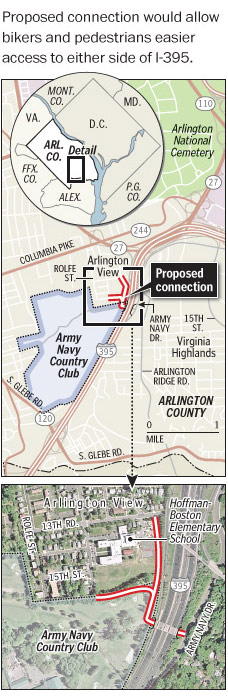
A public bike path? Cyclists and skateboarders whooshing by? Distracting concentration on Red Hole Five? That would not do.
“Once the word gets out to the younger generation there is a secluded place to come and visit and have some fun, you can bet they’re going to be there,” retired Navy Capt. Louis Kriser said at a recent public hearing. “Gangs. Rivals. Hazards to pedestrians coming in and out. . . . I can see The Washington Post: ‘Golf Ball From Army Navy Country Club Fifth Hole Hits Baby.’ ”
Last week, the normally staid country club was roiled by controversy when 14 of its members sued the club’s leaders, saying that they cut an inappropriate deal with the county for the bike path — or “hell’s canyon,” as one called it — without a vote from its members, which they say violates the club’s bylaws.
Continue reading “Army Navy Country Club members sue club’s leaders over bike path”
A Coffee Bar for Cyclists
Rapha Cycle Club, a pop-up bike shop that opened in NoHo, offers three important amenities: two flat-screen televisions that will show all stages of the Tour de France live (then played on a loop until the next stage), indoor bike parking and a full-service coffee bar from Third Rail Coffee.
“Everybody I know who’s a cyclist is also a coffee nut,” said Mike Spriggs, the manager of Rapha Cycle Club. “They go hand in hand. I do a lot of rides that end up at a coffee shop. That way I can get the fuel to get back.”
…
Continue reading “A Coffee Bar for Cyclists”