
…
Jirsa got the bike as a 59th-birthday present last November. Then, that month, he rode it to the grocery store to pick up Thanksgiving dinner.
"I carried a turkey, sweet potatoes, potatoes, milk, pop, some bread for stuffing," he said, "plus some food for the next few days."
The groceries fit into pouches strapped across the back of the bicycle. Jirsa said he has to be smart about how he packs the food before riding home.
"It’s really amazing how much he can carry," Claudia said. "Sometimes he comes home and you forget that he didn’t take a car."
Hy-Vee South is Jirsa’s main stop for food, about a mile from his house.
"I always wanted to be able to go to the grocery store (on bike). I saw this and I thought it was a good idea," he said. "There’s me and my wife and a son living at home. I can pretty much get enough (food) for my family for a week."
…
"When we first moved here, we had two cars," Jirsa said. "My wife and I each had a car. When we moved here, I started riding my bike to work during the summers. And then I thought, ‘Gee, if I could take the bus during the wintertime, I could get rid of the other car.’ I tried it and it worked and we did."
Getting rid of one of their two cars not only saves Jirsa money on gas, maintenance and insurance, it also saves on depreciation, he laughed.
"We’re saving money by riding bicycles," he said, "which is a really good thing, I think."
Continue reading “A bicycle for everything (video)”
Not enough Police to enforce traffic laws? Hire mimes.
[B’ Spokes: An interesting concept form Bogota:]
…
Mayor Mockus used educational group games as the main tool to establish a culture of “self-regulation,” consideration, and urban citizenship. These included:
* Cards, red on one side and white on the other, distributed among citizens and used as in football (soccer) games to show approval or disapproval of actions — particularly of car drivers
* Mimes in the streets that taught automobile drivers to respect pedestrian crossings, to use seatbelts, and to minimize the honking of horns
* Actors dressed as monks encouraging people to reflect on noise pollution
* Mass initiatives to promote tourism and proper payment of taxes
Residents of Bogota approved of these programs, giving them a rating of 7 out of 10 points. Sixty-one percent said citizen education was the administration’s most important initiative and 96% considered that these programs should continue.
…
Continue reading “Not enough Police to enforce traffic laws? Hire mimes.”
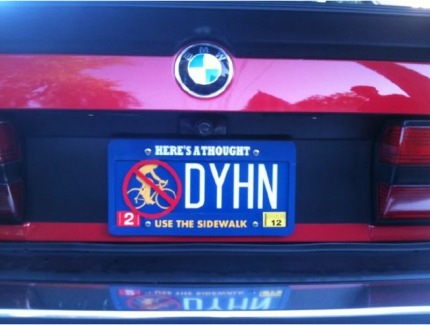
Use the sidewalk licence plate
L.A.’s Newly Biking Mayor Still Doesn’t Get It
from Streetsblog.net by Biking in LA
…
His Honor may have written — and Tweeted — that bikes belong on L.A. streets and he’ll be back on a bike as soon as he’s able. But according to the Daily Breeze, Villaraigosa insists that the cab driver shouldn’t face charges.
“He was very concerned when he realized it was me,” the mayor said. “He was careless, but that’s not illegal. He certainly didn’t do this on purpose.”
That’s where the Mayor is wrong — and where he’s done a huge disservice to everyone else on the roads, especially his new friends in the cycling community.
Because what the driver did was illegal. He pulled away from the curb without making sure the bike lane he was parked next to was clear. And as a result, caused a cyclist to be injured.
It’s called failure to yield. And it is against the law.
Continue reading “L.A.’s Newly Biking Mayor Still Doesn’t Get It”
Officer Charged after Allegedly Striking Brooklyn Biker Last Month
Juliet Papa Reports
Officer Louis Ramos is charged with reckless driving, reckless assault and leaving the scene of an accident — all misdemeanors.
Sources say Ramos and his partner — riding in a police radio vehicle — struck 61-year-old Yu Tong Chan at the corner of Jay and Sands streets in Dumbo.
Chan suffered a broken nose and facial cuts in the June 14th incident.
The officers allegedly got out of the vehicle, offered Chan a tissue and drove off without calling for aid.
Continue reading “Officer Charged after Allegedly Striking Brooklyn Biker Last Month”
Swanson Civil Case Settled in January
Kate Ryan at WTOP has another good story, this one about the Swanson anniversary and includes the news that there was a civil trial in January. The parties settled, though they don’t say how much for.
[Her mom, Ruth] Rowan says three experts in the civil trial,
which was settled in January, agreed that Swanson was hit by the truck,
not the other way around.
“If someone is in my blind spot, and I pull into their lane and hit
them, it’s my fault,” she says.
Rowan insists that her daughter was not at fault in the crash that
killed her, but the Metropolitan police investigation concluded Swanson
was the one who actually struck the trash truck on the passenger’s side
door.
Fast cars = the need to give blood

Is this a subtle way of suggesting motorists should slow down?
Let’s prevent ten 9/11s
Matt Yglesias notes that we spend vastly more money on Homeland Security to prevent another 9/11, which killed 3,000 people, than we do to reduce traffic fatalities which kill more than 10 times as many people every single year. And 1/3 of highway deaths involve speeding, which is eminently preventable.
Via Greater Greater Washington
Continue reading “Let’s prevent ten 9/11s”
How in Good Conscience Can St. Charles County, Missouri Ban Bicycles?
by Bryan Goebel
The government motto of St. Charles County, Missouri is “character, professionalism and conscience.” So how in good conscience can one of the country’s fastest-growing counties be seriously considering a ban on bicycles on some of its most popular routes?
The proposal from a local politician — via Jonathan Maus at Bike Portland — is being touted as a safety measure: shoulderless rural highways in St. Charles are too narrow for anything but cars. So rather than figure out a way to accommodate bicyclists and improve safety, Councilmember Joe Brazil wants an outright ban.
Maus found the above local TV news video on the story “scary and surreal”:
Have we really come to a point when we will simply give our roads over to the fastest vehicles? This same line of reasoning could be used to close all types of roads where there are fast-moving cars and no room for anything else.
I feel for the young woman who was hurt trying to avoid someone on a bike, but using that example as a reason to ban people riding bikes is absurd. How many deaths and injuries have occurred on those same roads between two people in cars? Rural roads are the main cause of traffic fatalities in America. We should do more to ban speeding than to ban people using a vehicle that is incapable of it…
Everyone frames this as “motorists” and “bicyclists” — but this is not about mode labels, this is about people and mobility. Our shared roads (being different from interstate highways and biking trails) are built to move people from one place to another. It’s an extremely slippery slope to even consider policy that would ban one type of user simply because they travel more slowly than another and are seen as an inconvenience to maintaining a certain speed.
Continue reading “How in Good Conscience Can St. Charles County, Missouri Ban Bicycles?”
The third place
Ellen Dunham-Jones Video: Converting Suburbia
By: Mark R. Brown
Ellen Dunham-Jones, author of “Retrofitting Suburbia” and professor of Architecture at Georgia Institute of Technology, talks about converting dying suburban malls and strip centers into vibrant, accessible places. There are quite a few struggling suburban-style shopping centers in Baltimore which could use this sort of treatment (Port Covington is one example).