New ‘Get The F*** Outta The Road’ Program Aims To Increase Pedestrian Safety

via the Onion:

WASHINGTON—In an attempt to address rising pedestrian deaths, the National Highway Traffic Safety Administration launched a new educational outreach program Monday to encourage people to “Get The Fuck Outta The Road.”

The new billboards stress the importance of not being an unbelievable asshole, and paying attention.

The program began in selected cities this month with the distribution of pamphlets at each city’s most dangerous intersections. It will also expand into national radio spots, televised PSAs, and, most importantly, word-of-mouth. Included in the pamphlets are tips on how every responsible pedestrian can learn to “Get The Fuck Outta The Road,” including “Move your ass!” and “Look where you’re fucking going for once!” as well as an instructive diagram for removing one’s head from one’s ass prior to stepping into the crosswalk.

NHTSA officials say they hope the program will eventually branch out to include elementary schools with the child-friendly program “Hey Kids, Get The Fuck Outta The Road!” which will feature a mascot called Tire-Tread Teddy.

“Our studies show that a large majority of accidents were caused by a direct failure of the pedestrian to not step right in front of a goddamned bus,” program director Drew Dawson said during a press conference to announce the NHTSA’s new website, MoveItOrLoseItAsshole.com. “We designed this program to be an easy-to-understand informational tool that will hopefully get these geniuses to pay some fucking attention.”

“We’re already planning a follow-up campaign to keep our message fresh,” Dawson added. “By the third time you tell a pedestrian to get outta the road, they’re already on their fucking cell phone again.”

The NHTSA has also launched a number of complementary subprograms using funding from the National Truck Drivers Union and Greyhound Bus Lines. These include “Oh, Good, Just Ride Your Bike Down The Middle Of The Road Why Don’t You,” “Ever Heard Of A Crosswalk, Dickhead?” and, for more affluent metropolitan neighborhoods, “What The Fuck—Are You Listening To Your Special Getting-Hit-By-A-Car Mix On That iPod, You Vacant Asshole?”

The new program has already shown positive results. A test study in downtown Chicago was found to be nearly twice as effective in preventing pedestrian casualties as the NHTSA’s previous “Have A Safer Journey” program. Likewise, early trials the family-oriented, “You Must Be Thinking, ‘Hey, I Bet My Kids Are Playing In The Driveway, So I Think I’ll Go Back My SUV Out Of The Garage Without Even Fucking Looking And Pulp Them Into A Steaming Red Mess,'” have been similarly successful.

Pedestrians who have been exposed to the NHTSA’s innovative approach have reportedly received the message loud and clear, with many crediting the ad campaign with reminded them of the importance of being vigilant and responsible pedestrians.

“Cram it up your ass, I’m walking here,” said Robert Catalonis, a D.C. native. “I’m an asshole? You’re the asshole.”


[B’ Spokes: Seems clearer then our Street Smart Campaign:
image]

Continue reading “New ‘Get The F*** Outta The Road’ Program Aims To Increase Pedestrian Safety”

San Francisco rolls out new smart parking meters with ‘demand-responsive pricing’

[B’ Spokes: I’ll assert that free on-street parking takes usable space from cyclists so it would be nice if these things could fund bike/ped projects. But that aside, cheep parking means too many cars and expensive parking means more alternate transportation so this is a great way to arrive at a balance. (I’m not anti-car just pro appropriate use of cars, and no I am not trying for the Olympics just because I can bike 6 miles, that distance should be doable for the vast majority of people.)]


by Donald Melanson

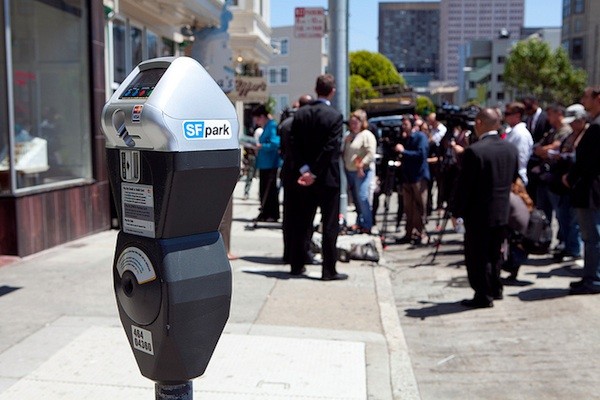
San Francisco has been working on making parking “smarter” for quite a while now, and it’s just recently taken another big step in that direction by starting to replace over 5,000 older parking meters with the snazzy new model pictured above. Those will not only let you pay with a credit or debit card (and soon a special SFMTA card), but automatically adjust parking rates based on supply and demand, which means you could pay anywhere from $0.25 to $6.00 an hour depending on how many free spaces there are. Those rates are determined with the aid of some sensors that keep a constant watch on parking spaces, which also means you’ll be able to check for free spaces in an area on your phone or your computer before you even leave the house. Hit up the link below for the complete details, and to check if the neighborhoods you frequent are included in the initial rollout.

Continue reading “San Francisco rolls out new smart parking meters with ‘demand-responsive pricing’”

Lawlessness due to lack of infrastructure and Sharrows work

Washcycle has a couple of good points:

  • The DCist article has a comment with an excellent point I’ve not heard raised before “It’s the absence of infrastructure that creates the perception of
    lawlessness. The problem is, unlike yourself, the overwhelming majority
    of people do not perceive the roads to be safe for cyclists, due to the
    lack of infrastructure, causing males between the ages of 17 and 23 to
    be disproportionately and overwhelmingly represented. If there is one
    universality the world over is that 17 to 23 year old males are reckless
    and lawless road users, be they using skateboards, bicycles or cars.
    When you install infrastructure that increases the perception of road
    safety, people between the ages of 7 to 70 use bicycles as transport,
    and actually respect the road laws, creating a safer environment for
    everybody.”
  • CommuterPageBlog has a post about sharrows “research by the U.S. Department of
    Transportation revealed that sharrows significantly increase the passing space between
    motor vehicles and bicyclists and reduce improper bicycle behavior, such as
    riding on the sidewalk or riding the wrong way on a street.

Continue reading “Lawlessness due to lack of infrastructure and Sharrows work”

Things I want for Christmas (in a new transportation bill)

by

Let me bore you with a federal transportation policy post!

Why your transit system sucks (from U.S. PIRG “A Better Way To Go” report)

SAFETEA-LU, the funding and authorization bill that guides federal transportation spending, expired last year and a new bill is in the works. With each subsequent iteration, federal transportation bills have made more provisions for alternate modes, but highway spending still dominates. $40 million in the highway account is allowed to be used by states as flex funds for alternate modes, but the ultimate decision of how this money is used is up to state DOTs.  Though I’m no expert in federal transportation policy, here are the things I think should be included in the next bill:

Gas tax alternatives – a vehicle miles tax (VMT) is an equitable way to tax people in proportion to how much they use our roads. The bank account will also take less of a hit as more fuel efficient vehicles fill the streets. It makes sense to charge people in proportion to the amount they use a service or good.  Fuel consumption will soon be an outdated proxy for road usage. 

Mandated multimodal funding – SAFETEA-LU marketeers made a big deal about flexible spending for alternate modes.  Big deal. These spending decisions were mostly left up to state DOTs.  This is fine if you’re in a progressive part of the country, but many state agencies still think highways are the bee’s knees (I love 1920′s slang).  This is like giving a blank check to a crack addict. Just as there are dedicated funds for highways, there should be a mandated percentage of funds going to walking/biking/transit. Or give more power to MPOs and cities to decide how to spend the money.

Increase federal match for transit – say you want to build a highway. No problem. The feds will give you 90% of the cost. A new transit line? You’re lucky if you get a 60% match. [Note that this is a 40% local match for transit while Maryland requires a 50% local match for bike/ped projects.] This is partly due to the huge demand of the New Starts program and the dearth of funding available for such projects. Oh yea, and highways don’t pay for themselves, and transit shouldn’t be held to a more stringent standard which requires unrealistic “cost effectiveness” goals. Show me one cost effective highway.

Incentives for more domestic light rail/commuter rail car manufacturers. All this know-how is in Europe and Japan. We need to bring it here and base our manufacturing sector on sustainability instead of waste.  Lately, when I walk by cars stuck in traffic, I see a racket.  Huge subsidies given to car manufacturers, who in turn spew out millions of cars on asphalt roads which employ millions of contractors and engineers so even more people can have their own steel box which shuttles them around in the most wasteful, environmentally and physically harmful way possible. Why not put these subsidies into a product which has a future and is actually good for people?

Transportation for America has a transportation bill petition with some interesting comments.

Download full  “A Better Way to Go – Meeting America’s 21st Century Transportation Challenges with Modern Public Transit” U.S. PIRG report.

Continue reading “Things I want for Christmas (in a new transportation bill)”

Getting Along

by

Lately, it seems, there has been a rash of stories about how drivers and cyclists can get along. It’s not an easy question to answer (if it were easy it would have already been done).

Steven Elbow of madison.com recently wrote a sprawling account of the bicyclist/driver confrontation in which he listed all the reasons drivers hate cyclists
[How do I hate thee, let me count the ways..]. In it he examines bad
cyclist behavior (as did Froggie recently in a post about why drivers hate cyclist), a driver’s sense of superiority that comes from having
a license and insurance, cyclist attire, partisan politics, cyclist
“attitude,” driver fear, resource concerns, and bully tendencies. It is
an excellent article full of facts and research. Some of the better
parts:

Dave Schlabowske, Milwaukee’s bicycle and pedestrian
coordinator, says he’s done plenty of traffic studies that show
that at least 60 percent of the cars on the road at any given time
are speeding. When it comes to stopping for pedestrians at
crosswalks, 90 percent don’t.

“But they see this bicyclist roll up to a red light and then
just roll through it, to them it seems so obvious and so
egregious,” he says. “But they never think, ‘Well, I was just
breaking the law for the last eight miles.’ They’re not thinking
about their own behavior.”

So
I agree, there isn’t one source of cyclist-directed anger (and, like
Elbow, I also think the anger flows more in one direction). The conflict has many dimensions. There is one conflict over space and another about resources.

There is a problem in that both see the road and the issues differently. Cyclists on the road – for whom arrival times are pretty constant – are focused on their safety. Drivers, who are pretty safe in their cars, are more focused on traffic flow and convenience.  Both see the other as an impediment to their goals. Some drivers see cyclists as interlopers who refuse to follow the rules and who thus need to straighten up to earn the right to the road, but they don’t seem to see cyclists as a threat. Most of the
anger I hear directed at drivers, on the other hand, is about dangerous driving or outright
harassment. (Though some people do hate drivers just for driving –
usually for environmental or health reasons. It is a
counterproductive attitude in my opinion.)

National Journal recently discussed the space and resource competition, asking if bicyclists and pedestrians will squeeze out cars. [Andy Clarke’s response is particularly good if you have the time] While Patrick Natale of the ASCE pulls out the old “cyclists don’t pay for roads” canard and Bill Graves of the American Trucking Association defends the status quo (“At least 80 percent of U.S. communities receive their goods exclusively by truck.” Yes, and that’s part of the problem) the other respondents note that it isn’t a zero sum game. Earl Blumenauer makes the excellent point that investing in biking and walking often requires less money for similar gains. Talking about a bridge improvement project in Portland he notes that “planners invested $50,000 for bike and pedestrian improvements, rather
than upwards of the $10 million that would have been necessary if they
had simply accommodated the same user increase just for cars.” The cyclists who use that bridge didn’t appear out of the ether. Some of them were probably drivers. So the bike investment improved things for cyclists and drivers. This is a message that needs to be repeated over and over.

It doesn’t help that drivers don’t directly see the positive externalities of cyclists (cleaner air, less CO2, more parking, less congestion, etc…), they just see the person who, in that moment, is slowing them down.

Jonathon Simmons, writing at Boston.com lists an assortment of things cyclists and others can do to help find peace between drivers and cyclists. While I agree with much of the list, I wouldn’t qualify it as advocacy. If you’re riding safely or courteously for advocacy, you’re doing it for the wrong reason. You should do those things because you care about your safety and the safety of others, and because it is the right way to share the road. By all means ride safe and ride courteously, but I’m not going to list that as something to do to get along on the road.

So what can heal the divide? I include three items:

1. Like Elbow, I think the best way to heal cyclist-motorists animosity is to get more motorists on a bike. Most cyclists are drivers from time to time, but few drivers know what it’s like to ride in rush hour traffic. The more people who know what it’s like to ride, the greater the sense of empathy. Most of the issues Elbow lists have to do with a fundamental misunderstand on the part of motorists, and getting more people biking is really the only way to deal with it. Most cities are already pursuing policies to get more people on bikes, the most important of these are bike sharing systems, which have the potential to be game changers.

2. Decriminalizing normal, safe biking behavior. I’m not going to tell cyclists to stop at stop signs and wait on stop lights when that isn’t what I do. Nor do I think it makes them safer – in fact evidence out of Idaho is that it makes them less safe. Some feel that when cyclists run stop signs and stop lights that makes all cyclists look bad. They may be right, because the behavior is illegal. But that behavior is also pretty rational. And that makes the game unwinnable from a game theory standpoint. It breaks down like this as I see it: if all participants follow traffic control device laws literally (which is a bit irrational) then all participants win, but if one participant runs lights and signs (which is more rational) than all participants lose. Why even play that game? And, we aren’t actually guaranteed that if all participants behave irrationally everyone wins, since drivers often complain about legal and safe cycling behavior. So rather than forcing cyclists to behave irrationally to appease drivers – which is probably impossible, it makes more sense to make cycling laws more rational so that cycling, as everyone does it, is legal.

3. Sheath the finger. I’ve done it. Someone passes you way too close, or yells at you that you “aren’t a car” or honks at you to get out of the way and out comes the middle finger. It’s so easy and so succinct. It also doesn’t really help. That person is not going to see your finger and do some soul-searching about their selfishness and come out tomorrow a better person. They’re going to think that cyclists are self-righteous jerks. Unlike rolling through stop signs, there is nothing rational about this. As hard as it is, we have to try to turn the other cheek.

Continue reading “Getting Along”